共
| ||||||||
Translingual
| Stroke order | |||
|---|---|---|---|
 | |||
Han character
共 (Kangxi radical 12, 八+4, 6 strokes, cangjie input 廿金 (TC), four-corner 44801, composition ⿱龷八)
- Shuowen Jiezi radical №64
Derived characters
References
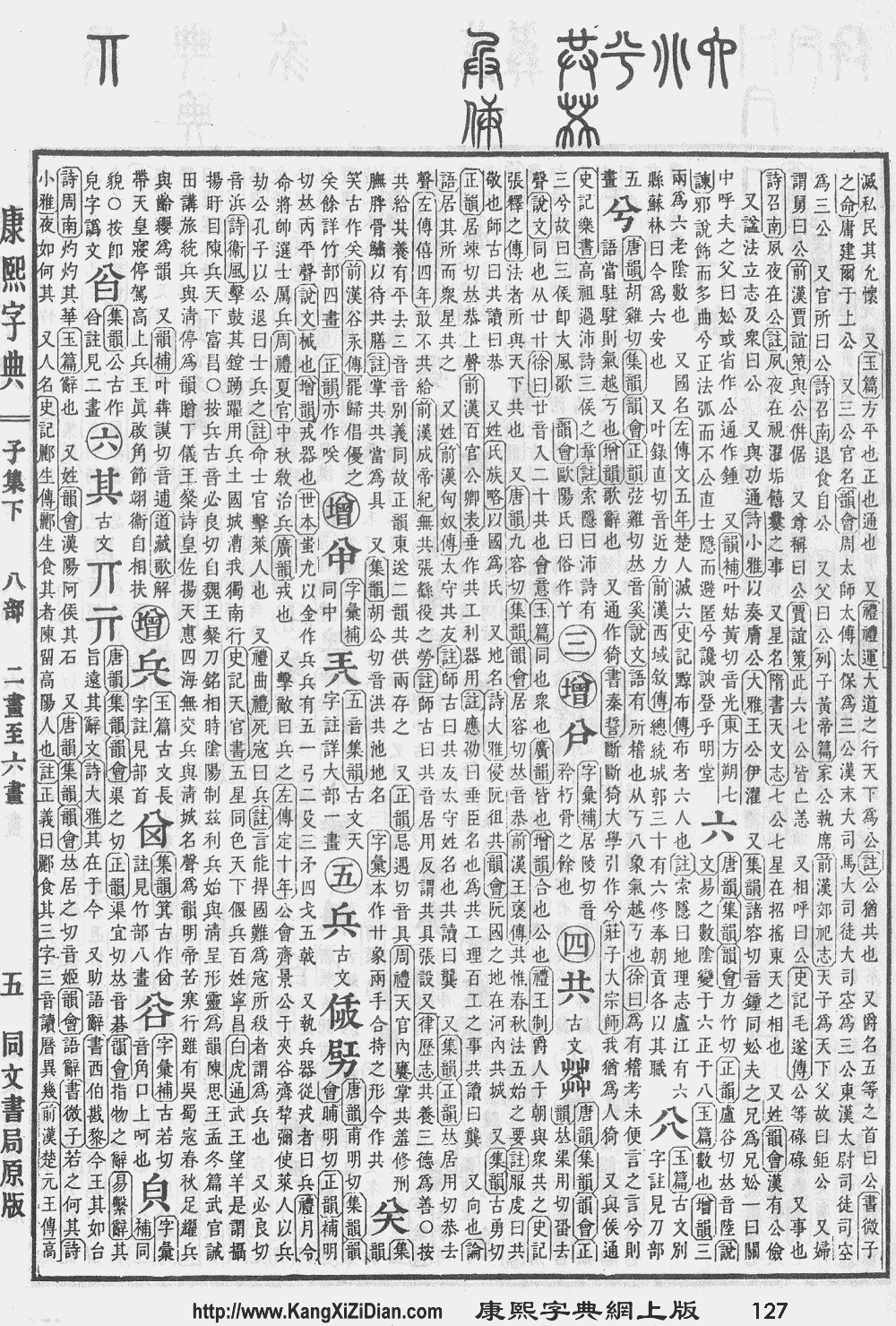
- KangXi: page 127, character 5
- Dai Kanwa Jiten: character 1458
- Dae Jaweon: page 283, character 6
- Hanyu Da Zidian (first edition): volume 1, page 243, character 2
- Unihan data for U+5171
Chinese
| simp. and trad. |
共 | |
|---|---|---|
| alternative forms | 𦱹 𠔏 𩇿 | |
Glyph origin
| Historical forms of the character 共 | ||||||||||||||||||||||||||
|---|---|---|---|---|---|---|---|---|---|---|---|---|---|---|---|---|---|---|---|---|---|---|---|---|---|---|
| Shang | Western Zhou | Warring States | Shuowen Jiezi (compiled in Han) | Liushutong (compiled in Ming) | ||||||||||||||||||||||
| Oracle bone script | Bronze inscriptions | Chu slip and silk script | Small seal script | Transcribed ancient scripts | ||||||||||||||||||||||
 |
 |
 |
 |
 | ||||||||||||||||||||||
||||
|
References: Mostly from Richard Sears' Chinese Etymology site (authorisation),
| ||||||||||||||||||||||||||


| Old Chinese | |
|---|---|
| 港 | *kroːŋʔ, *ɡloːŋs |
| 巷 | *ɡroːŋs |
| 衖 | *ɡroːŋs |
| 鬨 | *ɡroːŋs, *ɡloːŋs |
| 烘 | *qʰloːŋ, *qʰloːŋs, *ɡoːŋ, *ɡloːŋs |
| 洪 | *ɡloːŋ |
| 鉷 | *ɡloːŋ |
| 谼 | *ɡloːŋ |
| 葓 | *ɡoːŋ |
| 哄 | *ɡloːŋs |
| 蕻 | *ɡloːŋs |
| 恭 | *kloŋ |
| 供 | *kloŋ, *kloŋs |
| 龔 | *kloŋ |
| 珙 | *kloŋ, *kloŋʔ |
| 共 | *kloŋ, *ɡloŋs |
| 髸 | *kloŋ |
| 拱 | *kloŋʔ |
| 拲 | *kloŋʔ, *kloɡ |
| 蛬 | *kloŋʔ, *ɡloŋ |
| 栱 | *kloŋʔ |
| 輁 | *kloŋʔ, *ɡloŋ |
| 舼 | *ɡloŋ |
| 輂 | *kloɡ |
Ideogrammic compound (會意/会意) : 廾 (“two hands”) + 口 (“an object”) – holding up an object with two hands. Eventually 口 (not “mouth”) came to be written 廿 (not “twenty”), which later fused with 廾 to form the modern 共.
Possibly the original form of 供 (“to provide; to offer”).
Etymology
Etymology not clear. An OC medial *r should be assumed if related to 恭 and 龔. CVST 5: 57 relates this word to Western Tibetan ’kʰyoŋ-ba, kʰyoŋs ‘to bring’, WB kuiŋ ‘take hold of, apply hand’. An allofam may perhaps be 貢.
Pronunciation 1
Definitions
共
- common
- together
- 興起!地上大小邦,響應諸天共頌揚 [MSC, trad.]
- From: 1984, translation edited by 滕近輝 [Philip Teng] and 何統雄 [Richard Ho], 天使報信 [Hark! the Herald Angels Sing], in 《生命聖詩》 [Hymns of Life]
- Xīngqǐ! Dìshang dà xiǎo bāng, Xiǎngyìng zhūtiān gòng sòngyáng [Pinyin]
- Joyful, all ye nations, rise, Join the triumph of the skies [Original English lyrics]
Rise up! nations of the earth, big and small, Sing praises together in response to the skies [Literal English translation]
兴起!地上大小邦,响应诸天共颂扬 [MSC, simp.]
- to share
- altogether
- Short for 共產黨/共产党 (gòngchǎndǎng, “communist party”).
- 反共 ― fǎngòng ― anti-communist
- (specifically) the Communist Party of China
- 國共/国共 ― guógòng ― Kuomintang and the Communist Party of China
- (literary or dialectal) and
- (literary or Min Dong, Hokkien) with; to
- 死蔭幽谷中,祢伴我過渡,歡欣裡,風光裡祢共我同在 [Literary Cantonese, trad.]
- From: 鄧婉玲, lyrics by 西伯, 全因為祢
- sei2 jam3 jau1 guk1 zung1, nei4 bun6 ngo5 gwo3 dou6, fun1 jan1 leoi5, fung1 gwong1 leoi5 nei4 gung6 ngo5 tung4 zoi6 [Jyutping]
- (please add an English translation of this example)
死荫幽谷中,祢伴我过渡,欢欣里,风光里祢共我同在 [Literary Cantonese, simp.]
- (Min Dong, Hokkien, dated in Cantonese) for
- (Hokkien) Used in imperative sentences for emphasis
- (Min Dong, Hokkien) Particle introducing the object of the verb
- (Zhangzhou and Taiwanese Hokkien) same
- 共款 [Hokkien] ― kāng-khoán [Pe̍h-ōe-jī] ― the same
- 無共/无共 [Hokkien] ― bô-kāng [Pe̍h-ōe-jī] ― not the same; different
Synonyms
- (and):
- (for):
| Variety | Location | Words |
|---|---|---|
| Formal (Written Standard Chinese) | 替, 為 | |
| Mandarin | Beijing | 給, 替 |
| Taiwan | 給, 替 | |
| Jinan | 給, 替 | |
| Xi'an | 替, 給 | |
| Wuhan | 跟, 幫 | |
| Chengdu | 幫, 給, 跟 | |
| Yangzhou | 代, 替 | |
| Hefei | 代, 幫 | |
| Singapore | 替 | |
| Cantonese | Guangzhou | 同, 幫 |
| Hong Kong | 同, 幫 | |
| Yangjiang | 替, 幐 | |
| Gan | Nanchang | 跟, 幫 |
| Hakka | Meixian | 同, 代 |
| Jin | Taiyuan | 替, 給 |
| Min Bei | Jian'ou | 替, 幫 |
| Min Dong | Fuzhou | 替, 共 |
| Min Nan | Xiamen | 替, 共 |
| Quanzhou | 共 | |
| Zhangzhou | 共 | |
| Tainan | 替, 共 | |
| Singapore (Hokkien) | 替, 共 | |
| Chaozhou | 代, 個 | |
| Wu | Suzhou | 替, 搭 |
| Wenzhou | 代 | |
| Xiang | Changsha | 幫, 跟, 代 |
| Shuangfeng | 幫 | |
- (particle introducing the object of the verb):
Compounds
|
Pronunciation 2
Pronunciation 3
Definitions
共
- † Alternative form of 供 (gōng, “to provide”).
- † Alternative form of 恭 (gōng, “respectful”).
- † Alternative form of 宮/宫 (gōng, “castration (as punishment)”).
Pronunciation 4
Definitions
共
References
- “共”, in 漢語多功能字庫 (Multi-function Chinese Character Database), 香港中文大學/香港中文大学 (the Chinese University of Hong Kong), 2014–
Japanese
Pronunciation
Compounds
- 両方共 (ryōhōtomo)
- 中共 (chūkyō)
- 事共 (kotodomo)
- 何共 (nantomo)
- 公共 (kōkyō)
- 共依存 (kyōizon)
- 共催 (kyōsai)
- 共助 (kyōjo)
- 共同 (kyōdō)
- 共和国 (kyōwakoku)
- 共営 (kyōei)
- 共存 (kyōzon)
- 共学 (kyōgaku)
- 共感 (kyōkan)
- 共晶 (kyōshō)
- 共有 (kyōyū)
- 共栄 (kyōei)
- 共済 (kyōsai)
- 共演 (kyōen)
- 共犯 (kyōhan)
- 共産 (kyōsan)
- 共産党 (kyōsantō)
- 共用 (kyōyō)
- 共益 (kyōeki)
- 共著 (kyōcho)
- 共謀 (kyōbō)
- 共起 (kyōki)
- 共通 (kyōtsū)
- 共通語 (kyōtsūgo)
- 共鳴 (kyōmei)
- 共々 (tomodomo), 共共 (tomodomo)
- 共襟 (tomoeri)
- 容共 (yōkyō)
- 是非共 (zehitomo)
- 社共 (shakyō)
- 私共 (watakushidomo)
- 諸共 (morotomo)
- 身共 (midomo)
- 防共 (bōkyō)
Synonyms
- 込 (komi)
Usage notes
Affixing 共 to oneself indicates humbleness. Affixing 共 to other people is disrespectful compared to 達 (たち, -tachi).
Synonyms
- 達 (tachi)
Korean
Vietnamese
References
- Thiều Chửu : Hán Việt Tự Điển Hà Nội 1942
- Trần Văn Chánh: Từ Điển Hán Việt NXB Trẻ, Ho Chi Minh Ville, 1999
- Vũ Văn Kính: Đại Tự Điển Chữ Nôm, NXB Văn Nghệ, Ho Chi Minh Ville, 1999