將
| ||||||||
Translingual
| Japanese | 将 |
|---|---|
| Simplified | 将 |
| Traditional | 將 |
Han character
將 (Kangxi radical 41, 寸+8, 11 strokes, cangjie input 女一月木戈 (VMBDI), four-corner 27242, composition ⿰爿⿱⿴𠂊⺀寸(GHJKV) or ⿰爿⿱⿴𠂊冫寸(T))
Related characters
- 将 (Simplified Chinese and Japanese shinjitai)
Further reading
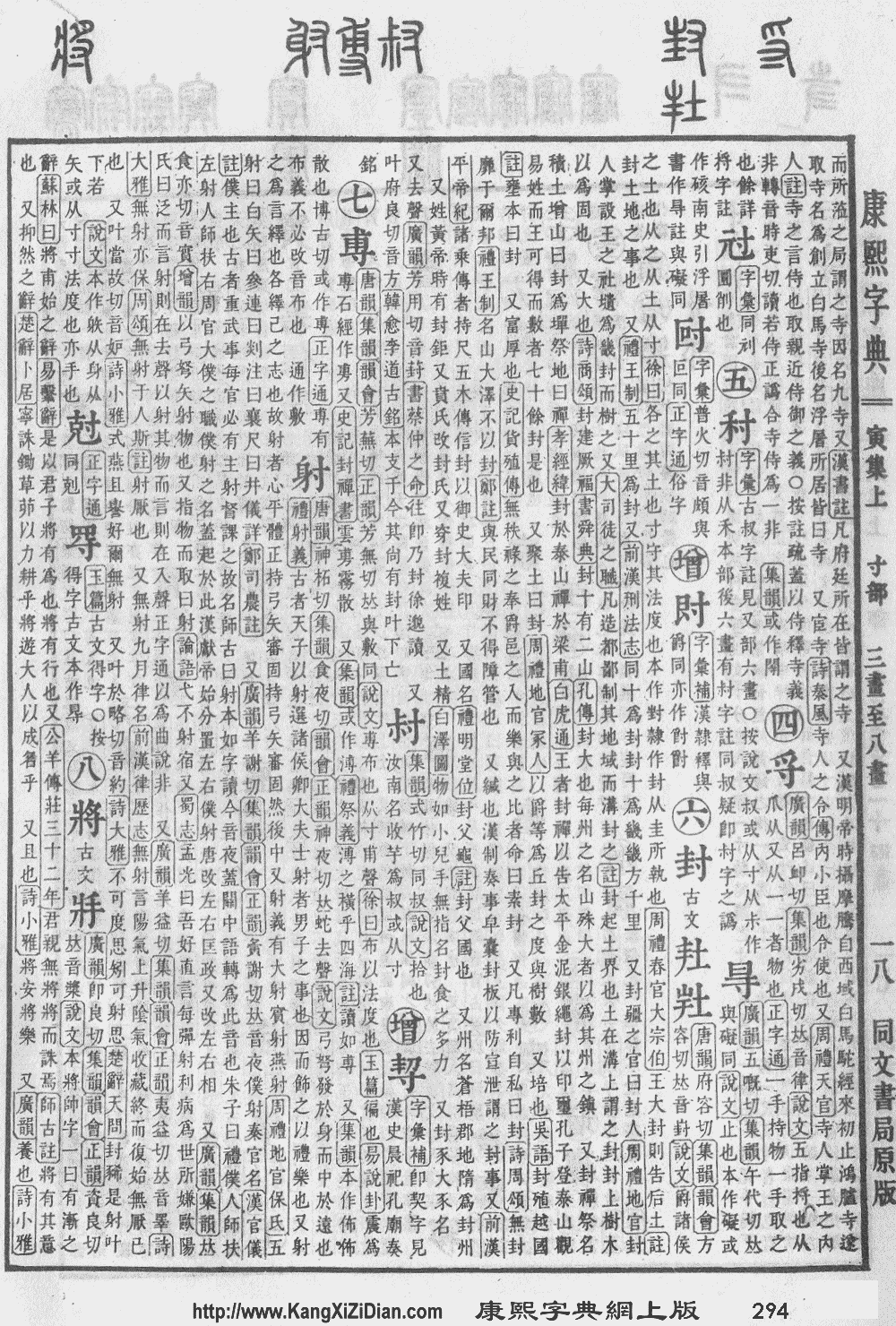
- KangXi: page 294, character 16
- Dai Kanwa Jiten: character 7438
- Dae Jaweon: page 583, character 4
- Hanyu Da Zidian (first edition): volume 4, page 2375, character 10
- Unihan data for U+5C07
Chinese
| trad. | 將 | |
|---|---|---|
| simp. | 將/将* | |
| alternative forms | 将 𢪇 𢪽 𤕭 | |
Glyph origin
| Old Chinese | |
|---|---|
| 臧 | *ʔsaːŋ |
| 牂 | *ʔsaːŋ |
| 戕 | *kaːl, *ʔsaːŋ, *zaŋ |
| 贓 | *ʔsaːŋ |
| 藏 | *zaːŋ, *zaːŋs |
| 奘 | *zaːŋʔ, *zaːŋs |
| 臟 | *zaːŋs |
| 將 | *ʔsaŋ, *ʔsaŋs |
| 漿 | *ʔsaŋ |
| 鱂 | *ʔsaŋ |
| 蔣 | *ʔsaŋ, *ʔsaŋʔ |
| 螿 | *ʔsaŋ |
| 槳 | *ʔsaŋʔ |
| 獎 | *ʔsaŋʔ |
| 醬 | *ʔsaŋs |
| 鏘 | *sʰaŋ |
| 蹡 | *sʰaŋ, *ʔshaŋs |
| 嶈 | *sʰaŋ |
| 斨 | *sʰaŋ |
| 爿 | *braːn, *zaŋ |
| 牆 | *zaŋ |
| 妝 | *ʔsraŋ |
| 莊 | *ʔsraŋ |
| 裝 | *ʔsraŋ, *ʔsraŋs |
| 壯 | *ʔsraŋs |
| 疒 | *rnɯːɡ, *zraŋ |
| 床 | *zraŋ |
| 牀 | *zraŋ |
| 狀 | *zraŋs |
Ideogrammic compound (會意/会意) : semantic 爿 (“bed; small table”) + semantic ⺼ (“meat”) + semantic 寸 (“hand”) – to offer meat as tribute by putting it on the table.
The ⺼ component is on its side, hence resembles 夕 with an added dot; compare 祭, 然.
Shuowen erroneously considers the phonetic component of 將 to be 醬 (OC *ʔsaŋs, “sauce”) (abbreviated).
Etymology
A conflation of two roots: “to take; to hold” and “will; be going to; near”.
- “to take; to hold” (Pronunciations 1, 2 and 3)
- Sino-Tibetan: compare Tibetan འཆང ('chang, “to hold, to keep, to carry”).
- “will; be going to; near” (Pronunciation 1)
- Austroasiatic: compare Khmer ចង់ (cɑng, “to want, to wish; to approach, to draw near; about to (do something), on the point of”) < Old Khmer caṅa (“to wish, to want”). Cognate with 且 (OC *sʰjaːʔ, *ʔsa, “about to; on the point of; moreover; also”) (Wu, 2015).
Pronunciation 1
Definitions
將
- will; going to
- † soon; in the near future
- † nearly; almost
- 78th tetragram of the Taixuanjing; "on the verge" (𝍓)
- † just; just now
- † certainly; surely
- † to take; to hold; to fetch
- 五花馬,千金裘。呼兒將出換美酒,與爾同銷萬古愁。 [Classical Chinese, trad.]
- From: circa 752, 李白 (Li Bai), 《將進酒》/《将进酒》
- Wǔhuāmǎ, qiānjīn qiú. Hū ér jiāng chū huàn měijiǔ, yǔ ěr tóng xiāo wàngǔ chóu. [Pinyin]
- My precious horse, and my furs worth a thousand gold pieces; call your son and have him take them out to be swapped for fine wine, and together with you I'll drown the sorrows of ten thousand ages.
五花马,千金裘。呼儿将出换美酒,与尔同销万古愁。 [Classical Chinese, simp.]
- † by; by means of; with
- † also; half ... half ...; or
- † if; in the case that ...
- Particle introducing the object of the verb, used in the same fashion as 把 but more formal.
- † to support; to assist
- † to advance; to go
- † to take orders; to follow
- † to see off; to send off
- † to take along; to bring
- † to use; to utilise
- † to handle; to deal with
- † to eat; to have
- † to lead; to guide
- † to submit to; to be obedient to
- † to provide for
- † to recuperate; to maintain; to take care of one's health
- † to express; to convey
- (dialectal) to incite someone to action
- (dialectal, of animals) to bear (an offspring); to give birth
- (chess) to check
- (obsolete or dialectal) Particle placed after the verb and before a resultative phrase (進來, 起來, 進去 etc.).
- 方陞座,殿角狂風驟起。只見一條大青蛇,從梁上飛將下來,蟠於椅上。 [Written Vernacular Chinese, trad.]
- From: c. 1330 - 1400: Luo Guanzhong, Romance of the Three Kingdoms, Chapter 1 (三國演義/第001回)
- Fāng shēng zuò, diàn jiǎo kuángfēng zhòu qǐ. Zhǐ jiàn yī tiáo dà qīng shé, cóng liáng shàng fēi jiāng xiàlái, pán yú yǐ shàng. [Pinyin]
- As soon as the emperor ascended onto his throne, a gust of wind suddenly arose out of the corner of the hall. A big green snake was spotted which flew down from the rafters and coiled up on the seat.
方升座,殿角狂风骤起。只见一条大青蛇,从梁上飞将下来,蟠于椅上。 [Written Vernacular Chinese, simp.]
Synonyms
Usage notes
In Cantonese, when used for introducing the object of a verb, the action should involve a change or movement of the object.
Compounds
Pronunciation 2
Definitions
將
Compounds
|
|
|
Pronunciation 3
Compounds
|
|
|
Descendants
References
- “將”, in 漢語多功能字庫 (Multi-function Chinese Character Database), 香港中文大學/香港中文大学 (the Chinese University of Hong Kong), 2014–
Japanese
| 将 | |
| 將 |
Readings
From 將 (MC t͡sɨɐŋ, “just now; also, half... half..., or; take, hold; etc.”):
- Go-on: そう (sō)←さう (sau, historical)
- Kan-on: しょう (shō)←しやう (syau, historical)
- Kun: はた (hata, 將); まさに (masani, 將に); もって (motte, 將て)
From 將 (MC t͡sɨɐŋH, “command, lead; commander, general; high-ranking military officer”):
- Go-on: そう (sō)←さう (sau, historical)
- Kan-on: しょう (shō)←しやう (syau, historical)
- Kun: ひきいる (hikiiru, 將いる)←ひきゐる (fikiwiru, historical)
Nanori readings:
Etymology
| Kanji in this term |
|---|
| 將 |
| Jinmeiyō |
| nanori |
Nominalization of verb 勝る (masaru, “to excel, rival, surpass”).
Pronunciation
Korean
Alternative forms
Etymology 1
From Middle Chinese 將 (MC t͡sɨɐŋH, “commander”).
| Historical Readings | ||
|---|---|---|
| Dongguk Jeongun Reading | ||
| Dongguk Jeongun, 1448 | 쟈ᇰ〮 (Yale: cyáng) | |
| Middle Korean | ||
| Text | Eumhun | |
| Gloss (hun) | Reading | |
| Hunmong Jahoe, 1527 | 자ᇰ〯슈〮 (Yale: cyǎngsywú) | 쟈ᇰ〯 (Yale: cyǎng) |
Pronunciation
- (in 장군 (將軍, janggun)):
- (SK Standard/Seoul) IPA(key): [t͡ɕa̠ŋ]
- Phonetic hangul: [장]
- (general; commander; etc.):
- (SK Standard/Seoul) IPA(key): [t͡ɕa̠(ː)ŋ]
- Phonetic hangul: [장(ː)]
- Though still prescribed in Standard Korean, most speakers in both Koreas no longer distinguish vowel length.
Compounds
- 장교 (將校, janggyo)
- 장군 (將軍, janggun)
- 장기 (將棋, janggi)
- 장병 (將兵, jangbyeong)
- 장사 (將士, jangsa)
- 장상 (將相, jangsang)
- 장성 (將星, jangseong)
- 장수 (將帥, jangsu)
- 장졸 (將卒, jangjol)
- 노장 (老將, nojang)
- 대장 (大將, daejang)
- 맹장 (猛將, maengjang)
- 명장 (名將, myeongjang)
- 변장 (邊將, byeonjang)
- 비장 (裨將, bijang)
- 소장 (少將, sojang)
- 신장 (神將, sinjang)
- 양장 (良將, yangjang)
- 왜장 (倭將, waejang)
- 적장 (敵將, jeokjang)
- 제장 (諸將, jejang)
- 주장 (主將, jujang)
- 준장 (准將, junjang)
- 패장 (牌將, paejang)
- 항장 (降將, hangjang)
- 호장 (虎將, hojang)
- 효장 (梟將, hyojang)
- 효장 (驍將, hyojang)
- 돌격장 (突擊將, dolgyeokjang)
- 수문장 (守門將, sumunjang)
- 진영장 (鎭營將, jinyeongjang)
- 무장지졸 (武將之卒, mujangjijol)
- 왕후장상 (王侯將相, wanghujangsang)
- 금부나장 (禁府羅將, geumbunajang)
- 패군지장 (敗軍之將, paegunjijang)
Etymology 2
From Middle Chinese 將 (MC t͡sɨɐŋ, “to take; to hold”).
| Historical Readings | ||
|---|---|---|
| Dongguk Jeongun Reading | ||
| Dongguk Jeongun, 1448 | 쟈ᇰ (Yale: cyàng) | |
| Middle Korean | ||
| Text | Eumhun | |
| Gloss (hun) | Reading | |
| Hunmong Jahoe, 1527 | 쟈ᇰᄎᆞ〮 (Yale: cyàngchá) | 쟈ᇰ (Yale: cyàng) |
Pronunciation
- (SK Standard/Seoul) IPA(key): [t͡ɕa̠ŋ]
- Phonetic hangul: [장]
Hanja
將 (eumhun 장차(將次) 장 (jangcha jang))
- Hanja form? of 장 (“take, hold; from now on, in the future”). [affix]
Vietnamese
Han character
將: Hán Việt readings: tướng (
將: Nôm readings: tướng[1][2][4][6], tương[2][3][7][4]
Noun
Derived terms
- 將領 (tướng lĩnh)
- 將軍 (tướng quân)
- 大將 (đại tướng)
- 少將 (thiếu tướng)
- 中將 (trung tướng)
References
- Nguyễn (2014).
- Nguyễn et al. (2009).
- Trần (2004).
- Bonet (1899).
- Génibrel (1898).
- Taberd & Pigneau de Béhaine (1838).
- Hồ (1976).