東
| ||||||||
Translingual
| Stroke order | |||
|---|---|---|---|
 | |||
| Stroke order | |||
|---|---|---|---|
 | |||
Han character
東 (Kangxi radical 75, 木+4, 8 strokes, cangjie input 木田 (DW), four-corner 50906, composition ⿻木日 or ⿻束一)
Derived characters
Related characters
References
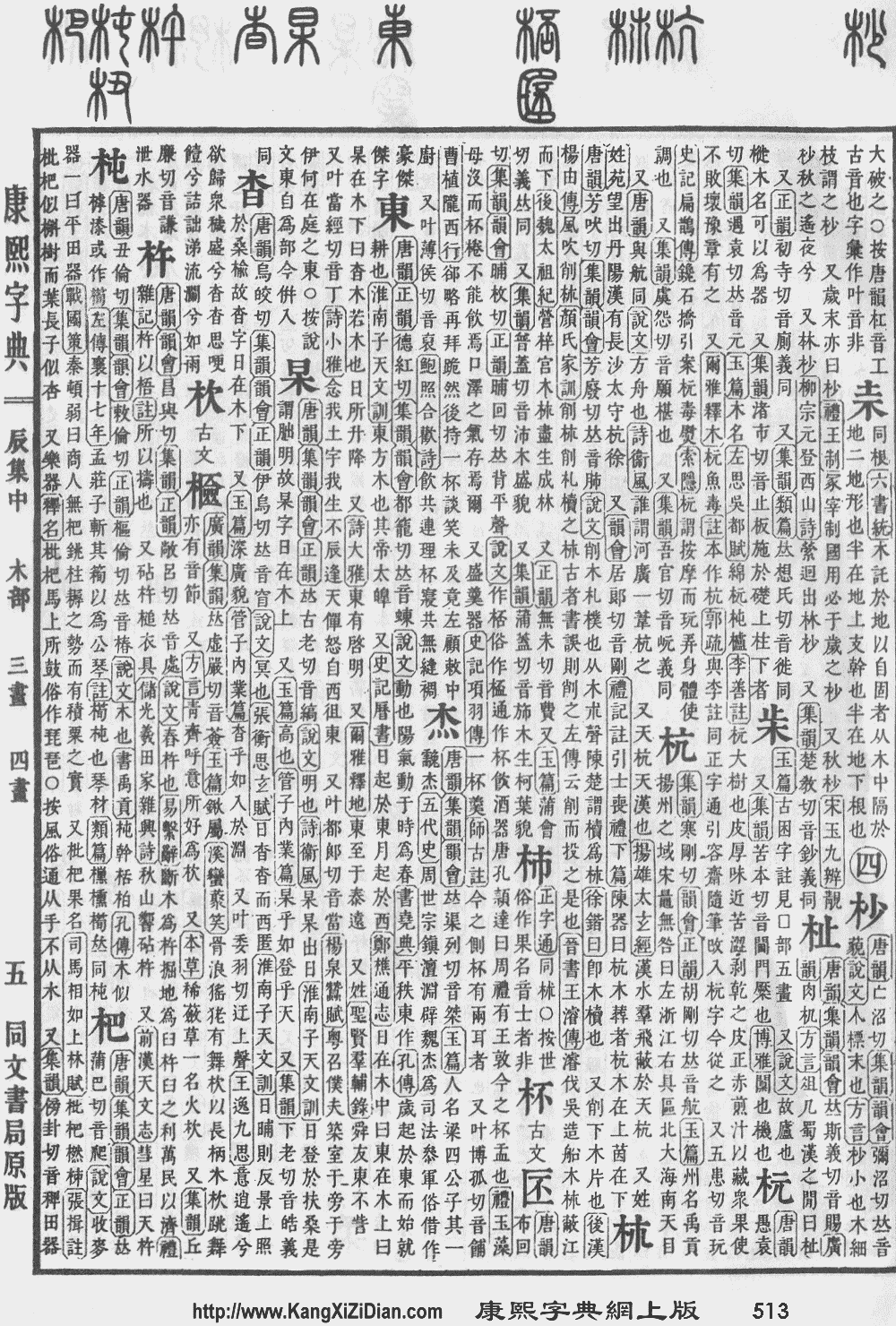
- KangXi: page 513, character 12
- Dai Kanwa Jiten: character 14499
- Dae Jaweon: page 899, character 8
- Hanyu Da Zidian (first edition): volume 2, page 1165, character 4
- Unihan data for U+6771
Chinese
| trad. | 東 | |
|---|---|---|
| simp. | 东 | |
Glyph origin
| Historical forms of the character 東 | |||||
|---|---|---|---|---|---|
| Shang | Western Zhou | Warring States | Shuowen Jiezi (compiled in Han) | Liushutong (compiled in Ming) | |
| Bronze inscriptions | Oracle bone script | Bronze inscriptions | Chu slip and silk script | Small seal script | Transcribed ancient scripts |
 |
 |
 |
 |
 |
 |
The traditional origin, as given in Shuowen, interprets the character as the sun (日) rising behind a tree (木). Some scholars stand by this; others challenge it, interpreting it as a phonetic borrowing of a character that originally represented either a bundle of faggots tied together or a bag tied at both ends (like a cellophane-wrapped candy with the ends twisted). See the discussion in Allan (1991), pp. 47-50. Allan herself argues that evidence from the oracle bone inscriptions support the Shuowen, and that the tree represents the Fu Sang tree.
Given the second theory, 橐 now refers to the original word.
Etymology
Cognate with Chepang थोङ्सा (thoŋ‑, “lighten; be bright”) and Chepang थोङ्ह (thoŋh, “awake time (as opposed to dream time)”) (Schuessler, 2007). Perhaps related to or influenced by 暾 (OC *tʰuːn, “rising sun”).
Pronunciation
Definitions
東
Compounds
|
|
|
Japanese
Readings
Compounds
Etymology 1
| Kanji in this term |
|---|
| 東 |
| ひがし Grade: 2 |
| kun’yomi |
/ɸiŋɡaɕi/ → /ɸiɡaɕi/ → /hiɡaɕi/
Sound shift from hingashi (see Etymology 2 below).
Pronunciation
Noun
東 • (higashi)
- the east (compass point)
- Antonym: 西 (nishi)
- the Orient
- Synonym: 東洋 (tōyō)
- an easterly (wind blowing from the east)
- Synonym: 東風 (kochi, kochikaze, tōfū, higashikaze)
- (sumo) higher-ranked wrestlers listed on the right of a banzuke
- Antonym: 西 (nishi)
- an Eastern Bloc country
- (regional, historical) Kamakura and/or Edo, as opposed to Kyoto and Osaka
- Antonym: 西 (nishi)
- (theater) This term needs a translation to English. Please help out and add a translation, then remove the text
{{rfdef}}.
Coordinate terms
- (compass points) 方角 (hōgaku);
| 西北 (seihoku) 北西 (hokusei) |
北 (kita) | 東北 (tōhoku) 北東 (hokutō) |
| 西 (nishi) |  |
東 (higashi) |
| 西南 (seinan) 南西 (nansei) |
南 (minami) | 東南 (tōnan) 南東 (nantō) |
Derived terms
- 東する (higashisuru)
- 東面 (higashi omote)
- 東風 (higashikaze)
- 東方 (higashikata)
- 東側 (higashigawa)
- 東北 (higashi-kita)
- 東口 (higashiguchi)
- 東久邇 (Higashikuni)
- 東日本 (Higashi Nihon)
- 東の衆 (Higashi no Shū)
- 東の陣 (Higashi no Jin)
- 東の対 (higashi no tai)
- 東半球 (Higashi Hankyū)
- 東塞がり (higashi fusagari)
- 東本願寺 (Higashi Hongan-ji)
- 東向き (higashimuki)
- 川東, 河東 (kawahigashi)
- 真東 (mahigashi)
Descendants
- → English: higashi
Proper noun
東 • (Higashi)
- (historical) a red-light district in Edo located east of Edo Castle (today in Fukagawa, Kōtō Ward)
- (Buddhism) Short for 東本願寺 (Higashi Hongan-ji): a Buddhist temple in Kyoto
- a placename, especially the name of a ward in various cities throughout Japan
- a surname
Derived terms
- お東, 御東 (o-Higashi)
Etymology 2
| Kanji in this term |
|---|
| 東 |
| ひんがし Grade: 2 |
| irregular |
*⟨pi1 muka si⟩ → */pʲimukasi/ → /pimʉɡasi/ → /ɸimʉɡaɕi/ → /ɸiŋɡaɕi/ → /hiŋɡaɕi/
Shift from Old Japanese 東 (*pi1mukasi).[1][2]
Quotations
For quotations using this term, see Citations:東.
Derived terms
Etymology 3
| Kanji in this term |
|---|
| 東 |
| あずま Grade: 2 |
| kun’yomi |
| Alternative spellings |
|---|
| 吾妻 吾嬬 |
⟨aduma⟩ → /ad͡zuma/ → /azuma/
From Old Japanese,[1][2] itself of unknown derivation.
Noun
- (archaic) the east
- (archaic) the lands east of the 都 (miyako, “imperial capital”)
- (regional, historical) during the Kamakura and Muromachi periods, the Kamakura region or its titular 幕府 (bakufu, “shogunate”), as opposed to the imperial capital of Kyoto
- (regional, historical) during the Edo period, the region around Edo
- Short for 東つ (azumatsu): This term needs a translation to English. Please help out and add a translation, then remove the text
{{rfdef}}. - Short for 東琴 (azumagoto): a six-stringed Japanese zither
- Short for 東下駄 (azumageta): This term needs a translation to English. Please help out and add a translation, then remove the text
{{rfdef}}.
Derived terms
- 東つ (azumatsu)
- 東遊び (azuma asobi)
- 東歌 (azuma uta)
- 東人 (azumaudo)
- 東夷, 東蝦夷 (azuma ebisu)
- 東男 (azuma otoko), 東男 (azuma onoko)
- 東折り (azuma ori)
- 東鑑 (Azuma Kagami)
- 東方 (azumagata)
- 東絡げ (azuma karage)
- 東菊 (azumagiku)
- 東絹 (azumaginu)
- 東下り (azuma kudari)
- 東下駄 (azumageta)
- 東っ子 (azumakko)
- 東声 (azuma-goe)
- 東コート (azuma kōto)
- 東琴 (azumagoto)
- 東言葉 (azuma kotoba)
- 東笹 (azumazasa)
- 東路 (azumaji)
- 東石南花 (azuma shakunage)
- 東障子 (azuma shōji)
- 東育ち (azuma sodachi)
- 東訛り (azuma namari)
- 東錦 (azuma nishiki)
- 東根笹 (azuma nezasa)
- 東の主 (azuma no aruji)
- 東彼岸 (azuma higan)
- 東人 (azumabito)
- 東百官 (azuma hyakkan)
- 東舞 (azuma mai)
- 東虫 (azumamushi)
- 東結び (azuma musubi)
- 東屋, 四阿, 阿舎 (azumaya)
- 東孺, 東豎子 (azuma warawa)
Proper noun
東 • (Tō)
- Short for 関東 (Kantō):: the Kantō region of Japan
- Short for 東国 (Tōgoku): a historical administrative division of Japan, corresponding to the modern Kantō and Tōkai regions
- Short for 東京 (Tōkyō): Tokyo
- a surname
Derived terms
- 東上 (tōjō, “going to Tokyo”)
Noun
東 • (tō)
- (music) This term needs a translation to English. Please help out and add a translation, then remove the text
{{rfdef}}.
Derived terms
Etymology 5
| Kanji in this term |
|---|
| 東 |
| とん Grade: 2 |
| sōon |
Noun
東 • (ton)
Derived terms
- 東風戦 (tonpūsen, “east-round game”)
See also
- 風牌 (kazehai, “wind tiles”): 東 (ton, “east wind”), 南 (nan, “south wind”), 西 (shā, “west wind”), 北 (pē, “north wind”)
Etymology 6
| Kanji in this term |
|---|
| 東 |
| Grade: 2 |
| nanori |
Nominalization of the stem of adjective 明らか (akiraka, “clear”).
Etymology 7
| Kanji in this term |
|---|
| 東 |
| Grade: 2 |
| nanori |
Korean
Etymology
From Middle Chinese 東 (MC tuŋ).
| Historical Readings | ||
|---|---|---|
| Dongguk Jeongun Reading | ||
| Dongguk Jeongun, 1448 | 도ᇰ (Yale: twòng) | |
| Middle Korean | ||
| Text | Eumhun | |
| Gloss (hun) | Reading | |
| Hunmong Jahoe, 1527 | 도ᇰ녁 (Yale: twòngnyèk) | 도ᇰ (Yale: twòng) |
Pronunciation
- (SK Standard/Seoul) IPA(key): [to̞ŋ]
- Phonetic hangul: [동]
Compounds
- 동경 (東京, Donggyeong)
- 동남 (東南, dongnam)
- 동방 (東方, dongbang)
- 동북 (東北, dongbuk)
- 동양 (東洋, Dong'yang)
- 동오 (東吳, Dong'o)
- 동해 (東海, Donghae)
- 광동 (廣東, Gwangdong)
- 극동 (極東, Geukdong)
- 근동 (近東, Geundong)
- 남동 (南東, namdong)
- 산동 (山東, Sandong)
- 안동 (安東, Andong)
- 영동 (嶺東, Yeongdong)
- 요동 (遼東, Yodong)
- 월동 (粤東, Woldong)
- 일동 (日東, Ildong)
- 정동 (征東, jeongdong)
- 정동 (正東, jeongdong)
- 중동 (中東, Jungdong)
- 향동 (向東, hyangdong)
- 활동 (活東, hwaldong)
- 동남아 (東南亞, Dongnama)
- 동대문 (東大門, Dongdaemun)
- 동반구 (東半球, dongban'gu)
- 동양풍 (東洋風, dong'yangpung)
- 동인도 (東印度, Dong'indo)
- 정동방 (正東方, jeongdongbang)
- 동분서주 (東奔西走, dongbunseoju)
- 제동야인 (齊東野人, jedong'yain)
- 조동율서 (棗東栗西, jodong'yulseo)
Okinawan
Etymology
| Kanji in this term |
|---|
| 東 |
| あがり Grade: 2 |
| kun’yomi |
From 上り (agari, “ascent, rise”) in reference to the direction where the sun rises or ascends.
Pronunciation
- IPA(key): /ʔaɡaɾi/
Old Japanese
Compounds
- 東風 (ayu, *koti, *kotikaze)
Etymology 1
Ultimate derivation unknown.
A speculative origin might be a compound of 天 (ama, “sky, heavens”, combining form) + 端 (tuma, “edge, beginning”), but the elision of the ma in ama does not follow normal patterns.
Alternative forms
Quotations
For quotations using this term, see Citations:東.
Descendants
- Japanese: 東 (azuma)
Etymology 2
Found in one poem of the Man'yōshū (c. 759 CE), but consistently spelled with this single kanji rather than in man'yōgana, thus leaving the reading unspecified.
Originally a compound of 日 (pi1, “sun”) + 向か (muka, the 未然形 (mizenkei, “incomplete form”) of verb 向く (muku), “to face a direction”).[1][2] The final -si is possibly either the 風 (si) affix meaning “wind”, or a suffix indicating direction as in 昔 (mukasi, “past”).
Quotations
For quotations using this term, see Citations:東.
Descendants
- Japanese: 東 (hingashi → higashi)
See also
- 日向 (Pi1muka)
References
- 1988, 国語大辞典(新装版) (Kokugo Dai Jiten, Revised Edition) (in Japanese), Tōkyō: Shogakukan
- 2006, 大辞林 (Daijirin), Third Edition (in Japanese), Tōkyō: Sanseidō, →ISBN
Vietnamese
References
- Nguyễn (2014).
- Nguyễn et al. (2009).
- Trần (2004).
- Trần (1999).
- Nguyễn (1974).
- Thiều Chửu (1942).
Yoron
Etymology
From 上り (agari, “ascent, rise”) in reference to the direction where the sun rises or ascends.
Pronunciation
- IPA(key): /ʔaɡaɾi/