把
| ||||||||
Translingual
| Stroke order | |||
|---|---|---|---|
 | |||
Han character
把 (Kangxi radical 64, 手+4, 7 strokes, cangjie input 手日山 (QAU), four-corner 57017, composition ⿰扌巴)
References
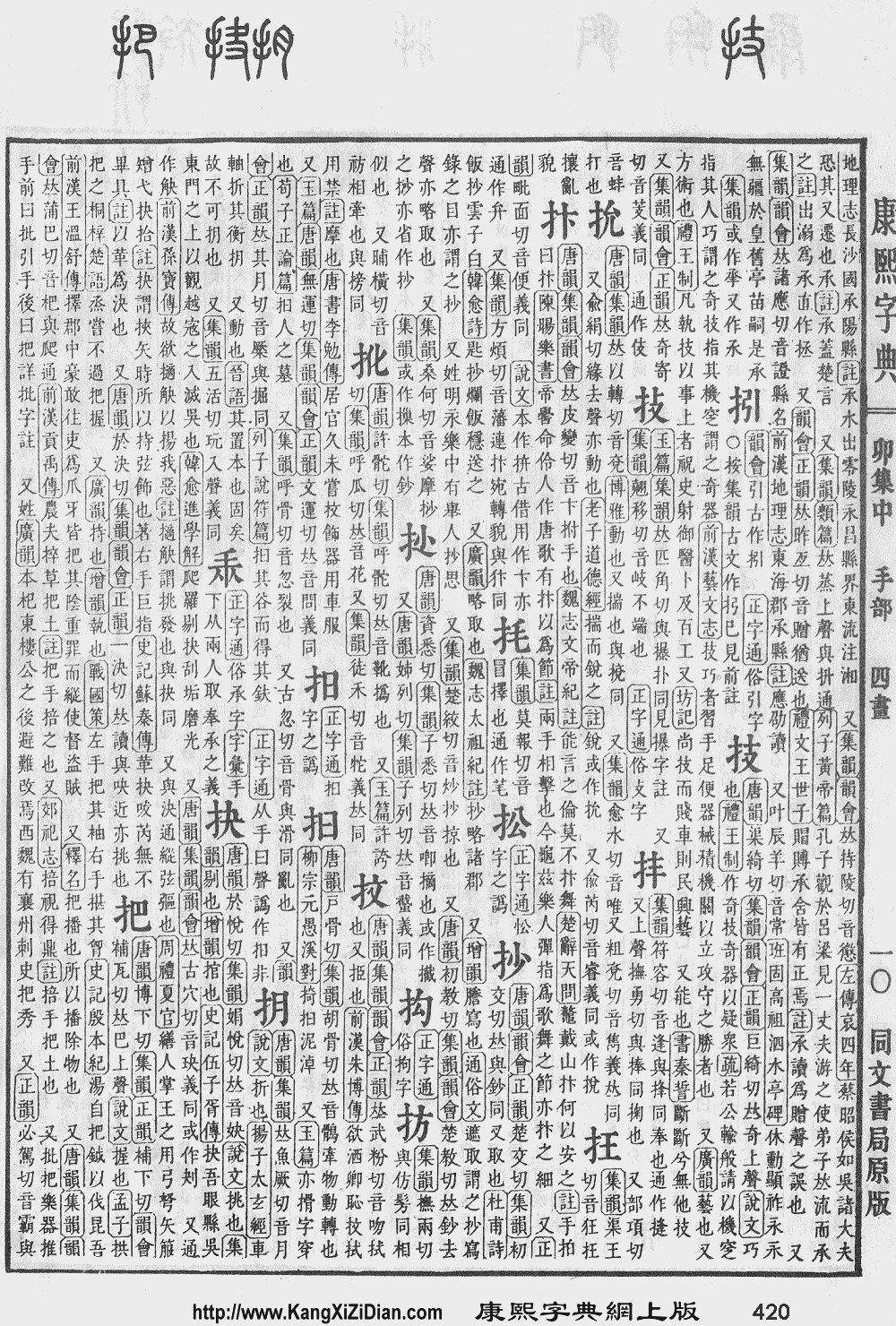
- KangXi: page 420, character 21
- Dai Kanwa Jiten: character 11874
- Dae Jaweon: page 768, character 1
- Hanyu Da Zidian (first edition): volume 3, page 1845, character 4
- Unihan data for U+628A
Chinese
| simp. and trad. |
把 | |
|---|---|---|
Glyph origin
Characters in the same phonetic series (巴) (Zhengzhang, 2003)
Phono-semantic compound (形聲/形声, OC *praːʔ) : semantic 扌 (“hand”) + phonetic 巴 (OC *praː).
Pronunciation 1
Definitions
把
- to hold; to grasp; to take
- 縱有健婦把鋤犁,禾生隴畝無東西。 [Classical Chinese, trad.]
- From: 8th century, 杜甫 (Du Fu), 《兵車行》 (The Army Wagons: A Ballad); translated by Stephen Owen
- Zòng yǒu jiànfù bǎ chúlí, hé shēng lǒngmǔ wú dōngxī. [Pinyin]
- Even though there are sturdy wives to hold the hoe and plow, the grain grows on the field boundary slopes and one can’t tell east from west.
纵有健妇把锄犁,禾生陇亩无东西。 [Classical Chinese, simp.]
- to control; to dominate
- 把控 ― bǎkòng ― to control
- to guard; to have control over
- (colloquial) to be close; to be near
- to hold a baby while it relieves itself
- 把尿 ― bǎniào ― to hold a baby while it urinates
- (traditional Chinese medicine) to feel (for the pulse)
- A light verb or preposition placed before the object of a sentence to allow it to be placed before the verb, giving greater flexibility in complex sentence construction.
- Used before a “subject + verb + complement” structure; to cause to; to make
- bundle; bunch
- 火把 ― huǒbǎ ― torch (stick with a flame on one end)
- handle; knob; grip (a part of an object which is held in the hand)
- stem (of a flower, leaf, fruit, etc.)
- 葉把兒/叶把儿 ― yèbàr ― stem of a leaf
- Classifier for objects that can be held using handles or knobs, such as guns, chairs, brooms, or umbrellas. ⇒ all nouns using this classifier
- Classifier for handfuls of something, such as grains, soil.
- Classifier for bundles or bunches.
- Classifier for some abstract ideas, such as force, effort or age.
- Classifier for something done with the hand.
- (Xiamen and Quanzhou Hokkien) Classifier for wheeled vehicles.
- Placed after numerals or classifiers to express uncertainty; approximately
- (dialectal) to give
- a surname
Usage notes
- A great deal of linguistic research has been carried out regarding the grammar of the "bǎ construction".
Synonyms
- (to control):
Synonyms of 把
|
|
- (to be close):
Synonyms of 把
- (light verb or preposition):
Dialectal synonyms of 把 (“particle introducing the object of the verb”) [map]
- (handle): 柄 (bǐng)
- (classifier):
Dialectal synonyms of 把 (“(classifier for knives)”) [map]
Dialectal synonyms of 輛 (“(classifier for vehicles)”) [map]
- (to give):
Dialectal synonyms of 給 (“to give”) [map]
Compounds
Derived terms from 把
|
|
|
Pronunciation 2
Japanese
Alternative forms
Kanji
把
- This term needs a translation to English. Please help out and add a translation, then remove the text
{{rfdef}}.
Etymology
| Kanji in this term |
|---|
| 把 |
| たば Grade: S |
| kun’yomi |
(This etymology is missing or incomplete. Please add to it, or discuss it at the Etymology scriptorium.)
Korean
Etymology
From Middle Chinese 把 (MC pˠaX).
| Historical readings |
|---|
|
Pronunciation
- (SK Standard/Seoul) IPA(key): [pʰa̠]
- Phonetic hangul: [파]
Compounds
Compounds
- 파로 (把撈, paro)
- 파반 (把盤, paban)
- 파배 (把杯, pabae)
- 파속 (把束, pasok)
- 파수 (把守, pasu)
- 파수 (把手, pasu)
- 파악 (把握, paak)
- 파장 (把掌, pajang)
- 파절 (把截, pajeol)
- 파주 (把住, paju)
- 파지 (把持, paji)
- 파지 (把指, paji)
- 파직 (把直, pajik)
- 파착 (把捉, pachak)
- 파총 (把摠, pachong)
- 파필 (把筆, papil)
- 검파 (劍把, geompa)
- 견파 (肩把, gyeonpa)
- 공파 (拱把, gongpa)
- 도파 (刀把, dopa)
- 만파 (輓把, manpa)
- 복파 (腹把, bokpa)
- 슬파 (膝把, seulpa)
- 외파 (外把, oepa)
- 입파 (入把, ip'pa)
- 총파 (銃把, chongpa)
- 낭파초 (狼把草, nangpacho)
Vietnamese
This article is issued from Wiktionary. The text is licensed under Creative Commons - Attribution - Sharealike. Additional terms may apply for the media files.