生
| ||||||||
| ||||||||
Translingual
| Stroke order (Chinese) | |||
|---|---|---|---|
 | |||
| Stroke order (Chinese) | |||
|---|---|---|---|
 | |||
| Stroke order (Japan) | |||
|---|---|---|---|
 | |||
Han character
生 (Kangxi radical 100, 生+0, 5 strokes, cangjie input 竹手一 (HQM), four-corner 25100, composition ⿻𠂉土)
- Kangxi radical #100, ⽣.
- Shuowen Jiezi radical №215
Derived characters
See also
Further reading
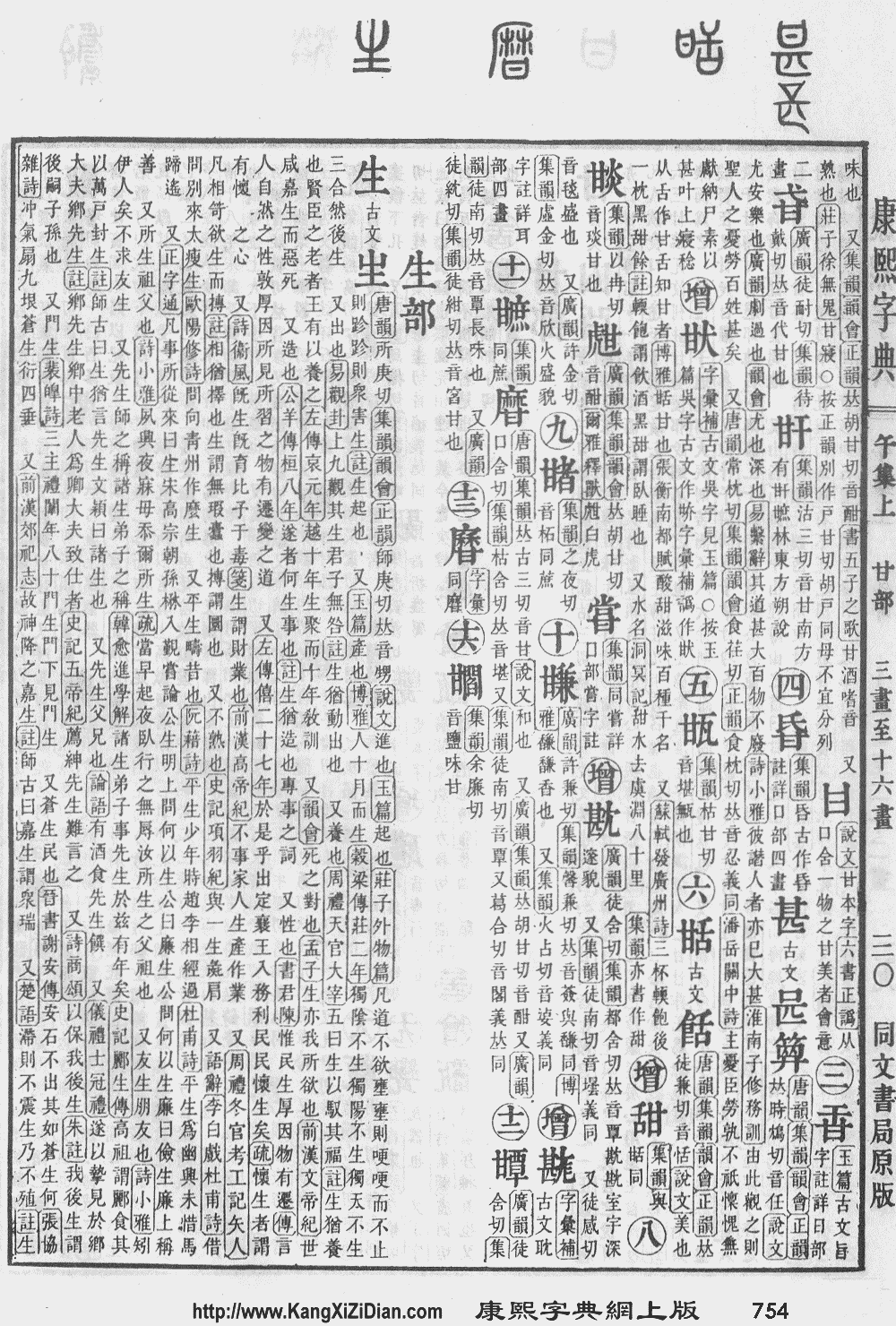
- KangXi: page 754, character 26
- Dai Kanwa Jiten: character 21670
- Dae Jaweon: page 1162, character 4
- Hanyu Da Zidian (first edition): volume 4, page 2575, character 1
- Unihan data for U+751F
Chinese
Glyph origin
| Historical forms of the character 生 | |||
|---|---|---|---|
| Shang | Western Zhou | Shuowen Jiezi (compiled in Han) | Liushutong (compiled in Ming) |
| Oracle bone script | Bronze inscriptions | Small seal script | Transcribed ancient scripts |
 |
 |
 |
 |
| Old Chinese | |
|---|---|
| 猜 | *sʰlɯː |
| 輤 | *sʰleːns |
| 綪 | *sʰleːns, *ʔsreːŋ |
| 倩 | *sʰleːns, *sʰleŋs |
| 棈 | *sʰleːns |
| 蒨 | *sʰeːns |
| 篟 | *sʰeːns |
| 生 | *sʰleːŋ, *sreŋs |
| 牲 | *sreŋ |
| 笙 | *sreŋ |
| 甥 | *sreŋ |
| 鉎 | *sreŋ, *sleːŋ |
| 珄 | *sreŋ |
| 鼪 | *sreŋ, *sreŋs |
| 猩 | *sreŋ, *seːŋ |
| 狌 | *sreŋ |
| 眚 | *sreŋʔ |
| 貹 | *sreŋs |
| 崝 | *zreːŋ |
| 精 | *ʔsleŋ, *ʔsleŋs |
| 菁 | *ʔsleŋ |
| 鶄 | *ʔsleŋ, *sʰleːŋ |
| 蜻 | *ʔsleŋ, *sʰleːŋ |
| 鼱 | *ʔsleŋ |
| 婧 | *ʔsleŋ, *zleŋs, *zleŋʔ |
| 睛 | *ʔsleŋ, *sʰleŋʔ |
| 箐 | *ʔsleŋ |
| 聙 | *ʔsleŋ |
| 旌 | *ʔsleŋ |
| 清 | *sʰleŋ |
| 圊 | *sʰleŋ |
| 請 | *sʰleŋʔ, *zleŋs, *zleŋ |
| 凊 | *sʰleŋs |
| 䝼 | *zleŋs, *zleŋ |
| 靚 | *zleŋs |
| 情 | *zleŋ |
| 晴 | *zleŋ |
| 夝 | *zleŋ |
| 靜 | *zleŋʔ |
| 靖 | *zleŋʔ |
| 睲 | *seŋʔ, *seːŋs |
| 惺 | *seŋʔ, *seːŋ |
| 性 | *sleŋs |
| 姓 | *sleŋs |
| 靗 | *l̥ʰeŋs |
| 鯖 | *ʔljeŋ, *sʰleːŋ |
| 青 | *sʰleːŋ |
| 靘 | *sʰleːŋ, *sʰleːŋs |
| 掅 | *sʰleːŋs |
| 胜 | *sleːŋ |
| 曐 | *sleːŋ |
| 星 | *sleːŋ |
| 鮏 | *sleːŋ |
| 腥 | *seːŋ, *seːŋs |
| 鯹 | *seːŋ |
| 醒 | *seːŋ, *seːŋʔ, *seːŋs |
| 篂 | *seːŋ |
Ideogrammic compound (會意/会意) : 屮 (“bud”) + 一 (“ground”) – sprouting from the ground.
Etymology 1
| simp. and trad. |
生 | |
|---|---|---|
| alternative forms | 𤯓 | |
From Proto-Sino-Tibetan *s-riŋ ~ s-r(j)aŋ (“to live; to be alive; to give birth; raw; green”). Cognate with Burmese ရှင် (hrang, “to live; alive”), Mizo hring (“to bear; to bring forth; to give birth to; green”).
Schuessler (2007) proposes that Proto-Sino-Tibetan *sriŋ is derived from the root *sri (“to exist”) (whence possibly Chinese 體 (OC *r̥ʰiːʔ, “body; shape; form”)) + *-ŋ (“terminative suffix”).
Both level tone and falling tone readings are found in Middle Chinese, but the latter has since been lost and is merged into the level-tone reading in modern dialects.
Related to 青 (OC *sʰleːŋ, “blue-green”), 蒼 (OC *sʰaːŋ, *sʰaːŋʔ, “dark blue; deep green”).
Derivatives: 性 (OC *sleŋs, “nature; character; personality; quality”), 姓 (OC *sleŋs, “family name”).
Pronunciation
Definitions
生
- to live; to subsist; to exist
- to grow; to develop; to bud
- (causative) to bear; to give birth; to bring up; to rear
- to be born; to come into existence
- pupil; disciple; student
- (historical) scholar; Confucian scholar
- (opera) actor or male character
- Short for 先生 (xiānshēng, “gentleman”).
- having life; live
- Synonym: 活 (huó)
- life; existence; being; living
- fresh; not stale
- unripe
- raw; uncooked
- (historical ethnography) uncultured; uncultivated; wild; uncivilized; savage
- 生黎 ― shēng Lí ― wild Li
- strange; unfamiliar
- mechanically; forcedly
- very; quite; extremely
- 生怕 ― shēngpà ― to fear; to be afraid of
- vivid; strong; forceful
- innate; natural; born with
- † Original form of 性 (xìng, “intelligence; natural endowment”).
- living things; organism
- livelihood; subsistence
- 謀生/谋生 ― móushēng ― to make a living
- lifetime; all one's life
- birthday; anniversary
- to bring back to life; to revive; to rescue
- to generate; to breed; to create
- to manufacture; to produce
- to happen; to occur; to take place
- to catch (a disease)
- (transitive) to be infested by a parasite
- (Buddhism) to go into society; to be reincarnated
- (dialectal) to set up; to put in; to settle
- to light; to ignite (a fire)
- a surname
Synonyms
| Variety | Location | Words |
|---|---|---|
| Classical Chinese | 生, 長 | |
| Formal (Written Standard Chinese) | 長 | |
| Mandarin | Taiwan | 長 |
| Yantai (Muping) | 生 | |
| Jinan | 長 | |
| Wanrong | 長 | |
| Xi'an | 長 | |
| Ürümqi | 生 | |
| Wuhan | 長 | |
| Guilin | 長 | |
| Yangzhou | 生 | |
| Singapore | 長 | |
| Cantonese | Guangzhou | 生 |
| Hong Kong | 生 | |
| Dongguan | 生 | |
| Gan | Lichuan | 長 |
| Pingxiang | 生 | |
| Hakka | Meixian | 生 |
| Miaoli (N. Sixian) | 生 | |
| Pingtung (Neipu; S. Sixian) | 生 | |
| Hsinchu County (Zhudong; Hailu) | 生 | |
| Taichung (Dongshi; Dabu) | 生 | |
| Hsinchu County (Qionglin; Raoping) | 生 | |
| Jin | Taiyuan | 長 |
| Min Dong | Fuzhou | 生 |
| Min Nan | Xiamen | 生 |
| Quanzhou | 生 | |
| Zhangzhou | 生 | |
| Taipei | 生 GT | |
| Shantou | 生 | |
| Jieyang | 生 | |
| Leizhou | 生 | |
| Haikou | 生 | |
| Wu | Suzhou | 長 |
| Ningbo | 生 | |
| Wenzhou | 生 | |
| Jinhua | 生 | |
| Xiang | Loudi | 生 |
| Note | GT - General Taiwanese (no specific region identified) | |
| Variety | Location | Words |
|---|---|---|
| Classical Chinese | 生 | |
| Formal (Written Standard Chinese) | 生 | |
| Mandarin | Taiwan | 生 |
| Yantai (Muping) | 生 | |
| Yinchuan | 生 | |
| Ürümqi | 生 | |
| Wuhan | 生 | |
| Singapore | 生 | |
| Cantonese | Guangzhou | 生, 臊 |
| Hong Kong | 生, 臊 | |
| Dongguan | 生 | |
| Singapore (Guangfu) | 生 | |
| Gan | Nanchang | 生 |
| Huizhou | Jixi | 生 |
| Jin | Taiyuan | 生 |
| Min Bei | Jian'ou | 洗 |
| Min Dong | Fuzhou | 生 |
| Min Nan | Xiamen | 生 |
| Quanzhou | 生 | |
| Zhangzhou | 生 | |
| Tainan | 生 | |
| Singapore (Hokkien) | 生 | |
| Manila (Hokkien) | 生 | |
| Singapore (Teochew) | 生 | |
| Haikou | 生 | |
| Wu | Wenzhou | 生 |
| Jinhua | 生 | |
| Xiang | Loudi | 生 |
| Variety | Location | Words |
|---|---|---|
| Formal (Written Standard Chinese) | 有生 | |
| Mandarin | Beijing | 活 |
| Taiwan | 活 | |
| Jinan | 活 | |
| Xi'an | 活 | |
| Wuhan | 活 | |
| Chengdu | 活 | |
| Guilin | 活 | |
| Yangzhou | 活 | |
| Hefei | 活 | |
| Singapore | 活 | |
| Cantonese | Guangzhou | 生 |
| Hong Kong | 生 | |
| Hong Kong (San Tin Weitou) | 生 | |
| Hong Kong (Ting Kok) | 生 | |
| Hong Kong (Tung Ping Chau) | 生 | |
| Yangjiang | 生 | |
| Singapore (Guangfu) | 生 | |
| Gan | Nanchang | 活 |
| Hakka | Meixian | 生 |
| Hong Kong | 生 | |
| Senai (Huiyang) | 生 | |
| Jin | Taiyuan | 活 |
| Min Bei | Jian'ou | 生 |
| Min Dong | Fuzhou | 活 |
| Min Nan | Xiamen | 活 |
| Singapore (Hokkien) | 活 | |
| Chaozhou | 活 | |
| Bangkok (Teochew) | 活 | |
| Johor Bahru (Teochew) | 活 | |
| Singapore (Teochew) | 活 | |
| Wu | Suzhou | 活 |
| Wenzhou | 活, 健 | |
| Xiang | Changsha | 活 |
| Shuangfeng | 活 | |
Pronunciation
Definitions
生
Pronunciation
Synonyms
- 桑 (sāng)
Compounds
Descendants
References
- “生”, in 漢語多功能字庫 (Multi-function Chinese Character Database), 香港中文大學/香港中文大学 (the Chinese University of Hong Kong), 2014–
Japanese
| Stroke order (Japan) | |||
|---|---|---|---|
 | |||
| Stroke order (Japan) | |||
|---|---|---|---|
| |||
Readings
- Go-on: しょう (shō, Jōyō)←しやう (syau, historical)
- Kan-on: せい (sei, Jōyō)
- Tō-on: さん (san)
- Kun: いきる (ikiru, 生きる, Jōyō); いかす (ikasu, 生かす, Jōyō); いける (ikeru, 生ける, Jōyō); うぶ (ubu, 生); うむ (umu, 生む, Jōyō); うまれる (umareru, 生まれる, Jōyō); うまれる (umareru, 生れる); うまれ (umare, 生れ); おう (ou, 生う, Jōyō); はえる (haeru, 生える, Jōyō); はやす (hayasu, 生やす, Jōyō); き (ki, 生, Jōyō); なま (nama, 生, Jōyō); なる (naru, 生る); なす (nasu, 生す); むす (musu, 生す)
- Nanori: あさ (asa); い (i); いき (iki); いく (iku); いけ (ike); うぶ (ubu); うまい (umai); え (e); おい (oi); ぎゅう (gyū); くるみ (kurumi); ごせ (gose); さ (sa); じょ (jo); すぎ (sugi); そ (so); そう (sō); ちる (chiru); なば (naba); にう (niu); にゅう (nyū); ふ (fu); み (mi); もう (mō); よい (yoi); りゅう (ryū)
Compounds
Etymology 1
| Kanji in this term |
|---|
| 生 |
| なま Grade: 1 |
| kun’yomi |
From Old Japanese. Numerous derivatives already in use in the Heian period.[1][2]
Noun
生 • (nama)
Prefix
生 • (nama-)
- (broadcasting) live
- 生演奏
- namaensō
- live performance
- 生演奏
- fresh, draft
- 生クリーム
- nama kurīmu
- fresh cream
- 生ビール
- nama bīru
- draft beer
- 生クリーム
- raw, uncooked, rare
- 生卵
- nama tamago
- a raw egg
- 生卵
- natural, unprocessed
Derived terms
Etymology 2
| Kanji in this term |
|---|
| 生 |
| せい Grade: 1 |
| on’yomi |
From Middle Chinese 生 (MC ʃˠæŋ, ʃˠæŋH, “alive; fresh; raw; unprocessed”).
Noun
生 • (sei)
Suffix
生 • (-sei)
Derived terms
Etymology 3
| Kanji in this term |
|---|
| 生 |
| き Grade: 1 |
| kun’yomi |
Likely a contraction from 生き (iki, “life, living; freshness”).[1]
Noun
生 • (ki)
Prefix
生 • (ki-)
- unrefined
- 生糸
- kiito
- raw silk
- 生糸
- pure, undefiled, unadulterated
- 生娘
- kimusume
- innocent young girl
- 生娘
Derived terms
- See 生/derived terms § Ki.
Etymology 4
| Kanji in this term |
|---|
| 生 |
| しょう Grade: 1 |
| goon |
From Middle Chinese 生 (MC ʃˠæŋ, ʃˠæŋH). The 呉音 (goon) reading, so likely the initial borrowing from Middle Chinese.
Derived terms
See also
- Appendix:Gikun Usage in Meiji Version of Japanese Bible/生
References
- 1988, 国語大辞典(新装版) (Kokugo Dai Jiten, Revised Edition) (in Japanese), Tōkyō: Shogakukan
- 2006, 大辞林 (Daijirin), Third Edition (in Japanese), Tōkyō: Sanseidō, →ISBN
Korean
Etymology
From Middle Chinese 生 (MC ʃˠæŋ, ʃˠæŋH).
| Historical readings |
|---|
|
Pronunciation
Lua error: not enough memory. See Wiktionary:Lua memory errors for more information.
Hanja
Wikisource Lua error: not enough memory. See Wiktionary:Lua memory errors for more information.
Compounds
Okinawan
Kanji
Lua error: not enough memory. See Wiktionary:Lua memory errors for more information.
Readings
Lua error: not enough memory. See Wiktionary:Lua memory errors for more information.
Compounds
- Lua error: not enough memory. See Wiktionary:Lua memory errors for more information.
Vietnamese
Han character
Lua error: not enough memory. See Wiktionary:Lua memory errors for more information.