等
| ||||||||
Translingual
| Stroke order | |||
|---|---|---|---|
 | |||
Han character
等 (Kangxi radical 118, 竹+6, 12 strokes, cangjie input 竹土木戈 (HGDI), four-corner 88341, composition ⿱𥫗寺)
Derived characters
- 𠎬, 𬼑, 𠾡, 𫮨, 𢡩, 㩐, 𣛆, 𥢜, 𥪸, 𦅯, 𮖴, 𨅸, 𨬻, 𠟚, 𫂨, 𮆠, 𮆩
References
- KangXi: page 882, character 24
- Dai Kanwa Jiten: character 25992
- Dae Jaweon: page 1311, character 5
- Hanyu Da Zidian (first edition): volume 5, page 2962, character 1
- Unihan data for U+7B49
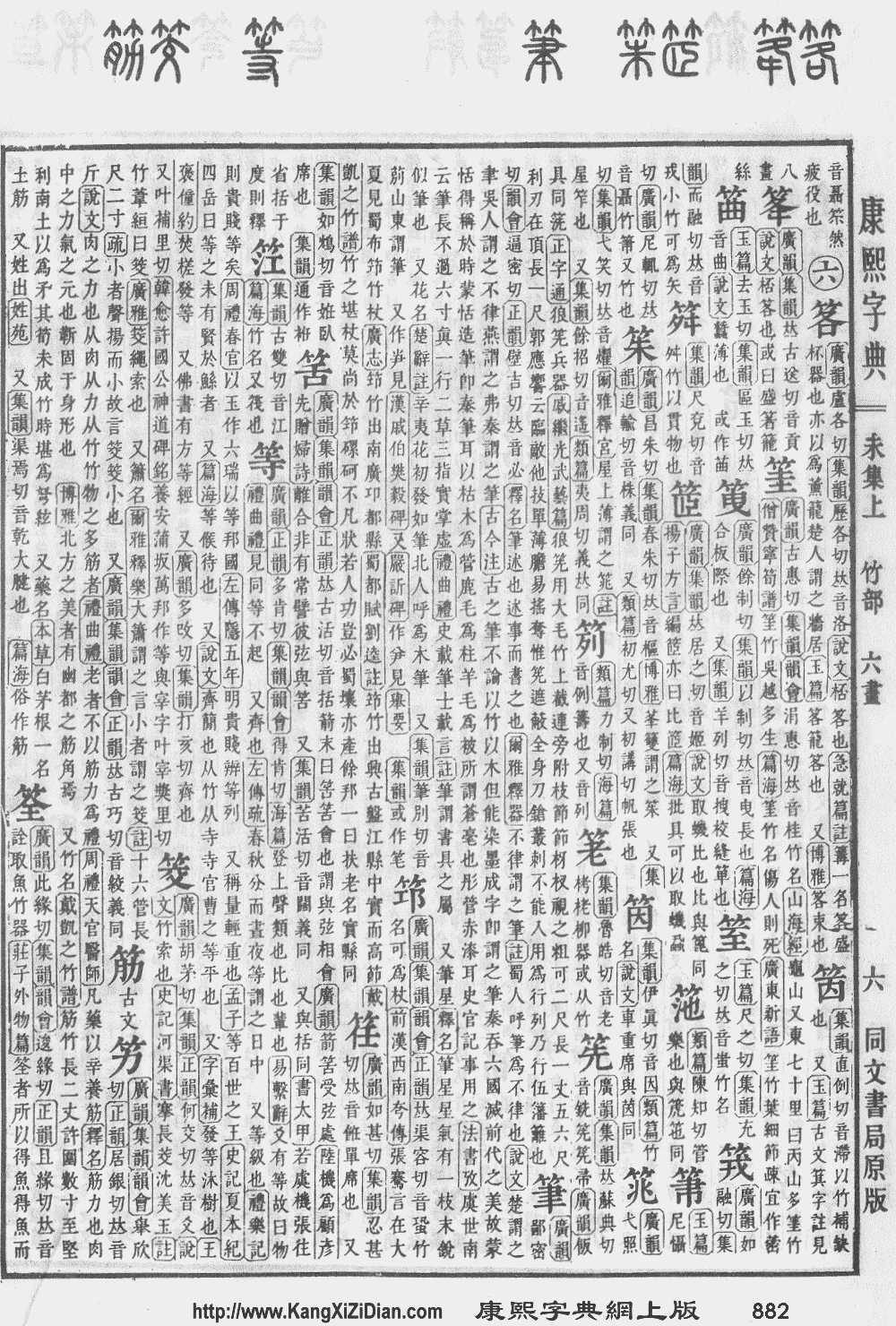
Chinese
| trad. | 等 | |
|---|---|---|
| simp. # | 等 | |
| 2nd round simp. | ⿱艹寸 | |
Glyph origin
Phono-semantic compound (形聲/形声, OC *tɯːʔ, *tɯːŋʔ) : semantic 竹 (“bamboo”) + phonetic 寺 (OC *ljɯs).
竹 here refers to the bamboo strips used for writing (e.g. grading, classification) in ancient times. 寺 (OC *ljɯs) was originally used phonetically; the character was subsequently borrowed for another word with the same meaning, but with no phonetic resemblance to 寺.
Etymology
- “rank; class; kind; to equate; and the like; plural particle”
- From Proto-Sino-Tibetan *s-tjaŋ (“top; to rise; to raise”) (STEDT). Endoactive of 登 (OC *tɯːŋ, “to rise; to ascend”) (Schuessler, 2007).
- “to wait”
- A medieval word, probably related to 待 (OC *dɯːʔ, “to wait”) (Wang, 1982).
Pronunciation
Definitions
等
- † to arrange bamboo slips neatly
- rank; grade; class
- sort; kind; type
- (Chinese phonetics) one of the "divisions" of a rime table, encoding some phonological distinction; see
 Middle Chinese finals on Wikipedia.Wikipedia
- 重紐三等/重纽三等 ― chóngniǔ sānděng ― the third division member of a rime doublet
- to equate; to be equal
- and the like; and so on; etc.; et al.
- Particle indicating the ending of enumeration.
- 沛公則置車騎,脫身獨騎,與樊噲、夏侯嬰、靳彊、紀信等四人持劍盾步走,從酈山下,道芷陽間行。 [Classical Chinese, trad.]
- From: The Records of the Grand Historian, by Sima Qian, c. 91 BCE
- Pèigōng zé zhì chēqí, tuōshēn dú qí, yǔ Fán Kuài, Xiàhóu Yīng, Jìn Qiáng, Jǐ Xìn děng sì rén chí jiàn dùn bùzǒu, cóng Lì Shān xià, dào Zhǐyáng jiān xíng. [Pinyin]
- (please add an English translation of this example)
沛公则置车骑,脱身独骑,与樊哙、夏侯婴、靳强、纪信等四人持剑盾步走,从郦山下,道芷阳间行。 [Classical Chinese, simp.]
- (literary or Hakka) Plural particle used after personal pronouns or nouns.
- 爾等/尔等 [Classical Chinese] ― ěrděng [Pinyin] ― you (plural)
- 𠊎等 [Sixian Hakka] ― ngài-tén [Pha̍k-fa-sṳ] ― we; us
- to wait
- (Cantonese) to let; to allow; to cause
- (Hakka) Progressive particle, used after verbs to indicate the continuation of an action or a state.
- a surname
Synonyms
- (to wait):
- (progressive particle):
| Variety | Location | Words |
|---|---|---|
| Formal (Written Standard Chinese) | 著 | |
| Mandarin | Beijing | 著 |
| Taiwan | 著 | |
| Harbin | 著 | |
| Yantai (Muping) | 著 | |
| Jinan | 著 | |
| Wanrong | 著 | |
| Xi'an | 著 | |
| Wuhan | 倒 | |
| Guiyang | 倒 | |
| Guilin | 倒 | |
| Liuzhou | 倒, 穩 | |
| Xuzhou | 著 | |
| Nanjing | 著 | |
| Singapore | 著 | |
| Cantonese | Guangzhou | 緊 |
| Hong Kong | 緊 | |
| Singapore (Guangfu) | 緊 | |
| Gan | Nanchang | 倒 |
| Hakka | Meixian | 等 |
| Miaoli (N. Sixian) | 等 | |
| Pingtung (Neipu; S. Sixian) | 等 | |
| Hsinchu County (Zhudong; Hailu) | 等 | |
| Taichung (Dongshi; Dabu) | 緊 | |
| Hsinchu County (Qionglin; Raoping) | 等 | |
| Kuching (Hepo) | 緊 | |
| Jin | Taiyuan | 著 |
| Southern Pinghua | Nanning (Tingzi) | 緊 |
| Wu | Shanghai | 勒海, 勒該 |
| Ningbo | 的, 該, 當, 東, 仔, 勒眼 | |
| Zhoushan | 底, 的 rare, 該, 當, 仔, 勒眼 | |
Compounds
|
|
|
Descendants
References
- “等”, in 漢語多功能字庫 (Multi-function Chinese Character Database), 香港中文大學/香港中文大学 (the Chinese University of Hong Kong), 2014–
- Dictionary of Chinese Character Variants (教育部異體字字典), A02997
- “Entry #8843”, in 臺灣閩南語常用詞辭典 [Dictionary of Frequently-Used Taiwan Minnan] (in Chinese and Min Nan), Ministry of Education, R.O.C., 2011.
Japanese
Readings
Etymology 1
| Kanji in this term |
|---|
| 等 |
| とう Grade: 3 |
| on’yomi |
From Middle Chinese 等 (tongX, “step, grade”), extended to mean ... kind of thing.
Usage notes
For the et cetera sense, the tō reading is somewhat more formal than the nado reading.
Derived terms
Etymology 2
| Kanji in this term |
|---|
| 等 |
| など Grade: 3 |
| kun’yomi |
From earlier なんど (nando, “etc., and so forth, and such like”), from earlier 何と (nani to, “etc., and so forth, and such like”, literally “and what”), itself a compound of 何 (nani, “what”) + と (to, “and”).[2][1][3]
Adverb
等 • (nado)
Usage notes
For the et cetera sense, the tō reading is somewhat more formal than the nado reading.
Often spelled in hiragana, as など.
Etymology 3
| Kanji in this term |
|---|
| 等 |
| なんど Grade: 3 |
| kun’yomi |
From earlier 何と (nani to, “etc., and so forth, and such like”, literally “and what”), itself a compound of 何 (nani, “what”) + と (to, “and”).[2][1][3]
Suffix
等 • (-ra)
Usage notes
Often spelled in hiragana, as ら.
References
- 2006, 大辞林 (Daijirin), Third Edition (in Japanese), Tōkyō: Sanseidō, →ISBN
- 1988, 国語大辞典(新装版) (Kokugo Dai Jiten, Revised Edition) (in Japanese), Tōkyō: Shogakukan
- 1995, 大辞泉 (Daijisen) (in Japanese), Tōkyō: Shogakukan, →ISBN