道
 | ||||||||
Translingual
| Stroke order | |||
|---|---|---|---|
 | |||
| Stroke order | |||
|---|---|---|---|
 | |||
Han character
道 (Kangxi radical 162, 辵+9, 13 strokes in traditional Chinese and Korean, 12 strokes in mainland China and Japanese, cangjie input 卜廿竹山 (YTHU), four-corner 38306, composition ⿺辶首)
References
- KangXi: page 1262, character 6
- Dai Kanwa Jiten: character 39010
- Dae Jaweon: page 1754, character 9
- Hanyu Da Zidian (first edition): volume 6, page 3864, character 1
- Unihan data for U+9053
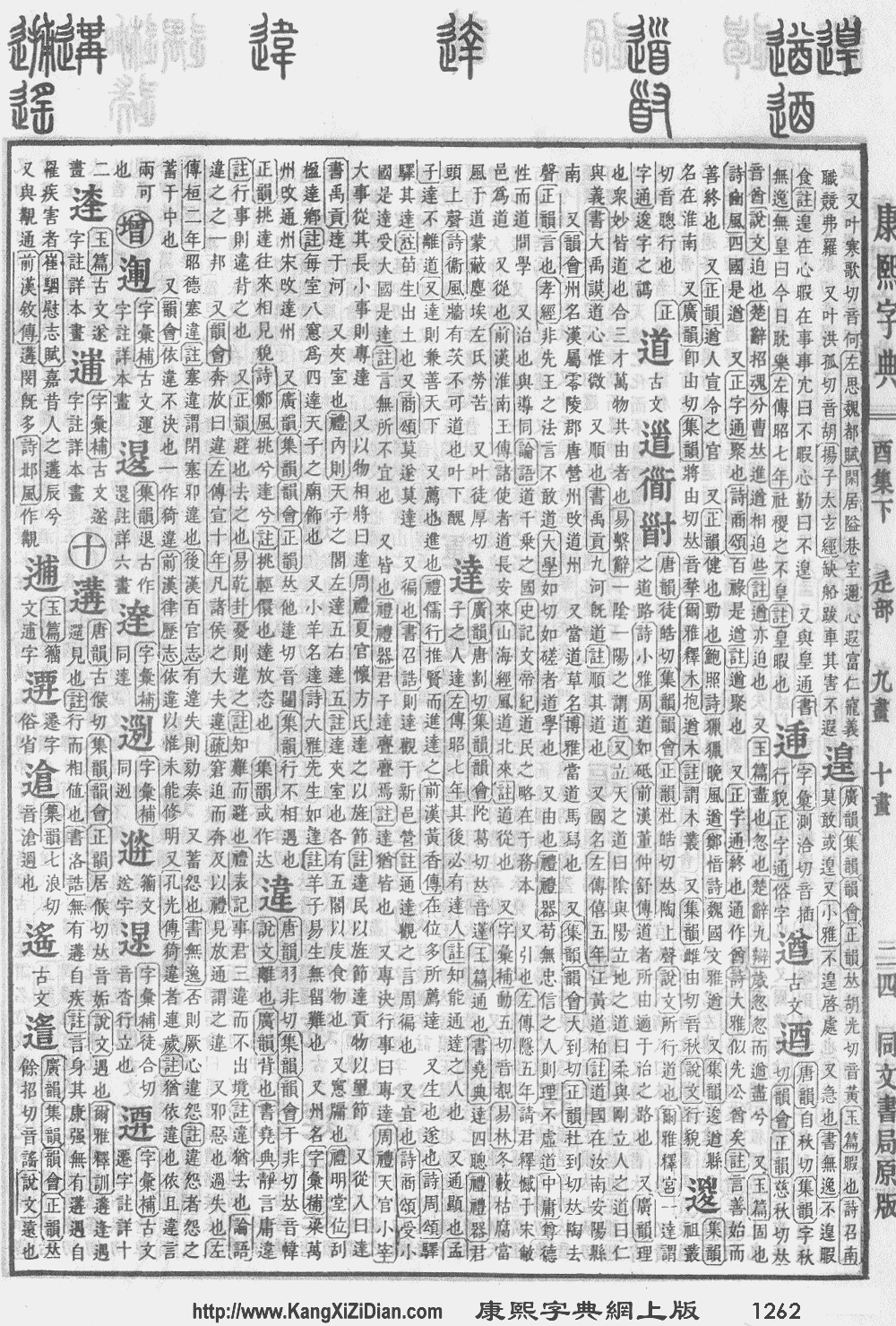
Chinese
Glyph origin
| Historical forms of the character 道 | |||
|---|---|---|---|
| Western Zhou | Warring States | Shuowen Jiezi (compiled in Han) | Liushutong (compiled in Ming) |
| Bronze inscriptions | Chu slip and silk script | Small seal script | Transcribed ancient scripts |
 |
 |
 |
 |
Phono-semantic compound (形聲/形声, OC *l'uːʔ) : semantic 辵 (“walking”) + phonetic 首 (OC *hljuʔ, *hljus).
Etymology
Possibly derived from 導 (OC *duːs, “to go along, to bring along, to conduct”):
- > "to explain" > "to talk about", and
- > "road, way".
Cognate with Proto-Hmong-Mien *kləuX (“road, way”) (White Hmong kev (“road”)). See also 首 (OC *hljuʔ, *hljus). Compare also with Burmese လျှောက် (hlyauk, “to walk”).
Definitions
道
- way; path; road
- 道路 ― dàolù ― road
- (historical) circuit: an administrative division of late imperial China comprising 2 or more commanderies
- (rail transport) track
- method; principle
- (Buddhism) the Marga; the Way of bodhi or enlightenment leading to nirvana through spiritual stages
- (philosophy, Taoism) the Way; the Tao; the Dao: the way of nature and/or the ideal way to live one's life
- (Christianity) Logos; the Word
- Short for 道教 (Dàojiào, “Taoism”).
- Short for 道士 (dàoshì, “Taoist priest”).
- (religion) doctrine; teachings
- (literary) to say; to utter
- 孟子道性善,言必稱堯舜。 [Classical Chinese, trad.]
- From: Mencius, c. 4th century BCE, translated based on James Legge's version
- Mèngzǐ dào xìngshàn, yán bì chēng Yáoshùn. [Pinyin]
- Mencius said that human nature is good; when speaking he always made laudatory reference to Yao and Shun.
孟子道性善,言必称尧舜。 [Classical Chinese, simp.]
- Classifier for long things.
- Classifier for barriers.
- Classifier for courses in a meal: dish
- Classifier for questions (in an exam), orders or proclamations.
- a surname
Synonyms
| Variety | Location | Words |
|---|---|---|
| Formal (Written Standard Chinese) | 扇, 道 | |
| Mandarin | Beijing | 扇兒 |
| Taiwan | 扇 | |
| Yantai (Muping) | 扇, 道 | |
| Jinan | 扇 | |
| Luoyang | 扇 | |
| Xi'an | 扇兒, 扇, 道 | |
| Yinchuan | 扇 | |
| Xining | 扇, 道 | |
| Ürümqi | 道 | |
| Wuhan | 扇, 道 | |
| Chengdu | 扇, 道 | |
| Guiyang | 扇 | |
| Guilin | 扇 | |
| Liuzhou | 扇, 道 | |
| Xuzhou | 扇兒, 扇, 道 | |
| Yangzhou | 扇 | |
| Nanjing | 扇 | |
| Hefei | 扇 | |
| Singapore | 扇 | |
| Cantonese | Guangzhou | 度 |
| Hong Kong | 度 | |
| Hong Kong (San Tin Weitou) | 隻 | |
| Hong Kong (Ting Kok) | 度 | |
| Hong Kong (Tung Ping Chau) | 隻 | |
| Taishan | 度 | |
| Dongguan | 度 | |
| Yangjiang | 扇 | |
| Kuala Lumpur (Guangfu) | 扇 | |
| Gan | Nanchang | 扇 |
| Pingxiang | 扇 | |
| Hakka | Meixian | 扇, 皮 |
| Yudu | 扇 | |
| Hong Kong | 隻 | |
| Senai (Huiyang) | 扇 | |
| Jin | Taiyuan | 扇, 道 |
| Xinzhou | 扇 | |
| Min Bei | Jian'ou | 扇 |
| Min Dong | Fuzhou | 扇 |
| Min Nan | Xiamen | 扇 |
| Quanzhou | 扇 | |
| Zhangzhou | 扇 | |
| Taipei (Wanhua) | 扇 | |
| Kaohsiung | 片 | |
| Yilan | 扇 | |
| Changhua (Lukang) | 扇 | |
| Taichung | 片 | |
| Taichung (Wuqi) | 扇 | |
| Tainan | 片, 扇 | |
| Taitung | 片 | |
| Hsinchu | 片 | |
| Penghu (Magong) | 扇 | |
| Chaozhou | 片 | |
| Jieyang | 片 | |
| Bangkok (Teochew) | 片 | |
| Johor Bahru (Teochew) | 扇 | |
| Singapore (Teochew) | 片 | |
| Haikou | 片 | |
| Southern Pinghua | Nanning (Tingzi) | 扇 |
| Wu | Shanghai | 扇 |
| Suzhou | 扇 | |
| Ningbo | 扇 | |
| Wenzhou | 爿 | |
| Xiang | Changsha | 扇, 張, 隻 |
| Shuangfeng | 扇 | |
Compounds
|
|
|
Descendants
Definitions
道
- † Alternative form of 導/导 (dǎo, “to direct; to guide; to lead; to conduct”).
- 子曰:「道之以政,齊之以刑,民免而無恥;道之以德,齊之以禮,有恥且格。」 [Classical Chinese, trad.]
- From: The Analects of Confucius, c. 475 – 221 BCE
- Zǐyuē: “Dǎo zhī yǐ zhèng, qí zhī yǐ xíng, mín miǎn ér wúchǐ; dǎo zhī yǐ dé, qí zhī yǐ lǐ, yǒuchǐ qiě gé.” [Pinyin]
- The Master said: "Guide them with policies and align them with punishments and the people will evade them and have no shame. Guide them with virtue and align them with propriety and the people will have a sense of shame and fulfill their roles.
子曰:“道之以政,齐之以刑,民免而无耻;道之以德,齐之以礼,有耻且格。” [Classical Chinese, simp.]- 其諫我也似子,其道我也似父,是以歎也。 [Classical Chinese, trad.]
- From: Zhuangzi, circa 3rd – 2nd centuries BCE
- Qí jiàn wǒ yě sì zǐ, qí dǎo wǒ yě sì fù, shì yǐ tàn yě. [Pinyin]
- He remonstrated with me as though he were my son, offered me guidance as though he were my father! That is why I sighed.
其谏我也似子,其道我也似父,是以叹也。 [Classical Chinese, simp.]
References
- “道”, in 漢語多功能字庫 (Multi-function Chinese Character Database), 香港中文大學/香港中文大学 (the Chinese University of Hong Kong), 2014–
- Dictionary of Chinese Character Variants (教育部異體字字典), A04159
Japanese
| Shinjitai | 道 | |
| Kyūjitai [1][2] |
道󠄁 道+ 󠄁?(Adobe-Japan1) |
|
| 道󠄃 道+ 󠄃?(Hanyo-Denshi) (Moji_Joho) | ||
| The displayed kanji may be different from the image due to your environment. See here for details. | ||
Readings
- Go-on: どう (dō, Jōyō)←だう (dau, historical)
- Kan-on: とう (tō, Jōyō †)←たう (tau, historical)
- Kun: みち (michi, 道, Jōyō); いう (iu, 道う); みちびく (michibiku, 道く)
- Nanori: おさめ (osame); おさむ (osamu); さ (sa); じ (ji); ち (chi); つな (tsuna); つね (tsune); ど (do); なおし (naoshi); ね (ne); のり (nori); まさ (masa); みち (michi); みつ (mitsu); ゆき (yuki); より (yori); わたる (wataru)
Compounds
- 合気道 (aikidō, “aikido”)
- 道具 (dōgu, “tool”)
- 道路 (dōro, “road”)
- 道徳 (dōtoku, “ethics”)
- 報道 (hōdō, “broadcast”)
- 柔道 (jūdō, “judo”)
- 軌道 (kidō, “orbit”)
- 赤道 (sekidō, “equator”)
- 食道 (shokudō, “oesophagus”)
- 水道 (suidō, “water supply”)
- 鉄道 (tetsudō, “railway”)
- 道教 (dōkyō, “Taoism”)
- 道理 (dōri, “rational”)
- 道州制 (dōshūsei, “wide-area administration”)
- 書道 (shodō, “calligraphy”)
- 武道 (budō, “budo”)
- 跆拳道 (taikendō, “taekwondo”)
- 空手道 (karatedō, “karate”)
- 茶道 (sadō, “tea ceremony”)
- 華道 (kadō, “flower arrangement”)
- 花道 (kadō, “flower arrangement”)
Etymology 1
| Kanji in this term |
|---|
| 道 |
| どう Grade: 2 |
| goon |
/dau/ → /dɔː/ → /doː/
From Middle Chinese 道 (MC dɑuX). Compare modern Mandarin 道 (dào), Cantonese 道 (dou6).
Noun
Etymology 2
| Kanji in this term |
|---|
| 道 |
| ち Grade: 2 |
| irregular |
| For pronunciation and definitions of 道 – see the following entry. | ||
| ||
| (This term, 道, is an alternative spelling of the above term.) |
Etymology 3
| Kanji in this term |
|---|
| 道 |
| じ Grade: 2 |
| irregular |
| For pronunciation and definitions of 道 – see the following entry. | ||
| ||
| (This term, 道, is an alternative spelling of the above term.) |
Etymology 4
| Kanji in this term |
|---|
| 道 |
| みち Grade: 2 |
| kun’yomi |
| Alternative spellings |
|---|
| 路 (uncommon) 途 (rare) 径 (rare) |
Originally a compound of 御 (mi, honorific prefix) + 路 (chi, “road, street, way”).[5] The prefix mi was in reference to the 神 (kami, “god, spirit”) of roads. Perhaps also cognate with *miti, a potentially road-related element found in Old Korean toponyms.[6]
Noun
道 • (michi)
Usage notes
This is the most common term for “road”, “street”, or “way” in modern Japanese.
Proper noun
道 or 道 or 道 or 道 or 道 or 道 or 道 or 道 or 道 • (Osamu or Susumu or Tadashi or Tadasu or Naoshi or Makoto or Michihiro or Motoi or Wataru)
- a male given name
References
- “道”, in 漢字ぺディア (Kanjipedia) (in Japanese), 日本漢字能力検定協会, 2015—2023
- 1914, 漢和大辭書 (Kanwa Dai Jisho, “The Great Kanji-Japanese Dictionary”) (in Japanese), page 2120 (paper), page 1112 (digital), Tōkyō: 興文社 (Kōbunsha)
- 2006, 大辞林 (Daijirin), Third Edition (in Japanese), Tōkyō: Sanseidō, →ISBN
- 1998, NHK日本語発音アクセント辞典 (NHK Japanese Pronunciation Accent Dictionary) (in Japanese), Tōkyō: NHK, →ISBN
- 1988, 国語大辞典(新装版) (Kokugo Dai Jiten, Revised Edition) (in Japanese), Tōkyō: Shogakukan
- Vovin, Alexander (2013), “From Koguryo to T'amna”, in Korean Linguistics (PDF), volume 15, issue 2, John Benjamins Publishing Company, DOI:, pages 222-240.
Korean
Etymology
From Middle Chinese 道 (MC dɑuX).
| Historical Readings | ||
|---|---|---|
| Dongguk Jeongun Reading | ||
| Dongguk Jeongun, 1448 | 또ᇢ〯 (Yale: ttwǒw) | |
| Middle Korean | ||
| Text | Eumhun | |
| Gloss (hun) | Reading | |
| Hunmong Jahoe, 1527 | 길〮 (Yale: kíl) | 도〯 (Yale: twǒ) |
Pronunciation
- (SK Standard/Seoul) IPA(key): [to̞(ː)]
- Phonetic hangul: [도(ː)]
- Though still prescribed in Standard Korean, most speakers in both Koreas no longer distinguish vowel length.
Compounds
Vietnamese
Han character
道: Hán Việt readings: đạo (
道: Nôm readings: dạo[1][2][3][6][4][5][7], đạo[1][2][3][4][7], đảo[2], nhạo[3]
Compounds
References
- Nguyễn (2014).
- Nguyễn et al. (2009).
- Trần (2004).
- Bonet (1899).
- Génibrel (1898).
- Hồ (1976).
- Taberd & Pigneau de Béhaine (1838).