朝
| ||||||||
Translingual
| Stroke order | |||
|---|---|---|---|
 | |||
Han character
朝 (Kangxi radical 74, 月+8, 12 strokes, cangjie input 十十月 (JJB), four-corner 47420, composition ⿰龺月)
References
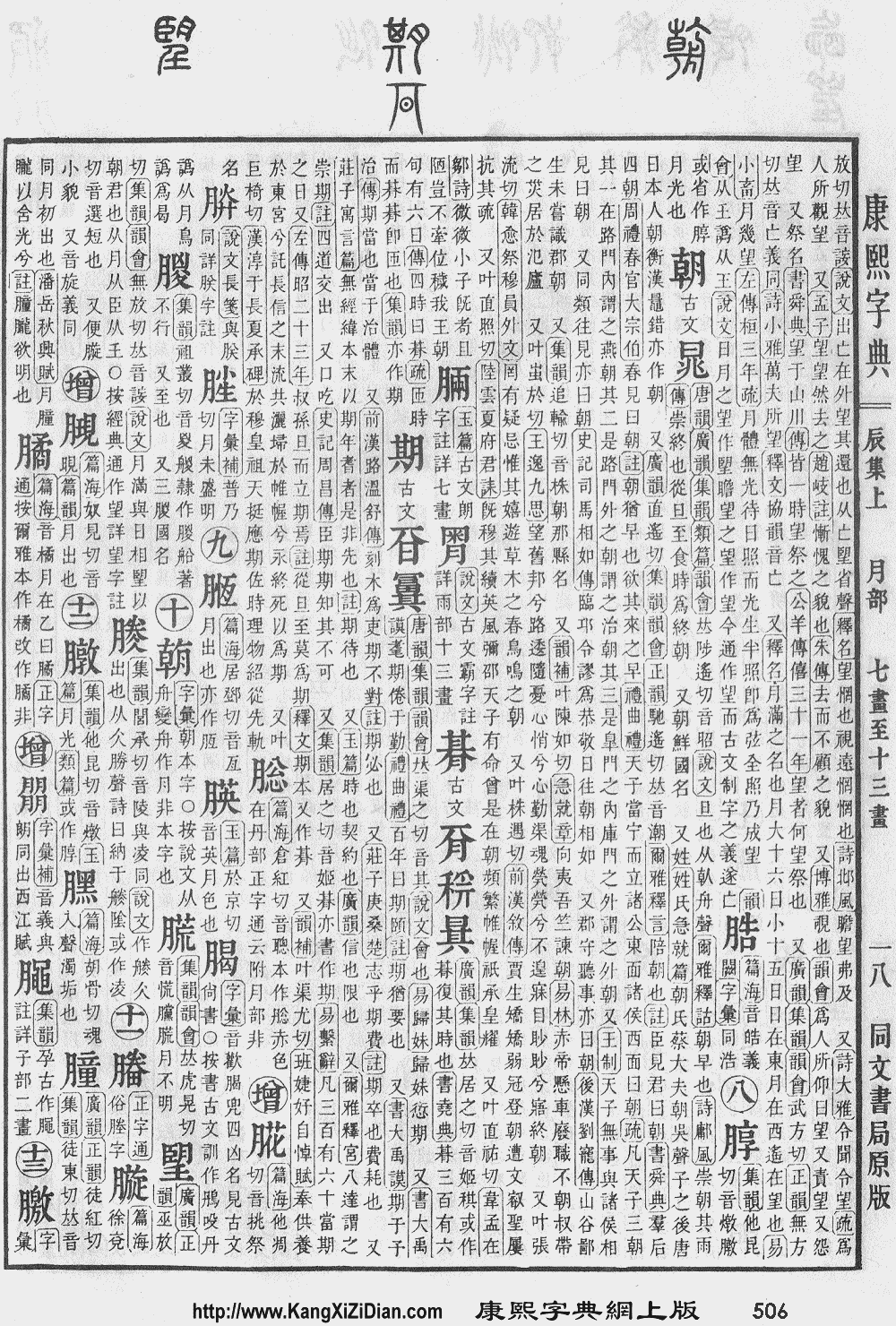
- KangXi: page 506, character 3
- Dai Kanwa Jiten: character 14374
- Dae Jaweon: page 885, character 7
- Hanyu Da Zidian (first edition): volume 3, page 2084, character 8
- Unihan data for U+671D
Chinese
| simp. and trad. |
朝 | |
|---|---|---|
| 2nd round simp. | 䢁 | |
| alternative forms | 𦩻 晁 𨊸/䢁 調/调 ancient 鼂/鼌 | |
Glyph origin
| Historical forms of the character 朝 | ||
|---|---|---|
| Shang | Western Zhou | Warring States |
| Oracle bone script | Bronze inscriptions | Qin slip script |
 |
 |
 |
In the oracle bone script, it was an ideogrammic compound (會意/会意) : 2 or 4 屮 (“grass”) or even 木 (“tree”) + 日 (“sun”) + 月 (“moon”) – the sun rising above the ground while the waning moon is still in the sky – the morning.
In the bronze script, it was a compound of 𠦝 and a pictograph of a river (川 or 水) – this was possibly an original form for 潮 (OC *r'ew, “tide”). The river glyph may be a corruption of 月 due to association with tides or diurnal events. Chi (2010) considers such forms to be phono-semantic (形聲/形声) , where 𠦝 is the abbreviated form of the phonetic 朝 (OC *ʔr'ew, *r'ew). In the some late Western Zhou forms, 𠦝 was corrupted into a form resembling 車.
According to Guo Moruo, in the stone drum inscriptions (石鼓文, likely from the Spring and Autumn period) 㫃 was added (attached to 車), and the river glyph was replaced with 舟 (OC *tjɯw), which was interpreted as the phonetic component; the small seal script might have inherited from this form. Shuowen interpreted the fused components of 𠦝 and 㫃 as a semantic component 倝 (“dawn”). However, the accuracy of identification has been questioned; the character was a heavily weathered one in which the 㫃 identification was probably spurious and likely influenced by the Shuowen. Meanwhile, the 舟 component on the right remained somewhat legible.[1]
The 舟 component remained in the bamboo and wooden slips of the Warring States period (see the table). In the clerical script since the Han dynasty, 舟 had been reverted to 月; it is unclear whether this was a remnant from 月 in the oracle bone script or a corruption of 舟 (as in 朕 < 𦩎 and many other characters). The current form is essentially inherited from the clerical script.
Etymology
“Morning” > “perform the morning ceremony” > “to go/come to court; to have an audience”. Derivative: 潮 (OC *r'ew, “morning tide”).
Perhaps related to Thai เพรา (prao, “morning”) (Manomaivibool, 1975).
Pronunciation 1
Definitions
朝
- morning
- 朝夕 ― zhāoxī ― morning and evening; all the time
- daytime; day; full day
- 由今之道,無變今之俗,雖與之天下,不能一朝居也。 [Classical Chinese, trad.]
- From: Mencius, c. 4th century BCE
- Yóu jīn zhī dào, wú biàn jīn zhī sú, suī yǔ zhī tiānxià, bùnéng yī zhāo jū yě. [Pinyin]
- Although a prince, pursuing the path of the present day, and not changing its practices, were to have the throne given to him, he could not retain it for a single day.
由今之道,无变今之俗,虽与之天下,不能一朝居也。 [Classical Chinese, simp.]- 今朝有酒今朝醉,明日愁來明日愁。 [Classical Chinese, trad.]
- From: c. 833-909: Luo Yin (羅隱/罗隐), 自遣 (Self Consolation)
- Jīnzhāo yǒu jiǔ jīnzhāo zuì, míngrì chóu lái míngrì chóu. [Pinyin]
- If there is wine today, then today is the day to get drunk. Worry about tomorrow's worries when they come tomorrow.
今朝有酒今朝醉,明日愁来明日愁。 [Classical Chinese, simp.]
- (obsolete) beginning; start
- (Cantonese, Hakka, Min Bei) breakfast
- a surname
Synonyms
Descendants
Compounds
Pronunciation 2
Definitions
朝
- (historical) to wish elders or seniors good health; to visit (a senior person)
- (historical) to have an audience with the king or emperor; to perform the morning ceremony; to go to court
- to make a pilgrimage to; to pay homage to
- to assemble; to call; to gather
- imperial court
- dynasty (line of rulers)
- emperor's reign; period ruled by a particular emperor or king
- government; imperial government
- affairs of the state
- (historical) courtier class
- (Huizhou) paternal grandfather
- to face
- towards; to; on
- Short for 朝鮮/朝鲜 (Cháoxiǎn, “North Korea; Korea”).
Synonyms
Descendants
Compounds
References
- 徐宝贵 (2007-07-15), “郭沫若《石鼓文研究》摹本及释文辨正”, in 考古学报 (in Chinese), issue 2007-03, pages 313–338
- “朝”, in 漢語多功能字庫 (Multi-function Chinese Character Database), 香港中文大學/香港中文大学 (the Chinese University of Hong Kong), 2014–
Japanese
| Shinjitai | 朝 | |
| Kyūjitai [1] |
朝󠄁 朝+ 󠄁?(Adobe-Japan1) |
 |
| 朝󠄃 朝+ 󠄃?(Hanyo-Denshi) (Moji_Joho) | ||
| The displayed kanji may be different from the image due to your environment. See here for details. | ||
Readings
From Middle Chinese 朝 (MC ʈˠiᴇu, “morning”):
- Go-on: ちょう (chō, Jōyō)←てう (teu, historical)
- Kan-on: ちょう (chō, Jōyō)←てう (teu, historical)
- Kun: あさ (asa, 朝, Jōyō); あした (ashita, 朝)
- Nanori: とき (toki); はじめ (hajime)
From Middle Chinese 朝 (MC ɖˠiᴇu, “dynasty; imperial court; epoch”):
Etymology 1
| Kanji in this term |
|---|
| 朝 |
| あさ Grade: 2 |
| kun’yomi |
From Old Japanese. Attested in the Man'yōshū of 759.[2]
Historically, a day was split into two halves:
- Afternoon cycle: 朝 (asa) → 昼 (hiru) → 夕 (yū)
- Evening cycle: 夕べ (yūbe) → 宵 (yoi) → 夜中 (yonaka) → 暁 (akatsuki) → 朝 (ashita)
While asa and ashita represent the same time period, asa was associated with beginning of the afternoon and ashita was associated with the end of the night. Both terms share an initial as- and are likely etymologically related.
Beyond Japonic, possibly related to Middle Korean 아ᄎᆞᆷ〮 (àchóm, “morning”) > Korean 아침 (achim). Alexander Vovin believes this is a Koreanic borrowing into Japanese, identifying Japanese つとめて (tsutomete) as the native Japonic root for "morning" (Vovin 2010, p. 224).
- However, つとめて (tsutomete) is not attested until the late 800s or early 900s,[3] and root 夙 (tsuto) as in 夙に (tsuto ni, “early in the morning”, adverb) not until roughly 850.[4]
Alternatively, may be cognate with adjective 浅い (asai, “shallow; early”), verbs 浅せる (aseru, “to become shallow”) and 褪せる (aseru, “to fade, to become pale”).
Pronunciation
Derived terms
Etymology 2
| Kanji in this term |
|---|
| 朝 |
| あした Grade: 2 |
| kun’yomi |
| Alternative spelling |
|---|
| 晨 (morning) |
From Old Japanese. Attested in the Nihon Shoki of 720.[9]
Historically, a day was split into two halves:
- Afternoon cycle: 朝 (asa) → 昼 (hiru) → 夕 (yū)
- Evening cycle: 夕べ (yūbe) → 宵 (yoi) → 夜中 (yonaka) → 暁 (akatsuki) → 朝 (ashita)
While asa and ashita represent the same time period, asa was associated with beginning of the afternoon and ashita was associated with the end of the night. Both terms share an initial as- and are likely etymologically related.
Pronunciation
Derived terms
Idioms
- 朝に星をかずく (ashita ni hoshi o kazuku)
- 朝に夕べを謀らず (ashita ni yūbe o hakarazu)
Proverbs
- 朝には紅顔ありて夕べには白骨となる (ashita ni wa kōgan arite yūbe ni wa hakkotsu to naru)
- 朝に道を聞かば夕べに死すとも可なり (ashita ni michi o kikaba yūbe ni shisu tomo ka nari)
- 朝の雲夕べの雨 (ashita no kumo yūbe no ame)
- 一日の計は朝にあり、一年の計は元旦にあり (ichinichi no kei wa asa ni ari, ichinen no kei wa gantan ni ari)
Etymology 3
| Kanji in this term |
|---|
| 朝 |
| ちょう Grade: 2 |
| on’yomi |
/teu/ → /t͡ɕeu/ → /t͡ɕoː/
The “morning” and “Korea” senses are from Middle Chinese 朝 (MC ʈˠiᴇu).
The “imperial court”, “dynasty”, and “epoch” senses are from Middle Chinese 朝 (MC ɖˠiᴇu), using the 漢音 (kan'on, literally “Han sound”) borrowing.
Noun
Derived terms
Affix
Derived terms
- 朝朝 (chōchō)
- 朝食 (chōshoku)
- 朝賀 (chōga)
- 朝刊 (chōkan, “morning newspaper”)
- 朝議 (chōgi)
- 朝見 (chōken)
- 朝貢 (chōkō)
- 朝臣 (chōshin)
- 朝夕 (chōseki)
- 朝旦 (chōtan)
- 朝廷 (chōtei)
- 朝野 (chōya)
- 王朝 (ōchō)
- 帰朝 (kichō)
- 後朝 (gochō)
- 後朝 (kōchō)
- 今朝 (konchō)
- 参朝 (sanchō)
- 早朝 (sōchō)
- 天朝 (tenchō)
- 日朝 (Nitchō)
- 入朝 (nyūchō)
- 本朝 (honchō)
- 明朝 (myōchō)
- 来朝 (raichō)
- 歴朝 (rekichō)
References
- 1914, 漢和大辭書 (Kanwa Dai Jisho, “The Great Kanji-Japanese Dictionary”) (in Japanese), page 1093 (paper), page 597 (digital), Tōkyō: 興文社 (Kōbunsha)
- “朝”, in 日本国語大辞典 (Nihon Kokugo Daijiten, “Nihon Kokugo Daijiten”) (in Japanese), 2nd edition, Tōkyō: Shogakukan, 2000, →ISBN
- “つとめて”, in 日本国語大辞典 (Nihon Kokugo Daijiten, “Nihon Kokugo Daijiten”) (in Japanese), 2nd edition, Tōkyō: Shogakukan, 2000, →ISBN
- “夙に”, in 日本国語大辞典 (Nihon Kokugo Daijiten, “Nihon Kokugo Daijiten”) (in Japanese), 2nd edition, Tōkyō: Shogakukan, 2000, →ISBN
- “浅”, in 日本国語大辞典 (Nihon Kokugo Daijiten, “Nihon Kokugo Daijiten”) (in Japanese), 2nd edition, Tōkyō: Shogakukan, 2000, →ISBN
- 2006, 大辞林 (Daijirin), Third Edition (in Japanese), Tōkyō: Sanseidō, →ISBN
- 1974, 新明解国語辞典 (Shin Meikai Kokugo Jiten), Second Edition (in Japanese), Tōkyō: Sanseidō
- 2002, 京阪系アクセント辞典 (A Dictionary of Tone on Words of the Keihan-type Dialects) (in Japanese), Tōkyō: Bensei, →ISBN
- “朝・明日”, in 日本国語大辞典 (Nihon Kokugo Daijiten, “Nihon Kokugo Daijiten”) (in Japanese), 2nd edition, Tōkyō: Shogakukan, 2000, →ISBN
Korean
Etymology 1
From Middle Chinese 朝 (MC ʈˠiᴇu).
| Historical readings |
|---|
|
Pronunciation
- (SK Standard/Seoul) IPA(key): [t͡ɕo̞]
- Phonetic hangul: [조]
Etymology 2
From Middle Chinese 朝 (MC ɖˠiᴇu).
| Historical readings |
|---|
|
Pronunciation
- (SK Standard/Seoul) IPA(key): [t͡ɕo̞]
- Phonetic hangul: [조]
Old Japanese
Etymology 1
From Proto-Japonic *asa.
The as- stem refers to “the morning” or “after the dawn”, possibly cognate with or an apophonic form of 明日 (asu, “tomorrow”).
Quotations
For quotations using this term, see Citations:朝.
Derived terms
- 朝寢 (asai)
- 朝影 (asakage2)
- 朝柏 (asakasipa)
- 朝霞 (asakasumi1)
- 朝風 (asakaze)
- 朝川 (asakapa)
- 朝顏 (asagapo)
- 朝髮の (asakami1 no2)
- 朝烏 (asagarasu)
- 朝狩り (asagari)
- 朝霧 (asagi2ri)
- 朝雲 (asakumo)
- 朝明け (asake2)
- 朝東風 (*asago2ti)
- 朝毎 (asago2to2)
- 朝去らず (asa sarazu)
- 朝霜 (asasimo)
- 朝立つ (asatatu)
- 朝月の (asaduki2 no2)
- 朝月夜 (asadukuyo1)
- 朝妻 (asaduma)
- 朝露 (asatuyu)
- 朝戸 (asato1)
- 朝床 (asado2ko2)
- 朝鳥の (asato2ri no2)
- 朝菜 (asana)
- 朝凪 (asanagi1)
- 朝な朝な (asa na 'sa na)
- 朝に日に (asa ni ke2 ni)
- 朝寢髪 (asanegami1)
- 朝羽振る (asapapuru)
- 朝日 (asapi1)
- 朝開き (asabi1raki1)
- 朝宮 (asami1ya)
- 朝宵 (asayo2pi1)
- 今朝 (ke1sa)
Descendants
- Japanese: 朝 (asa)
Etymology 2
Possibly from 朝 (asa, “morning”, see above) + た (ta, “direction, side”). (Can this(+) etymology be sourced?)
Quotations
For quotations using this term, see Citations:朝.
Derived terms
- 朝夕へ (asitayupupe1)
Vietnamese
Han character
朝: Hán Nôm readings: triều, chầu, chào, tràu, trều, triêu, chiều, giàu, giầu, trào
- Related to chầu (“to attend an audience; to attend upon (in design)”). (Nguyễn Văn Khang. Từ ngoại lai trong tiếng Việt, 2007)
Readings
- Nôm: chào, chầu, chiều, chìu, dèo, giàu, trào, trèo, triêu, triều
References
- Thiều Chửu : Hán Việt Tự Điển Hà Nội 1942
- Trần Văn Chánh: Từ Điển Hán Việt NXB Trẻ, Ho Chi Minh Ville, 1999
- Vũ Văn Kính: Đại Tự Điển Chữ Nôm, NXB Văn Nghệ, Ho Chi Minh Ville