也
| ||||||||
Translingual
| Stroke order | |||
|---|---|---|---|
 | |||
| Stroke order | |||
|---|---|---|---|
 | |||
Han character
也 (Kangxi radical 5, 乙+2, 3 strokes, cangjie input 心木 (PD), four-corner 44712, composition ⿻乜丨)
Derived characters
Descendants
- ㄝ (ê̄) (Zhuyin alphabet)
- ㆤ (Zhuyin alphabet)
- や (Hiragana character derived from Man'yōgana)
- ヤ (Katakana character derived from Man'yōgana)
References
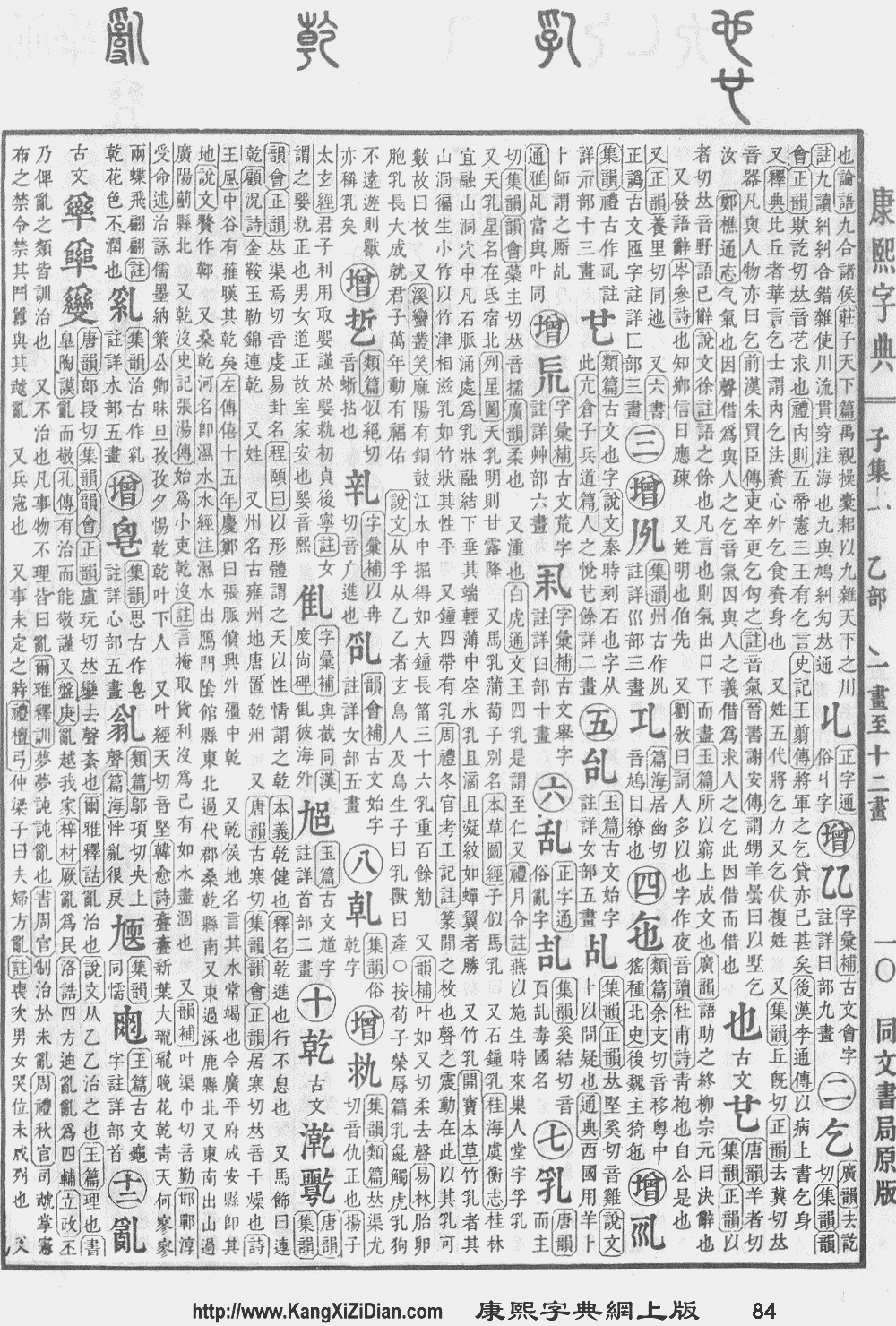
- KangXi: page 84, character 4
- Dai Kanwa Jiten: character 171
- Dae Jaweon: page 170, character 4
- Hanyu Da Zidian (first edition): volume 1, page 50, character 5
- Unihan data for U+4E5F
Chinese
| trad. | 也 | |
|---|---|---|
| simp. # | 也 | |
| alternative forms | ||
Glyph origin
| Historical forms of the character 也 | ||||||||||||||||
|---|---|---|---|---|---|---|---|---|---|---|---|---|---|---|---|---|
| Spring and Autumn | Warring States | Shuowen Jiezi (compiled in Han) | Liushutong (compiled in Ming) | |||||||||||||
| Bronze inscriptions | Chu slip and silk script | Small seal script | Transcribed ancient scripts | |||||||||||||
 |
 |
 |
 | |||||||||||||
|||
|
References: Mostly from Richard Sears' Chinese Etymology site (authorisation),
| ||||||||||||||||


| Old Chinese | |
|---|---|
| 他 | *l̥ʰaːl |
| 拖 | *l̥ʰaːl, *l̥ʰaːls |
| 駞 | *l'aːl |
| 池 | *l'aːl, *l'al |
| 灺 | *ljalʔ |
| 鍦 | *ɦljaːl, *hljal, *hljals |
| 虵 | *ɦljal, *laːlʔ, *lal |
| 也 | *laːlʔ |
| 忚 | *hleːl |
| 髢 | *l'eːls |
| 杝 | *l̥ʰalʔ, *l'alʔ, *lal |
| 肔 | *l̥ʰalʔ, *lalʔ |
| 馳 | *l'al |
| 阤 | *l'alʔ, *hljalʔ |
| 施 | *hljal, *hljals |
| 絁 | *hljal |
| 葹 | *hljal |
| 弛 | *hljalʔ |
| 箷 | *lal |
| 衪 | *lel, *lalʔ |
| 暆 | *lel |
| 迆 | *lal, *lalʔ |
| 酏 | *lal, *lalʔ |
| 匜 | *lal, *lalʔ |
| 迤 | *lalʔ |
| 扡 | *lalʔ |
| 崺 | *lalʔ |
| 貤 | *lals, *ɦljels, *lels |
| 地 | *l'els |
Uncertain. There are various possible explanations:
- The traditional glyph origin given in Shuowen explains the character to be a pictogram (象形) of female genitalia.
- It is possibly a pictogram (象形) of an ancient funnel or wash basin. It may be an early form of 匜.
- It was once interchangeable with 它 and may have originated as a simplification.
- It may have been created to represent the modal particle (語氣詞/语气词 (yǔqìcí)). In some bronze inscriptions, it appears to be a mouth (口) with a curved line descending from it to represent air coming out of the mouth.
- It may have signified a big-headed scorpion with its legs flattened, signifying as something very "flat" or "stretched out".
Etymology
Unclear. Possibly Sino-Tibetan, connectable to Tibetan ལ (la), which is often used as a marker (for oblique locative, dative, possessor in constructions with a copula verb, etc.) but also a topicalizer like ནི (ni, “as for”) (Schuessler, 2007).
Pronunciation
Definitions
也
- also; too; as well; (in negative sentences) neither; either
- Used for emphasis.
- † An emphatic final particle of strong affirmation or identity; indeed.
- (Teochew) if
- a surname. Ye
Synonyms
| Variety | Location | Words |
|---|---|---|
| Classical Chinese | 亦 | |
| Formal (Written Standard Chinese) | 也 | |
| Mandarin | Beijing | 也 |
| Taiwan | 也 | |
| Jinan | 也 | |
| Xi'an | 也 | |
| Wuhan | 也 | |
| Chengdu | 也 | |
| Guilin | 也 | |
| Yangzhou | 也 | |
| Hefei | 也 | |
| Malaysia | 也 | |
| Singapore | 也 | |
| Cantonese | Guangzhou | 都, 亦 |
| Hong Kong | 都, 亦, 亦都 | |
| Macau | 都, 亦 formal | |
| Zhongshan (Shiqi) | 都, 也 | |
| Taishan | 亦 | |
| Kaiping (Chikan) | 亦, 都, 亦都 | |
| Yangjiang | 也 | |
| Kuala Lumpur (Guangfu) | 都 | |
| Singapore (Guangfu) | 都, 亦都 | |
| Gan | Nanchang | 也 |
| Hakka | Meixian | 也 |
| Wuhua (Meilin) | 也 | |
| Miaoli (N. Sixian) | 乜 | |
| Pingtung (Neipu; S. Sixian) | 乜, 也 | |
| Hsinchu County (Zhudong; Hailu) | 乜 | |
| Taichung (Dongshi; Dabu) | 乜 | |
| Hsinchu County (Qionglin; Raoping) | 乜 | |
| Yunlin (Lunbei; Zhao'an) | 嘛 | |
| Kuching (Hepo) | 呠 | |
| Huizhou | Jixi | 也 |
| Jin | Taiyuan | 也 |
| Min Bei | Jian'ou | 也 |
| Min Dong | Fuzhou | 也 |
| Min Nan | Xiamen | 也, 嘛 |
| Quanzhou | 也, 嘛 | |
| Zhangzhou | 也, 嘛 | |
| Taipei | 也, 嘛 | |
| Penang (Hokkien) | 呠 | |
| Singapore (Hokkien) | 也, 呠, 嘛 | |
| Manila (Hokkien) | 也, 嘛 | |
| Chaozhou | 也 | |
| Shantou | 也 | |
| Jieyang | 也 | |
| Singapore (Teochew) | 呠, 也, 嘛 | |
| Pontianak (Teochew) | 也 | |
| Wenchang | 也 | |
| Wu | Shanghai | 也 |
| Suzhou | 亦 | |
| Wenzhou | 也 | |
| Xiang | Changsha | 也 |
| Shuangfeng | 也 | |
Compounds
|
Japanese
Readings
As an alternative form of 迆:
Etymology 1
| Kanji in this term |
|---|
| 也 |
| なり Jinmeiyō |
| kun’yomi |
Glyph origin
Orthographic borrowing from Literary Chinese 也 (copula).
Definitions
| For pronunciation and definitions of 也 – see the following entry. | ||
| ||
| (This term, 也, is an alternative (terminal form) spelling of the above term.) |
Etymology 2
| Kanji in this term |
|---|
| 也 |
| また Jinmeiyō |
| kun’yomi |
Korean
Hanja
- This term needs a translation to English. Please help out and add a translation, then remove the text
{{rfdef}}.
- This term needs a translation to English. Please help out and add a translation, then remove the text
{{rfdef}}.
也 (eumhun 잇달을 야 (itdareul ya))
- This term needs a translation to English. Please help out and add a translation, then remove the text
{{rfdef}}.
Vietnamese
Han character
也: Hán Việt readings: giã, dã
也: Nôm readings: dạ, dã, giã, rã
- This term needs a translation to English. Please help out and add a translation, then remove the text
{{rfdef}}.
References
- Hồ Lê (1976). Bảng Tra Chữ Nôm. Hanoi: Viện Ngôn Ngữ Học.
- Nguyễn, Quang Hồng (2014). Tự Điển Chữ Nôm Dẫn Giải (Nôm Characters with Quotations and Annotations). Hanoi: Nhà xuất bản Khoa học Xã hội (Social Sciences Publishing House).
- Williams, Noriko Kurosawa (2010). "The Key to Kanji". Boston: Cheng & Tsui Company, Inc.