春
| ||||||||
Translingual
| Stroke order | |||
|---|---|---|---|
 | |||
| Stroke order | |||
|---|---|---|---|
 | |||
Alternative forms
There are minor differences in where the last stroke of the top component (top-left to bottom-right diagonal) starts – on the second horizontal stroke or on the third.
Han character
春 (Kangxi radical 72, 日+5, 9 strokes, cangjie input 手大日 (QKA), four-corner 50603, composition ⿱𡗗日)
Usage notes
- This character is not to be confused with 舂 (
U+8202) which is visually similar but unrelated.
Derived characters
References
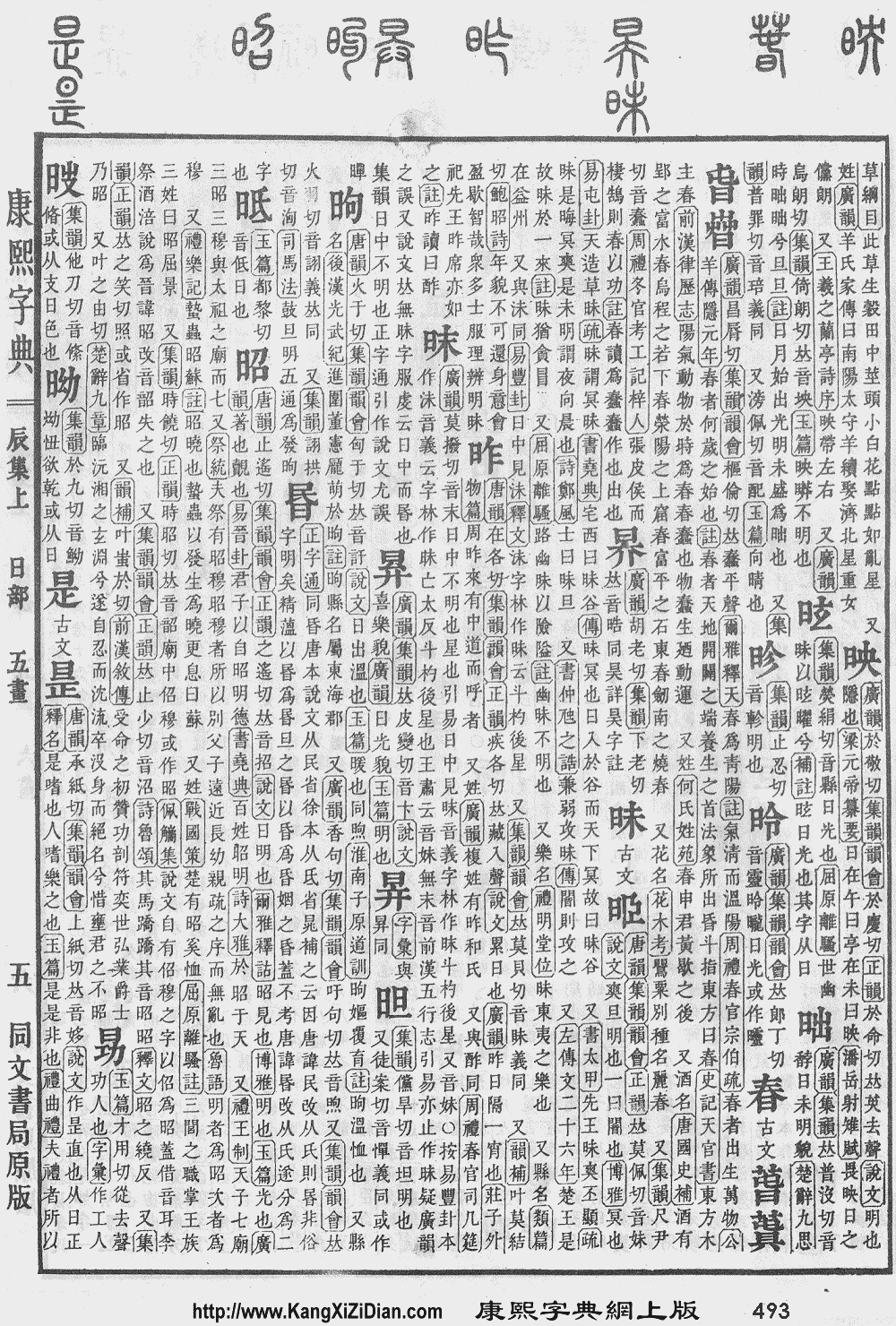
- KangXi: page 493, character 6
- Dai Kanwa Jiten: character 13844
- Dae Jaweon: page 856, character 7
- Hanyu Da Zidian (first edition): volume 2, page 1496, character 10
- Unihan data for U+6625
Chinese
Glyph origin
| Historical forms of the character 春 | ||||
|---|---|---|---|---|
| Shang | Spring and Autumn | Warring States | Shuowen Jiezi (compiled in Han) | Liushutong (compiled in Ming) |
| Oracle bone script | Bronze inscriptions | Chu slip and silk script | Small seal script | Transcribed ancient scripts |
 |
 |
 |
 |
 |
| Old Chinese | |
|---|---|
| 躉 | *tuːnʔ |
| 窀 | *rduːn, *duːn, *tun |
| 沌 | *donʔ, *duːn, *duːnʔ |
| 盹 | *tuːnʔ, *tjuns |
| 頓 | *tuːns |
| 扽 | *tuːns |
| 黗 | *tʰuːn, *tʰuːnʔ |
| 吨 | *tʰuːnʔ |
| 屯 | *duːn, *tun |
| 飩 | *duːn |
| 豘 | *duːn |
| 軘 | *duːn |
| 坉 | *duːn |
| 邨 | *duːn, *stʰuːn |
| 忳 | *duːn |
| 芚 | *duːn |
| 庉 | *duːn, *duːnʔ |
| 囤 | *duːnʔ |
| 迍 | *tun |
| 杶 | *tʰun |
| 瑃 | *tʰun |
| 椿 | *tʰun |
| 偆 | *tʰunʔ, *tʰjunʔ |
| 肫 | *tjun |
| 訰 | *tjun, *tjuns |
| 純 | *tjunʔ, *djun |
| 春 | *tʰjun |
| 蠢 | *tʰjunʔ |
| 踳 | *tʰjunʔ |
| 惷 | *tʰjunʔ |
| 蒓 | *djun |
| 賰 | *hljunʔ |
| 鬊 | *hljuns |
Originally phono-semantic compound (形聲, OC *tʰjun) : semantic 艸 (“grass”) + phonetic 屯 (OC *duːn, *tun, “sprout”) + semantic 日 (“sun”). Later 艸 and 屯 merged into 𡗗.
The character 春 itself is probably a variant of 屯 (OC *duːn, *tun) as they are equivalent for the meaning “spring” in Old Chinese literature.
Etymology 1
| simp. and trad. |
春 | |
|---|---|---|
| alternative forms | 萅 旾 㫩 𣈤 | |
Related to 芚 (OC *duːn, “(of plants) to begin to grow”) (Schuessler, 2007). Also compare Khmer ដុះ (doh, “to grow; to germinate; to sprout”), as well as 穿 (OC *kʰljon, *kʰljons, “to bore through”) (ibid.).
Pronunciation
Definitions
春
- spring (season)
- (literary) year; age
- spring scenery
- vitality; liveliness; energy; life
- 妙手回春 ― miàoshǒuhuíchūn ― to effect a miraculous cure and bring the dying back to life
- love; lust
- 春情 ― chūnqíng ― amorous feelings
- 思春期 ― sīchūnqī ― puberty
- 有女懷春,吉士誘之。 [Pre-Classical Chinese, trad.]
- From: The Classic of Poetry, c. 11th – 7th centuries BCE, translated based on James Legge's version
- Yǒu nǚ huái chūn, jíshì yòu zhī. [Pinyin]
- There is a young lady with thoughts natural to the spring,
And a fine gentleman would lead her astray.
有女怀春,吉士诱之。 [Pre-Classical Chinese, simp.]
- a type of alcoholic drink which is fermented from spring to winter
See also
| Seasons in Chinese · 四季 (sìjì, “four seasons”) (layout · text) · category | |||
|---|---|---|---|
| 春 (chūn, “spring”) | 夏 (xià, “summer”) | 秋 (qiū, “fall; autumn”) | 冬 (dōng, “winter”) |
Compounds
|
|
|
Descendants
Etymology 2
| simp. and trad. |
春 | |
|---|---|---|
| alternative forms | 膥 | |
Possibly from Proto-Sino-Tibetan *d(w)əj (“egg; testicle”) (Baxter and Sagart, 2014).
Pronunciation
Definitions
春
Synonyms
References
- “春”, in 漢語多功能字庫 (Multi-function Chinese Character Database), 香港中文大學 (the Chinese University of Hong Kong), 2014–
Japanese
Compounds
- 小春 (koharu, “early autumn, Indian summer”)
- 小春日和 (koharubiyori, “early autumn, Indian summer”)
- 常春 (tokoharu, “everlasting spring”)
- 初春 (hatsuharu), 初春 (shoshun, “early spring, New Year”)
- 春菊 (shungiku, “garland chrysanthemum”)
- 春秋 (shunjū, “spring and autumn, months and years, Chronicles of Lu”)
- 春秋戦国 (shunjūsengoku, “Spring and Autumn Period and Warring States Period in China”)
- 春一番 (haruichiban, “first storm of spring”)
- 春風 (harukaze, “spring breeze”)
- 春霞 (harugasumi, “springtime haze”)
- 春着 (harugi, “springwear, New Year's clothes”)
- 春蚕 (harugo, “spring breed of silkworms”)
- 春先 (harusaki, “beginning of spring”)
- 春雨 (harusame, “spring rain, cellophane noodles”)
- 春場所 (harubasho, “the spring sumo tournament in Osaka”)
- 春繭 (harumayu, “the spring cocoon crop”)
- 春休み (haruyasumi, “spring break”)
- 来春 (raishun, “next spring”)
- 翌春 (yokushun, “next spring”)
- 春分 (shunbun, “spring equinox, vernal equinox”)
Coordinate terms
| Seasons in Japanese · 四季 (shiki, “four seasons”) (layout · text) · category | |||
|---|---|---|---|
| 春 (haru, “spring”) 春季 (shunki, “spring”) 春期 (shunki, “spring period”) |
夏 (natsu, “summer”) 夏季 (kaki, “summer”) 夏期 (kaki, “summer period”) |
秋 (aki, “fall; autumn”) 秋季 (shūki, “fall; autumn”) 秋期 (shūki, “fall period”) |
冬 (fuyu, “winter”) 冬季 (tōki, “winter”) 冬期 (tōki, “winter period”) |
Derived terms
- 春めく (harumeku)
Korean
Etymology
From Middle Chinese 春 (MC t͡ɕʰiuɪn).
| Historical Readings | ||
|---|---|---|
| Dongguk Jeongun Reading | ||
| Dongguk Jeongun, 1448 | 츈 (Yale: chyùn) | |
| Middle Korean | ||
| Text | Eumhun | |
| Gloss (hun) | Reading | |
| Hunmong Jahoe, 1527 | 봄〮 (Yale: pwóm) | 츈 (Yale: chyùn) |
Pronunciation
- (SK Standard/Seoul) IPA(key): [t͡ɕʰun]
- Phonetic hangul: [춘]
Compounds
Vietnamese
Han character
春: Hán Việt readings: xuân (
春: Nôm readings: xuân[1][2][5][4][6][7], xoan[1][2][3][4][7]
Compounds
- 仲春 (trọng xuân)
- 回春 (hồi xuân)
- 孟春 (mạnh xuân)
- 新春 (tân xuân)
- 春亭 (xuân đình)
- 春分 (xuân phân)
- 春夏秋冬 (xuân hạ thu đông)
- 春山 (xuân sơn)
- 春桃 (xuân đào)
- 春秋 (xuân thu)
- 立春 (lập xuân)
- 賞春 (thưởng xuân)
- 迎春 (nghênh xuân)
- 遊春 (du xuân)
- 開春 (khai xuân)
- 青春 (thanh xuân)
References
- Nguyễn (2014).
- Nguyễn et al. (2009).
- Trần (2004).
- Bonet (1899).
- Hồ (1976).
- Génibrel (1898).
- Taberd & Pigneau de Béhaine (1838).