毛
| ||||||||
| ||||||||
Translingual
| Stroke order | |||
|---|---|---|---|
 | |||
| Stroke order | |||
|---|---|---|---|
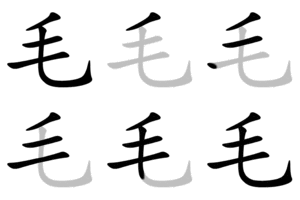 | |||
Han character
毛 (Kangxi radical 82, 毛+0, 4 strokes, cangjie input 竹手山 (HQU), four-corner 20714)
Derived characters
References
- KangXi: page 591, character 22
- Dai Kanwa Jiten: character 16772
- Dae Jaweon: page 983, character 26
- Hanyu Da Zidian (first edition): volume 3, page 1994, character 1
- Unihan data for U+6BDB

Chinese
| simp. and trad. |
毛 | |
|---|---|---|
Glyph origin
| Historical forms of the character 毛 | |||
|---|---|---|---|
| Western Zhou | Warring States | Shuowen Jiezi (compiled in Han) | Liushutong (compiled in Ming) |
| Bronze inscriptions | Chu slip and silk script | Small seal script | Transcribed ancient scripts |
 |
 |
 |
 |
Pictogram (象形) – feather or hair.
Etymology
From Proto-Sino-Tibetan *s/r-m(u/i/ja)l (“hair; fur; feather”); related to 眉 (OC *mril, “eyebrow”) and cognate with Manipuri [script needed] (mun, “pubic hair”), Garo খিমিল (khimil, “hair; fur”), Proto-Lolo-Burmese *ʔ-məw¹ (“body hair”) (STEDT; Schuessler, 2007).
Pronunciation
Definitions
毛
- hair (of humans or animals); fur; feather (Classifier: 根 m; 條/条 c)
- (dialectal) hair on the head
- mildew; mold
- (colloquial) jiao; one tenth of a yuan or dollar; ten cents; dime
- coarse; raw; semifinished
- 毛茶 ― máochá ― raw tea
- gross
- rough; sketchy
- 毛估 ― máogū ― to make a rough estimate
- small; little
- careless; unthinking
- 毛手毛腳/毛手毛脚 ― máoshǒumáojiǎo ― to be careless
- panicked; scared; nervous
- angry; furious
- (of currency) depreciated
- (Mainland China, colloquial or slang) no; nothing; damn all; my ass
- (Cantonese, colloquial, always with the classifier) nothing; damn all; jack shit; bugger all (Classifier: 條/条)
- (ACG) hair (in unnatural colours)
- 白毛 ― bái máo ― [the character] with white-coloured hair
- 假毛 ― jiǎmáo ― wig
- a surname
- 毛澤東/毛泽东 ― Máo Zédōng ― Mao Zedong (Mao Tse-tung), founder of the People's Republic of China
Synonyms
- (hair on the head):
- (jiao):
Compounds
|
|
|
Descendants
References
- “毛”, in 漢語多功能字庫 (Multi-function Chinese Character Database), 香港中文大學 (the Chinese University of Hong Kong), 2014–
Japanese
Readings
Etymology 1
| Kanji in this term |
|---|
| 毛 |
| け Grade: 2 |
| kun’yomi |
From Old Japanese. First attested in the Nihon Shoki of 720 CE.[1] Ultimately from Proto-Japonic *kay.
Appears in compounds from the Man'yōshū completed sometime around 759 CE with the reading ⟨ka⟩, seen in 白髪 (shiraga, “white hair”)[1][2] and 鬘 (katsura, “wig”, from "hair vine", possibly in reference to how they are made).[1][3] This analysis suggests an ancient bound form *⟨ka⟩, changing to ⟨ke2⟩, perhaps by fusion of emphatic nominal particle い (i), seen in nouns such as 神 (kami, “god”, from kamu + i) and 目 (me, “eye”, from ma + i):
*/ka.i/ → */kai/ → ⟨ke2⟩ → */kəɨ/ → /ke/
Cognate with Proto-Ryukyuan *ke (“hair, fur”).
Compare also:
- Proto-Indo-European *kes- (“to scrape, comb”), Proto-Indo-Iranian *káyćas (“hair”), Sanskrit केश (keśa, “hair”)
- Proto-Tai *q.pɯlᴬ (“body hair; feather”), Thai ขน (kǒn, “body hair, fur, feather”)
- Proto-Turkic *kïl (“hair”)
References
- 1988, 国語大辞典(新装版) (Kokugo Dai Jiten, Revised Edition) (in Japanese), Tōkyō: Shogakukan
- “白髪”, in 日本国語大辞典 (Nihon Kokugo Daijiten, “Nihon Kokugo Daijiten”) (in Japanese), 2nd edition, Tōkyō: Shogakukan, 2000, →ISBN
- “鬘”, in 日本国語大辞典 (Nihon Kokugo Daijiten, “Nihon Kokugo Daijiten”) (in Japanese), 2nd edition, Tōkyō: Shogakukan, 2000, →ISBN
- 2006, 大辞林 (Daijirin), Third Edition (in Japanese), Tōkyō: Sanseidō, →ISBN
- 1998, NHK日本語発音アクセント辞典 (NHK Japanese Pronunciation Accent Dictionary) (in Japanese), Tōkyō: NHK, →ISBN
Okinawan
Etymology
From Proto-Ryukyuan *ke, from Proto-Japonic *kay. Cognate with Japanese 毛 (ke).