所
| ||||||||
Translingual
| Stroke order | |||
|---|---|---|---|
 | |||
| Stroke order (Japan) | |||
|---|---|---|---|
 | |||
| Stroke order | |||
|---|---|---|---|
 | |||
| Japanese | 所 |
|---|---|
| Simplified | 所 |
| Traditional | 所 |
Alternative forms
Note different composition due to different forms of 戶, namely 户 (in some Japanese fonts more resembles 戸).
Han character
所 (Kangxi radical 63, 戶+4, 8 strokes, cangjie input 竹尸竹一中 (HSHML), four-corner 72221, composition ⿰戶斤 (GTK) or ⿰戸斤(J))
Descendants
References
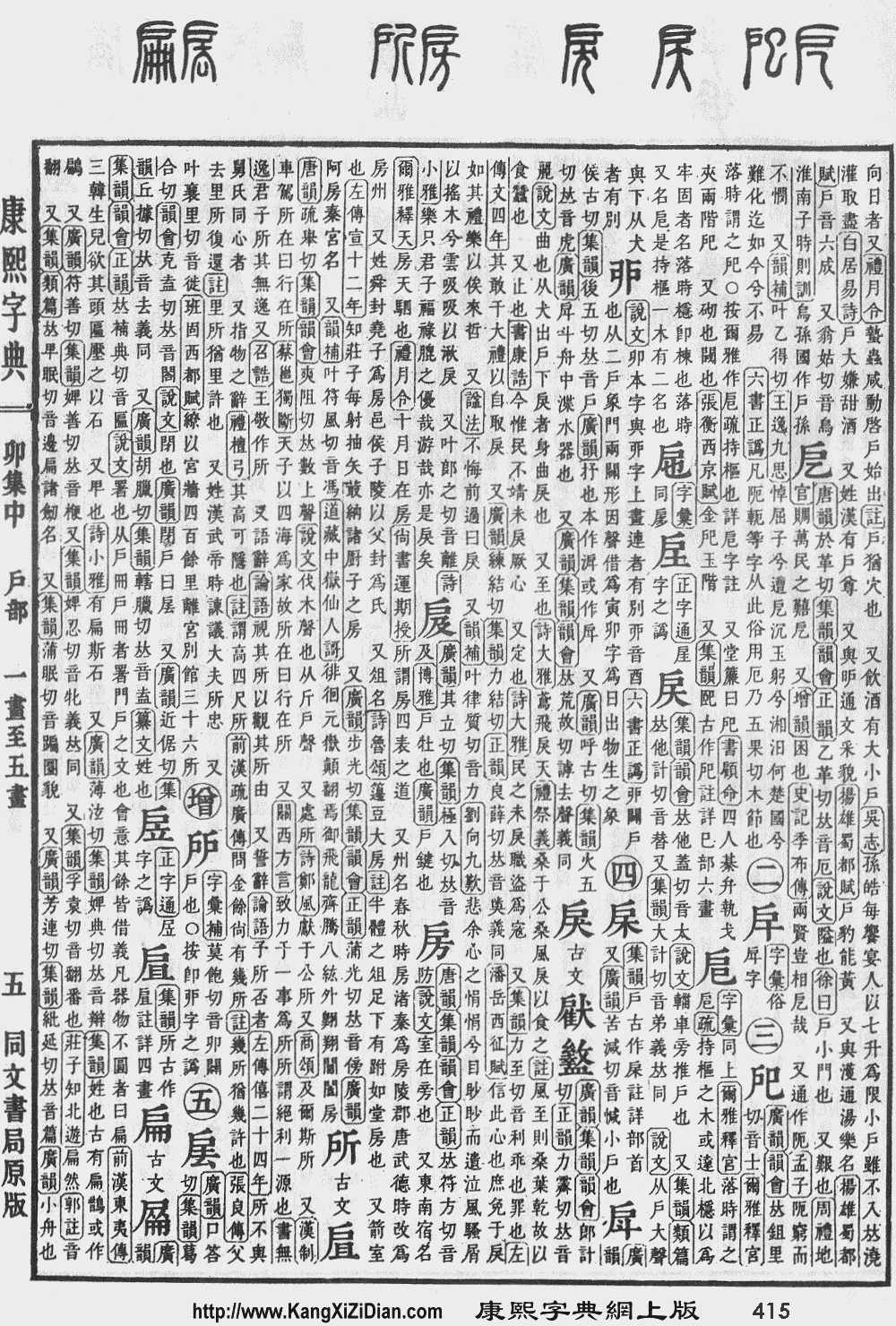
- KangXi: page 415, character 16
- Dai Kanwa Jiten: character 11715
- Dae Jaweon: page 760, character 2
- Hanyu Da Zidian (first edition): volume 3, page 2259, character 1
- Unihan data for U+6240
Chinese
| simp. and trad. |
所 | |
|---|---|---|
| alternative forms | 㪽 𫝂 𠩄 | |
Glyph origin
Phono-semantic compound (形聲, OC *sqʰraʔ) : phonetic 戶 (OC *ɡʷaːʔ) + semantic 斤 (“axe”) – the sound of logging (the definition given in Shuowen).
Pronunciation
Definitions
所
- (in compounds) place; location
- (in compounds) establishment for a particular function
- Short for 研究所 (yánjiūsuǒ, “research institute; graduate school”).
- 病毒所 ― bìngdú suǒ ― institute of virology
- Classifier for buildings, schools, hospitals, etc. ⇒ all nouns using this classifier
- Prefix attached to verbs to form noun phrases, indicating the patient of the verb, similar to a passive participle.
- 所以 ― suǒyǐ ― what one uses; what one relies on; means > the reason why > therefore
- 所得 ― suǒdé ― income (literally, "what is gained")
- 所見即所得/所见即所得 ― suǒjiànjísuǒdé ― what you see is what you get
- 所長/所长 ― suǒcháng ― forte (what one is good at)
- 無所謂/无所谓 ― wúsuǒwèi ― to be irrelevant (literally, "to not [have or be] what one can refer to [as]")
- 你所用的電腦/你所用的电脑 ― nǐ suǒ yòng de diànnǎo ― the computer used by you
- 不知所云 ― bùzhī suǒ yún ― do not know what is said
- 所見異辭,所聞異辭,所傳聞異辭。 [Classical Chinese, trad.]
- From: Commentary of Gongyang, c. 206 BCE– 9 CE
- Suǒ jiàn yì cí, suǒ wén yì cí, suǒ chuánwén yì cí. [Pinyin]
- Different phrasings were applied to what was witnessed, what was learned, and what was transmitted via tradition.
所见异辞,所闻异辞,所传闻异辞。 [Classical Chinese, simp.]- 西伯將出獵,卜之,曰「所獲非龍非彨非虎非羆;所獲霸王之輔」。 [Classical Chinese, trad.]
- From: The Records of the Grand Historian, by Sima Qian, c. 91 BCE
- Xībó jiāng chū liè, bǔ zhī, yuē “suǒhuò fēi lóng fēi chī fēi hǔ fēi pí; suǒhuò bàwáng zhī fǔ.” [Pinyin]
- The Western Count, about to go out on a hunt, divined it; it is said: "What will be caught will be neither horned dragon, nor hornless dragon, nor tiger, nor brown bear. Who will be gained will be an aide to hegemons and kings."
西伯将出猎,卜之,曰“所获非龙非彨非虎非罴;所获霸王之辅”。 [Classical Chinese, simp.]
- Used in the construction 為……所…… to form the passive voice.
Compounds
|
|
|
Japanese
| Shinjitai | 所 | |
| Kyūjitai [1] |
所󠄁 所+ 󠄁?(Adobe-Japan1) |
 |
| 所󠄃 所+ 󠄃?(Hanyo-Denshi) (Moji_Joho) | ||
| The displayed kanji may be different from the image due to your environment. See here for details. | ||
Readings
Compounds
- 一所懸命 (isshokenmei)
- 近所 (kinjo)
- 住所 (jūsho)
- 便所 (benjo)
- 所為 (shoi)
- 所感 (shokan)
- 所管 (shokan)
- 所見 (shoken)
- 所作 (shosa)
- 所在 (shozai)
- 所在地 (shozaichi)
- 所在 (shozai)
- 所持 (shoji)
- 所属 (shozoku)
- 所存 (shozon)
- 所帯 (shotai)
- 所得 (shotoku)
- 所得税 (shotokuzei)
- 所有物 (shoyūbutsu)
- 所有者 (shoyūsha)
- 所有 (shoyū)
- 所有権 (shoyūken)
- 所謂 (iwayuru)
- 適材適所 (tekizaitekisho)
- 場所 (basho)
- 所以 (yuen)
- 所有制 (shoyūsei)
- 所有主 (shoyūnushi)
Pronunciation
- IPA(key): [ɕo̞]
Derived terms
Etymology 2
| Kanji in this term |
|---|
| 所 |
| ところ Grade: 3 |
| kun’yomi |
| Alternative spelling |
|---|
| 処 |
⟨to2ko2ro2⟩ → /tokoro/
From Old Japanese. First attested in the Kojiki of 712 CE.[2] From Proto-Japonic *təkərə.
A surface analysis suggests that this could be an ancient compound of ⟨to2⟩ (“place”, as in 跡 ⟨ato2⟩, “footprint, track”, from “foot place, where one has stepped”) + ⟨ko2⟩ (noun-forming suffixing element denoting “place”, as in ここ ⟨ko2ko2⟩, “here”, from “this place”) + ⟨ro2⟩ (noun-forming suffixing element, apparently indicating within a general area, possibly as in 心 ⟨ko2ko2ro2⟩, “heart, mind, emotions”, 頃 ⟨ko2ro2⟩, “general span of time, around a certain time”, うつろ ⟨uturo2⟩, “hollowness, empty interior”).
Pronunciation
- (Tokyo) ところ [tòkóró] (Heiban – [0])[3][4][5]
- (Tokyo) ところ [tòkóróꜜ] (Odaka – [3])[4][5]
- IPA(key): [to̞ko̞ɾo̞]
The odaka version is used when:
- it is preceded by a modifier, such as in 山田さんの所に (Yamada-san no tokoro ni, “at Yamada-san's place”)
- it appears as a grammatical element, such as in ところが (tokoro ga, “however”) or ところで (tokoro de, “by the way”)
Noun
所 • (tokoro)
- a place, a scene, a site; an address
- 遠い所に行ってみたい。
- Tōi tokoro ni itte mitai.
- I want to go to a faraway place.
- あの窓のところにいる人は誰?
- Ano mado no tokoro ni iru hito wa dare?
- Who is the person by that window?
- 嫌なところを直す
- iya na tokoro o naosu
- to change the unpleasant part/aspect (of one's personality)
- 遠い所に行ってみたい。
- a state of being
- (after a plain verb) about to
- 映画を見に行くところだった。
- Eiga o mi ni iku tokoro datta.
- I was about to go to a movie.
- 忘れるところだった。
- Wasureru tokoro datta.
- I was on the brink of forgetting.
- 映画を見に行くところだった。
- (after a verb in the past tense) just
- 駅に着いたところです。
- Eki ni tsuita tokoro desu.
- I just arrived at the station.
- 駅に着いたところです。
- (after a verb in the progressive ている) indicates the current state, or how you have progressed so far in a chain of actions
- (after a verb in the past tense) at that point in time, upon
- (after a plain verb) about to
- (literary, calque of Literary Chinese 所) Attaches to verbs to form noun phrases, meaning the object of that verb.
Derived terms
- 所で (tokoro de): by the way, incidentally
- 所々 (tokorodokoro), 所所 (tokorodokoro), 処々 (tokorodokoro), 処処 (tokorodokoro): here and there
- 所へ (tokoro e): thereupon
- 所もある (tokoro mo aru): some, sometimes
- 国所 (kunitokoro): country of birth, birthplace
Etymology 3
| Kanji in this term |
|---|
| 所 |
| とこ Grade: 3 |
| kun’yomi |
Listed in some sources as an abbreviation of tokoro above.[6][3][7] However, this is also listed as cognate with 床 (toko, “raised area; bed”),[6] which term already appears in use as far back as the Man'yōshū (c. 759 CE), one of the oldest Japanese texts.[8]
Alternative forms
Pronunciation
Etymology 4
| Kanji in this term |
|---|
| 所 |
| と Grade: 3 |
| kun’yomi |
⟨to2⟩ → /*tə/ → /to/
From Old Japanese, from Proto-Japonic *tə. Appears mainly as an affixing element indicating place, as in 後 (ato, “after; behind; the back of something”), from 跡 (ato, “footprint, track”), itself a compound of 足 (a, “foot”) + 所 (to, “place”); or in 留まる (todomaru, “to stop in a place”), itself a compound of と (to, “place”) + とまる (tomaru, “to stop”).
In modern Japanese references,[6][3] there are various compound terms ending in -to or -do that are spelled and / or described as deriving from this 所 (to, “place”), including 隈所 (kumato, “a bent and twisted place, such as a tunnel, out of sight”), 立ち所 (tachido, “standing place”), 竈 (kamado, “kiln”). However, a historical analysis reveals that many of these terms do not derive from 所, 処 ⟨to2⟩ “place”, but rather from 戸, 門 ⟨to1⟩ “gate, door, place of entry and exit”.
Alternative forms
Pronunciation
- IPA(key): [to̞]
Derived terms
References
- “所”, in 漢字ぺディア (Kanjipedia) (in Japanese), 日本漢字能力検定協会, 2015—2023
- “所・処”, in 日本国語大辞典 (Nihon Kokugo Daijiten, “Nihon Kokugo Daijiten”) (in Japanese), 2nd edition, Tōkyō: Shogakukan, 2000, →ISBN
- 2006, 大辞林 (Daijirin), Third Edition (in Japanese), Tōkyō: Sanseidō, →ISBN
- 1998, NHK日本語発音アクセント辞典 (NHK Japanese Pronunciation Accent Dictionary) (in Japanese), Tōkyō: NHK, →ISBN
- 1997, 新明解国語辞典 (Shin Meikai Kokugo Jiten), Fifth Edition (in Japanese), Tōkyō: Sanseidō, →ISBN
- 1988, 国語大辞典(新装版) (Kokugo Dai Jiten, Revised Edition) (in Japanese), Tōkyō: Shogakukan
- 1995, 大辞泉 (Daijisen) (in Japanese), Tōkyō: Shogakukan, →ISBN
- c. 759, Man'yōshū (book 14, poem 3554), text here
Korean
Okinawan
Compounds
- ゴルフ所 (ゴルフじゅ, gorufuju, “golf course”)
- スキー所 (スキーじゅ, sukīju, “ski field”)
- 所間 (とぅくま, tukuma, “place, location, area, space, room”)