良
| ||||||||
| ||||||||
Translingual
| Stroke order | |||
|---|---|---|---|
 | |||
Han character
良 (Kangxi radical 138, 艮+1, 7 strokes, cangjie input 戈日女 (IAV), four-corner 30732, composition ⿱丶艮(GHT) or ⿱丨艮(JK) or ⿱一艮(V))
Derived characters
References
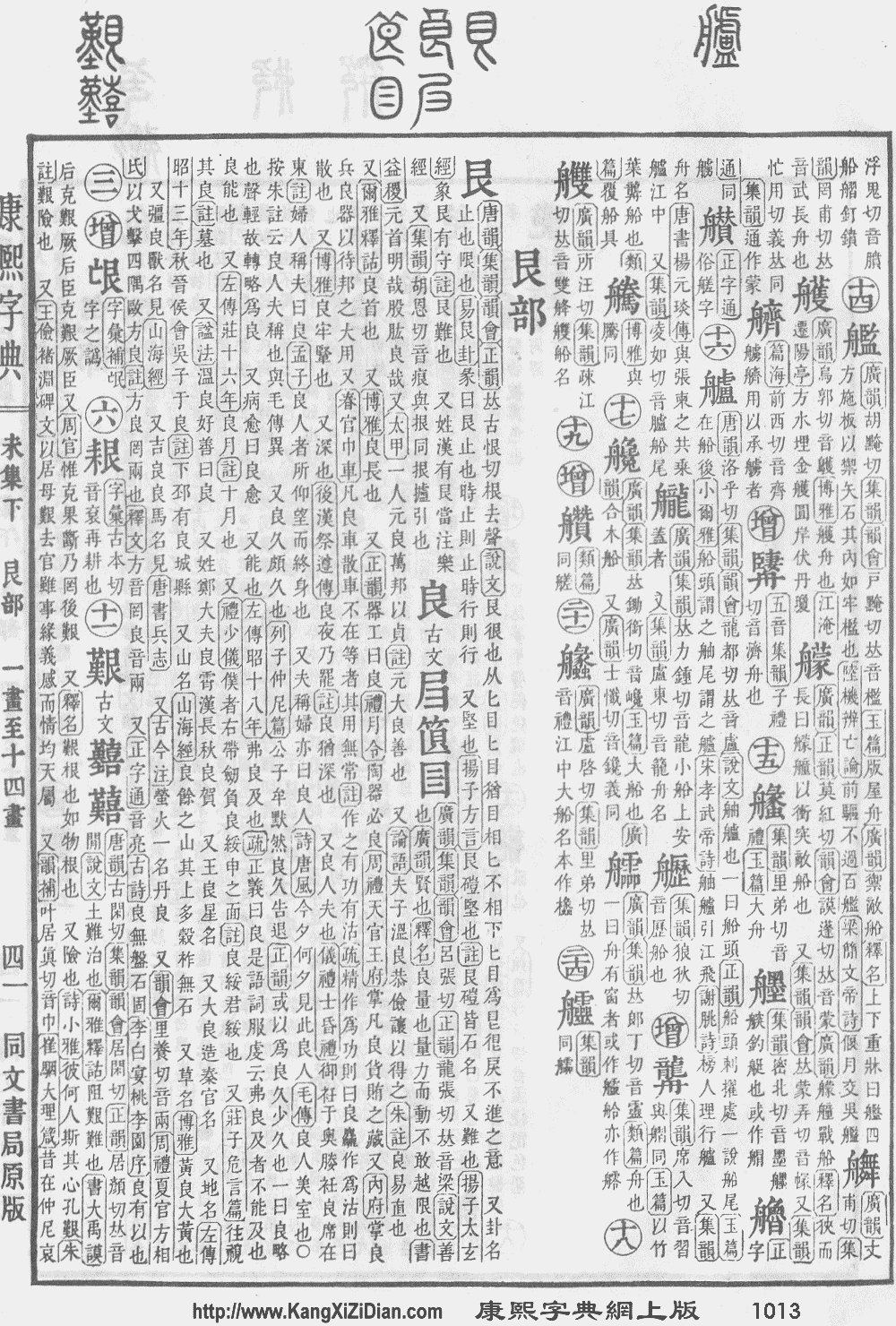
- KangXi: page 1013, character 23
- Dai Kanwa Jiten: character 30597
- Dae Jaweon: page 1472, character 16
- Hanyu Da Zidian (first edition): volume 5, page 3170, character 2
- Unihan data for U+826F
- Unihan data for U+F97C
Chinese
| simp. and trad. |
良 | |
|---|---|---|
| alternative forms | ||
Glyph origin
| Historical forms of the character 良 | ||||
|---|---|---|---|---|
| Shang | Western Zhou | Warring States | Shuowen Jiezi (compiled in Han) | Liushutong (compiled in Ming) |
| Oracle bone script | Bronze inscriptions | Chu slip and silk script | Small seal script | Transcribed ancient scripts |
 |
 |
 |
 |
 |
Characters in the same phonetic series (良) (Zhengzhang, 2003)
| Old Chinese | |
|---|---|
| 剆 | *raːl, *raːlʔ |
| 郎 | *raːŋ |
| 稂 | *raːŋ |
| 桹 | *raːŋ |
| 鋃 | *raːŋ |
| 硠 | *raːŋ |
| 浪 | *raːŋ, *raːŋs |
| 蜋 | *raːŋ, *raŋ |
| 琅 | *raːŋ |
| 狼 | *raːŋ |
| 欴 | *raːŋ |
| 踉 | *raːŋ, *raŋ, *raŋs |
| 莨 | *raːŋ, *raːŋs |
| 艆 | *raːŋ |
| 駺 | *raːŋ |
| 躴 | *raːŋ |
| 筤 | *raːŋ |
| 閬 | *raːŋ, *raːŋs |
| 哴 | *raːŋ, *raŋs |
| 蓈 | *raːŋ |
| 廊 | *raːŋ |
| 榔 | *raːŋ, *raːŋʔ |
| 螂 | *raːŋ |
| 瑯 | *raːŋ |
| 朗 | *raːŋʔ |
| 朖 | *raːŋʔ |
| 誏 | *raːŋʔ |
| 俍 | *raːŋʔ |
| 崀 | *raːŋʔ |
| 埌 | *raːŋs |
| 蒗 | *raːŋs |
| 娘 | *naŋ |
| 良 | *raŋ |
| 粮 | *raŋ |
| 悢 | *raŋs |
Pictogram (象形) . Possibly depicts corridors and a room, in which case it would be the original form of 廊.
Etymology
Possibly from Proto-Sino-Tibetan *l(j)a(k/ŋ) (“good, beautiful”).
Pronunciation 1
Definitions
良
Compounds
Derived terms from 良
|
|
|
Pronunciation 2
References
- (Min Nan) “Query for 良”, in 臺灣閩南語常用詞辭典 [Dictionary of Frequently-Used Taiwan Minnan], Ministry of Education, R.O.C., 2011.
- “良”, in 漢語多功能字庫 (Multi-function Chinese Character Database), 香港中文大學 (the Chinese University of Hong Kong), 2014–
Japanese
Readings
Compounds
- 良い (yoi), 良い (ii, “good, beneficial”)
- 良さ (yosa, “merit, virtue”)
- 良く (yoku, “well, much”)
- 良好 (ryōkō, “good, fine”)
- 良質 (ryōshitsu, “good quality”)
- 良否 (ryōhi, “quality”)
- 良心 (ryōshin, “conscience”)
- 良識 (ryōshiki, “good sense”)
- 良い男 (yoi otoko, “handsome man”)
- 良導体 (ryōdōtai, “good conductor”)
- 良い天気 (yoi tenki, “fair weather”)
- 良かったら (yokattara, “if you like”)
- 最良 (sairyō, “best, ideal”)
- 優良 (yūryō, “superior, excellent”)
- 改良 (kairyō, “improvement, reform”)
- 不良 (furyō, “badness, delinquency”)
- 善良 (zenryō, “goodness, excellence”)
- 野良 (nora, “the fields”)
- 純良品 (junryōbin, “genuine article”)
- 仲良し (nakayoshi, “intimacy, bosom buddy”)
- 読み良い (yomiyoi, “easy to read”)
- 気分が良い (kibun ga yoi, “feel good”)
- 健康に良い (kenkō ni yoi, “be good for the health”)
- 丁度良い時に (chōdo yoi toki ni, “none too soon”)
Etymology
| Kanji in this term |
|---|
| 良 |
| りょう Grade: 4 |
| kan’on |
Noun
Korean
Etymology
From Middle Chinese 良 (MC lɨɐŋ).
| Historical Readings | ||
|---|---|---|
| Dongguk Jeongun Reading | ||
| Dongguk Jeongun, 1448 | 랴ᇰ (Yale: lyàng) | |
| Middle Korean | ||
| Text | Eumhun | |
| Gloss (hun) | Reading | |
| Gwangju Cheonjamun, 1575 | 알 (Yale: al) | 량 (Yale: lyang) |
| Sinjeung Yuhap, 1576 | 어딜 (Yale: etil) | 량 (Yale: lyang) |
| Seokbong Cheonjamun, 1583 | 어딜 (Yale: etil) | 냥 (Yale: nyang) |
Pronunciation
- (SK Standard/Seoul) IPA(key): [ja̠ŋ] ~ [ɾja̠ŋ]
- Phonetic hangul: [양/량]
Old Korean
Particle
良 (*-a)
Usage notes
- First-millennium Old Korean also featured the locative particle 中 (*-kuy). The two particles were compounded as 良中 (*-a-kuy) as early as the seventh century. The compounded form becomes predominant in the corpus after the eleventh century, after which 良 (*-a) in isolation is not encountered. The compounded form eventually fused into a single morpheme, becoming the Middle Korean locative particle 에〮/애〮 (-éy/áy).
- After the fourteenth century, Korean scribes occasionally reused the character 良 (良) to write 에〮/애〮 (-éy/áy). This is a feature of Middle Korean writing, not Old Korean.
Descendants
See also
References
- 배대은 (Bae Dae-eun) (1996), “Idu cheogyeok josa-ui tongsijeok gochal [A diachronic study of locative case markers in Idu]”, in Baedalmal, volume 21, pages 139–156
- 이승재 (Lee Seung-jae) (2000), “Chaja pyogi jaryo-ui gyeokjosa yeon'gu [Study of case markers in the Chinese-based orthography [of Korean]]”, in Gugeo Gukmunhak, volume 127, pages 107–132
- Hwang Seon-yeop (2006). "Godae gugeo-ui cheogyeok josa" 고대국어의 처격조사] ["The locative case markers of Old Korean"]. Hanmal Yeon'gu Hakhoe Jeon'guk Haksul Daehoe (conference). Seongnam, South Korea. pp. 35–48.
- Nam Pung-hyun (2012), “Old Korean”, in The Languages of Japan and Korea, Routledge, →ISBN, pages 41–72
Vietnamese
This article is issued from Wiktionary. The text is licensed under Creative Commons - Attribution - Sharealike. Additional terms may apply for the media files.