車
| ||||||||
| ||||||||
| ||||||||
Translingual
| Stroke order | |||
|---|---|---|---|
 | |||
Han character
車 (Kangxi radical 159, 車+0, 7 strokes, cangjie input 十田十 (JWJ), four-corner 50006, composition ⿻亘丨 or ⿻二申)
- Kangxi radical #159, ⾞.
Derived characters
References
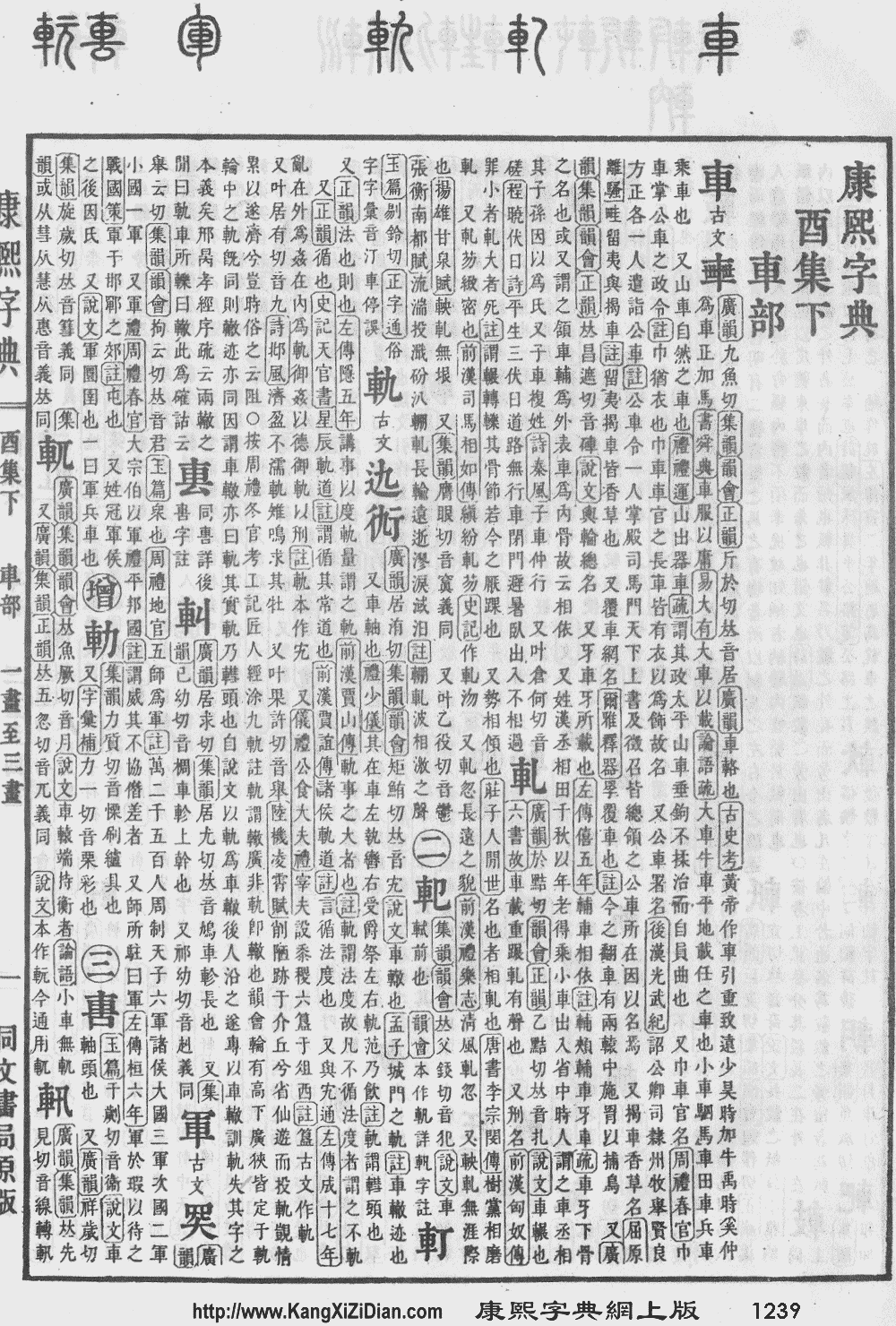
- KangXi: page 1239, character 1
- Dai Kanwa Jiten: character 38172
- Dae Jaweon: page 1712, character 34
- Hanyu Da Zidian (first edition): volume 5, page 3511, character 1
- Unihan data for U+8ECA
- Unihan data for U+F902
Chinese
| trad. | 車 | |
|---|---|---|
| simp. | 车 | |
Glyph origin
| Historical forms of the character 車 | |||||||||
|---|---|---|---|---|---|---|---|---|---|
| Shang | Western Zhou | Spring and Autumn | Warring States | Shuowen Jiezi (compiled in Han) | Liushutong (compiled in Ming) | ||||
| Bronze inscriptions | Oracle bone script | Bronze inscriptions | Bronze inscriptions | Bronze inscriptions | Chu slip and silk script | Qin slip script | Shizhoupian script | Small seal script | Transcribed ancient scripts |
 |
 |
 |
 |
 |
 |
 |
 |
 |
 |
Pictogram (象形) – originally a carriage seen from above. In the oracle bone script, there were large wheels on both sides and a sun shade on the top. Later, when Chinese characters were written vertically, the wheels on both sides were simply drawn in strokes and the loading area was marked with a 田 (OC *l'iːŋ). Therefore, it is important to understand that the current character, 車 (OC *kʰlja, *kla) is a vertical depiction of a carriage.
Note that 倝 (OC *kaːns) and 朝 (OC *ʔr'ew, *r'ew) are not derived from 車 (OC *kʰlja, *kla).
Etymology
Perhaps a loan from an Indo-European language because horse and chariot were introduced into China around 1200 BC from Inner Asia; compare Tocharian A kukäl, Tocharian B kokale (“wagon; cart”) (Mair, 1990; Bauer, 1994). An older variant survives in Mandarin 軲轆/轱辘 (gūlu, “wheel”) (Bauer, 1994). Alternatively, the word is a derivation by k-prefix from 舁 (OC *la, “to lift”) (Baxter and Sagart, 1998); compare the semantic parallel in Tibetan ཐེག་པ (theg pa, “vehicle; carriage”) (<to support; to carry; to lift).
Pronunciations 1 and 2 are cognate. A similar phonological doublet is 處 (OC *kʰljaʔ, *kʰljas) and 居 (OC *kas) (Schuessler, 2007). Pronunciation 2 is traditionally regarded as the older pronunciation.
Pronunciation 1
Definitions

車
- (countable) land wheeled vehicle; (specifically) car (Classifier: 輛/辆 m; 部 m c; 臺/台 m mn; 架 c; 頂/顶 mn; 張/张 mn-t)
- 有車隣隣,有馬白顛。 [Pre-Classical Chinese, trad.]
- From: The Classic of Poetry, c. 11th – 7th centuries BCE, translated based on James Legge's version
- Yǒu chē línlín, yǒu mǎ bái diān. [Pinyin]
- He has many carriages, giving forth their lin-lin;
He has horses with their white foreheads.
有车邻邻,有马白颠。 [Pre-Classical Chinese, simp.]- 阿Q被抬上了一輛沒有蓬的車,幾個短衣人物也和他同坐在一處。 [MSC, trad.]
- From: Lu Xun, 1922. The True Story of Ah Q (《阿Q正傳》)
- Āqiū bèi tái shàng le yī liàng méiyǒu péng de chē, jǐ ge duǎnyī rénwù yě hé tā tóng zuò zài yī chù. [Pinyin]
- Ah Q was lifted on to an uncovered cart, and several men in short jackets sat down with him.
阿Q被抬上了一辆没有蓬的车,几个短衣人物也和他同坐在一处。 [MSC, simp.]
- wheeled instrument
- machine; instrument (Classifier: 部 m; 臺/台 m)
- to lathe
- to lift water using a 水車/水车 (“old-style machine that is human or animal-powered and lifts water”)
- (dialectal, including Cantonese, Wu, Min Bei, Min Nan, Liuzhou Mandarin) to transport using a vehicle
- to tailor or sew using a sewing machine
- (dialectal) to turn (one's body, etc.)
- (Sichuanese) to rotate; to turn
- (Internet slang) pornography; lewd content
- Classifier for loads of things carried by a vehicle.
- a surname
Usage notes
Synonyms
- (vehicle):
Compounds
|
|
|
Pronunciation 2

Compounds
Descendants
Others:
See also
| Chess pieces in Chinese · 國際象棋棋子 (layout · text) | |||||
|---|---|---|---|---|---|
 |
 |
 |
 |
 |
 |
| 王 (wáng), 國王/国王 (guówáng) |
后 (hòu), 皇后 (huánghòu) |
車/车 (jū), 城堡 (chéngbǎo) |
象 (xiàng), 主教 (zhǔjiào) |
馬/马 (mǎ), 騎士/骑士 (qíshì) |
兵 (bīng) |
References
- “車”, in 漢語多功能字庫 (Multi-function Chinese Character Database), 香港中文大學/香港中文大学 (the Chinese University of Hong Kong), 2014–
- “Entry #3408”, in 臺灣閩南語常用詞辭典 [Dictionary of Frequently-Used Taiwan Minnan] (in Chinese and Min Nan), Ministry of Education, R.O.C., 2011.
Japanese
Readings
Affix
車 • (sha)
Etymology 2
| Kanji in this term |
|---|
| 車 |
| くるま Grade: 1 |
| kun’yomi |
From Old Japanese. Appears in the Man'yōshū completed some time after 759 CE, with the ideographic spelling 車.[1]
Assuming an initial meaning of wheel, may be a compound of くる (kuru, related to spinning or rotating, as in 繰る (kuru, “to spin (as in thread)”), 枢 (kuru, “hinge”), くるくる (kurukuru, “spinningly, round and round”), 転めく (kurumeku, “to spin round and round, to rotate; to be dizzy”)) + ま (ma, a suffix added to various parts of speech to form an indeclinable word indicating state).
Speculatively, compare also Sanskrit चक्र (cakrá) and English wheel (< Proto-Indo-European *kʷékʷlos) and hence a possible doublet of チャクラ (chakura) and チャクラム (chakuramu).
Noun
- a car, an automobile, a carriage, a cart
- a wheel, a caster
- something wheel-shaped
- a style of 紋 (mon, “family crest”)
- short for various terms:
- short for 車海老 (kuruma ebi): a prawn
- short for 車懸 (kuruma-gakari): “wheel formation”, a battle tactic where units attack in staged waves in order to prevent the opponent from resting
- short for 肩車 (kata-guruma): riding on one's shoulders, piggyback
- short for 手車 (te-guruma): a handcart, a wheelbarrow
- short for 車座 (kuruma za): sitting in a circle
- (obsolete) during the Edo period, in the red-light district in Ōsaka, a prostitute whose services cost four 匁 (monme) and three 分 (bun) (possibly in reference to the cost of a carriage ride)
Derived terms
- 車椅子 (kurumaisu, “wheelchair”)
Korean
Etymology 1
From Middle Chinese 車 (MC t͡ɕʰia).
| Historical Readings | ||
|---|---|---|
| Dongguk Jeongun Reading | ||
| Dongguk Jeongun, 1448 | 챵 (Yale: chyà) | |
| Middle Korean | ||
| Text | Eumhun | |
| Gloss (hun) | Reading | |
| Hunmong Jahoe, 1527 | 又音 | 챠 (Yale: chyà) |
| Early Modern Korean | ||
| Text | Eumhun | |
| Gloss (hun) | Reading | |
| Juhae Cheonjamun, 1804 | 수뤼 (surwi) | 챠 (cha) |
Pronunciation
- (SK Standard/Seoul) IPA(key): [t͡ɕʰa̠]
- Phonetic hangul: [차]
Usage notes
This reading is used as a standalone word to mean "car."
Compounds
Etymology 2
From Middle Chinese 車 (MC kɨʌ).
| Historical Readings | ||
|---|---|---|
| Dongguk Jeongun Reading | ||
| Dongguk Jeongun, 1448 | 겅 (Yale: kè) | |
| Middle Korean | ||
| Text | Eumhun | |
| Gloss (hun) | Reading | |
| Hunmong Jahoe, 1527 | 술위〮 (Yale: swùlGwúy) | 거 (Yale: kè) |
| Early Modern Korean | ||
| Text | Eumhun | |
| Gloss (hun) | Reading | |
| Juhae Cheonjamun, 1804 | 수뤼 (surwi) | 거 (geo) |
Pronunciation
- (SK Standard/Seoul) IPA(key): [kʌ̹]
- Phonetic hangul: [거]
Compounds
Kunigami
Pronunciation
- IPA(key): /kˀuɾumaː/
Miyako
Pronunciation
- IPA(key): /kuɾuma/
Okinawan
Pronunciation
- IPA(key): /kuɾuma/
Vietnamese
Han character
Yaeyama
Pronunciation
- IPA(key): /kuɾuma/
Yonaguni
Pronunciation
- IPA(key): /kuɾuma/