王
| ||||||||
| ||||||||
Translingual
| Stroke order | |||
|---|---|---|---|
 | |||
| Stroke order (Japan) | |||
|---|---|---|---|
 | |||
| Stroke order | |||
|---|---|---|---|
 | |||
Han character
王 (Kangxi radical 96, 玉+-1, 4 strokes, cangjie input 一土 (MG), four-corner 10104, composition ⿱一土)
- Shuowen Jiezi radical №5
Derived characters
References
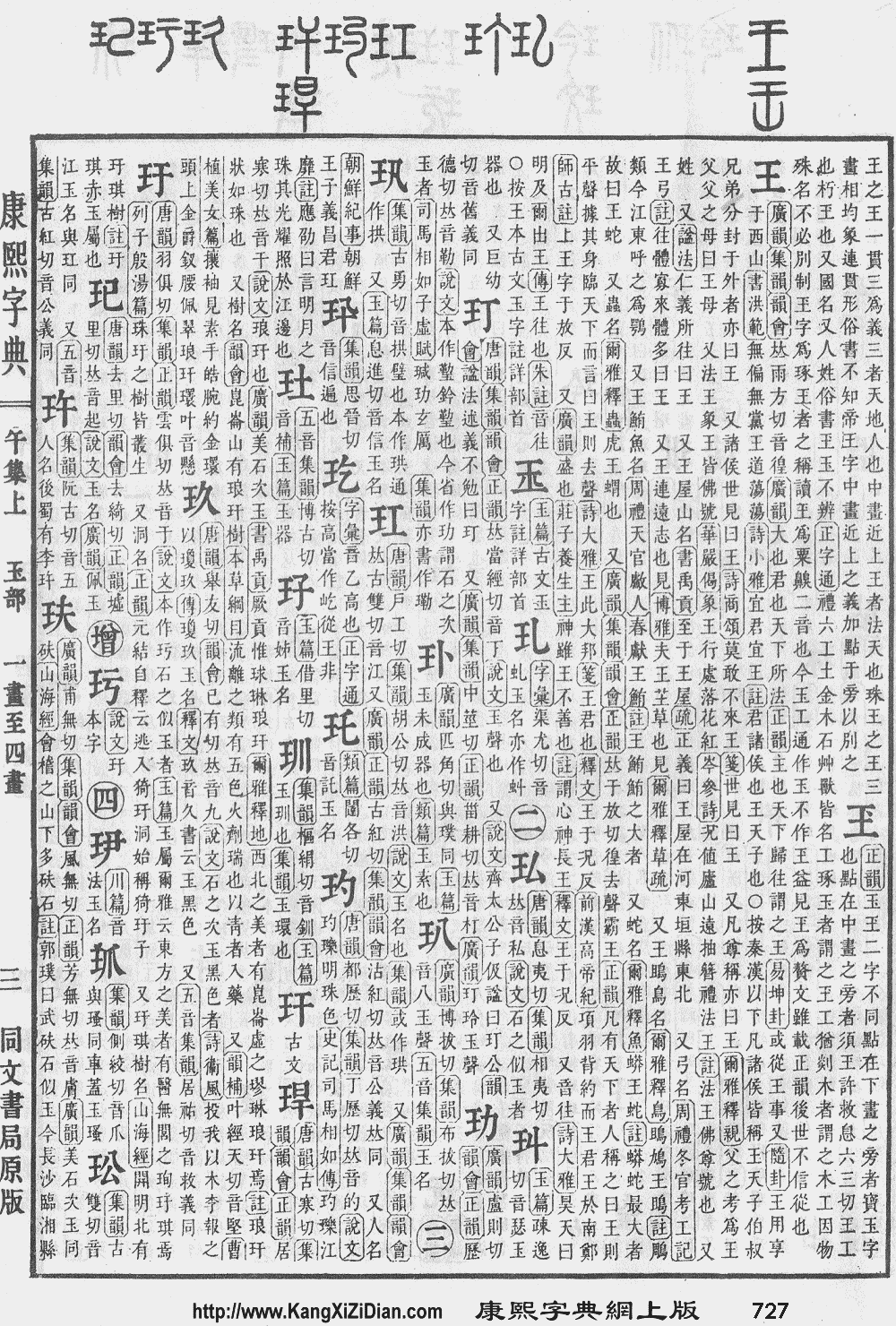
- KangXi: page 727, character 2
- Dai Kanwa Jiten: character 20823
- Dae Jaweon: page 1137, character 1
- Hanyu Da Zidian (first edition): volume 2, page 1099, character 10
- Unihan data for U+738B
- Unihan data for U+2F929
Chinese
| simp. and trad. |
王 | |
|---|---|---|
| alternative forms | 𠙻 | |
Glyph origin
| Historical forms of the character 王 | |||||||||||||||||||||||||||||||||||||||||||||||||||||||||||||||||||||||||||||||||||||||||||
|---|---|---|---|---|---|---|---|---|---|---|---|---|---|---|---|---|---|---|---|---|---|---|---|---|---|---|---|---|---|---|---|---|---|---|---|---|---|---|---|---|---|---|---|---|---|---|---|---|---|---|---|---|---|---|---|---|---|---|---|---|---|---|---|---|---|---|---|---|---|---|---|---|---|---|---|---|---|---|---|---|---|---|---|---|---|---|---|---|---|---|---|
| Shang | Western Zhou | Spring and Autumn | Warring States | Shuowen Jiezi (compiled in Han) | Liushutong (compiled in Ming) | ||||||||||||||||||||||||||||||||||||||||||||||||||||||||||||||||||||||||||||||||||||||
| Bronze inscriptions | Oracle bone script | Bronze inscriptions | Bronze inscriptions | Bronze inscriptions | Chu slip and silk script | Qin slip script | Ancient script | Small seal script | Transcribed ancient scripts | ||||||||||||||||||||||||||||||||||||||||||||||||||||||||||||||||||||||||||||||||||
 |
 |
 |
 |
 |
 |
 |
 |
 |
 | ||||||||||||||||||||||||||||||||||||||||||||||||||||||||||||||||||||||||||||||||||
|||||||||
|
References: Mostly from Richard Sears' Chinese Etymology site (authorisation),
| |||||||||||||||||||||||||||||||||||||||||||||||||||||||||||||||||||||||||||||||||||||||||||


| Old Chinese | |
|---|---|
| 皇 | *ɡʷaːŋ |
| 惶 | *ɡʷaːŋ |
| 遑 | *ɡʷaːŋ |
| 堭 | *ɡʷaːŋ |
| 煌 | *ɡʷaːŋ |
| 餭 | *ɡʷaːŋ |
| 騜 | *ɡʷaːŋ |
| 艎 | *ɡʷaːŋ |
| 隍 | *ɡʷaːŋ |
| 湟 | *ɡʷaːŋ |
| 徨 | *ɡʷaːŋ |
| 篁 | *ɡʷaːŋ |
| 蝗 | *ɡʷaːŋ, *ɡʷraːŋ, *ɡʷraːŋs |
| 凰 | *ɡʷaːŋ |
| 偟 | *ɡʷaːŋ |
| 媓 | *ɡʷaːŋ |
| 韹 | *ɡʷaːŋ, *ɡʷraːŋ |
| 葟 | *ɡʷaːŋ |
| 皝 | *ɡʷaːŋʔ |
| 汪 | *qʷaːŋ, *qʷaːŋs, *qʷaŋʔ |
| 尪 | *qʷaːŋ |
| 迋 | *kʷaŋʔ, *kʰʷaŋ, *ɡʷaŋ, *ɢʷaŋs |
| 逛 | *kʷaŋʔ |
| 誑 | *kʷaŋs, *ɡʷaŋ, *kʷaŋs |
| 匡 | *kʰʷaŋ |
| 筐 | *kʰʷaŋ |
| 框 | *kʰʷaŋ |
| 眶 | *kʰʷaŋ |
| 誆 | *kʰʷaŋ, *ɡʷaŋs |
| 邼 | *kʰʷaŋ |
| 恇 | *kʰʷaŋ |
| 劻 | *kʰʷaŋ |
| 洭 | *kʰʷaŋ |
| 軭 | *kʰʷaŋ, *ɡʷaŋ |
| 狂 | *ɡʷaŋ, *ɡʷaŋs |
| 軖 | *ɡʷaŋ |
| 鵟 | *ɡʷaŋ |
| 俇 | *ɡʷaŋʔ |
| 王 | *ɢʷaŋ, *ɢʷaŋs |
| 蚟 | *ɢʷaŋ |
| 彺 | *ɢʷaŋ |
| 旺 | *ɢʷaŋs |
| 諻 | *qʰʷraːŋ |
| 喤 | *qʰʷraːŋ, *ɡʷraːŋ |
| 瑝 | *ɡʷraːŋ |
| 鍠 | *ɡʷraːŋ |
| 揘 | *ɡʷaŋ |
The traditional interpretation is that the three horizontal strokes represent Heaven, Man and Earth. The vertical stroke is the king, the one who connects them together. Older representation of the character shows a man like 大 or 天 above a horizontal stroke.
The modern interpretation is that the character is a pictogram (象形) of either an axe or a crown, one of two symbols of the king's power. A ceremonial axe was kept near the throne, and was used for performing rituals in ancient China.
Etymology 1
Uncertain. There are many proposed etymologies:
- Sagart and Baxter (2009) compare it to Tibetan གོང་མ (gong ma, “superior one”).
- Schuessler (2007) compares it to Tibetan དབང (dbang, “strength, power”) and Burmese အန် (an, “strength, power”), which derive from Proto-Sino-Tibetan *d-baŋ (“strength, power”). However, reconstructing the Old Chinese as *waŋ, he notes the mismatch between Old Chinese *w- vs. Tibetan *b- (unless *dw- can become db-; for possible *b- ~ * w- variation, see 花). He also compares it to Proto-Northern Naga *waŋ (“chief”).
- Schuessler (2007) alternatively proposes a connection to Old Khmer vāṅ, vaṅ (modern Khmer វាំង (veăng), “royal palace”), which he considers to be cognate with Khmer ហ្លួង (luŏng, “king”). This is perhaps supported by a bronze inscription where 王 refers to a place, not the Zhou king (Shaughnessy, 1991). The semantic shift from "palace" to "king" parallels Egyptian pr ꜥꜣ (“pharaoh”, literally “palace”), from pr (“house”) + ꜥꜣ (“great, big”). The connection to the Old Khmer word would thus relate it to Proto-Mon-Khmer *waŋ ~ *waaŋ (“enclosure; to go round”), which is part of a larger Austroasiatic word family, including 營 (OC *ɢʷeŋ) and 環 (OC *ɡʷraːn). Bodman (1980) connects 王 with 皇 (OC *ɡʷaːŋ, “sovereign”), which Schuessler (2007) connects to this word family.
- Speculations exist about its connection to 尪 (OC *qʷaːŋ, “lame, crippled”) and 狂 (OC *ɡʷaŋ, “mad”), based on theories about the connection between ancient Chinese kingship and shamanism (Keightley, 1995).
Pronunciation
Definitions
王
- king; monarch
- duke; prince
- best or strongest of its kind
- chief; head; ringleader
- (chess) king
- (graph theory) king (a vertex in a directed graph which can reach every other vertex via a path with a length of at most 2)
- † grand; great
- † (of feudal monarchs) to see the emperor
- a surname: Wang; Wong; Ong; Heng
- 王勃 ― Wáng Bó ― Wang Bo (Tang dynasty poet)
- 王延政 ― Wáng Yánzhèng ― Wang Yanzheng (Emperor of Min)
Descendants
Others:
Compounds
|
|
|
Etymology 2
王 (OC *ɢʷaŋ) with a denominalizing *-s suffix (Schuessler, 2007; Baxter and Sagart, 2014).
Pronunciation
Definitions
王
- † to reign; to rule, to be a king
- † Alternative form of 旺 (wàng, “flourishing; prosperous”).
Compounds
|
|
See also
| Chess pieces in Chinese · 國際象棋棋子 (layout · text) | |||||
|---|---|---|---|---|---|
 |
 |
 |
 |
 |
 |
| 王 (wáng), 國王/国王 (guówáng) |
后 (hòu), 皇后 (huánghòu) |
車/车 (jū), 城堡 (chéngbǎo) |
象 (xiàng), 主教 (zhǔjiào) |
馬/马 (mǎ), 騎士/骑士 (qíshì) |
兵 (bīng) |
References
- “王”, in 漢語多功能字庫 (Multi-function Chinese Character Database), 香港中文大學/香港中文大学 (the Chinese University of Hong Kong), 2014–
- “Entry #1229”, in 臺灣閩南語常用詞辭典 [Dictionary of Frequently-Used Taiwan Minnan] (in Chinese and Min Nan), Ministry of Education, R.O.C., 2011.
Japanese
Readings
- Go-on: おう (ō, Jōyō)←わう (wau, historical)
- Kan-on: おう (ō, Jōyō)←わう (wau, historical)
- Kun: おおきみ (ōkimi, 王)←おほきみ (ofokimi, historical); きみ (kimi, 王)
Etymology 1
| Kanji in this term |
|---|
| 王 |
| おう Grade: 1 |
| on’yomi |
/wau/ → /wɔː/ → */woː/ → /oː/
From Middle Chinese 王 (MC ɦʉɐŋ).
Noun
- a king, especially one who is not East Asian or was East Asian in pre-imperial times; in China and Vietnam, generally a king before Qin Shi Huangdi who invented the title 皇帝 (kōtei, “huangdi; emperor”); in Korea, one of the many kings before the Korean Empire which was modeled after Japan's; in Japan, one of the rulers before Emperor Jinmu
- 越王勾践 ― Etsuō Kōsen ― King Goujian of Yue
- an East Asian queen regnant
- 親魏倭王 ― Shingi Waō ― the pro-Wei Queen of Wa
- 徴 (女)王 ― Chō (Jo)ō ― the Trưng Queen
- 善徳 (女)王 ― Zentoku (Jo)ō ― Queen Seondeok
- a nobility title for a Chinese or Vietnamese prince, bestowed on one of the 皇帝 (kōtei, “huangdi; emperor”)'s adult sons, brothers, or nephews, especially as a coming-of-age title, generally comes with an estate ("principality"); compare 皇子 (ōji, “imperial princes”, especially pre-adult ones) and 公 (kō, “dukes”, an alternative used by certain dynasties)
- 武成王 ― Busei Ō ― Prince Wucheng
- 興道王 ― Kōdō Ō ― Prince Hưng Đạo
- a Japanese prince's son (such princes include 親王 (shinnō) or 王 (ō) themselves)
Usage notes
- An East Asian queen regnant (except in Korea) has the same title as a king, not specifically a “queen (regnant)” like in European languages. Similarly, an empress regnant has the same title as an emperor.
See also
Derived terms
Etymology 2
| Kanji in this term |
|---|
| 王 |
| こきし Grade: 1 |
| irregular |
| Kanji in this term |
|---|
| 王 |
| こにきし Grade: 1 |
| irregular |
| Alternative spelling |
|---|
| 国主 |
From Old Japanese, derived from Baekje 鞬吉支 (*k(j)ənkilci).
Noun
王 or 王 • (konikishi or kokishi)
Korean
Etymology
From Middle Chinese 王 (MC ɦʉɐŋ).
| Historical Readings | ||
|---|---|---|
| Dongguk Jeongun Reading | ||
| Dongguk Jeongun, 1448 | ᅌᅪᇰ (Yale: ngwàng) | |
| Middle Korean | ||
| Text | Eumhun | |
| Gloss (hun) | Reading | |
| Hunmong Jahoe, 1527 | 님〯굼〮 (Yale: nǐmkwúm) | 와ᇰ (Yale: wàng) |
| Gwangju Cheonjamun, 1575 | 긔ᄌᆞ (Yale: kuyco) | 왕 (Yale: wang) |
Pronunciation
- (SK Standard/Seoul) IPA(key): [wa̠ŋ]
- Phonetic hangul: [왕]
Compounds
Okinawan
Etymology
From Middle Chinese 王 (MC ɦʉɐŋ).
Pronunciation
- IPA(key): /(ʷ)oː/
Usage notes
- An East Asian queen regnant (except in Korea) has the same title as a king, not specifically a “queen (regnant)” like in European languages. Similarly, an empress regnant has the same title as an emperor.
Old Japanese
Vietnamese
Han character
王: Hán Việt readings: vương (
王: Nôm readings: vương[1][2][3][4][5][6], vướng[1][7][5]
Compounds
- 王家 (vương gia)
- 王后 (vương hậu)
- 王國 (vương quốc)
- 王朝 (vương triều)
- 王子 (vương tử)
- 海王星 (Hải Vương tinh)
- 女王 (nữ vương)
- 封王 (phong vương)
- 國王 (quốc vương)
References
- Nguyễn (2014).
- Nguyễn et al. (2009).
- Trần (2004).
- Bonet (1899).
- Génibrel (1898).
- Taberd & Pigneau de Béhaine (1838).
- Hồ (1976).