黃
| ||||||||
| ||||||||
Translingual
| Stroke order | |||
|---|---|---|---|
 | |||
Han character
黃 (Kangxi radical 201, 黃+0, 12 strokes, cangjie input 廿一田金 (TMWC), four-corner 44806, composition ⿱⿱廿一⿱由八(GHJK) or ⿱⿱廿一⿱田八(T))
- Kangxi radical #201, ⿈.
- Shuowen Jiezi radical №486
Derived characters
- Appendix:Chinese radical/黃
- 僙, 墴, 嫹, 彉, 撗, 潢, 獚, 曂, 䐵, 熿, 𤖖, 𤗶, 𤛥, 璜, 穔, 𧝒, 䊣, 䌙, 蟥, 觵, 趪, 䤑, 䪄, 䬝, 䮲, 鱑, 䵃, 𨝴, 斢, 𤮏, 𩙁, 鷬, 𡐳, 廣, 癀, 簧, 𨶰 (Exception: Contains 黃 in all regions except mainland China which contains simplified 黄)
- (Contains 黃 in all regions)
- (Exception: All regions except mainland China and Vietnam which contains 黄)
- (Exception: Contains 黃 for Taiwan glyph and 黄 for Vietnam glyph)
Related characters
- 黄 (Japanese shinjitai and Simplified Chinese)
Further reading
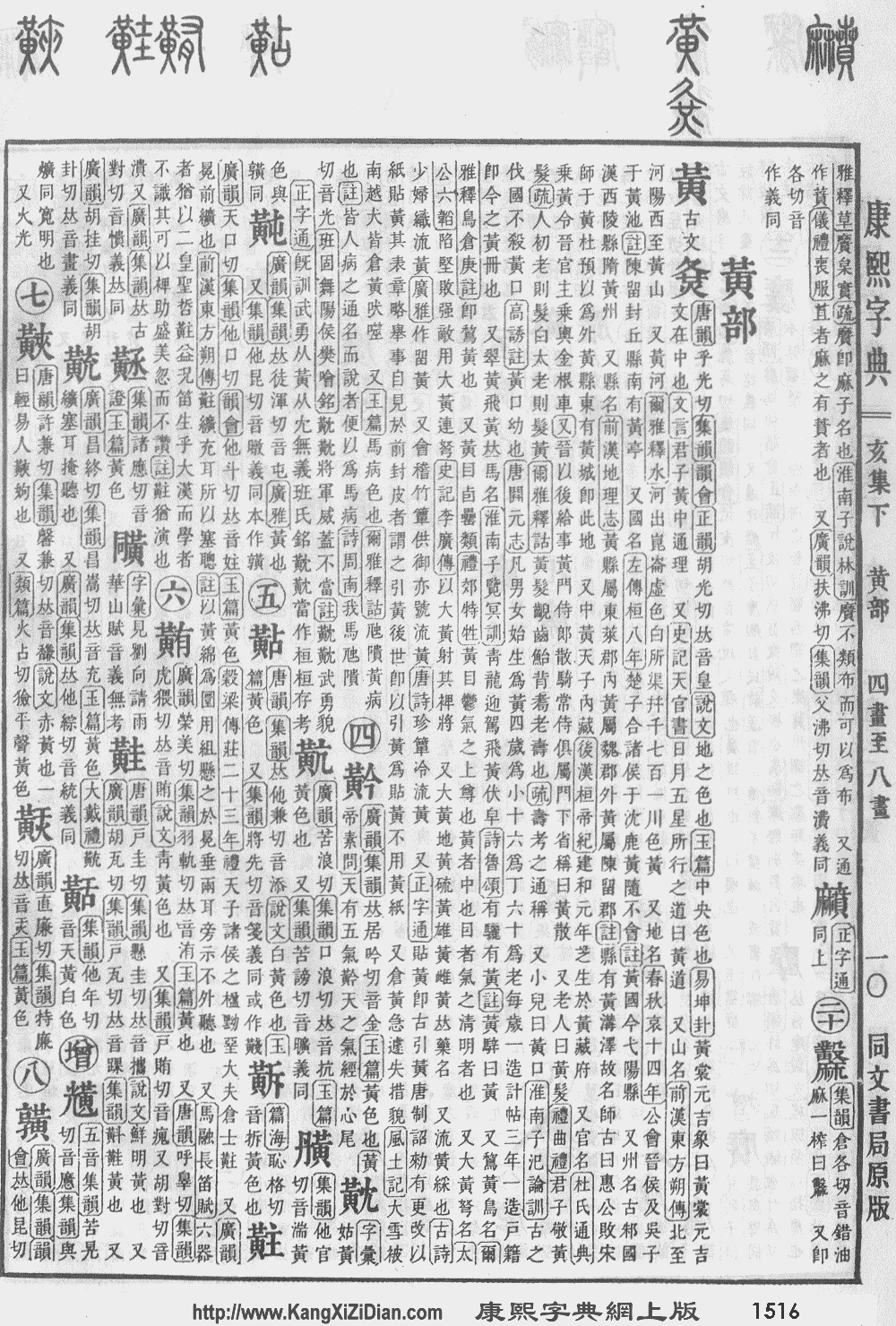
- KangXi: page 1516, character 3
- Dai Kanwa Jiten: character 47926
- Dae Jaweon: page 2046, character 11
- Hanyu Da Zidian (first edition): volume 7, page 4596, character 2
- Unihan data for U+9EC3
Chinese
| trad. | 黃/黄 | |
|---|---|---|
| simp. | 黄 | |
Glyph origin
| Historical forms of the character 黃 | |||
|---|---|---|---|
| Shang | Western Zhou | Shuowen Jiezi (compiled in Han) | Liushutong (compiled in Ming) |
| Oracle bone script | Bronze inscriptions | Small seal script | Transcribed ancient scripts |
 |
 |
 |
 |
| Old Chinese | |
|---|---|
| 僙 | *kʷaːŋ |
| 廣 | *kʷaːŋʔ |
| 鄺 | *kʷaːŋʔ, *qʰʷaːŋ |
| 懬 | *kʰʷaːŋʔ, *kʰaːŋʔ |
| 爌 | *kʰʷaːŋʔ, *kʰʷaːŋs, *qʰʷaːŋʔ |
| 曠 | *kʰʷaːŋs |
| 矌 | *kʰʷaːŋs |
| 壙 | *kʰʷaːŋs |
| 纊 | *kʰʷaːŋs |
| 黃 | *ɡʷaːŋ |
| 璜 | *ɡʷaːŋ |
| 潢 | *ɡʷaːŋ, *ɡʷaːŋs |
| 簧 | *ɡʷaːŋ |
| 癀 | *ɡʷaːŋ |
| 鱑 | *ɡʷaːŋ |
| 獚 | *ɡʷaːŋ |
| 蟥 | *ɡʷaːŋ |
| 趪 | *ɡʷaːŋ |
| 櫎 | *ɡʷaːŋʔ |
| 擴 | *ɡʷlaːŋs, *kʰʷaːɡ |
| 瀇 | *qʷaːŋʔ |
| 獷 | *kʷaŋʔ, *kʷraːŋʔ |
| 觵 | *kʷraːŋ |
| 礦 | *kʷraːŋʔ |
| 鑛 | *kʷraːŋʔ |
| 穬 | *kʷraːŋʔ |
| 橫 | *ɡʷraːŋ, *ɡʷraːŋs, *kʷaːŋ |
| 黌 | *ɡʷraːŋ |
| 鐄 | *ɡʷraːŋ |
| 嚝 | *qʰʷraːŋ |
| 彉 | *kʷaːɡ, *qʰʷaːɡ |
| 彍 | *kʷaːɡ, *qʰʷaːɡ |
Chi (2010) proposes that 黃 was originally a pictogram (象形) and the original character of 尪 (OC *qʷaːŋ, “a disabled person with a protruding chest or abdomen”). It has been phonetically borrowed for "yellow" since the era of the oracle bone script. He (1998) noted the possible ritual of burning disabled people with a protruding chest or abdomen to pray for rain as mentioned in Zuozhuan. The 口 in the upper part of the bronze inscription of 黃 might be depicting the disabled person's face facing upwards.
Li (2012), on the other hand, proposes that 黃 was originally a pictogram (象形) and the original character of 璜 (OC *ɡʷaːŋ, “semicircular jade”) as the 口 in the oracle bone script resembles a ring of jade, so the character would carry the meaning of "a man wearing a ring of jade on his chest". The meaning "yellow" is the result of rebus.
According to Shuowen, it is both a phono-semantic compound (形聲/形声, OC *ɡʷaːŋ) and ideogrammic compound (會意/会意) : phonetic 炗 (“light”) + semantic 田 (“field”) – the color of earth, with 炗 being the ancient form of 光 (OC *kʷaːŋ, *kʷaːŋs, “light”). However, this interpretation is likely erroneous as 廿 at the top was formed as a result of corruption of 口 in the bronze inscription.
Etymology
From Proto-Sino-Tibetan *hwaŋ (“shine; bright; yellow”). Cognate with 光 (OC *kʷaːŋ, *kʷaːŋs, “light; bright”), 曠 (OC *kʰʷaːŋs, “bright; well-lit”), Burmese ဝင်း (wang:, “bright”), Burmese ဝါ (wa, “yellow”).
Pronunciation
Definitions
黃
- yellow (colour)
- yolk
- Short for 蟹黃/蟹黄 (xièhuáng).
- yellow; Far East Asian
- 無論紅黃黑白種,都是耶穌心寶貝,耶穌喜愛世上所有的小孩。 [MSC, trad.]
- From: 1985, 耶穌喜愛小孩 (Jesus Loves the Little Children), in 《教會聖詩》 (Hymns for God's People)
- Wúlùn hóng huáng hēi bái zhǒng, dōu shì Yēsū xīn bǎobèi, Yēsū xǐ'ài shìshàng suǒyǒu de xiǎohái. [Pinyin]
- Red and yellow, black and white, they are precious in His sight—Jesus loves the little children of the world. [original English lyrics]
No matter red, yellow, black, white, they are all treasured in Jesus' heart—Jesus loves all the children of the world. [literal English translation]
无论红黄黑白种,都是耶稣心宝贝,耶稣喜爱世上所有的小孩。 [MSC, simp.]
- (colloquial) pornographic; lewd
- (colloquial) to fizzle out; to fall through
- (Cantonese) to let the cat out of the bag (to let a secret be known)
- (Hong Kong, politics) supportive of Hong Kong's pro-democracy movement
- See also: 黃絲
- (Min Nan) to ripen
- Short for 黃帝/黄帝 (Huángdì).
- Short for 黃河/黄河 (Huáng Hé, “Yellow River”).
- a surname
- 黃宗羲/黄宗羲 ― Huáng Zōngxī ― Huang Zongxi (Chinese intellectual and political theorist that lived during the latter part of the Ming dynasty into the early part of the Qing)
- 黃蕙蘭/黄蕙兰 [Hokkien] ― Ûiⁿ Hūi-lân [Pe̍h-ōe-jī] ― Oei Hui-lan (a Chinese-Indonesian socialite and First Lady of the Republic of China)
Synonyms
Descendants
Others:
Compounds
|
|
|
Japanese
| 黄 | |
| 黃 |
Vietnamese
Han character
黃: Hán Việt readings: hoàng[1][2][3][4][5][6], huỳnh[2][5][7]
黃: Nôm readings: vàng[7][6]
References
- Génibrel (1898).
- Bonet (1899).
- Thiều Chửu (1942).
- Nguyễn (1974).
- Trần (1999).
- Nguyễn et al. (2009).
- Trần (2004).