似
| ||||||||
Translingual
| Stroke order | |||
|---|---|---|---|
 | |||
Han character
似 (Kangxi radical 9, 人+4 in Chinese, 人+5 in Japanese, 6 strokes in Chinese, 7 strokes in Japanese, cangjie input 人女戈人 (OVIO), four-corner 28200, composition ⿰亻以)
Derived characters
- 𠳎, 娰, 𬠊, 𩛮, 𠏳, 𫣵, 𫈄
References
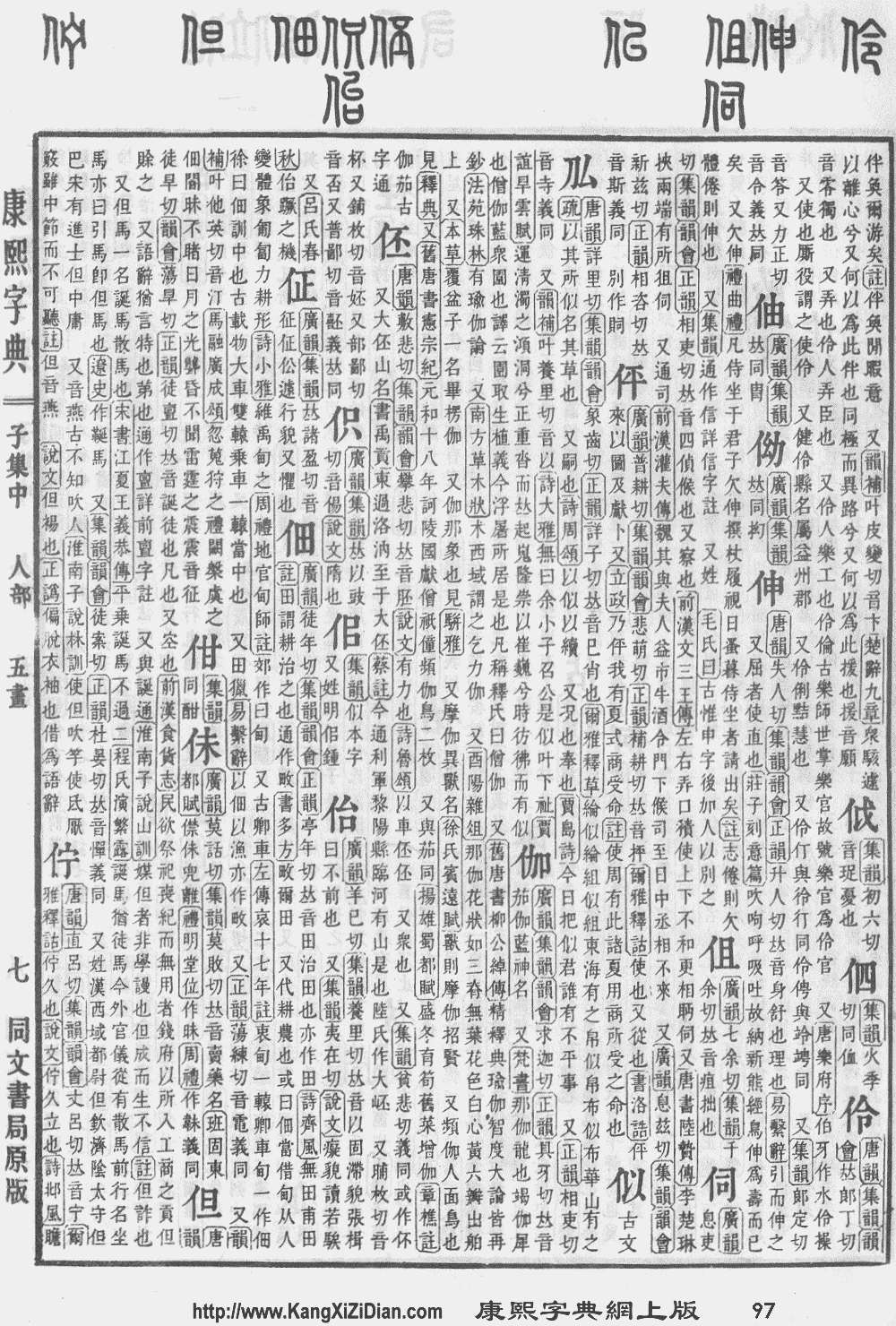
- KangXi: page 97, character 10
- Dai Kanwa Jiten: character 485
- Dae Jaweon: page 205, character 16
- Hanyu Da Zidian (first edition): volume 1, page 127, character 2
- Unihan data for U+4F3C
Chinese
| trad. | 似 | |
|---|---|---|
| simp. # | 似 | |
| alternative forms | 佀 仏 𠚦 | |
Glyph origin
| Historical forms of the character 似 | |||||||||||||||||||
|---|---|---|---|---|---|---|---|---|---|---|---|---|---|---|---|---|---|---|---|
| |||||||||||||||||||
|
References: Mostly from Richard Sears' Chinese Etymology site (authorisation),
|


Characters in the same phonetic series (以) (Zhengzhang, 2003)
Phono-semantic compound (形聲/形声, OC *ljɯʔ) : semantic 亻 (“human”) + phonetic 以 (OC *lɯʔ).
Pronunciation 1
Definitions
似
- to be like; to be similar to; to resemble
- Used in conjunction with another adjective in a comparison that the first object/person is in a better position than the second.
- as if; it seems that...
- 似乎 ― sìhū ― as if
- † to give; to present
- † Alternative form of 嗣 (sì, “to inherit”).
- † Alternative form of 以 (yǐ).
Synonyms
Dialectal synonyms of 像 (“to be like; to be similar to; to resemble”) [map]
| Variety | Location | Words |
|---|---|---|
| Classical Chinese | 似 | |
| Formal (Written Standard Chinese) | 像 | |
| Mandarin | Taiwan | 像 |
| Yantai (Muping) | 像 | |
| Wanrong | 像 | |
| Wuhan | 像 | |
| Chengdu | 像 | |
| Guilin | 像 | |
| Malaysia | 像 | |
| Singapore | 像 | |
| Cantonese | Guangzhou | 似 |
| Hong Kong | 似 | |
| Kuala Lumpur (Guangfu) | 似 | |
| Singapore (Guangfu) | 似 | |
| Gan | Nanchang | 像 |
| Lichuan | 像 | |
| Jin | Taiyuan | 像 |
| Min Dong | Fuzhou | 像 |
| Min Nan | Xiamen | 像 |
| Taipei | 像 | |
| New Taipei (Sanxia) | 像 | |
| Kaohsiung | 像 | |
| Yilan | 像 | |
| Changhua (Lukang) | 像 | |
| Taichung | 像 | |
| Tainan | 像 | |
| Hsinchu | 像 | |
| Kinmen | 像 | |
| Penghu (Magong) | 像 | |
| Singapore (Hokkien) | 𫝛, macam | |
| Chaozhou | 然 | |
| Shantou | 然 | |
| Jieyang | 然 | |
| Singapore (Teochew) | 然, macam | |
| Batam (Teochew) | 然, macam | |
| Haikou | 像 | |
| Southern Pinghua | Nanning (Tingzi) | 像 |
| Wu | Danyang | 像 |
| Ningbo | 像, 像人家, 像家 | |
- (as if):
Synonyms of 似
|
Compounds
Pronunciation 2
Japanese
Korean
Hanja
似 (eum 사 (sa))
- This term needs a translation to English. Please help out and add a translation, then remove the text
{{rfdef}}.
Vietnamese
Han character
似: Hán Nôm readings: tự, tợ, tựa, từa
- This term needs a translation to English. Please help out and add a translation, then remove the text
{{rfdef}}.
References
This article is issued from Wiktionary. The text is licensed under Creative Commons - Attribution - Sharealike. Additional terms may apply for the media files.