格
| ||||||||
Translingual
| Stroke order | |||
|---|---|---|---|
 | |||
Han character
格 (Kangxi radical 75, 木+6, 10 strokes, cangjie input 木竹水口 (DHER), composition ⿰木各)
References
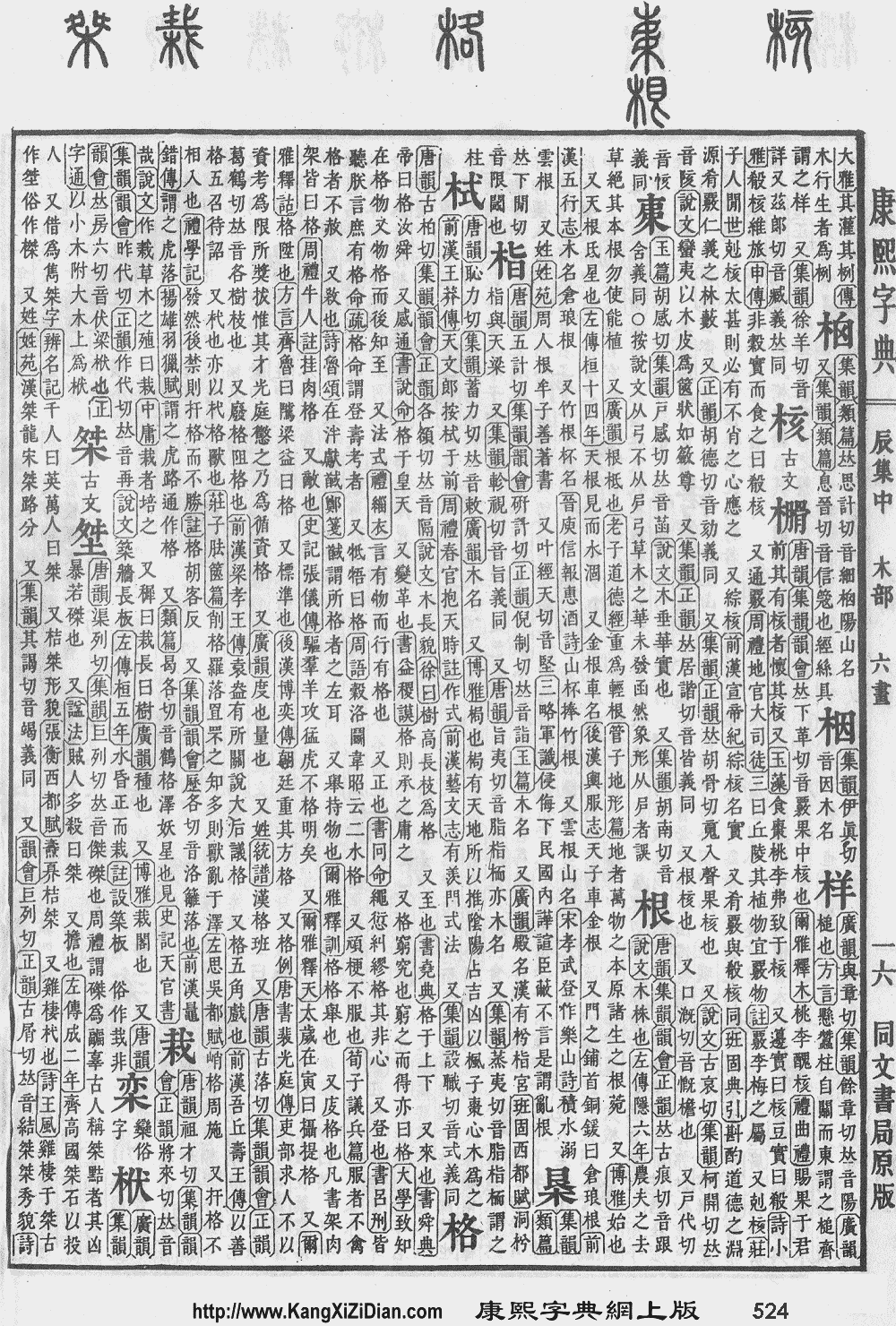
- KangXi: page 524, character 11
- Dai Kanwa Jiten: character 14749
- Dae Jaweon: page 912, character 13
- Hanyu Da Zidian (first edition): volume 2, page 1203, character 6
- Unihan data for U+683C
Chinese
| simp. and trad. |
格 | |
|---|---|---|
Glyph origin
| Historical forms of the character 格 | ||||
|---|---|---|---|---|
| Shang | Western Zhou | Warring States | Shuowen Jiezi (compiled in Han) | Liushutong (compiled in Ming) |
| Oracle bone script | Bronze inscriptions | Chu slip and silk script | Small seal script | Transcribed ancient scripts |
 |
 |
 |
 |
 |
Characters in the same phonetic series (各) (Zhengzhang, 2003)
| Old Chinese | |
|---|---|
| 髂 | *kʰraːɡs |
| 路 | *ɡ·raːɡs |
| 輅 | *ɡ·raːɡs |
| 賂 | *ɡ·raːɡs |
| 虂 | *ɡ·raːɡs |
| 露 | *ɡ·raːɡs |
| 潞 | *raːɡs |
| 鷺 | *raːɡs |
| 璐 | *raːɡs |
| 簬 | *raːɡs |
| 簵 | *ɡ·raːɡs |
| 洛 | *ɡ·raːɡ |
| 駱 | *ɡ·raːɡ |
| 絡 | *ɡ·raːɡ |
| 酪 | *ɡ·raːɡ |
| 烙 | *ɡ·raːɡ |
| 雒 | *ɡ·raːɡ |
| 珞 | *ɡ·raːɡ |
| 硌 | *ɡ·raːɡ |
| 袼 | *ɡ·raːɡ, *klaːɡ |
| 笿 | *ɡ·raːɡ |
| 鉻 | *ɡ·raːɡ, *kraːɡ |
| 鮥 | *ɡ·raːɡ |
| 鵅 | *ɡ·raːɡ, *kraːɡ |
| 挌 | *ɡ·raːɡ, *kraːɡ |
| 落 | *ɡ·raːɡ |
| 各 | *klaːɡ |
| 胳 | *klaːɡ |
| 閣 | *klaːɡ |
| 格 | *klaːɡ, *kraːɡ |
| 擱 | *klaːɡ |
| 恪 | *kʰlaːɡ |
| 愙 | *kʰaːɡ |
| 貉 | *ɡlaːɡ, *mɡraːɡ |
| 狢 | *ɡlaːɡ |
| 佫 | *ɡlaːɡ |
| 略 | *ɡ·raɡ |
| 茖 | *kraːɡ |
| 骼 | *kraːɡ |
| 觡 | *kraːɡ |
| 蛒 | *kraːɡ |
| 敋 | *kraːɡ |
| 客 | *kʰraːɡ |
| 喀 | *kʰraːɡ |
| 揢 | *kʰraːɡ |
| 額 | *ŋɡraːɡ |
| 峉 | *ŋɡraːɡ |
| 頟 | *ŋɡraːɡ |
| 詻 | *ŋɡraːɡ |
| 垎 | *ɡraːɡ |
| 楁 | *ɡraːɡ |
Phono-semantic compound (形聲/形声, OC *klaːɡ, *kraːɡ) : semantic 木 (“wood”) + phonetic 各 (OC *klaːɡ).
Etymology 1
- “to go; to come; to arrive”
- Possibly cognate to Tibetan འགྲོ་བ། ('gro ba, “to go, walk, travel”), འགྲོ་བ་པོ ('gro ba po, “traveler”), འགྲོན་པ ('gron pa, “to go, travel”), མགྲོན (mgron, “guest”), མགྲོན་ཁང (mgron khang, “inn”) (Geilich, 1994). If so, from Proto-Sino-Tibetan *grwat (“to go through, to travel”). However, STEDT does not compare this to Tibeto-Burman lexical items under *grwat.
- Baxter (1992) proposes that this is related to 路 (OC *ɡ·raːɡs, “road”). Confer 客 (OC *kʰraːɡ, “guest, visitor”), 旅 (OC *ɡ·raʔ, “travel, lodge”), and 行 (OC *ɡaːŋ, *ɡaːŋs, *ɡraːŋ, *ɡraːŋs, “to go”)
- “to obstruct; to hinder”
- (This etymology is missing or incomplete. Please add to it, or discuss it at the Etymology scriptorium.)
- “frame; square”
- (This etymology is missing or incomplete. Please add to it, or discuss it at the Etymology scriptorium.)
- “style; form; pattern; standard; personality; character”
- (This etymology is missing or incomplete. Please add to it, or discuss it at the Etymology scriptorium. Particularly: “Semantically derived from "square, frame" sense?”)
Compare with Burmese ချက် (hkyak, “fact, point, data, stroke, blow, article”).
Pronunciation
Definitions
格
- (literary, or in compounds) pattern; standard; form; style
- square; frame
- (literary, or in compounds) special property; personality; character (Can we add an example for this sense?) (particularly for the "personality" in literary form)
- (grammar) case
- 共格 ― gònggé ― comitative case
- (mathematics) lattice; grid; cross-hatch; checkers
- (literary) to beat; to lash; to strike; to hit
- (Cantonese) partitioned cell
- † to come; to arrive; to go to
- 帝曰:「格,汝舜。詢事考言,乃言厎可績。」 [Classical Chinese, trad.]
- From: The Book of Documents, circa 4th – 3rd century BCE, translated based on James Legge's version
- Dì yuē: “Gé, rǔ Shùn. Xún shì kǎo yán, nǎi yán zhǐ kě jì.” [Pinyin]
- The Di said, "Come, you Shun. I have consulted you on affairs, and examined your words, and found that they can be carried into practice."
帝曰:“格,汝舜。询事考言,乃言厎可绩。” [Classical Chinese, simp.]- 月正元日,舜格于文祖。 [Classical Chinese, trad. and simp.]
- From: The Book of Documents, circa 4th – 3rd century BCE, translated based on James Legge's version
- Yuèzhēng yuánrì, Shùn gé yú wénzǔ. [Pinyin]
- On the first day of the first month, Shun went to (the temple of) the Accomplished Ancestor.
- † to obstruct; to hinder
- † to investigate
- 22nd tetragram of the Taixuanjing; "resistance" (𝌛)
- a surname
Synonyms
- (standard):
Synonyms of 格
- (special property):
- (to beat):
Compounds
Derived terms from 格
|
|
|
Etymology 2
Onomatopoeic.
Pronunciation
Compounds
|
|
Etymology 3
From Proto-Sino-Tibetan *s-ka(:)k (“fork, branch, crotch”). Cognate with Apatani á-ha (“branch”), Mizo kâk (“fork of a tree”), Burmese အခက် (a.hkak, “tree branch”).
Attested since the Northern and Southern dynasties period. According to Schuessler (2007), the word may be much older as the graph already appeared in Zhou texts and was intended to mean "branch" (with 木 radical).
Pronunciation
References
- “格”, in 漢語多功能字庫 (Multi-function Chinese Character Database), 香港中文大學/香港中文大学 (the Chinese University of Hong Kong), 2014–
Japanese
Readings
Compounds
- 価格 (kakaku): price
- 具格 (gukaku): instrumental
- 呼格 (kokaku): vocative
- 向格 (kōkaku): allative
- 斜格 (shakaku): oblique
- 主格 (shukaku): nominative
- 修飾格 (shūshokukaku): attributive
- 述格 (jukkaku): predicative
- 所有格 (shoyūkaku): possessive
- 人格 (jinkaku): personality
- 接格 (sekkaku): adessive
- 絶対格 (zettaikaku): absolutive
- 前置格 (zenchikaku): locative
- 造格 (zōkaku): instrumental
- 属格 (zokkaku): genitive
- 対格 (taikaku): accusative
- 奪格 (dakkaku): ablative
- 能格 (nōkaku): ergative
- 賓格 (hinkaku): objective
- 補格 (hokaku): supplement
- 目的格 (mokutekikaku): objective
- 与格 (yokaku): dative
- 連体格 (rentaikaku): adnominal
- 格助詞 (kakujoshi)
Vietnamese
This article is issued from Wiktionary. The text is licensed under Creative Commons - Attribution - Sharealike. Additional terms may apply for the media files.