水
.svg.png.webp) | ||||||||
| ||||||||
| ||||||||
Translingual
| Stroke order | |||
|---|---|---|---|
 | |||
| Stroke order | |||
|---|---|---|---|
 | |||
Han character
水 (Kangxi radical 85, 水+0, 4 strokes, cangjie input 水 (E), four-corner 12230, composition ⿰𰛄⿺㇏丿(GJKV) or ⿰㇇𰛅(GJKV) or ⿰𰛄⿱丿㇏(HT))
- Kangxi radical #85, ⽔.
Derived characters
References
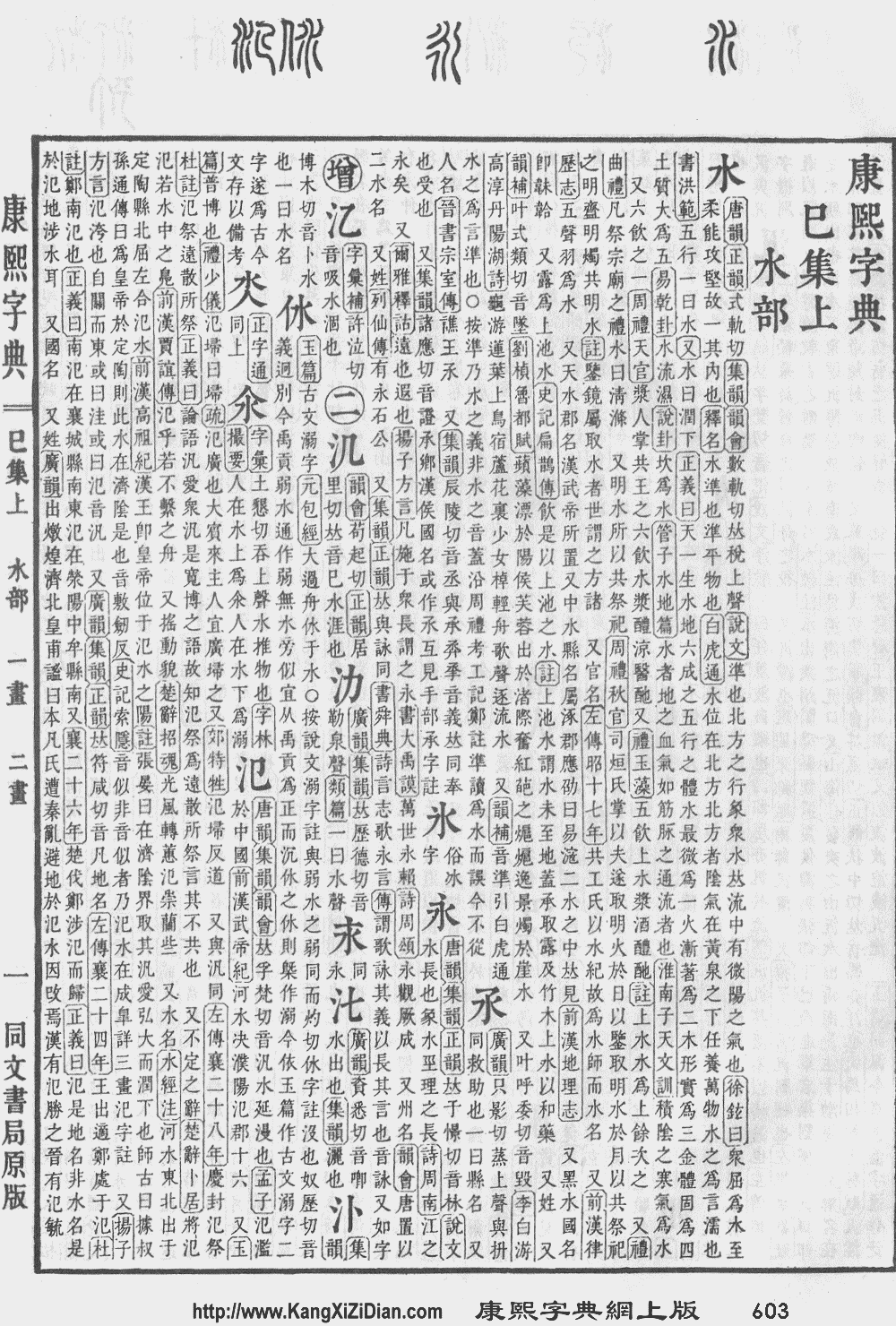
- KangXi: page 603, character 1
- Dai Kanwa Jiten: character 17083
- Dae Jaweon: page 992, character 9
- Hanyu Da Zidian (first edition): volume 3, page 1545, character 1
- Unihan data for U+6C34

Central Bai
Noun
水 (xuix)
- hanzi form of xuix
- 1450, Yang Fu (楊黼), 《詞記山花——咏蒼洱境》:
- 煴煊茶水㱔呼𪢂
- Boiling tea water, greeting each other.
-
Chinese
| simp. and trad. |
水 | |
|---|---|---|
| alternative forms | 𡿭 𣸕 | |
Glyph origin
| Historical forms of the character 水 | ||||||
|---|---|---|---|---|---|---|
| Shang | Western Zhou | Warring States | Shuowen Jiezi (compiled in Han) | Liushutong (compiled in Ming) | ||
| Oracle bone script | Bronze inscriptions | Bronze inscriptions | Chu slip and silk script | Qin slip script | Small seal script | Transcribed ancient scripts |
 |
 |
 |
 |
 |
 |
 |
Etymology 1
From Proto-Sino-Tibetan *lwi(j) (“flow; stream”) (Benedict, 1974; Coblin, 1986; Handel, 1998; Schuessler, 2007; STEDT). Cognate with Mizo lui (“stream; brook; river”), Tedim Chin [script needed] (luːi³, “stream; river”), Jingpho lawi (“to flow (as water)”).
Old Chinese 水 (OC lhuiʔ) (minimally reconstructed) is Sino-Tibetan root's endoactive derivation with suffix *-ʔ, meaning "that which is flowing"; its voiceless initial suggests the presence of a nominalizing prefix *k- or *s-. Another derivative from the Sino-Tibetan root is possibly 泫 (OC winʔ, “to flow”) (minimally reconstructed).
Compare also areal etymon Proto-Mon-Khmer *lujʔ ~ luuj() ~ luəj() ~ ləəj() (“to wade; to swim”).
Alternatively, Gong (1995) reconstructs Old Chinese *hljədx and compares it to Tibetan ཆུ (chu, “water”), which STEDT derives from Proto-Sino-Tibetan *tsju (“water; liquid; bodily fluid”). Baxter and Sagart (2014), employing evidence from Proto-Min, reconstructs Old Chinese *s.turʔ and compares it to Proto-Sino-Tibetan *twəj (“to flow; to suppurate”), which is likely related to *m-t(w)əj-n ~ m-ti-s (“water; fluid; to soak; to be wet”) (STEDT). Like Gong (1995), Sagart (2017) compares it to Tibetan ཆུ (chu), but he also compares it to Bodo (India) दै (dwi), Mizo tui, Proto-Karen *thejᴬ, all of which STEDT derives from Proto-Sino-Tibetan *m-t(w)əj-n ~ m-ti-s. Handel deems derivations from Proto-Sino-Tibetan *tsju or *m-t(w)əj-n ~ m-ti-s unlikely because of phonological issues (STEDT).
Pronunciation
Definitions
水
- water (Classifier: 瓶 m; 樽 c; 滴 m c; 池 m c; 盆 m c; 杯 m c)
- liquid; potion; juice
- (colloquial, chiefly Singapore, Malaysia) Synonym of 飲料/饮料 (yǐnliào, “beverage”).
- (archaic) river
- body of water
- flood
- additional cost or income
- (dialectal) rain
- (Cantonese) money
- (Cantonese) hundred dollars (Classifier: 嚿)
- (Cantonese) to fool; to deceive; to misguide
- to swim
- 水性 ― shuǐxìng ― swimming ability
- (colloquial) lacking substance or power; worthless
- Short for 划水 (huáshuǐ, “to shirk; to slack off”).
- one of the five elements of Wu Xing (五行)
- (colloquial) Classifier for the number of times clothing was washed.
- Sui people
- a surname
Synonyms
Compounds
Descendants
Etymology 2
| For pronunciation and definitions of 水 – see 媠 (“Min Nan: pretty; beautiful”). (This character, 水, is a variant form of 媠.) |
References
- See 水/derived terms § Water (Chinese).
- <水> at the Glyph Database from the Institute of History and Language of the Academia Sinica and the Institute of Information Science
Japanese
Readings
- Go-on: すい (sui, Jōyō)←すい (sui, historical)←すゐ (suwi, ancient)
- Kan-on: すい (sui, Jōyō)←すい (sui, historical)←すゐ (suwi, ancient)
- Kun: みず (mizu, 水, Jōyō)←みづ (midu, historical)
- Nanori: うず (uzu); ずみ (zumi); たいら (taira)←たひら (tafira, historical); つ (tsu); ど (do); な (na); なか (naka); み (mi); みさ (misa); みつ (mitsu); みな (mina); みん (min); ゆ (yu); ゆく (yuku)
Compounds
Etymology 1
| Kanji in this term |
|---|
| 水 |
| みず Grade: 1 |
| kun’yomi |
⟨mi1du⟩ → */mʲidu/ → /mid͡zu/ → /mizu/
From Old Japanese, from Proto-Japonic *mentu. Cognate with Proto-Ryukyuan *medu.
Possibly cognate with 瑞 (mizu, “freshness, youth”).
Possible cognate with Proto-Tungusic *mū, Jurchen 木克 (mu-ke /muke/), Manchu ᠮᡠᡴᡝ (muke), Goguryeo 買 (*me, “river; water”), Mongolian мөрөн (mörön, “river”), Korean 물 (mul, “water”).
Noun
Usage notes
Note that, while mizu is the most general Japanese term for “water”, it does refer specifically to “water that is not hot”. Meanwhile, the word 湯 (yu) refers specifically to “hot water”. Consider 水風呂 (mizu-buro, “cold-water bath”), contrasting with 風呂 (furo, “bath”, implying hot water).
Derived terms
Idioms
Proverbs
Derived terms
Etymology 2
| Kanji in this term |
|---|
| 水 |
| み Grade: 1 |
| kun’yomi |
⟨mi1⟩ → */mʲi/ → /mi/
From Old Japanese.
Typically found in compounds.[2]
Derived terms
Etymology 3
| Kanji in this term |
|---|
| 水 |
| すい Grade: 1 |
| on’yomi |
/ɕuwi/ → */suwi/ → /sui/
From Middle Chinese 水 (MC ɕˠiuɪX).
Noun
水 • (sui)
Derived terms
Etymology 4
| Kanji in this term |
|---|
| 水 |
| もい Grade: 1 |
| irregular |
⟨mopi1⟩ → */mopʲi/ → /moɸi/ → /mowi/ → /moi/
From Old Japanese. Via metonymy from the word 椀, 盌 (moi, “bowl”), from the meaning of “that which goes in the 椀, 盌 (moi, “bowl”)”.[1][2]
Pronunciation
- IPA(key): [mo̞i]
Derived terms
- 水取, 主水 (moitori)
References
- 2006, 大辞林 (Daijirin), Third Edition (in Japanese), Tōkyō: Sanseidō, →ISBN
- 1988, 国語大辞典(新装版) (Kokugo Dai Jiten, Revised Edition) (in Japanese), Tōkyō: Shogakukan
Korean
Etymology
From Middle Chinese 水 (MC ɕˠiuɪX).
| Historical Readings | ||
|---|---|---|
| Dongguk Jeongun Reading | ||
| Dongguk Jeongun, 1448 | ᄉᆔᆼ〯 (Yale: syǔy) | |
| Middle Korean | ||
| Text | Eumhun | |
| Gloss (hun) | Reading | |
| Hunmong Jahoe, 1527 | 믈〮 (Yale: múl) | 슈〮 (Yale: syú) |
Pronunciation
- (SK Standard/Seoul) IPA(key): [sʰu]
- Phonetic hangul: [수]
Compounds
Okinawan
Compounds
Etymology
From earlier 水 (midu → midzu → mizu), attested in 1711 in the 混効験集 (Konkōkenshū), itself from Proto-Ryukyuan *mezu.
The word underwent a pronunciation change due to the shifting of /u/ to /i/ after alveolar consonants.
Cognate with Japanese 水 (mizu), Old Japanese 水 (mi1du).
Derived terms
Vietnamese
Han character
水: Hán Việt readings: thủy/thuỷ (
水: Nôm readings: thủy/thuỷ[1][2][4][6], nước[2]
Compounds
References
- Nguyễn (2014).
- Nguyễn et al. (2009).
- Trần (2004).
- Bonet (1899).
- Génibrel (1898).
- Taberd & Pigneau de Béhaine (1838).
Yonaguni
Kanji
水
Etymology
From Proto-Ryukyuan *mezu.
Possibly also related to Korean 물 (mul), Middle Korean 밀 (mil, “water”).
Pronunciation
- IPA(key): [miŋ]
Yoron
Kanji
水
Etymology
From Proto-Ryukyuan *mezu.
Possibly also related to Korean 물 (mul), Middle Korean 밀 (mil, “water”).