火
| ||||||||
| ||||||||
Translingual
| Stroke order | |||
|---|---|---|---|
 | |||
Alternative forms
- 灬 (when used as a bottom Chinese radical)
Han character
| Stroke order | |||
|---|---|---|---|
 | |||
火 (Kangxi radical 86, 火+0, 4 strokes, cangjie input 火 (F), four-corner 90800, composition ⿻⿰丿丿人(GJKV) or ⿻丷人(HT))
- Kangxi radical #86, ⽕.
Derived characters
References
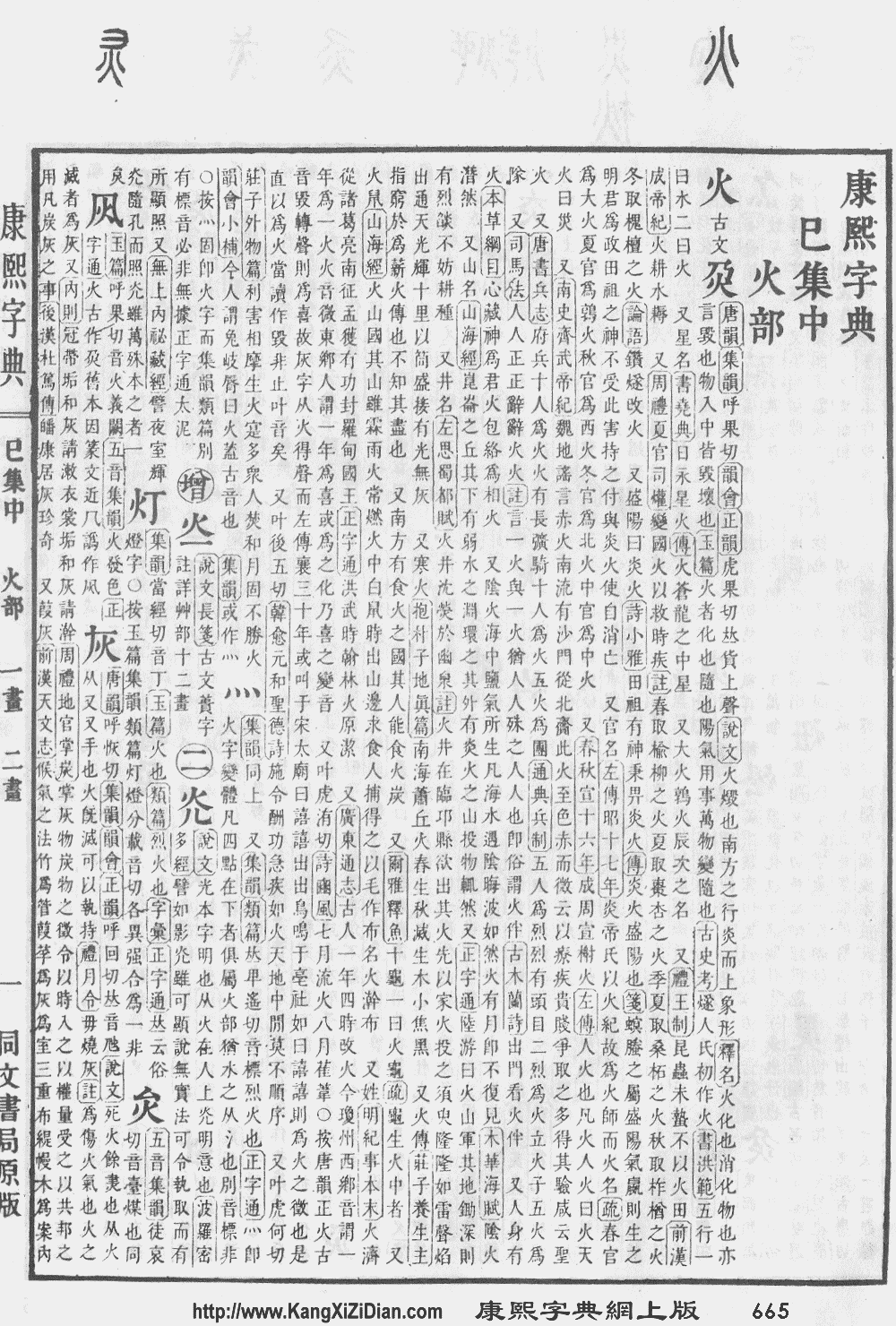
- KangXi: page 665, character 1
- Dai Kanwa Jiten: character 18850
- Dae Jaweon: page 1073, character 19
- Hanyu Da Zidian (first edition): volume 3, page 2187, character 1
- Unihan data for U+706B
Chinese
| trad. | 火 | |
|---|---|---|
| simp. # | 火 | |
Glyph origin
| Historical forms of the character 火 | ||||||
|---|---|---|---|---|---|---|
| Shang | Western Zhou | Spring and Autumn | Warring States | Shuowen Jiezi (compiled in Han) | Liushutong (compiled in Ming) | |
| Oracle bone script | Bronze inscriptions | Bronze inscriptions | Chu slip and silk script | Qin slip script | Small seal script | Transcribed ancient scripts |
 |
 |
 |
 |
 |
 |
 |
Pictogram (象形) – pictographic representation of a fire.
Etymology
Possibly from Proto-Sino-Tibetan *mej (Schuessler 2007; STEDT). However, see there for phonological problems.
Pronunciation
Definitions
火
- fire; flame
- fire (as a disaster); inferno
- red; fiery; bright; brilliant
- to burn down
- light; torch
- (dialectal) light; lamp
- anger; rage; wrath
- to become enraged
- angry; furious
- (traditional Chinese medicine) internal heat
- firearm; ammunition; weapon
- war; warfare
- thriving; brisk
- urgent; pressing
- (neologism) to become popular; to go viral
- (neologism) to be popular; to be viral
- (Cantonese) watt (unit of power)
- ※Definitely, "火" here is a unit of brightness (luminous intensity). However, the brightness of a luminous device is measured in watts in life because of luminous intensity's dependence on power, which resulted in it being bonded to watt, the unit of power.
- 20火嘅燈膽/20火嘅灯胆 [Cantonese] ― 20 fo2 ge3 dang1 daam2 [Jyutping] ― 20-watt lightbulb
- Short for 火星 (Huǒxīng, “Mars”).
- (Cantonese) roasted
Synonyms
| Variety | Location | Words |
|---|---|---|
| Formal (Written Standard Chinese) | 燈 | |
| Mandarin | Taiwan | 燈 |
| Xi'an | 燈 | |
| Chengdu | 亮 | |
| Guilin | 燈 | |
| Malaysia | 火, 燈 | |
| Singapore | 燈 | |
| Sokuluk (Gansu Dungan) | 燈 | |
| Cantonese | Guangzhou | 燈 |
| Hong Kong | 燈 | |
| Taishan | 燈, 火 | |
| Singapore (Guangfu) | 燈, 火 | |
| Gan | Nanchang | 燈 |
| Hakka | Meixian | 燈 |
| Miaoli (N. Sixian) | 燈, 火 | |
| Pingtung (Neipu; S. Sixian) | 燈, 火 | |
| Hsinchu County (Zhudong; Hailu) | 燈, 火 | |
| Taichung (Dongshi; Dabu) | 燈, 火 | |
| Hsinchu County (Qionglin; Raoping) | 燈, 火 | |
| Yunlin (Lunbei; Zhao'an) | 燈, 火 | |
| Jin | Taiyuan | 燈 |
| Min Dong | Fuzhou | 燈 |
| Min Nan | Xiamen | 燈 |
| Penang (Hokkien) | 燈, 火 | |
| Singapore (Hokkien) | 火 | |
| Manila (Hokkien) | 火, 燈 | |
| Singapore (Teochew) | 火, 燈 | |
| Waxiang | Guzhang (Gaofeng) | 燈 |
| Wu | Suzhou | 燈 |
| Ningbo | 燈, 亮 dated | |
| Wenzhou | 燈 | |
| Xiang | Changsha | 燈, 亮 |
| Xiangxiang | 燈 | |
| Variety | Location | Words |
|---|---|---|
| Formal (Written Standard Chinese) | 瓦特, 瓦 | |
| Mandarin | Taiwan | 瓦 |
| Wuhan | 支光 | |
| Guiyang | 支光, 瓦 | |
| Guilin | 瓦 | |
| Dagudi (Maliba) | 瓦 | |
| Reshuitang (Longling) | 瓦 | |
| Mae Salong (Lancang) | 瓦 | |
| Mae Sai (Tengchong) | 瓦 | |
| Cantonese | Guangzhou | 火, 𡆇 |
| Hong Kong | 火, 𡆇 | |
| Taishan (Guanghai) | 瓦 | |
| Beihai | 瓦 | |
| Beihai (Qiaogang - Cô Tô) | 瓦, 火 | |
| Beihai (Qiaogang - Cát Bà) | 瓦 | |
| Fangchenggang (Fangcheng) | 瓦 | |
| Ho Chi Minh City (Guangfu) | 瓦 | |
| Móng Cái | 瓦 | |
| Mandalay (Taishan) | 度 | |
| Hakka | Meixian | 𡆇 |
| Min Nan | Shantou | 瓦 |
| Wu | Hangzhou | 支光 |
| Ningbo | 支光 | |
- (internal heat (traditional Chinese medicine)):
Compounds
|
|
|
Japanese
Readings
Compounds
- 火炎 (kaen, “flame”)
- 火気 (kaki, “fire”)
- 火器 (kaki, “firearms”)
- 火急 (kakyū, “emergency”)
- 火球 (kakyū, “fireball”)
- 火口 (kakō, “crater”)
- 火鼠 (kaso, “fire rat”)
- 火災 (kasai, “conflagration”)
- 火山 (kazan, “volcano”)
- 火事 (kaji, “fire”)
- 火傷 (kashō, “burn”)
- 火星 (kasei, “Mars”)
- 火勢 (kasei, “force of flames”)
- 火成 (kasei)
- 火葬 (kasō, “cremation”)
- 火中 (kachū)
- 火難 (kanan, “fire calamity”)
- 火薬 (kayaku, “gunpowder”)
- 火曜 (kayō)
- 火力 (karyoku, “steam power, firepower”)
- 煙火 (enka)
- 火鈴 (korin, “(Zen) fire bell”)
- 業火 (gōka, “hellfire”)
- 小火 (shōka)
- 野火 (yaka, “wildfire”)
- 小火 (boya)
- 火傷 (yakedo)
Etymology 1
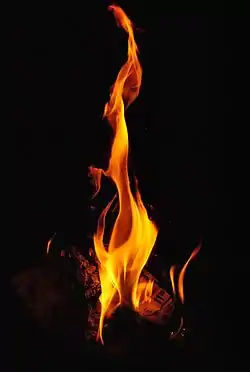
| Kanji in this term |
|---|
| 火 |
| ひ Grade: 1 |
| kun’yomi |
⟨pi2⟩ → */pʷɨ/ → /ɸi/ → /hi/
From Old Japanese,[1] from Proto-Japonic *poy.
Apophonic form of ho (see below), possibly by fusion with emphatic particle い (i). Compare the development of 木 (ko → ki, “tree”).
Alternative forms
- (light): 灯
Noun
火 • (hi)
Derived terms
- 火遊び (hiasobi, “playing with fire”)
- 火口 (higuchi): torch head, welding tip
- 火先 (hisaki, “tip of a flame”)
- 火縄 (hinawa)
- 火鼠 (hinezumi, “fire rat/mouse”)
- 火の車 (hi no kuruma): a fire-spouting cart in Hell, in which sinners are transported: a metaphor for being in a difficult situation, usually financially
- 火の手 (hi no te, “flames”)
- 火鉢 (hibachi)
- 火花 (hibana)
- 火箸 (hibashi, “tongs”)
- 火蓋 (hibuta)
- 火偏 (hihen, “fire radical”)
- 火元 (himoto, “origin of a fire”)
- 火矢, 火箭 (hiya, “fire arrow”)
- 漁り火 (isaribi)
- 鬼火 (onibi, “devilfire; will-o'-the-wisp; jack-o'-lantern”)
- 篝火 (kagaribi): a fire set in an iron cage-like bucket and used as illumination by guards or hunters; a capable person who gets things done
- 狐火 (kitsunebi, “will o' the wisp, foxfire”)
- 灯 (tomoshibi)
- 花火, 煙火 (hanabi, “fireworks”)
Idioms
- 火を見るよりも明らか (hi o miru yori mo akiraka, “clearer than seeing the fire → as plain as day, as plain as the nose on one's face, as clear as a bell”)
Etymology 2
| Kanji in this term |
|---|
| 火 |
| ほ Grade: 1 |
| kun’yomi |
/po/ → /ɸo/ → /ho/
From Old Japanese.[1]
Combining form of hi above. Probably the oldest form, possibly cognate with Korean 불 (bul, “fire”).
Pronunciation
- IPA(key): [ho̞]
Derived terms
- 火影 (hokage, “firelight/fire shadow”)
- 火口 (hokuchi, “tinder, firestarter”)
- 火気 (hoke, “flame; heat; smoke”)
- 火先 (hosaki, “tip of a flame”)
- 蛍 (hotaru, “firefly”)
- 火照る (hoteru, “to feel hot or flushed”)
- 火中 (honaka)
- 炎 (honō, “flame”)
- 炎, 焔 (homura, “flames, metaphorical flames”, connoting strong emotions such as anger or jealousy, or such as ambition or passion)


Noun

Derived terms
- 風林火山 (fūrinkazan)
Proper noun
- Antares, in the constellation Scorpio
References
- 1988, 国語大辞典(新装版) (Kokugo Dai Jiten, Revised Edition) (in Japanese), Tōkyō: Shogakukan
- 2006, 大辞林 (Daijirin), Third Edition (in Japanese), Tōkyō: Sanseidō, →ISBN
Korean
Etymology
From Middle Chinese 火 (MC huɑX).
| Historical Readings | ||
|---|---|---|
| Dongguk Jeongun Reading | ||
| Dongguk Jeongun, 1448 | 황〯 (Yale: hwǎ) | |
| Middle Korean | ||
| Text | Eumhun | |
| Gloss (hun) | Reading | |
| Hunmong Jahoe, 1527 | 블〮 (Yale: púl) | 화〯 (Yale: hwǎ) |
Pronunciation
- (in 화요 (火曜, hwayo)):
- (SK Standard/Seoul) IPA(key): [ɸwa̠]
- Phonetic hangul: [화]
- (fire; anger; etc.):
- (SK Standard/Seoul) IPA(key): [ɸwa̠(ː)]
- Phonetic hangul: [화(ː)]
- Though still prescribed in Standard Korean, most speakers in both Koreas no longer distinguish vowel length.
Compounds
- 곡제화주 (穀製火酒, gokjehwaju)
- 귀화 (鬼火, gwihwa)
- 내화복 (耐火服, naehwabok)
- 대화 (大火, daehwa)
- 도화선 (導火線, dohwaseon)
- 등화 (燈火, deunghwa)
- 발화 (發火, balhwa)
- 방화 (放火, banghwa)
- 방화 (防火, banghwa)
- 병화 (病火, byeonghwa)
- 봉화 (烽火, bonghwa)
- 성화 (聖火, seonghwa)
- 소화 (燒火, sohwa)
- 소화기 (消火器, sohwagi)
- 소화전 (消火栓, sohwajeon)
- 연화신호 (煙火信號, yeonhwasinho)
- 요화 (燎火, yohwa)
- 유화 (流火, yuhwa)
- 인화 (引火, inhwa)
- 전화 (戰火, jeonhwa)
- 점화 (點火, jeomhwa)
- 진화 (鎭火, jinhwa)
- 착화 (着火, chakhwa)
- 포화 (砲火, pohwa)
- 화각 (火角, hwagak)
- 화기 (火器, hwagi)
- 화기 (火技, hwagi)
- 화기 (火氣, hwagi)
- 화대 (火大, hwadae)
- 화두 (火頭, hwadu)
- 화둔 (火遁, hwadun)
- 화력 (火力, hwaryeok)
- 화륜선 (火輪船, hwaryunseon)
- 화마 (火魔, hwama)
- 화산 (火山, hwasan)
- 화상 (火傷, hwasang)
- 화상 (火床, hwasang)
- 화성 (火星, hwaseong)
- 화성 (火聲, hwaseong)
- 화신 (火神, hwasin)
- 화약 (火藥, hwayak)
- 화염 (火焰, hwayeom)
- 화염병 (火焰甁, hwayeombyeong)
- 화요일 (火曜日, hwayoil)
- 화장 (火葬, hwajang)
- 화재 (火災, hwajae)
- 화제 (火帝, hwaje)
- 화주 (火主, hwaju)
- 화증 (火症, hwajeung)
- 화직성 (火直星, hwajikseong)
- 화청 (火淸, hwacheong)
Old Japanese
Etymology 1
From Proto-Japonic *poy.
Apophonic form of po (see below), possibly by fusion with emphatic particle い (i2).
Noun
火 (pi2) (kana ひ)
Derived terms
Etymology 2
Combining form of pi2 above, probably the older form.
Descendants
- Japanese: 火 (ho)
Vietnamese
References
- Nguyễn (2014).
- Nguyễn et al. (2009).
- Trần (2004).
- Bonet (1899).
- Génibrel (1898).