米
| ||||||||
| ||||||||
Translingual
| Stroke order | |||
|---|---|---|---|
 | |||
Han character
米 (Kangxi radical 119, 米+0, 6 strokes, cangjie input 火木 (FD), four-corner 90904, composition ⿻丷木(GHJKV) or ⿻十⿱丷八(T) or ⿻丷⿻十八(T))
- Kangxi radical #119, ⽶.
Derived characters
References
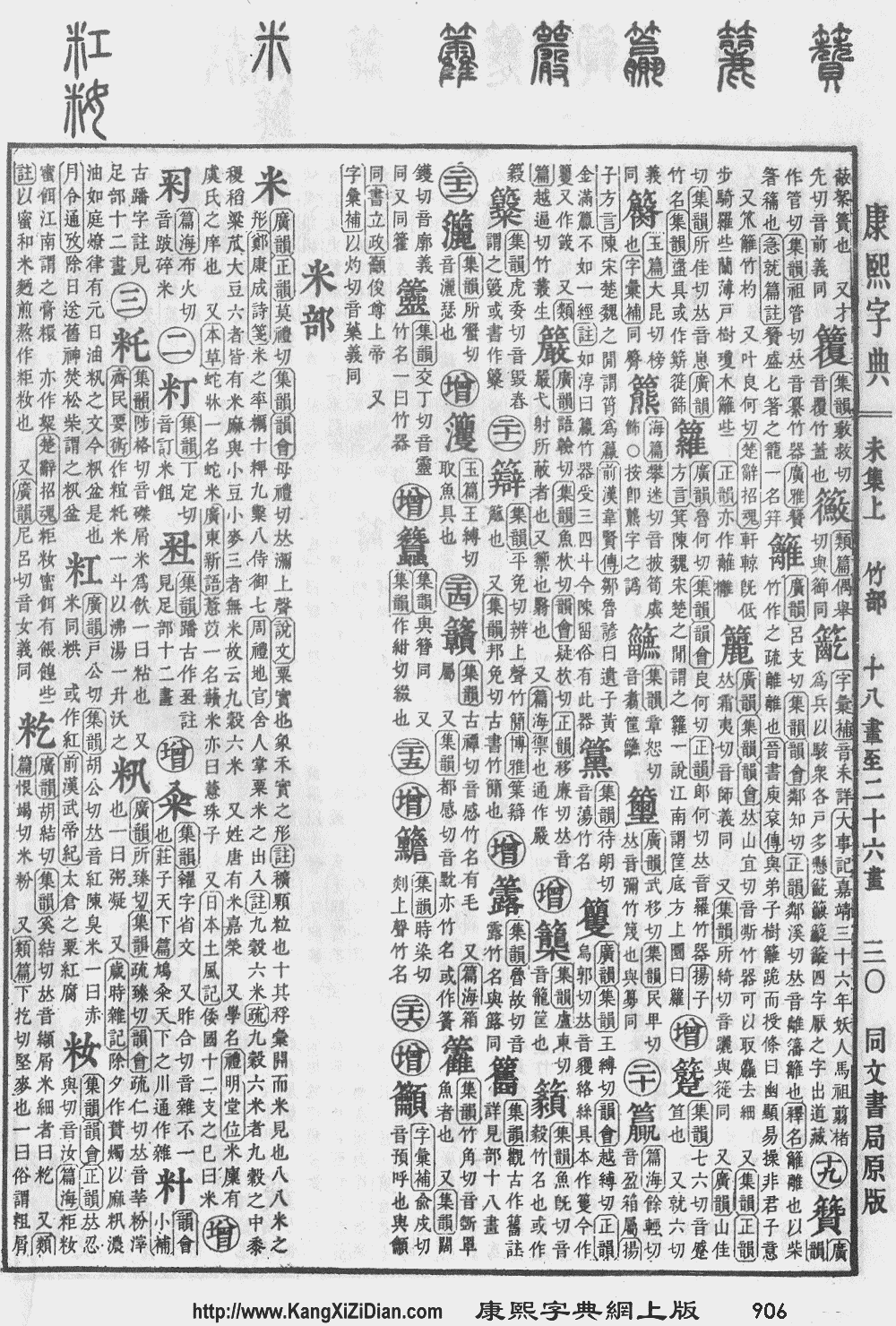
- KangXi: page 906, character 31
- Dai Kanwa Jiten: character 26832
- Dae Jaweon: page 1331, character 28
- Hanyu Da Zidian (first edition): volume 5, page 3141, character 1
- Unihan data for U+7C73
Chinese
| trad. | 米 | |
|---|---|---|
| simp. # | 米 | |
Glyph origin
| Historical forms of the character 米 | |||||
|---|---|---|---|---|---|
| Shang | Western Zhou | Warring States | Shuowen Jiezi (compiled in Han) | Liushutong (compiled in Ming) | |
| Oracle bone script | Bronze inscriptions | Chu slip and silk script | Qin slip script | Small seal script | Transcribed ancient scripts |
 |
 |
 |
 |
 |
 |
Pictogram (象形) – rice kernels.
Etymology 1
From Proto-Sino-Tibetan *ma-j ~ mej (“rice; paddy”). Cognate with Garo mi (“rice”), Atong (India) mai (“rice”), Jingpho ma (“rice; paddy”), Rabha মাই (mai), Dimasa mai.
Pronunciation
Definitions
米
- hulled or husked uncooked rice
- husked seed
- grain-like things
- (chiefly Cantonese) Short for 米粉 (mǐfěn, “rice vermicelli”).
- 星洲炒米 ― Xīngzhōu chǎomǐ ― Singapore-style noodles
- (Cantonese, Shanghainese Wu, slang) money
- 有米 [Cantonese] ― jau5 mai5 [Jyutping] ― rich
- 背米 [Shanghainese] ― [pe̞⁴⁴ mi²³] [IPA] ― to earn money
- (Shanghainese Wu, slang) ten thousand of a currency designation (Classifier: 粒)
- a surname
Synonyms
Compounds
|
|
|
Pronunciation
Definitions
米
Synonyms
References
- “米”, in 漢語多功能字庫 (Multi-function Chinese Character Database), 香港中文大學/香港中文大学 (the Chinese University of Hong Kong), 2014–
- “Entry #2599”, in 臺灣閩南語常用詞辭典 [Dictionary of Frequently-Used Taiwan Minnan] (in Chinese and Min Nan), Ministry of Education, R.O.C., 2011.
Japanese
Readings
Compounds
- 米原 (Maibara)
- 米塩 (beien)
- 米価 (beika)
- 米軍 (Beigun)
- 米国 (Beikoku, “the United States”)
- 米穀 (beikoku)
- 米作 (beisaku)
- 米寿 (beiju)
- 米粟 (beizoku)
- 米栂 (beitsuga)
- 米飯 (beihan)
- 米粉 (beifun)
- 赤米 (akamai)
- 入り米 (irimai)
- 欧米 (Ō-Bei)
- 外国米 (gaikokumai), 外米 (gaimai)
- 供米 (kyōmai)
- 供米 (kumai)
- 玄米 (genmai)
- 黒米 (kokumai)
- 五斗米 (gotobei)
- 散米 (sanmai)
- 産米 (sanmai)
- 舂米 (shōmai)
- 親米 (shin-Bei)
- 新米 (shinmai)
- 神米 (shinmai)
- 精白米 (seihakumai)
- 精米 (seimai)
- 洗米 (senmai)
- 饌米 (senmai)
- 大唐米 (daitōmai)
- 渡米 (to-Bei)
- 内地米 (naichimai)
- 南米 (Nanbei, “South America”)
- 日米 (Nichi-Bei)
- 白米 (hakumai)
- 平米 (heibei, “square meter, square metre”)
- 北米 (Hokubei, “North America”)
- 立米 (ryūbei, “cubic meter, cubic metre”)
- 禄米 (rokumai)
- 早稲米 (wasemai)
- 糈米 (kumashine)
- 米粉 (bīfun, “rice vermicelli”)
Etymology 1
| Kanji in this term |
|---|
| 米 |
| こめ Grade: 2 |
| kun’yomi |
⟨ko2me2⟩ → */kəməj/ → /kome/
From Old Japanese. First appears in the Nihon Shoki of 720 CE, with the phonetic man'yōgana spelling 渠梅.[1]
Many theories exist regarding the ultimate derivation:
- From reconstructed Proto-Japonic *kəmay, in which this case it would be cognate with Proto-Ryukyuan *kome.
- Perhaps from 籠め (kome), the 連用形 (ren'yōkei, “stem or continuative form”) of verb 籠める (komeru, “do with one's heart”), from the way rice is farmed.
- Possibly cognate with Proto-Vietic *kəːm (“cooked rice”), modern cơm.
- Possibly cognate with Proto-Austronesian *Semay and Old Chinese 糜 (OC *mral).[2][3] However, none of the known derivations from Proto-Austronesian *Semay develop initial /k/, nor is this shift explainable by any known mechanism within Japonic.
Noun
米 • (kome)
- rice (husked grains of the Asian rice plant, Oryza sativa), one of the five grains
- Hypernym: 五穀 (gokoku)
Derived terms
- 米揚げ (komeage)
- 米揚げ笊 (komeage zaru)
- 米油 (kome abura)
- 米市 (komeichi)
- 米占 (komeura)
- 米浙 (komekashi)
- 米浙桶 (komekashi oke)
- 米噛み
- 米茅 (komegaya)
- 米粉 (komeko)
- 米麹 (kome kōji)
- 米座 (komeza)
- 米刺し, 米差し (komesashi)
- 米将軍 (Kome Shōgun)
- 米酢 (kome-su), 米酢 (komezu)
- 米代 (komedai)
- 米俵, 米苞 (kome-dawara)
- 米栂 (kometsuga)
- 米搗き, 米舂き (kometsuki)
- 米粒 (kometsubu)
- 米糠 (komenuka)
- 米偏 (komehen)
- 米屋 (komeya)
- 赤米 (akagome)
- 煎り米, 炒り米 (irigome)
- 粳米 (urugome)
- 生米 (kigome)
- 黒米, 玄米 (kurogome)
- 小米, 粉米 (kogome)
- 白米 (shirogome)
- 大唐米 (daito-gome)
- 大唐米 (daitō-gome)
- 搗き米, 舂き米 (tsukigome)
- 生米 (namagome)
- 碾き米 (hikigome)
- 陳米 (hinegome)
- 蓑米 (minogome)
- 糯米, 餅米 (mochigome)
- 籾米 (momigome)
- 焼米, 焼き米, 糄 (yakigome)
- 闇米 (yamigome)
- 早稲米 (wasagome)
Proverbs
- 米の飯とお天道様はどこへ行っても付いて回る (kome no meshi to o-tentō-sama wa doko e itte mo tsuite mawaru)
- 乞食が米を零したよう (kojiki ga kome o koboshita yō)
- 糠を舐りて米に及ぶ (nuka o neburi te kome ni oyobu)
- 熊野松風は米の飯 (Yuya Matsukaze wa kome no meshi)
Coordinate terms
- 五穀 (gokoku, “five grains”): 米 (kome, “rice”), 麦 (mugi, “wheat”), 粟 (awa, “foxtail millet”), 黍 (kibi, “proso millet”), 豆 (mame, “soybeans”)
Etymology 2
| Kanji in this term |
|---|
| 米 |
| よね Grade: 2 |
| kun’yomi |
⟨yo2nai⟩ → */jənai/ → */jəne/ → /jone/
First attested in the Wamyō Ruijushō (938 CE).
Possibly from Proto-Japonic *jənaC- (Vovin, 1998)[7] and related to 稲 (ine, “rice plant”).
Unknown "-C-" consonantal segment, reconstructed by Vovin, seems unlikely considering [a ~ e] vowel alternation, seen in bound form yona- and free form yone:[8]
- Compare 藍 (awi → ai, “indigo”) from 青 (awo → ao, “blue”) + い (i, emphatic nominative particle)[9] against 白い /siroi/ from ⟨siro1ki1⟩.[10]
The colloquial sense is derived from the components of the 米 kanji: 八 (hachi, “eight”) + 十 (jū, “ten”) + 八 (hachi, “eight”).
Noun
米 • (yone)
Derived terms
- 米市 (Yoneichi)
- 米占 (yoneura)
- 米川 (Yonekawa)
- 米沢 (Yonezawa)
- 米代 (Yoneshiro)
- 米酢 (yonezu)
- 米の祝い (yone no iwai)
- 米の守り (yone no mamori)
- 米原 (Yonehara)
- 米饅頭 (yone manjū)
- 米山 (Yoneyama)
- 米琉 (Yone-Ryū)
- 洗い米 (arai yone)
- 売り米, 糶 (uriyone)
- 買い米, 糴 (kaiyone)
- 粿米, 淅米 (kashiyone)
- 精げ米 (shirage yone)
- 白米 (shirayone)
- 散らし米 (chirashi yone)
- 籾米 (momiyone)
Etymology 3
| Kanji in this term |
|---|
| 米 |
| めめ Grade: 2 |
| kun’yomi |
First attested around the Edo period.
Probably a shortened reduplication of kome (see above). (Can this(+) etymology be sourced?)
Etymology 4
| Kanji in this term |
|---|
| 米 |
| めーとる Grade: 2 (ateji) |
| kun’yomi |
Borrowing from French mètre.[4]
The use of this kanji is attested in the Meiji period and is an example of ateji (当て字), shortened from Mandarin 米突 (mǐtū), see Chinese section above.
Noun
米 • (mētoru)
Derived terms
- 粍 (mirimētoru, “millimetre”)
- 糎 (senchimētoru, “centimetre”)
- 粉 (deshimētoru, “decimetre”)
- 籵 (dekamētoru, “decametre”)
- 粨 (hekutomētoru, “hectometre”)
- 粁 (kiromētoru, “kilometre”)
See also
Pronunciation
- IPA(key): [be̞ː]
Affix
- rice
- Short for アメリカ合衆国/亜米利加合衆国 (Amerika Gasshūkoku, “United States (a country)”).
- 米国 (Beikoku, “US”)
- 日米関係 (Nichi-Bei kankei, “Japan–United States relations”)
References
- “米”, in 日本国語大辞典 (Nihon Kokugo Daijiten, “Nihon Kokugo Daijiten”) (in Japanese), 2nd edition, Tōkyō: Shogakukan, 2000, →ISBN
- 2006, 大辞林 (Daijirin), Third Edition (in Japanese), Tōkyō: Sanseidō, →ISBN
- 1974, 新明解国語辞典 (Shin Meikai Kokugo Jiten), Second Edition (in Japanese), Tōkyō: Sanseidō
- 1960, Tetsuo Hirayama (平山輝男, editor), 全国アクセント辞典 (Zenkoku Akusento Jiten, “Nationwide Accent Dictionary”), (in Japanese), Tōkyō: Tōkyōdō, →ISBN
- Whitman, John (2012). "Northeast Asian Linguistic Ecology and the Advent of Rice Agriculture in Korea and Japan, Rice, Volume 4, Issue 3–4, pp 149–158. https://doi.org/10.1007/s12284-011-9080-0
- Salingre, Maëlys Apophonic toponyms in Japanese 2019
- Thomas Pellard (2013). Ryukyuan perspectives on the proto-Japonic vowel system. Frellesvig, Bjarke; Sells, Peter. Japanese/Korean Linguistics 20, CSLI Publications, pp.81–96, 2013.
- Hamano, S. "Voicing of Obstruents in Old Japanese: Evidence from the Sound-Symbolic Stratum." Journal of East Asian Linguistics (2000) 9. 3: 207-225. https://doi.org/10.1023/A:1008367619295
Korean
Etymology
From Middle Chinese 米 (MC meiX).
| Historical Readings | ||
|---|---|---|
| Dongguk Jeongun Reading | ||
| Dongguk Jeongun, 1448 | 몡〯 (Yale: myěy) | |
| Middle Korean | ||
| Text | Eumhun | |
| Gloss (hun) | Reading | |
| Hunmong Jahoe, 1527 | ᄡᆞᆯ〮 (Yale: psól) | 미〯 (Yale: mǐ) |
Pronunciation
- (SK Standard/Seoul) IPA(key): [mi]
- Phonetic hangul: [미]
Compounds
Old Korean
Reconstruction notes
- This form is attested commonly in the hyangga poems of the first millennium, but nowhere else.
- In the twentieth century, this was conventionally compared to Modern Korean 으매 (-eumae, “because, since”), but this seems impossible given that the modern construction is a grammaticalization of elements not found in Old Korean, and is not attested in Middle Korean.
- Some scholars believe it is a mere orthographic variant of 㢱 (*-mye, connective suffix).
Further reading
- 이용 (Yi-Yong) (1999) 연결 어미의 형성에 관한 연구 [Study of the formation of connective suffixes], Seoul City University (PhD), pages 144—146
- 김지오 (Kim Ji-o) (2019), “고대국어 연결어미 연구의 현황과 과제 [The conditions and future tasks of analyzing connective endings in Old Korean]”, in Gugyeol Yeon'gu, volume 43, pages 55–87
Vietnamese
References
- Trần (2004).
- Bonet (1899).
- Génibrel (1898).
- Taberd & Pigneau de Béhaine (1838).