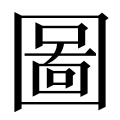
圖
| ||||||||
 | ||||||||
Translingual
| Traditional | 圖 |
|---|---|
| Shinjitai | 図 |
| Simplified | 图 |
Alternative forms
Note that the 啚 component in this character is written ⿳口十回 (China, Vietnam) and ⿳口亠回 (Taiwan, Hong Kong, Japan, Korea). Differences between the traditional Chinese forms exist due to different national standards.
Han character
圖 (Kangxi radical 31, 囗+11, 14 strokes, cangjie input 田口十田 (WRJW) or 田口卜田 (WRYW), four-corner 60600, composition ⿴囗啚)
Derived characters
References
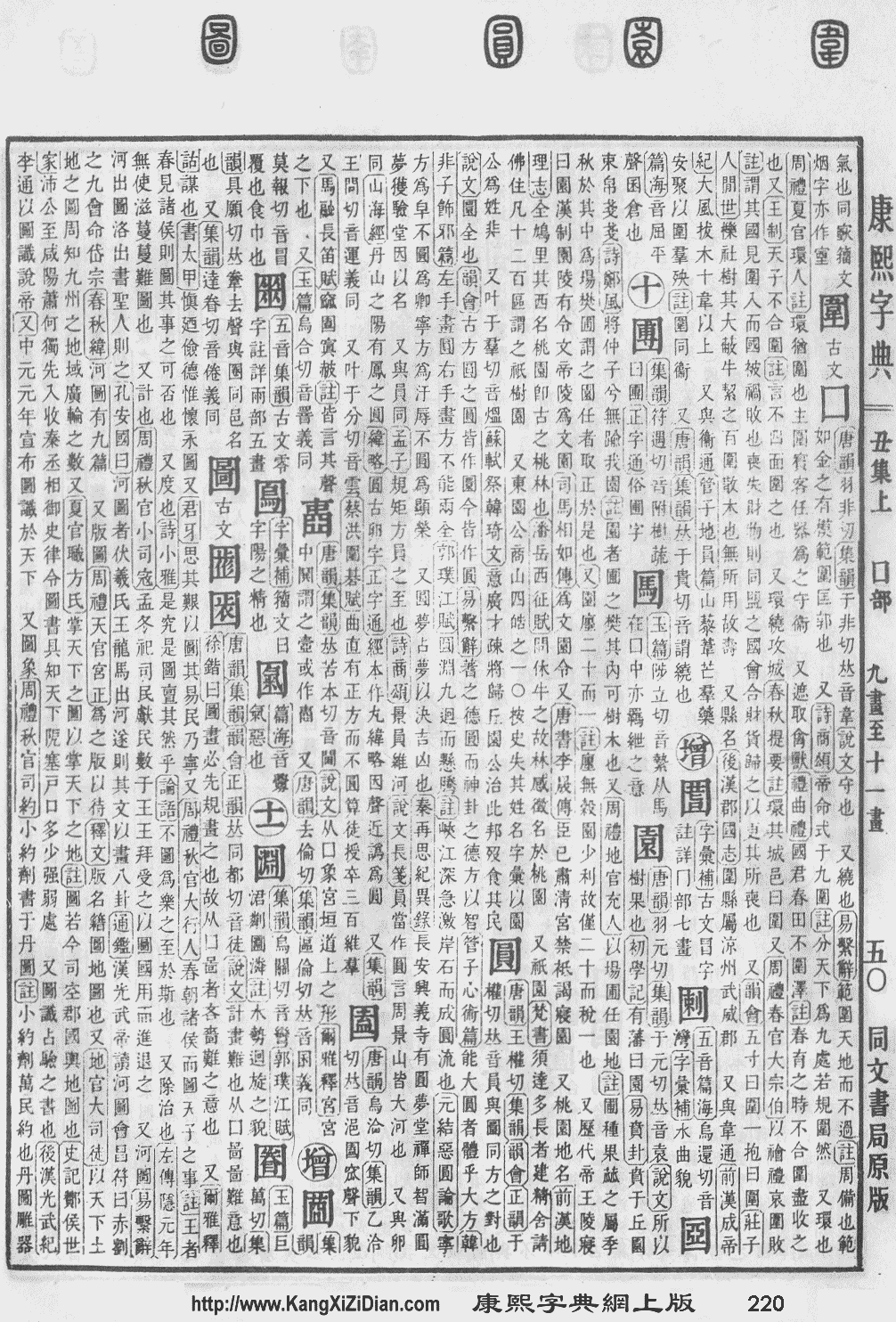
- KangXi: page 220, character 18
- Dai Kanwa Jiten: character 4832
- Dae Jaweon: page 452, character 11
- Hanyu Da Zidian (first edition): volume 1, page 725, character 6
- Unihan data for U+5716
- Unihan data for U+2F84B
Chinese
| trad. | 圖 | |
|---|---|---|
| simp. | 图 | |
| alternative forms | ||
Glyph origin
| Historical forms of the character 圖 | ||||
|---|---|---|---|---|
| Western Zhou | Warring States | Shuowen Jiezi (compiled in Han) | Liushutong (compiled in Ming) | |
| Bronze inscriptions | Bronze inscriptions | Qin slip script | Small seal script | Transcribed ancient scripts |
 |
 |
 |
 |
 |
Ideogrammic compound (會意/会意) : 囗 (“walled city”) + 啚.
啚 is the early form of 鄙 (OC *prɯʔ, “remote areas”), thus meaning “territory”.
Pronunciation
Definitions
圖
Compounds
Derived terms from 圖
|
|
|
References
- “圖”, in 漢語多功能字庫 (Multi-function Chinese Character Database), 香港中文大學/香港中文大学 (the Chinese University of Hong Kong), 2014–
- Dictionary of Chinese Character Variants (教育部異體字字典), A00739
Korean
Vietnamese
This article is issued from Wiktionary. The text is licensed under Creative Commons - Attribution - Sharealike. Additional terms may apply for the media files.