Portal:Nepal

स्वागतम् / Welcome to the Nepal Portal
  Budhanilkantha Temple in Budhanilkantha, Nepal
 The flag of Nepal .svg.png.webp) Location on the world map Nepal (English: /nɪˈpɔːl/; Nepali: नेपाल [nepal]), officially the Federal Democratic Republic of Nepal (Nepali: सङ्घीय लोकतान्त्रिक गणतन्त्र नेपाल), is a landlocked country in South Asia. It is mainly situated in the Himalayas, but also includes parts of the Indo-Gangetic Plain, bordering the Tibet Autonomous Region of China to the north, and India in the south, east, and west, while it is narrowly separated from Bangladesh by the Siliguri Corridor, and from Bhutan by the Indian state of Sikkim. Nepal has a diverse geography, including fertile plains, subalpine forested hills, and eight of the world's ten tallest mountains, including Mount Everest, the highest point on Earth. Nepal is a multi-ethnic, multi-lingual, multi-religious and multi-cultural state, with Nepali as the official language. Kathmandu is the nation's capital and the largest city. The name "Nepal" is first recorded in texts from the Vedic period of the Indian subcontinent, the era in ancient Nepal when Hinduism was founded, the predominant religion of the country. In the middle of the first millennium BC, Gautama Buddha, the founder of Buddhism, was born in Lumbini in southern Nepal. Parts of northern Nepal were intertwined with the culture of Tibet. The centrally located Kathmandu Valley is intertwined with the culture of Indo-Aryans, and was the seat of the prosperous Newar confederacy known as Nepal Mandala. The Himalayan branch of the ancient Silk Road was dominated by the valley's traders. The cosmopolitan region developed distinct traditional art and architecture. By the 18th century, the Gorkha Kingdom achieved the unification of Nepal. The Shah dynasty established the Kingdom of Nepal and later formed an alliance with the British Empire, under its Rana dynasty of premiers. The country was never colonised but served as a buffer state between Imperial China and British India. Parliamentary democracy was introduced in 1951 but was twice suspended by Nepalese monarchs, in 1960 and 2005. The Nepalese Civil War in the 1990s and early 2000s resulted in the establishment of a secular republic in 2008, ending the world's last Hindu monarchy. The Constitution of Nepal, adopted in 2015, affirms the country as a secular federal parliamentary republic divided into seven provinces. Nepal was admitted to the United Nations in 1955, and friendship treaties were signed with India in 1950 and China in 1960. Nepal hosts the permanent secretariat of the South Asian Association for Regional Cooperation (SAARC), of which it is a founding member. Nepal is also a member of the Non-Aligned Movement and the Bay of Bengal Initiative. The Nepalese Armed Forces are the fifth-largest in South Asia; and are notable for their Gurkha history, particularly during the world wars, and has been a significant contributor to United Nations peacekeeping operations. (Full article...) More Did you know (auto generated)
Selected article -
Chhairo Monastery (Wylie: tshe rogs dgon pa, THL Tsérok Monastery) was the first monastery of the Nyingma school of Tibetan Buddhism founded in Upper Mustang. It was established in the 16th century and is part of present-day Mustang District, Nepal. The village and the gompa are located on the historic salt trade route and the population of both Chhairo Monastery and Chhairo village fell into decline when China closed its border with Nepal in the 1960s to restrict movement by pro-Tibetan activists and again recently due to security concerns during the 2008 Summer Olympics. (Full article...)
| ||||||||||||||||||||||||||||||||||||||||||||||||||||||||||||||||||||||||||||||||||||||||||||||||||||||||||||||||||||||||||||||||||||||||||||||||||


.jpg.webp) Shah at the Nepalese movie premiere of A Mero Hajur 2 (2017). |
Samragyee Rajya Laxmi Shah (Nepali: सम्राज्ञी राज्य लक्ष्मी शाह; born 18 November 1995), credited as Samragyee RL Shah, is a Nepali film actress who works in Nepali cinema. Shah is the recipient of several awards, including one NFDC National Film Awards and one NEFTA Film Awards.
She has starred in numerous Nepali films, including A Mero Hajur 2 (2017), Intu Mintu Londonma (2018), and Rato Tika Nidharma (2019). Shah debuted as an actress in the 2016 romantic drama Dreams, which went on to become a commercial success, and earned several awards for her performance. After being cast in Ashok Sharma's directorial project Rato Tika Nidharma (2019) and paid 1.6 million (1,600,000) Nepalese rupees (NPR), Shah became the highest-paid actress in the Nepali film industry. She is also related to the Nepali royal family. Her upcoming movie is Timro Mero Saath, which also marks directorial debut of Ramesh MKPoudel. (Full article...)List of Good articles |
|---|
Selected picture -

Categories

Selected biography -
 Koirala in the 1950s |
Bishweshwar Prasad Koirala (Nepali: विश्वेश्वरप्रसाद कोइराला; 8 September 1914 – 21 July 1982), (Nepali: 1971 B.S. Bhadra 24 - 2039 B.S Shrawan 6) better known as B. P. Koirala (Nepali: बीपी कोइराला), was a Nepali revolutionary, political leader and writer. He was the Prime Minister of Nepal from 1959 to 1960. He led the Nepali Congress, a social democratic political party. He was the grandfather of Bollywood actress Manisha Koirala and older brother of former prime minister Girija Prasad Koirala and younger brother of former prime minister Matrika Prasad Koirala.
Koirala was the first democratically elected and 22nd Prime Minister of Nepal. He held the office for 18 months before being deposed and imprisoned at the instruction of King Mahendra. The rest of his life was spent largely in prison or exile and in steadily deteriorating health. (Full article...)Selected fare or cuisine -
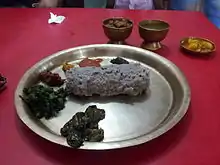 |
 listen)) is a meal prepared in Nepal. It is prepared by gradually adding flour to boiling water while stirring. It is a staple meal in various parts of Nepal and the Sikkim and Darjeeling regions of India. Though it is a staple food in Nepal, dhindo has previously been seen as an inferior food compared to rice, and was associated with low status. The inclusion of dhindo on urban restaurant menus has coincided with a rise in the food's prestige, possibly attributable to the changing perception of Nepal's indigenous crops, which are now recognized for their nutritional advantage. (Full article...)
List of fare/cuisine articles |
|---|
Did you know -
- ... that according to legend, Swayambhunath, one of the oldest stupas in Nepal, came out of a sacred lotus at the centre of Kathmandu when the city was a lake?
- ... that construction of the 195 m (640 ft) Gorkha Bridge in Nepal reconnected seven remote villages and reestablished a portion of a popular hiking trail?
Wiki Loves Nepal
  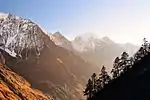 |
Wiki Loves Earth is an international photographic competition to promote natural heritage sites around the World through Wikimedia projects (mainly Wikipedia and Wikimedia Commons).
- 2018 • 2017 • 2016 • 2015 • 2014 • More information • Main category page

Wiki Loves Monuments is an international photographic competition to promote cultural monuments around the World through Wikimedia projects (mainly Wikipedia and Wikimedia Commons.
- 2017 • 2016 • 2015 • 2014 • 2013 • More information • Main category page
Provinces

General images -
The following are images from various Nepal-related articles on Wikipedia.
.jpg.webp) Procession of Nepali Pahadi Hindu Wedding (from Culture of Nepal)
Procession of Nepali Pahadi Hindu Wedding (from Culture of Nepal) Senior offering Dashain Tika on great Nepali Hindu festival at a traditional home. (from Culture of Nepal)
 Nepali traditional Pahadi dress used for dance (from Culture of Nepal)
 Nepali Pahadi groom (from Culture of Nepal)
.jpg.webp) A map of Greater Nepal with the book published in 1819 by Francis Hamilton M. D. named "An Account of the Kingdom of Nepal and the Territories annexed to this Dominion by the House of Gorkha". (from History of Nepal)
A map of Greater Nepal with the book published in 1819 by Francis Hamilton M. D. named "An Account of the Kingdom of Nepal and the Territories annexed to this Dominion by the House of Gorkha". (from History of Nepal) Costumed Hindu girls of Kathmandu during festival time in Nepal (from Culture of Nepal)
 Senior offering Dashain Tika to junior (from Culture of Nepal)
 Nepali Pahadi Hindu marriage at Narayangadh, Chitawan (from Culture of Nepal)
 A Buddhist monastery in southern Nepal. (from Culture of Nepal)
 A 1905 painting of Nepalese woman (from Culture of Nepal)
 Women in cultural costume at Ubhauli Kirati festival 2017 at Gough Whitlam Park, Earlwood (from Culture of Nepal)
.jpg.webp) Procession of Nepali Hindu Wedding; Groom being carried by a bride brother or relatives (from Culture of Nepal)
Procession of Nepali Hindu Wedding; Groom being carried by a bride brother or relatives (from Culture of Nepal).jpg.webp) Procession of Nepali Hindu Wedding (from Culture of Nepal)
Procession of Nepali Hindu Wedding (from Culture of Nepal) Statue of the Bodhisattva Avalokiteshvara, gilded bronze, Nepal, 16th century CE (from Culture of Nepal)
 Mohar of king Prithvi Narayan Shah dated Saka Era 1685 (CE 1763) (from History of Nepal)
 "Nēpāla" in the late Brahmi script, in the Allahabad Pillar inscription of Samudragupta (350-375 CE). (from History of Nepal)
Topics
| Sino-Tibetan (Trans-Himalayan) |
| ||||||||
|---|---|---|---|---|---|---|---|---|---|
| Indo-Aryan |
| ||||||||
| Indo-Aryan of a distinct origin | |||||||||
| Other peoples (M, D, i) of Indus-Ganga |
| ||||||||
| Immigrants | |||||||||
| Other basis |
| ||||||||
| Africa | |
|---|---|
| Americas | |
| Asia | |
| Europe | |
| Oceania | |
| International organizations | |
| Treaties | |
| Related topics | |
| |

| Nepalese diaspora (NRN) | |||||||||
|---|---|---|---|---|---|---|---|---|---|
| Africa | |||||||||
| Asia |
| ||||||||
| Europe | |||||||||
| North America | |||||||||
| Oceania | |||||||||
| |||||||||||||
| |||||||||||||
| ||
| Cultural | ||
|---|---|---|
| Natural | ||

| 20th century |
| |
|---|---|---|
| 21st century | ||
Related portals
Recognized content


_(restoration).jpg.webp)


_4.jpg.webp)
_(restoration).jpg.webp)


%252C_male%252C_Gokarna.jpg.webp)


.jpg.webp)
Associated Wikimedia
The following Wikimedia Foundation sister projects provide more on this subject:
-
 Commons
Free media repository -
 Wikibooks
Free textbooks and manuals -
 Wikidata
Free knowledge base -
 Wikinews
Free-content news -
 Wikiquote
Collection of quotations -
 Wikisource
Free-content library -
 Wikiversity
Free learning tools -
 Wikivoyage
Free travel guide -
 Wiktionary
Dictionary and thesaurus
-
 List of all portalsList of all portals
 -
 The arts portal
 -
 Biography portal
 -
 Current events portal
 -
 Geography portal
 -
 History portal
 -
 Mathematics portal
 -
 Science portal
 -
 Society portal
 -
 Technology portal
 -
 Random portalRandom portal
 -
 WikiProject PortalsWikiProject Portals