Portal:Latin America

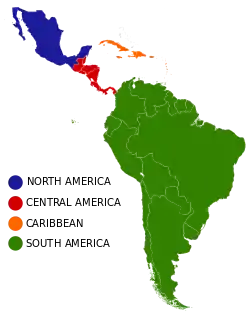
Latin America is a cultural concept denoting the Americas where Romance languages—languages derived from Latin—are predominantly spoken. The term was coined in the nineteenth century, to refer to regions in the Americas that were ruled by the Spanish, Portuguese and French empires. The term does not have a precise definition, but it is "commonly used to describe South America, Central America, Mexico, and the islands of the Caribbean." In a narrow sense, it refers to Spanish America, Brazil (Portuguese America), French West Indies and Antillean Creole French speaking Caribbean countries. The term "Latin America" is broader than categories such as Hispanic America, which specifically refers to Spanish-speaking countries; and Ibero-America, a term not generally used that specifically refers to Spanish, French and French Creole-speaking countries and Portuguese-speaking countries sometimes leaving French and British excolonies aside.

The term Latin America was first used in an 1856 conference called "Initiative of America: Idea for a Federal Congress of the Republics" (Iniciativa de la América. Idea de un Congreso Federal de las Repúblicas), by the Chilean politician Francisco Bilbao. The term was further popularized by French emperor Napoleon III's government in the 1860s as Amérique latine to justify France's military involvement in the Second Mexican Empire and to include French-speaking territories in the Americas such as French Canada, French Louisiana, French Guiana, Martinique, Guadeloupe, Haiti and the French Antillean Creole Caribbean islands Saint Lucia and Dominica, in the larger group of countries where Spanish and Portuguese languages prevailed.

The region covers an area that stretches from Mexico to Tierra del Fuego and includes much of the Caribbean. It has an area of approximately 19,197,000 km2 (7,412,000 sq mi), almost 13% of the Earth's land surface area. As of March 2, 2020, the population of Latin America and the Caribbean was estimated at more than 652 million, and in 2019, Latin America had a combined nominal GDP of US$5,188,250 trillion and a GDP PPP of US$10,284,588 trillion. (Full article...)

Recognized content -

Entries here consist of Good and Featured articles, which meet a core set of high editorial standards.

The General in His Labyrinth (original Spanish title: El general en su laberinto) is a 1989 dictator novel by Colombian writer and Nobel laureate Gabriel García Márquez. It is a fictionalized account of the last seven months of Simón Bolívar, liberator and leader of Gran Colombia. The book traces Bolívar's final journey from Bogotá to the Caribbean coastline of Colombia in his attempt to leave South America for exile in Europe. Breaking with the traditional heroic portrayal of Bolívar El Libertador, García Márquez depicts a pathetic protagonist, a prematurely aged man who is physically ill and mentally exhausted. The story explores the labyrinth of Bolívar's life through the narrative of his memories, in which "despair, sickness, and death inevitably win out over love, health, and life".

Following the success of One Hundred Years of Solitude (1967) and Love in the Time of Cholera (1985), García Márquez decided to write about the "Great Liberator" after reading an unfinished novel by his friend Álvaro Mutis. He borrowed the setting—Bolívar's voyage down the Magdalena River in 1830—from Mutis. García Márquez spent two years researching the subject, encompassing the extensive memoirs of Bolívar's Irish aide-de-camp, Daniel Florencio O'Leary, as well as numerous other historical documents and consultations with academics. (Full article...)
List of recognized articles

Topics

More did you know -

WikiProjects

  • WikiProject South America
  • WikiProject Latin America (semi-active)

Selected article -

A coffee plantation in Santo Antônio do Amparo, Minas Gerais

Brazil produces about a third of the world's coffee, making the country by far the world's largest producer. Coffee plantations, covering some 27,000 km2 (10,000 sq mi), are mainly located in the southeastern states of Minas Gerais, São Paulo and Paraná where the environment and climate provide ideal growing conditions.

The crop first arrived in Brazil in the 18th century, and the country had become the dominant producer by the 1840s. Brazilian coffee prospered since the early 19th century, when immigrants came to work in the coffee plantations. Production as a share of world coffee output peaked in the 1920s but has declined since the 1950s due to increased global production. (Full article...)
List of selected articles

Did you know (auto-generated)

General images

The following are images from various Latin America-related articles on Wikipedia.

Selected panorama

Iguazú Falls
Iguazú Falls

Panorama of the Iguazú Falls, in the Brazilian side. Walkways allow close views of the falls from both Brazil and Argentina. The falls, an UNESCO World Heritage Site, are located on the border of the Brazilian State of Paraná and the Argentine Province of Misiones.

Selected picture

A gaucho from Argentina, circa 1868
Portrait of an Argentine gaucho, a term commonly used to describe residents of the South American pampas, chacos, or Patagonian grasslands, found principally in parts of Argentina, Uruguay, Southern Chile, and Southern Brazil.

Categories

Category puzzle
Category puzzle
Select [►] to view subcategories
Latin America
Ibero-America
South America
Aviation in Latin America
Communications in Latin America
Latin American countries
Crime in Latin America
Drugs in Latin America
Education in Latin America
Gender in Latin America
Human rights in Latin America
Latin American culture
Latin American history
Latin American people
Latin American studies
Latin America-related lists
Mesoamerica
Military history of Latin America
Oil fields of Latin America
Organizations based in Latin America
Pontifical Commission for Latin America
Race in Latin America
Spanish language in the Americas
Stock exchanges in Latin America
Warner Bros. Discovery Americas
Works about Latin America
Writers on Latin America
Latin American law stubs

Countries

Associated Wikimedia

More portals

Discover Wikipedia using portals
This article is issued from Wikipedia. The text is licensed under Creative Commons - Attribution - Sharealike. Additional terms may apply for the media files.