mó
See also: Appendix:Variations of "mo"
Irish
Etymology
From Old Irish mó, from Proto-Celtic *māyūs, comparative form of *māros, from Proto-Indo-European *meh₁-. Cognate with Scottish Gaelic mò and Welsh mwy.
Derived terms
Mutation
| Irish mutation | ||
|---|---|---|
| Radical | Lenition | Eclipsis |
| mó | mhó | not applicable |
| Note: Some of these forms may be hypothetical. Not every possible mutated form of every word actually occurs. | ||
Lashi
Pronunciation
- IPA(key): /mo/
Mandarin
Alternative forms
- mo (nonstandard)
Pronunciation
audio (file)
Romanization
- Hanyu Pinyin reading of 無/无, 无.
- Hanyu Pinyin reading of 劘.
- Hanyu Pinyin reading of 嚤.
- Hanyu Pinyin reading of 嚰.
- Hanyu Pinyin reading of 嫫.
- Hanyu Pinyin reading of 摩.
- Hanyu Pinyin reading of 摷.
- Hanyu Pinyin reading of 摹.
- Hanyu Pinyin reading of 擵.
- Hanyu Pinyin reading of 攟.
- Hanyu Pinyin reading of 模.
- Hanyu Pinyin reading of 橅/𬂠.
- Hanyu Pinyin reading of 焝.
- Hanyu Pinyin reading of 磨.
- Hanyu Pinyin reading of 糢.
- Hanyu Pinyin reading of 膜.
- Hanyu Pinyin reading of 藦.
- Hanyu Pinyin reading of 蘑.
- Hanyu Pinyin reading of 謧.
- Hanyu Pinyin reading of 謨/谟, 谟.
- Hanyu Pinyin reading of 謩.
- Hanyu Pinyin reading of 靟.
- Hanyu Pinyin reading of 饃/馍, 馍.
- Hanyu Pinyin reading of 饝/馍.
- Hanyu Pinyin reading of ⿸麻食.
- Hanyu Pinyin reading of 髍.
- Hanyu Pinyin reading of 魔.
- Hanyu Pinyin reading of 尛.
- Hanyu Pinyin reading of 摸.
- Hanyu Pinyin reading of 麼/么, 麽/么.
- Hanyu Pinyin reading of 嬤/嬷, 嬷.
Namuyi
Etymology
From Proto-Sino-Tibetan *k-m-raŋ ~ s-raŋ. Cognate to Chinese 馬/马 (mǎ).
Pronunciation
- IPA(key): [mo˨]
Old Irish
Etymology
From Early Old Irish *máu from Proto-Celtic *māyūs comparative form of *māros, from Proto-Indo-European *meh₁-. Cognate with Welsh mwy.
Pronunciation
- IPA(key): /moː/
Mutation
| Old Irish mutation | ||
|---|---|---|
| Radical | Lenition | Nasalization |
| mó also mmó after a proclitic |
mó pronounced with /ṽ(ʲ)-/ |
unchanged |
| Note: Some of these forms may be hypothetical. Not every possible mutated form of every word actually occurs. | ||
References
- Kim McCone (1994), “An tSean-Ghaeilge agus a Réamhstair”, in Kim McCone, Damian McManus, Cathal Ó Háinle, Nicholas Williams, Liam Breatnach, editors, Stair na Gaeilge: in ómós do P[h]ádraig Ó Fiannachta (in Irish), Roinn na Sean-Ghaeilge, Coláiste Phádraig, Maigh Nuad, →ISBN, §20.3, page 125: “Síolraíonn SG brc. mó ‘níos mó’ (gnáthfhoirm Wb.) go díreach ó *máu (11.3-4) < *māūh < *mā(y)ūs (> Briot. *mōīh > MB mwy) […].”
Portuguese
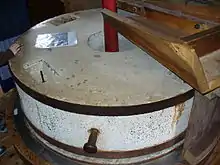
mó
Etymology 1
From Old Portuguese moo, from Latin mola, from Proto-Indo-European *melh₂- (“to grind, crush”). Cognate with Spanish muela.
Derived terms
- estar na mó de baixo
- estar na mó de cima
Adjective
mó (invariable)
Adverb
mó (not comparable)
Scottish Gaelic
Vietnamese
Pronunciation
- (Hà Nội) IPA(key): [mɔ˧˦]
- (Huế) IPA(key): [mɔ˨˩˦]
- (Hồ Chí Minh City) IPA(key): [mɔ˦˥]
Derived terms
Derived terms
- sờ mó
This article is issued from Wiktionary. The text is licensed under Creative Commons - Attribution - Sharealike. Additional terms may apply for the media files.