See also:
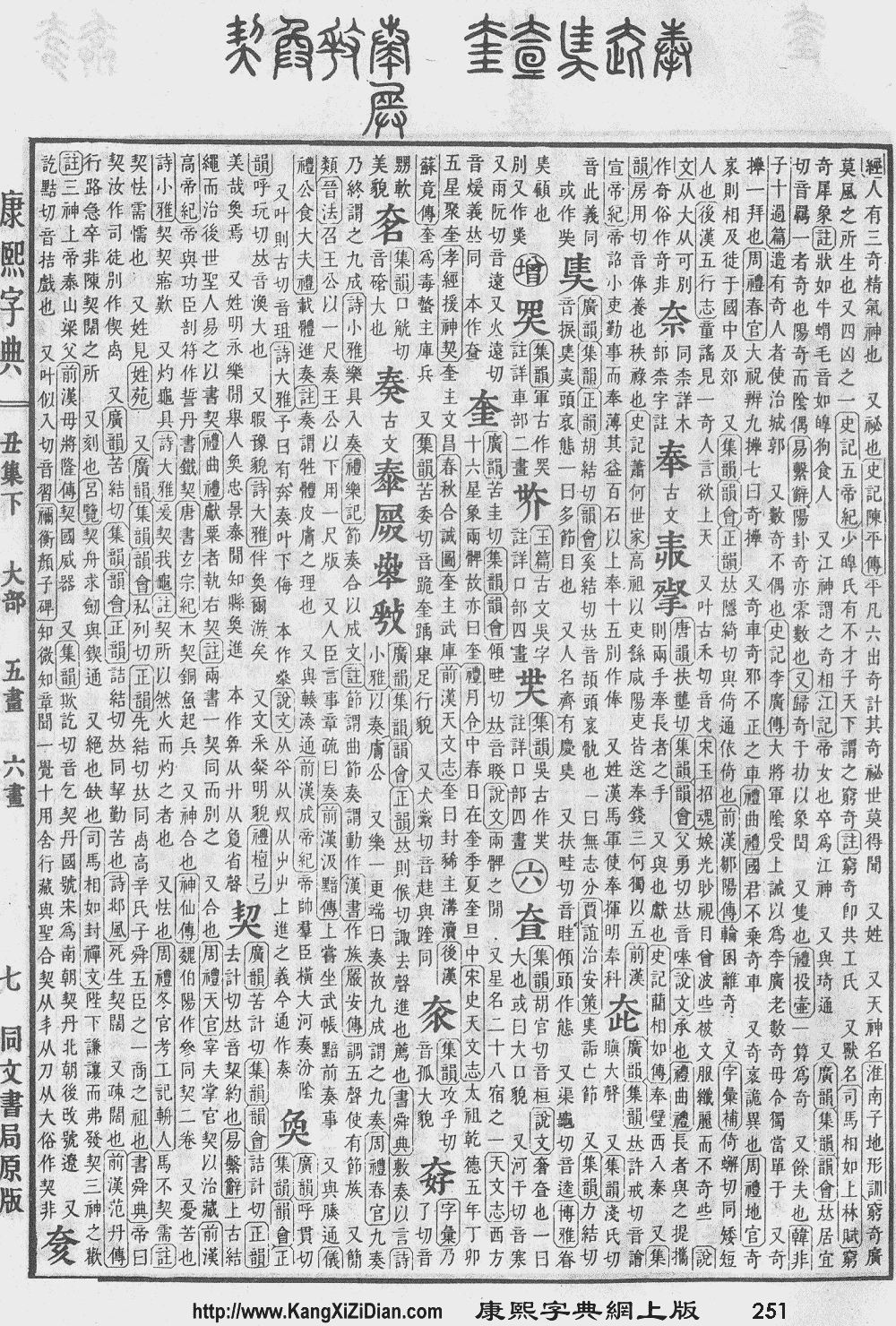
U+5948, 奈
CJK UNIFIED IDEOGRAPH-5948

[U+5947]
CJK Unified Ideographs
[U+5949]
U+F90C, 奈
CJK COMPATIBILITY IDEOGRAPH-F90C

[U+F90B]
CJK Compatibility Ideographs
[U+F90D]

Translingual

Han character

(Kangxi radical 37, +5, 8 strokes, cangjie input 大一一火 (KMMF), four-corner 40901, composition)

Derived characters

Descendants

References


Chinese

trad.
simp. #
alternative forms

Glyph origin

A variant of .

Etymology

“how; why”
Possibly a contraction of (OC *nak) and (OC *tə), as in 若之何 (Pulleyblank, 1995, p. 34).
“nano-”
Borrowed from English nano-.

Pronunciation


Note:
  • ta/tai/tā - vernacular (limited, e.g. 無奈何);
  • nāi - literary.

Rime
Character
Reading # 1/2 2/2
Initial () (8) (8)
Final () (25) (94)
Tone (調) Departing (H) Departing (H)
Openness (開合) Open Open
Division () I I
Fanqie
Reconstructions
Zhengzhang
Shangfang
/nɑiH/ /nɑH/
Pan
Wuyun
/nɑiH/ /nɑH/
Shao
Rongfen
/nɑiH/ /nɑH/
Edwin
Pulleyblank
/najH/ /naH/
Li
Rong
/nɑiH/ /nɑH/
Wang
Li
/nɑiH/ /nɑH/
Bernard
Karlgren
/nɑiH/ /nɑH/
Expected
Mandarin
Reflex
nài nuò
Expected
Cantonese
Reflex
naai6 no6
BaxterSagart system 1.1 (2014)
Character
Reading # 1/1
Modern
Beijing
(Pinyin)
nài
Middle
Chinese
‹ najH ›
Old
Chinese
/*nˁa[t]-s/
English cope with

Notes for Old Chinese notations in the Baxter–Sagart system:

* Parentheses "()" indicate uncertain presence;
* Square brackets "[]" indicate uncertain identity, e.g. *[t] as coda may in fact be *-t or *-p;
* Angle brackets "<>" indicate infix;
* Hyphen "-" indicates morpheme boundary;

* Period "." indicates syllable boundary.
Zhengzhang system (2003)
Character
Reading # 1/2 2/2
No. 9349 9350
Phonetic
component
Rime
group
Rime
subdivision
1 1
Corresponding
MC rime
Old
Chinese
/*naːls/ /*naːds/

Definitions

  1. how; why (used in rhetorical questions)
  2. to bear; to stand; to endure
  3. (Taiwan) nano- (SI unit prefix)
    Synonym: () (Mainland China)

See also

SI prefix
Last Next
/

Compounds

  • 不奈
  • 不奈何
  • 可奈
  • 叵奈
  • 基奈
  • 奈上祝下
  • 奈何 (nàihé)
  • 奈向
  • 奈守
  • 奈曼
  • 奈洛比 (Nàiluòbǐ)
  • 奈秒
  • 奈米 (nàimǐ)
  • 奈良 (Nàiliáng)
  • 如之奈何 (rú zhī nàihé)
  • 尀奈
  • 山奈
  • 怎奈
  • 沒極奈何没极奈何
  • 沒計奈何没计奈何
  • 澀奈涩奈
  • 無可奈何无可奈何 (wúkěnàihé)
  • 無奈无奈 (wúnài)
  • 無奈我何无奈我何
  • 無如奈何无如奈何
  • 無計奈何无计奈何
  • 爭奈争奈
  • 神奈川縣神奈川县
  • 萬般無奈万般无奈
  • 葛林奈爾葛林奈尔
  • 葛林奈爾大學葛林奈尔大学
  • 蘇爾奈苏尔奈 (sū'ěrnài)
  • 西奈半島西奈半岛 (Xīnài Bàndǎo)
  • 西奈協定西奈协定
  • 頗奈颇奈
  • 香奈兒香奈儿

References


Japanese

Kanji

(grade 4 “Kyōiku” kanji)

  1. Abbreviation of 奈良: the city of Nara
  2. what
  3. (obsolete) apple tree

Readings

Etymology 1

(This etymology is missing or incomplete. Please add to it, or discuss it at the Etymology scriptorium.)

Alternative forms

Pronunciation

Noun

(からなし) (karanashi) 

  1. Obsolete form of 唐梨 (red apple).
  2. (by extension) Obsolete spelling of 林檎 (apple)

Etymology 2

(This etymology is missing or incomplete. Please add to it, or discuss it at the Etymology scriptorium.)

Alternative forms

Pronunciation

Pronoun

(いかん) (ikan) 

  1. Alternative form of 奈何 (what)

Korean

Etymology 1

From Middle Chinese (MC nɑiH).

Historical readings

Pronunciation

Hanja

Wikisource (eumhun 어찌 (eojji nae))

  1. Hanja form? of (but; how).

Compounds

Etymology 2

From Middle Chinese (MCH).

Pronunciation

Hanja

(eumhun 어찌 (eojji na))

  1. Hanja form? of (but; how).

Compounds

References

  • 국제퇴계학회 대구경북지부 (國際退溪學會 大邱慶北支部) (2007). Digital Hanja Dictionary, 전자사전/電子字典.

Vietnamese

Han character

: Hán Nôm readings: nại, nhự

  1. This term needs a translation to English. Please help out and add a translation, then remove the text {{rfdef}}.
This article is issued from Wiktionary. The text is licensed under Creative Commons - Attribution - Sharealike. Additional terms may apply for the media files.