龍
| ||||||||
| ||||||||
| ||||||||
Translingual
| Stroke order | |||
|---|---|---|---|
 | |||
| Traditional | 龍 |
|---|---|
| Shinjitai | 竜 |
| Simplified | 龙 |
Han character
龍 (Kangxi radical 212, 龍+0, 16 strokes, cangjie input 卜月卜尸心 (YBYSP), four-corner 01211, composition ⿰𦚏⿱⺊⿷己三)
- Kangxi radical #212, ⿓.
- Shuowen Jiezi radical №427
Derived characters
Related characters
- 竜 (Japanese shinjitai, also an ancient form of 龍)
- 龙 (Simplified Chinese)
Further reading
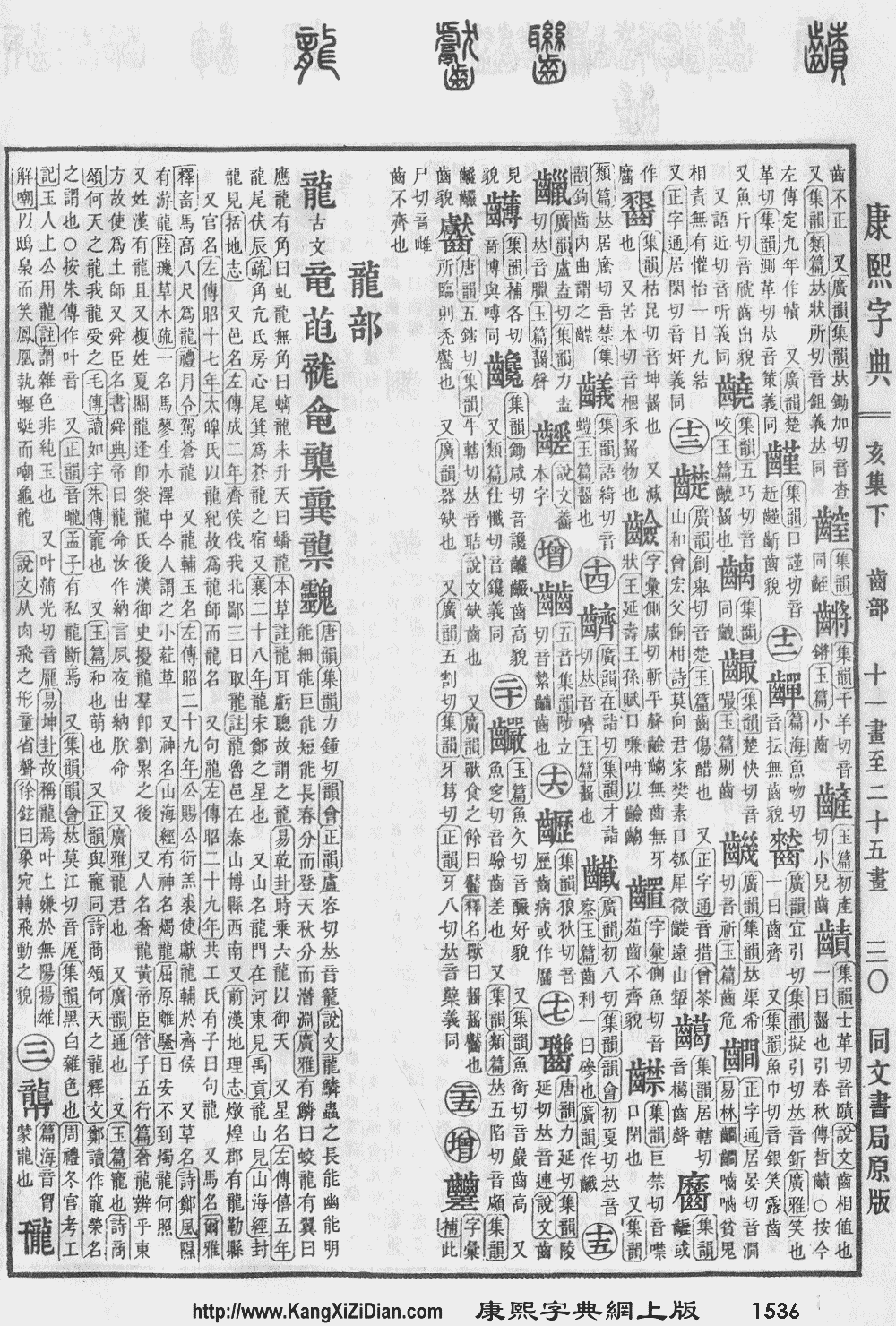
- KangXi: page 1536, character 33
- Dai Kanwa Jiten: character 48818
- Dae Jaweon: page 2076, character 1
- Hanyu Da Zidian (first edition): volume 7, page 4803, character 1
- Unihan data for U+9F8D
- Unihan data for U+F9C4
Chinese
| trad. | 龍 | |
|---|---|---|
| simp. | 龙 | |
| alternative forms | ||
Glyph origin
| Historical forms of the character 龍 | |||||||
|---|---|---|---|---|---|---|---|
| Shang | Western Zhou | Spring and Autumn | Warring States | Shuowen Jiezi (compiled in Han) | Liushutong (compiled in Ming) | ||
| Bronze inscriptions | Oracle bone script | Bronze inscriptions | Bronze inscriptions | Chu slip and silk script | Qin slip script | Small seal script | Transcribed ancient scripts |
 |
 |
 |
 |
 |
 |
 |
 |
| Old Chinese | |
|---|---|
| 驡 | *ʔslaːŋʔ, *roŋ |
| 龐 | *broːŋ |
| 瀧 | *rroːŋ, *sroːŋ, *roːŋ |
| 籠 | *roːŋ, *roːŋʔ, *roŋ |
| 豅 | *roːŋ |
| 朧 | *roːŋ, *roŋs |
| 龓 | *roːŋ, *roːŋʔ |
| 聾 | *roːŋ |
| 礱 | *roːŋ, *roːŋs |
| 嚨 | *roːŋ |
| 蘢 | *roːŋ, *roŋ |
| 櫳 | *roːŋ |
| 襱 | *roːŋ, *roːŋʔ, *r'oŋʔ |
| 瓏 | *roːŋ |
| 曨 | *roːŋ, *roːŋʔ |
| 鸗 | *roːŋ, *roŋ |
| 蠪 | *roːŋ |
| 巃 | *roːŋʔ |
| 竉 | *roːŋʔ |
| 攏 | *roːŋʔ |
| 儱 | *roːŋʔ, *roŋs |
| 龍 | *b·roŋ, *mroːŋ |
| 躘 | *roŋ, *roŋs |
| 隴 | *roŋʔ |
| 壠 | *roŋʔ |
| 壟 | *roŋʔ |
| 寵 | *r̥ʰoŋʔ |
| 龏 | *kloŋ, *kloŋs, *qroːɡ |
Pictogram (象形) – originally a serpent with prominent whiskered mouth and eyes.
Current form developed in large seal script, with serpent’s body on right (tail at upper right, legs on right), whiskered/fanged mouth at lower left, and eyes/crown at upper left. Left side was subsequently simplified and abstracted, with some influence of 立 and ⺼/月. Note that 竜 existed as a traditional variant dating back to large seal script, and figures a dragon seen face-on, rather than curled around.
Etymology
From Proto-Sino-Tibetan *m-bru(ŋ/k) (“dragon; thunder”). Cognate with Tibetan འབྲུག ('brug, “dragon; thunder”). The STEDT database also lists 隆 (OC *ɡ·ruːŋ, “thunder; sound of thunder”) and 雹 (OC *bruːɡ, “hail”) as cognates. Also compare 靐 (OC *brɯŋs, “sound of thunder”) and 霹靂 (OC *pʰeːɡ reːɡ, “thunder”).
This word is found in many languages of the region. Compare Proto-Hmong-Mien *-roŋ (“dragon”) (White Hmong zaj), Proto-Vietic *-roːŋ (“dragon”) (Vietnamese rồng), Vietnamese thuồng luồng (“serpent-like monster”), Khmer រោង (roong, “year of the dragon”), Thai มะโรง (má-roong, “dragon; year of the dragon”), Lao ມະໂລງ (ma lōng, “year of the dragon”), perhaps also Old Turkic [script needed] (*-lan, suffix denoting a wild, predatory animal) (Turkish aslan (“lion”), kaplan (“tiger”), yılan (“snake”)).
Pronunciation
Definitions
龍
- (mythology) Chinese dragon (Classifier: 條/条)
- (mythology) Western dragon
- (figurative) emperor; sovereign; king; of the emperor
- (figurative) chief; hero; towering figure
- (by extension) dragon-shaped object; long object
- (by extension) dragon-adorned object
- (zoology, paleontology) extinct reptilian creature; -saur
- (Min Dong) to become clear-minded; to be revitalised
- (Cantonese, soccer and other sports) goal
- (figurative) queue; line (Classifier: 條/条 c)
- (Hong Kong Cantonese, slang) money
- (Hong Kong Cantonese, slang) snake meat
- (Shanghainese Wu, slang) a hundred of a currency designation
- a surname
Compounds
|
|
|
Descendants
Others:
See also
References
- “龍”, in 漢語多功能字庫 (Multi-function Chinese Character Database), 香港中文大學/香港中文大学 (the Chinese University of Hong Kong), 2014–
Japanese
| 竜 | |
| 龍 |
Readings
Compounds
Usage notes
- This kanji is the 旧字体 (kyūjitai) form of simplified 竜, itself as isolated 新字体 (shinjitai) kanji, but is used in Jōyō characters 襲 and 籠, with the latter categorized as Jōyō as of 2010.
- Although it is officially simplified into 竜, 龍 is often used instead for certain words for its aesthetics (such as in literary contexts or for spelling words borrowed from Chinese). For example, 烏龍茶 (ūroncha, “oolong tea”) is rarely spelled as 烏竜茶.
Etymology 1
| Kanji in this term |
|---|
| 龍 |
| りゅう Jinmeiyō |
| goon |
| Alternative spelling |
|---|
| 竜 |
From Middle Chinese 龍 (MC lɨoŋ).
The 呉音 (goon, literally “Wu sound”) reading, so likely the initial borrowing from Middle Chinese.
Pronunciation
Noun
Affix
Derived terms
Proper noun
龍 • (Ryū) (kyūjitai, shinjitai 竜)
- (astronomy) Short for りゅう座 (Ryūza): the constellation Draco
- a male given name
- a surname
Etymology 2
| Kanji in this term |
|---|
| 龍 |
| りょう Jinmeiyō |
| kan’on |
| Alternative spelling |
|---|
| 竜 |
From Middle Chinese 龍 (MC lɨoŋ).
The 漢音 (kan'on, literally “Han sound”) reading, so likely a later borrowing from Middle Chinese.
Noun
龍 • (ryō) (kyūjitai, shinjitai 竜)
- Kyūjitai form of 竜: (rare or in Chinese contexts) a Chinese dragon
Affix
Derived terms
Etymology 3
| Kanji in this term |
|---|
| 龍 |
| たつ Jinmeiyō |
| kun’yomi |
| Alternative spelling |
|---|
| 竜 |
⟨tatu⟩ → /tat͡su/
From Old Japanese.
Noun
龍 • (tatsu) (kyūjitai, shinjitai 竜)
- Kyūjitai form of 竜: (mythology) a Japanese dragon
- 931–938, Minamoto no Shitagō, Wamyō Ruijushō (book 19)
- 龍 文字集略云:「龍(力鍾反。和名:太都)四足五采甚有神靈者也。」白虎通云:「鱗虫三百六十六而龍爲之長也。」
- (please add an English translation of this usage example)
- 931–938, Minamoto no Shitagō, Wamyō Ruijushō (book 19)
Korean
Alternative forms
Etymology
From Middle Chinese 龍 (MC lɨoŋ). Recorded as Middle Korean 료ᇰ (lyong) (Yale: lyong) in Hunmong Jahoe (訓蒙字會 / 훈몽자회), 1527.
Pronunciation
- (SK Standard/Seoul) IPA(key): [ɾjoŋ] ~ [joŋ]
- Phonetic hangul: [룡/용]
Compounds
- 용문/룡문 (龍門, yongmun/ryongmun, “dragon gate”)
- 용왕/룡왕 (龍王, yong'wang/ryong'wang, “dragon king”)
- 용산 (龍山, Yongsan, “Yongsan city”)
- 용인 (龍仁, Yong'in, “Yongin city”)
- 용대 (龍台, Yongdae, “Yongdae Gap”)
- 어룡 (魚龍, eoryong, “ichthyosaur”)
- 익룡 (翼龍, ingnyong, “pterosaur”)
- 공룡 (恐龍, gongnyong, “dinosaur”)
- 청룡 (靑龍, cheongnyong, “green dragon”)
- 용수철/룡수철 (龍鬚鐵, yongsucheol/ryongsucheol, “spring”)
- 용설란/룡설란 (龍舌蘭, yongseollan/ryongseollan, “agave; century plant”)
- 등용문 (登龍門, deung'yongmun, “gateway”)
- 흑룡강 (黑龍江, Heungnyonggang, “Amur river”)
- 용두사미/룡두사미 (龍頭蛇尾, yongdusami/ryongdusami, “anticlimax (lit. dragon head and snake tail)”)
Old Japanese
Usage notes
Also used once phonetically as a 借訓 (shakkun) for ⟨tatu⟩.
Pai-lang
Etymology
Coblin, reconstructing the Pai-lang pronunciation as *gljung, suggests that it derives from Proto-Sino-Tibetan *kl(j)u(ŋ/k) (“river, gorge”) and retains its consonant cluster, which was lost in Proto-Lolo-Burmese. Compare Tibetan ལྗོངས (ljongs), Chinese 谷 (OC *kloːɡ).
References
- W. South Coblin, "A New Study of the Pai-lang Songs" (1979), Tsing Hua Journal of Chinese Studies, 12:179–216
- Christopher I. Beckwith, "The Pai-lang songs: The earliest texts in a Tibeto-Burman language and their Late Old Chinese transcriptions" (2008), in Medieval Tibeto-Burman Languages III
Vietnamese
Han character
龍: Hán Việt readings: long (
龍: Nôm readings: long[2][3][1][6], lung[2][3][7], lỏng[7][5][6], lúng[7][1], luông[3], luồng[7]
Compounds
- 龍山 (Long Sơn)
- 下龍 (Hạ Long)
- 恐龍 (khủng long)
- 昇龍 (Thăng Long)
References
- Bonet (1899).
- Nguyễn (2014).
- Nguyễn et al. (2009).
- Trần (2004).
- Génibrel (1898).
- Taberd & Pigneau de Béhaine (1838).
- Hồ (1976).