Portal:England

The England portal
 Flag of England |
 Royal Standard of England |
 | |
England is a country that is part of the United Kingdom. It shares land borders with Wales to its west and Scotland to its north. The Irish Sea lies northwest and the Celtic Sea area of the Atlantic Ocean to the southwest. It is separated from continental Europe by the North Sea to the east and the English Channel to the south. The country covers five-eighths of the island of Great Britain, which lies in the North Atlantic, and includes over 100 smaller islands, such as the Isles of Scilly and the Isle of Wight.
The area now called England was first inhabited by modern humans during the Upper Paleolithic period, but takes its name from the Angles, a Germanic tribe deriving its name from the Anglia peninsula, who settled during the 5th and 6th centuries. England became a unified state in the 10th century and has had a significant cultural and legal impact on the wider world since the Age of Discovery, which began during the 15th century.
The English language, the Anglican Church, and English law, which collectively served as the basis for the common law legal systems of many other countries around the world, developed in England, and the country's parliamentary system of government has been widely adopted by other nations. The Industrial Revolution began in 18th-century England, transforming its society into the world's first industrialised nation. England is also home to the two oldest institutions of higher learning in the English-speaking world, the University of Cambridge, founded in 1209, and the University of Oxford, founded in 1096, both of which are routinely ranked among the most prestigious universities globally.
England's terrain is chiefly low hills and plains, especially in the centre and south. Upland and mountainous terrain is mostly restricted to the north and west, including the Lake District, Pennines, Dartmoor and Shropshire Hills. The capital is London, whose greater metropolitan population of 14.2 million as of 2021 represents the United Kingdom's largest metropolitan area. England's population of 56.3 million comprises 84% of the population of the United Kingdom, largely concentrated around London, the South East, and conurbations in the Midlands, the North West, the North East, and Yorkshire, which each developed as major industrial regions during the 19th century. (Full article...)
 Featured article -
 Late 15th-century artistic portrayal of the battle: Edward IV (left), wearing a circlet and mounted on a horse, leads the Yorkist charge and pierces the Earl of Warwick (right) with his lance; in reality, Warwick was not killed by Edward. |
The Battle of Barnet was a decisive engagement in the Wars of the Roses, a dynastic conflict of 15th-century England. The military action, along with the subsequent Battle of Tewkesbury, secured the throne for Edward IV. On Sunday 14 April 1471, Easter Day, near Barnet, then a small Hertfordshire town north of London, Edward led the House of York in a fight against the House of Lancaster, which backed Henry VI for the throne. Leading the Lancastrian army was Richard Neville, Earl of Warwick, who played a crucial role in the fate of each king. Historians regard the battle as one of the most important clashes in the Wars of the Roses, since it brought about a decisive turn in the fortunes of the two houses. Edward's victory was followed by 14 years of Yorkist rule over England.
Formerly a key figure in the Yorkist cause, Warwick defected to the Lancastrians over disagreements about Edward's nepotism, secret marriage, and foreign policy. Leading a Lancastrian army, the earl defeated his former allies, forcing Edward to flee to Burgundy in October 1470. The Yorkist king persuaded his host, Charles the Bold, the Duke of Burgundy, to help him regain the English throne. Leading an army raised with Burgundian money, Edward launched his invasion of England, which culminated at the fields north of Barnet. Under cover of darkness, the Yorkists moved close to the Lancastrians and clashed in a thick fog at dawn. As both armies fought, the Earl of Oxford on the Lancastrian right routed the Yorkists opposite under Lord Hastings, chasing them back to Barnet. On their return to the battlefield, Oxford's men were erroneously shot at by the Lancastrian centre commanded by Lord Montagu. As cries of treason (always a possibility in that chaotic period) spread through their line, Lancastrian morale was disrupted and many abandoned the fight. While retreating, Warwick was killed by Yorkist soldiers. (Full article...)Selected article -

The National Railway Museum is a museum in York forming part of the Science Museum Group. The museum tells the story of rail transport in Britain and its impact on society. It is the home of the national collection of historically significant railway vehicles such as Mallard, Stirling Single, Duchess of Hamilton and a Japanese bullet train. In addition, the National Railway Museum holds a diverse collection of other objects, from a household recipe book used in George Stephenson's house to film showing a "never-stop railway" developed for the British Empire Exhibition. It has won many awards, including the European Museum of the Year Award in 2001.
the museum is about to embark on a major site development. As part of the York Central redevelopment which will divert Leeman Road, the National Railway Museum will be building a new entrance building to connect the two separate parts of the museum together. At the same time, the space around the museum will be landscaped to provide public spaces. (Full article...)General images
 Portrait of Edward VI, c. 1550 (from History of England)
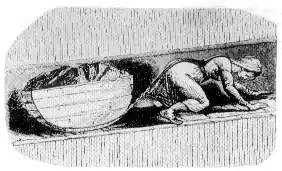 The first general laws against child labour, the Factory Acts, were passed in Britain in the first half of the 19th century. Children younger than nine were not allowed to work and the work day of youth under the age of 18 was limited to twelve hours. (from History of England)
 National performing arts are held annually at the Royal Albert Hall, as well as The Proms during the summer. (from Culture of England)
 The Royal College of Music is a conservatoire established by royal charter in 1882, located in South Kensington, London. (from Culture of England)
 Christopher Lee (seen here as Dracula in 1958) starred in many of Hammer's British horror films. (from Culture of England)
 Countries where English has official status or is widely spoken (from Culture of England)
 The Lindisfarne Gospels (from Culture of England)
 Caesar's first invasion of Britain (from History of England)
 England playing Australia at Lord's Cricket Ground in the 2009 Ashes series. After winning the 2019 Cricket World Cup, England became the first country to win the World Cups in football, rugby union and cricket. (from Culture of England)
 King Charles I, who was beheaded in 1649 (from History of England)
.jpg.webp) Morris dancing (from Culture of England)
Morris dancing (from Culture of England) Canterbury Cathedral is the seat of the Primate of All England, the Archbishop of Canterbury, the most senior bishop of the Church of England. (It was the property of the Roman Catholic Church before the English Reformation.) (from Culture of England)
 Anglo-Saxon helmet from the Sutton Hoo ship burial, 625 AD (replica) (from History of England)
- Folio 27r from the Lindisfarne Gospels, c. 720 AD (from History of England)
 The Spanish Armada and English ships in August 1588, (unknown, 16th-century, English School) (from History of England)
.jpg.webp) Remains of the Roman baths at Bath, England. (from History of England)
Remains of the Roman baths at Bath, England. (from History of England).jpg.webp) Frontispiece of Bede's Life of St Cuthbert, showing King Æthelstan presenting a copy of the book to the saint himself. c. 930 (from History of England)
Frontispiece of Bede's Life of St Cuthbert, showing King Æthelstan presenting a copy of the book to the saint himself. c. 930 (from History of England)
.jpg.webp)
 Astley's Amphitheatre, London circa 1808. Astley performed stunts in a 42 ft diameter ring; the standard size used by circuses ever since. (from Culture of England)
 The Lady Chapel of Wells Cathedral (from Culture of England)
 King Charles II, a patron of the arts and sciences, supported the Royal Society, a scientific group whose early members included Robert Hooke, Robert Boyle and Sir Isaac Newton. (from Culture of England)
 Edward Elgar is one of England's most celebrated classical composers. (from Culture of England)
.jpg.webp)
 The Ruthwell Cross, 8th century AD (from History of England)
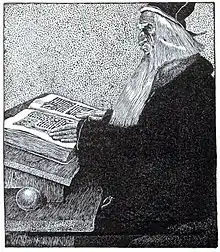 The wizard Merlin features as a character in many works of fiction, including the BBC series Merlin. (from Culture of England)
 King Alfred the Great statue in Winchester, Hampshire. The 9th-century English king encouraged education in his kingdom, and proposed that primary education be taught in English, with those wishing to advance to holy orders to continue their studies in Latin. (from Culture of England)
 Alfred Hitchcock is often regarded as the greatest British filmmaker, and was described as "a straightforward middle-class Englishman who just happened to be an artistic genius." (from Culture of England)
 Sir Francis Drake's voyage 1585–86 (from History of England)
 Elizabeth I (from History of England)
 Tomb of Richard I of England and Isabella of Angoulême (from History of England)
 Maps of territory held by Royalists (red) and Parliamentarians (green) during the English Civil War (1642–1645) (from History of England)
 Stonehenge, erected in several stages from c.3000-2500 BC (from History of England)
 Artefacts from Bush Barrow at Stonehenge. Wessex culture, Early Bronze Age, c. 1900 BC (from History of England)
 View of the ramparts of the hillfort of Maiden Castle (450 BC), as they look today (from History of England)
 A pint of real ale (from Culture of England)
 The Great Fire London, 1666. (from History of England)
 Anglo-Saxon king with his Witan. Biblical scene in the Old English Hexateuch (11th century) (from History of England)
 The English landscape garden at Stourhead, described as a 'living work of art' when first opened in the 1750s (from Culture of England)
 England in 878 (from History of England)
.jpg.webp) Londinium (Roman London), c. 120 AD (from History of England)
Londinium (Roman London), c. 120 AD (from History of England) Francis Bacon in a portrait by Pourbus the Younger, (1617). His works are seen as developing the scientific method and remained highly influential through the Scientific revolution. (from Culture of England)
 Durham Cathedral, dating from 1093 (from Culture of England)
 The Roman Baths in Bath; a temple was constructed on the site between 60–70CE in the first few decades of Roman Britain. It is a lasting monument from Roman Britain. (from Culture of England)
 Remains of Hadrian's Wall (from History of England)
 King Henry VIII (from History of England)
.jpg.webp) The Billingsgate Fish Market in London in the early 19th century (from History of England)
The Billingsgate Fish Market in London in the early 19th century (from History of England)
.jpg.webp) One of only four surviving exemplifications of the 1215 text, Cotton MS. Augustus II. 106, property of the British Library (from History of England)
One of only four surviving exemplifications of the 1215 text, Cotton MS. Augustus II. 106, property of the British Library (from History of England) King's College in Cambridge is regarded as one of the greatest examples of late English Gothic architecture. It has the world's largest fan vault, while the chapel's stained-glass windows and wooden chancel screen are considered some of the finest from their era. (from Culture of England)
 The Alfred Jewel, late 9th century (from History of England)
 Durham Cathedral, built 1093–1133 (from History of England)
 First English Civil War at the Battle of Marston Moor, 1644 (from History of England)
 The Battersea Shield (detail), 350 BC (from History of England)
 Hampton Court Palace (from Culture of England)
 Charles Dickens' 1843 novella A Christmas Carol played a major role in reviving the "spirit" of Christmas and seasonal goodwill. (from Culture of England)
 Large miniature of George Clifford, 3rd Earl of Cumberland by Nicholas Hilliard, c. 1590, after his appointment as the Queen's Champion, in tilting attire with the Queen's glove as her favour pinned to his hat (from Culture of England)
 Flatford Mill ('Scene on a Navigable River') by John Constable, c. 1816 (from Culture of England)
 The Procession Picture, c. 1600, showing Elizabeth I borne along by her courtiers (from History of England)
![Image 64The Staffordshire Hoard is the largest hoard of Anglo-Saxon gold and silver metalwork yet found[update]. It consists of almost 4,600 items and metal fragments. (from Culture of England)](../I/Staffordshire_hoard_annotated.jpg.webp) The Staffordshire Hoard is the largest hoard of Anglo-Saxon gold and silver metalwork yet found. It consists of almost 4,600 items and metal fragments. (from Culture of England)
The Staffordshire Hoard is the largest hoard of Anglo-Saxon gold and silver metalwork yet found. It consists of almost 4,600 items and metal fragments. (from Culture of England) William Hogarth's depiction of a scene from Shakespeare's The Tempest is an example of how English literature influenced English painting in the 18th century. (from Culture of England)
 Canterbury Cathedral nave, 1377 (from History of England)
 Dover Castle, 12th-13th century (from History of England)
 Victory in Europe Day celebrations in London, 8 May 1945 (from History of England)
 Shoulder clasp from Sutton Hoo, 625 AD (from History of England)
 Silbury Hill, c. 2400 BC (from History of England)
 First played in 1877, the Wimbledon Championships is the oldest tennis tournament in the world. (from Culture of England)
 Procession of characters from Shakespeare's plays (from Culture of England)
 A traditional Punch and Judy booth, at Swanage, Dorset, England (from Culture of England)
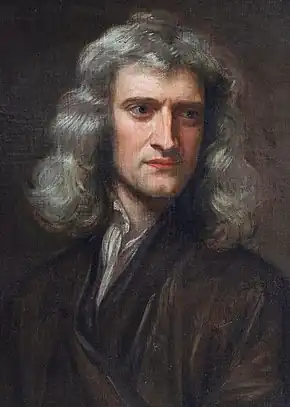 Sir Isaac Newton, 1689. Regarded as one of the most influential scientists of all time and as a key figure in the Scientific Revolution. (from Culture of England)
 Good article -

The Herdwick is a breed of domestic sheep native to the Lake District in North West England. The name "Herdwick" is derived from the Old Norse herdvyck, meaning sheep pasture. Though low in lambing capacity and perceived wool quality when compared to more common commercial breeds, Herdwicks are prized for their robust health, their ability to live solely on forage, and their tendency to be territorial and not to stray over the difficult upland terrain of the Lake District. It is considered that up to 99% of all Herdwick sheep are commercially farmed in the central and western Lake District.
The wool of a Herdwick has unique qualities relating to durability. Thick bristle type fibres will often protrude from garments made from the wool, forming a protective layer in blizzards—most likely the same qualities that protect the sheep in similar conditions. Herdwicks have been known to survive under a blanket of snow for three days while eating their own wool. (Full article...)Did you know?

- ...that the Mendip Hills (commonly called The Mendips) are a range of limestone hills situated to the south of Bristol and Bath in Somerset?
- ...the England and Wales Cricket Board was created on 1 January 1997 combining the roles of the Test and County Cricket Board (TCCB), the National Cricket Association (NCA) and the Cricket Council?
- ...that the Flag of England is the St George's Cross?
- ...that the Tudor rose (pictured) is a traditional heraldic emblem of England and takes its name and origins from the Tudor dynasty?
In the news

- 6 April 2023 – 2023 Women's Finalissima
- In association football, England defeat Brazil 4–2 on penalties. (UEFA)
- 26 March 2023 –
- A pipeline leak causes an oil spill at Poole Harbour in Dorset, England, in which more than 200 barrels of reservoir fluids, including oil, leak into a Site of Special Scientific Interest. The RSPB reported sightings of oiled birds. (BBC News)
- 23 March 2023 –
- A 28-year-old Muslim man is charged by West Midlands Police with attempted murder for immolating two elderly Muslim men outside of mosques in London and Birmingham, United Kingdom, on 27 February and 20 March. (Al Jazeera)
Selected featured content
Articles:
- Arsenal F.C.
- BBC television drama
- Charles I of England
- Manchester
- Mendip Hills
- National parks of England and Wales
- Only Fools and Horses
- Weymouth
- William IV of the United Kingdom
Lists:
- Grade I listed buildings in Bristol
- List of English Academy Award nominees and winners
- List of Sites of Special Scientific Interest in Cleveland
- Locks on the Kennet and Avon Canal
Categories

Selected quotes
| “ | The rustics of England, especially those inhabiting the South hams (villages) of Devonshire, have great fun Wassailing the Orchards on Christmans Eve, New Year's and Twelfth Nigh (Boxing Day), when they drink toasts to the largest apple trees and sprinkle them with cyder (cider) carried by the beadle, the parish clerk, or some other such obsolete individual. The Devonshire people do this because they did it the year before. | ” |
Related WikiProjects
England • Bedfordshire • Brighton • Cheshire • Cornwall • Derbyshire • Dorset • Greater Manchester • Hampshire • Lincolnshire • London • Merseyside • Northamptonshire • North East England • Sheffield • Surrey. Warwickshire • West Midlands • Worcestershire • Yorkshire
Topics
Things you can do

- Please visit the English Wikipedians' notice board and help to write new England-related articles, and expand and improve existing ones.
- Visit Wikipedia:WikiProject England/Assessment, and help out by assessing unrated English articles.
- Add the Project Banner to English articles around Wikipedia.
- Check for announcements and open tasks for ways to improve English related articles.
- Help nominate and select new content for the England portal.
- Requested articles: Charterhouse Lane • Renewable energy in England • Ealing Village
- Expand: Dorothy Boyd • David Troughton
Related Portals
 East Midlands |
 London |
 North East England |
 North West England |
 South East England |
 South West England |
 West Midlands |
 Yorkshire and the Humber |
| East Midlands | London | North East | North West | South East | South West | West Midlands | Yorkshire and the Humber |

.svg.png.webp)


 |
 |
 |
 |
 |
| Ireland | Northern Ireland | Scotland | United Kingdom | Wales |
Associated Wikimedia
The following Wikimedia Foundation sister projects provide more on this subject:
-
 Commons
Free media repository -
 Wikibooks
Free textbooks and manuals -
 Wikidata
Free knowledge base -
 Wikinews
Free-content news -
 Wikiquote
Collection of quotations -
 Wikisource
Free-content library -
 Wikiversity
Free learning tools -
 Wikivoyage
Free travel guide -
 Wiktionary
Dictionary and thesaurus
-
 List of all portalsList of all portals
 -
 The arts portal
 -
 Biography portal
 -
 Current events portal
 -
 Geography portal
 -
 History portal
 -
 Mathematics portal
 -
 Science portal
 -
 Society portal
 -
 Technology portal
 -
 Random portalRandom portal
 -
 WikiProject PortalsWikiProject Portals