Portal:Ecology
 Portal Portal |
 Topics and categories Topics and categories |
 WikiProject WikiProject |
Ecology |
|
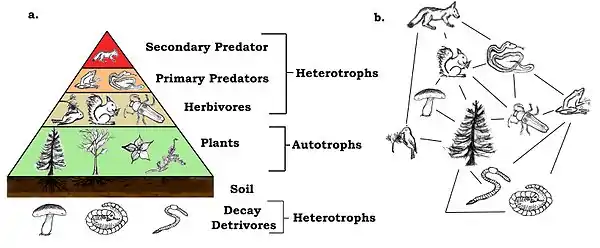
Ecology (from Ancient Greek οἶκος (oîkos) 'house', and -λογία (-logía) 'study of') is the study of the relationships among living organisms, including humans, and their physical environment. Ecology considers organisms at the individual, population, community, ecosystem, and biosphere level. Ecology overlaps with the closely related sciences of biogeography, evolutionary biology, genetics, ethology, and natural history. Ecology is a branch of biology, and it is not synonymous with environmentalism. Among other things, ecology is the study of:
Ecology has practical applications in conservation biology, wetland management, natural resource management (agroecology, agriculture, forestry, agroforestry, fisheries, mining, tourism), urban planning (urban ecology), community health, economics, basic and applied science, and human social interaction (human ecology). The word ecology (German: Ökologie) was coined in 1866 by the German scientist Ernst Haeckel. The science of ecology as we know it today began with a group of American botanists in the 1890s. Evolutionary concepts relating to adaptation and natural selection are cornerstones of modern ecological theory. Ecosystems are dynamically interacting systems of organisms, the communities they make up, and the non-living (abiotic) components of their environment. Ecosystem processes, such as primary production, nutrient cycling, and niche construction, regulate the flux of energy and matter through an environment. Ecosystems have biophysical feedback mechanisms that moderate processes acting on living (biotic) and abiotic components of the planet. Ecosystems sustain life-supporting functions and provide ecosystem services like biomass production (food, fuel, fiber, and medicine), the regulation of climate, global biogeochemical cycles, water filtration, soil formation, erosion control, flood protection, and many other natural features of scientific, historical, economic, or intrinsic value. (Full article...) Selected article -In biology, evolution is the change in heritable characteristics of biological populations over successive generations. These characteristics are the expressions of genes, which are passed on from parent to offspring during reproduction. Variation tends to exist within any given population as a result of genetic mutation and recombination. Evolution occurs when evolutionary processes such as natural selection (including sexual selection) and genetic drift act on this variation, resulting in certain characteristics becoming more common or more rare within a population. The evolutionary pressures that determine whether a characteristic is common or rare within a population constantly change, resulting in a change in heritable characteristics arising over successive generations. It is this process of evolution that has given rise to biodiversity at every level of biological organisation. The theory of evolution by natural selection was conceived independently by Charles Darwin and Alfred Russel Wallace in the mid-19th century and was set out in detail in Darwin's book On the Origin of Species. Evolution by natural selection is established by observable facts about living organisms: (1) more offspring are often produced than can possibly survive; (2) traits vary among individuals with respect to their morphology, physiology, and behaviour (phenotypic variation); (3) different traits confer different rates of survival and reproduction (differential fitness); and (4) traits can be passed from generation to generation (heritability of fitness). In successive generations, members of a population are therefore more likely to be replaced by the offspring of parents with favourable characteristics. In the early 20th century, other competing ideas of evolution such as mutationism and orthogenesis were refuted as the modern synthesis concluded Darwinian evolution acts on Mendelian genetic variation. (Full article...)Selected image -Some Hydrothermal vents support peculiar ecosystems, based on dissolved minerals. Hydrothermal vent communities are able to sustain such vast amounts of life because vent organisms depend on chemosynthetic bacteria for food. The water that comes out of the hydrothermal vent is rich in dissolved minerals and supports a large population of chemo-autotrophic bacteria.
General imagesThe following are images from various ecology-related articles on Wikipedia.
Related WikiProjectsWikiProject Ecology 
Things you can do
| ||||||||||||||||||||||||


_peeking_from_a_leaf_hole_of_an_Alnus_nepalensis_tree_(cropped).jpg.webp)


_18.jpg.webp)


.JPG.webp)


.jpg.webp)


| “ | I used to think of the environment as trees and blue sky. Then I learned that for some people, the environment is gangs and concrete. All the issues that we face are connected. Worldwide, ecosystems are being destroyed, and indigenous peoples are losing their homelands and their entire way of life. Three out of every five African-Americans and Latinos in the US lives in a community with a toxic waste site. As long as pollution is being produced, it's going to go somewhere, and as long as there are marginalized communities where land is cheaper and the people don't have the time or the money to fight back, polluters will have a place to deposit toxins. As long as people and the planet are being exploited, and billions of dollars are being made precisely because laborers and the environment are being abused and used up, there will be children going hungry and ecological destruction. As long as war and violence are in our hearts and our streets as well as in our nations, as long as corporate greed and unsustainable consumption are at the forefront of our economies, no child will be born into a truly safe, peaceful or loving world. | ” |
—Ocean Robbins, founder of YES! — “Helping Visionary Young Leaders Build A Better World” |
Ecology news

- April 23: European Union to reduce carbon emissions by 55% of 1990 levels by 2030
- November 27: Wikinews interviews Craig Farquharson, Liberal Democrat candidate for 2020 Groom by-election
- November 27: Wikinews interviews Sandra Jephcott, Sustainable Australia candidate for 2020 Groom by-election
- December 14: Greta Thunberg named 2019 Time Person of the Year
- November 23: Researchers break down deaths due to power plant pollution in the United States
- November 21: Slippery business: Materials scientists invent new coating for self-cleaning, water-efficient toilets
- October 19: Northern Arapaho Tribe welcomes buffalo herd in Wyoming, United States
- October 12: Scientists describe how 'upside-down rivers' of warm water break Antarctica's ice shelf
- October 5: Voracious fish defend coral reefs against warming, say scientists
- September 8: Scientists report skyrocketing phytoplankton population in aftermath of Kīlauea eruption
- November 5, 2009: "New ocean forming in African desert."
Selected publication -
Checkerspot was a biannual climate change magazine in Canada published by the Canadian Wildlife Federation. A free magazine, its inaugural issue was launched May 2007 and stopped production in 2009 due to the economic downturn. The Canadian Wildlife Federation, one of Canada’s largest non-profit, non-governmental conservation organizations, works to protect Canada’s wild species and spaces. Checkerspot was used to advance activism on and promote discussions about climate change. (Full article...)
Related portals
More did you know -
Related articles


| Main fields | 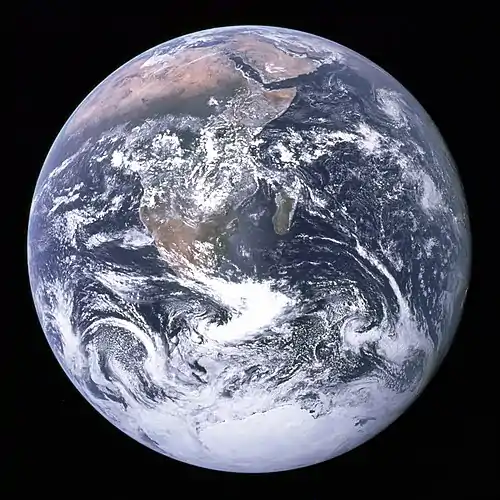 | |
|---|---|---|
| Related fields | ||
| Applications | ||
| Lists | ||
| See also | ||
| ||

.jpg.webp)

Associated Wikimedia
The following Wikimedia Foundation sister projects provide more on this subject:
-
 Commons
Free media repository -
 Wikibooks
Free textbooks and manuals -
 Wikidata
Free knowledge base -
Wikinews
Free-content news -
 Wikiquote
Collection of quotations -
 Wikisource
Free-content library -
 Wikiversity
Free learning tools -
 Wiktionary
Dictionary and thesaurus
Web resources
-
 List of all portalsList of all portals
 -
 The arts portal
 -
 Biography portal
 -
 Current events portal
 -
 Geography portal
 -
 History portal
 -
 Mathematics portal
 -
 Science portal
 -
 Society portal
 -
 Technology portal
 -
 Random portalRandom portal
 -
 WikiProject PortalsWikiProject Portals
