Portal:Biology


Introduction


Biology is the scientific study of life. It is a natural science with a broad scope but has several unifying themes that tie it together as a single, coherent field. For instance, all organisms are made up of cells that process hereditary information encoded in genes, which can be transmitted to future generations. Another major theme is evolution, which explains the unity and diversity of life. Energy processing is also important to life as it allows organisms to move, grow, and reproduce. Finally, all organisms are able to regulate their own internal environments.
Biologists are able to study life at multiple levels of organization, from the molecular biology of a cell to the anatomy and physiology of plants and animals, and evolution of populations. Hence, there are multiple subdisciplines within biology, each defined by the nature of their research questions and the tools that they use. Like other scientists, biologists use the scientific method to make observations, pose questions, generate hypotheses, perform experiments, and form conclusions about the world around them.
Life on Earth, which emerged more than 3.7 billion years ago, is immensely diverse. Biologists have sought to study and classify the various forms of life, from prokaryotic organisms such as archaea and bacteria to eukaryotic organisms such as protists, fungi, plants, and animals. These various organisms contribute to the biodiversity of an ecosystem, where they play specialized roles in the cycling of nutrients and energy through their biophysical environment. (Full article...)
Selected article -
 The standard RNA codon table organized in a wheel |
A codon table can be used to translate a genetic code into a sequence of amino acids. The standard genetic code is traditionally represented as an RNA codon table, because when proteins are made in a cell by ribosomes, it is messenger RNA (mRNA) that directs protein synthesis. The mRNA sequence is determined by the sequence of genomic DNA. In this context, the standard genetic code is referred to as translation table 1. It can also be represented in a DNA codon table. The DNA codons in such tables occur on the sense DNA strand and are arranged in a 5′-to-3′ direction. Different tables with alternate codons are used depending on the source of the genetic code, such as from a cell nucleus, mitochondrion, plastid, or hydrogenosome.
There are 64 different codons in the genetic code and the below tables; most specify an amino acid. Three sequences, UAG, UGA, and UAA, known as stop codons, do not code for an amino acid but instead signal the release of the nascent polypeptide from the ribosome. In the standard code, the sequence AUG—read as methionine—can serve as a start codon and, along with sequences such as an initiation factor, initiates translation. In rare instances, start codons in the standard code may also include GUG or UUG; these codons normally represent valine and leucine, respectively, but as start codons they are translated as methionine or formylmethionine. (Full article...)Selected picture -

Major topics
Selected biography -
 Portrait of Marshall McDonald |
Marshall McDonald (October 18, 1835 – September 1, 1895) was an American engineer, geologist, mineralogist, pisciculturist, and fisheries scientist. McDonald served as the commissioner of the United States Commission of Fish and Fisheries from 1888 until his death in 1895. He is best known for his inventions of a number of fish hatching apparatuses and a fish ladder that enabled salmon and other migrating fish species to ascend the rapids of watercourses resulting in an increased spawning ground. McDonald's administration of the U.S. Commission of Fish and Fisheries was notably free of scandal and furthered the "protection and culture" of fish species throughout the United States.
Born in 1835 in Romney, Virginia (present-day West Virginia), McDonald was the son of Angus William McDonald, a military officer and lawyer, and his wife, Leacy Anne Naylor. From 1854 to 1855, McDonald studied natural history under Spencer Fullerton Baird at the Smithsonian Institution in Washington, D.C. He then attended the University of Virginia and Virginia Military Institute, from which he graduated in 1860. McDonald served as an assistant professor of chemistry at the institute under Stonewall Jackson and continued to teach intermittently throughout the American Civil War. (Full article...)General images -
 Inside of a 48-well thermal cycler, a device used to perform polymerase chain reaction on many samples at once (from History of biology)
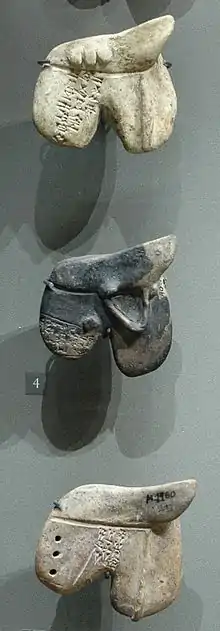 Clay models of animal livers dating between the nineteenth and eighteenth centuries BCE, found in the royal palace at Mari (from History of biology)
 The frontispiece to Erasmus Darwin's evolution-themed poem The Temple of Nature shows a goddess pulling back the veil from nature (in the person of Artemis). Allegory and metaphor have often played an important role in the history of biology. (from History of biology)
 Blending Inheritance (from History of genetics)
 Carefully engineered strains of the bacterium Escherichia coli are crucial tools in biotechnology as well as many other biological fields. (from History of biology)
 Wendell Stanley's crystallization of tobacco mosaic virus as a pure nucleoprotein in 1935 convinced many scientists that heredity might be explained purely through physics and chemistry. (from History of biology)
 In the course of his travels, Alexander von Humboldt mapped the distribution of plants across landscapes and recorded a variety of physical conditions such as pressure and temperature. (from History of biology)
 Mendelian inheritance states characteristics are discrete and are inherited by the parents. This image depicts a monohybrid cross and shows 3 generations: P1 generation (1), F1 generation (2), and F2 generation (3). Each organism inherits two alleles, one from each parent, that make up the genotype. The observed characteristic, the phenotype, is determined by the dominant allele in the genotype. In this monohybrid cross the dominant allele encodes for the colour red and the recessive allele encodes for the colour white. (from History of genetics)
 Thomas Hunt Morgan's illustration of crossing over, part of the Mendelian-chromosome theory of heredity (from History of biology)
 Penicillin was viewed as a miracle drug that brought enormous profits and public expectations. (from History of biotechnology)
 A pie chart image showing the relative biomass representation in a rain forest through a summary of children's perceptions from drawings and artwork (left), through a scientific estimate of actual biomass (middle), and by a measure of biodiversity (right). Notice that the biomass of social insects (middle) far outweighs the number of species (right). (from Conservation biology)
.jpg.webp) 2016 conservation indicator which includes the following indicators: marine protected areas, terrestrial biome protection (global and national), and species protection (global and national) (from Conservation biology)
2016 conservation indicator which includes the following indicators: marine protected areas, terrestrial biome protection (global and national), and species protection (global and national) (from Conservation biology)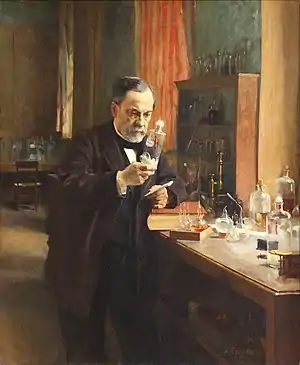 Innovative laboratory glassware and experimental methods developed by Louis Pasteur and other biologists contributed to the young field of bacteriology in the late 19th century. (from History of biology)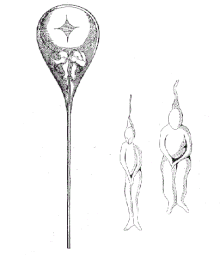
 A Genentech-sponsored sign declaring South San Francisco to be "The Birthplace of Biotechnology." (from History of biotechnology)
 Frontispiece to a 1644 version of the expanded and illustrated edition of Historia Plantarum, originally written by Theophrastus around 300 BC (from History of biology)
 August Weismann's germ plasm theory. The hereditary material, the germ plasm, is confined to the gonads. Somatic cells (of the body) develop afresh in each generation from the germ plasm. (from History of genetics)
 Cabinets of curiosities, such as that of Ole Worm, were centers of biological knowledge in the early modern period, bringing organisms from across the world together in one place. Before the Age of Exploration, naturalists had little idea of the sheer scale of biological diversity. (from History of biology)
_fig._2.png.webp) More conservation research is needed for understanding ecology and behaviour of the dhole in central China. (from Conservation biology)
More conservation research is needed for understanding ecology and behaviour of the dhole in central China. (from Conservation biology) An art scape image showing the relative importance of animals in a rain forest through a summary of (a) child's perception compared with (b) a scientific estimate of the importance. The size of the animal represents its importance. The child's mental image places importance on big cats, birds, butterflies, and then reptiles versus the actual dominance of social insects (such as ants). (from Conservation biology)
 A biomedical work by Ibn al-Nafis, an early adherent of experimental dissection who discovered the pulmonary and coronary circulation (from History of biology)
 The "central dogma of molecular biology" (originally a "dogma" only in jest) was proposed by Francis Crick in 1958. This is Crick's reconstruction of how he conceived of the central dogma at the time. The solid lines represent (as it seemed in 1958) known modes of information transfer, and the dashed lines represent postulated ones. (from History of biology)
 Efforts are made to preserve the natural characteristics of Hopetoun Falls, Australia, without affecting visitors' access. (from Conservation biology)
 Diagram of Charles Darwin's pangenesis theory. Every part of the body emits tiny particles, gemmules, which migrate to the gonads and contribute to the fertilised egg and so to the next generation. The theory implied that changes to the body during an organism's life would be inherited, as proposed in Lamarckism. (from History of genetics)
 Aristotle's model of transmission of movements from parents to child, and of form from the father. The model is not fully symmetric. (from History of genetics)
 Thomas Hunt Morgan discovered sex linked inheritance of the white eyed mutation in the fruit fly Drosophila in 1910, implying the gene was on the sex chromosome. (from History of genetics)
 De arte venandi, by Frederick II, Holy Roman Emperor, was an influential medieval natural history text that explored bird morphology. (from History of biology)
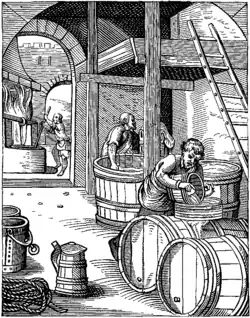 Brewing was an early example of biotechnology (from History of biotechnology)
 Charles Darwin's first sketch of an evolutionary tree from his First Notebook on Transmutation of Species (1837) (from History of biology)
 In Micrographia, Robert Hooke had applied the word cell to biological structures such as this piece of cork, but it was not until the 19th century that scientists considered cells the universal basis of life. (from History of biology)
 Synthetic insulin crystals synthesized using recombinant DNA technology (from History of biotechnology)
 Description of rare animals (写生珍禽图), by Huang Quan (903–965) during the Song dynasty. (from History of biology)
Did you know -
- ... that endemics along the wildlife of Morocco include more than six hundred species of vascular plants and a single species of bird?
- ... that an extract of Alchemilla diademata, a plant endemic to Lebanon, shows antimicrobial activity against Staphylococcus aureus?
- ... that more than 5,000 hen fleas were recorded from the nest of a coal tit?
Things you can do
|
|
Here are some Open Tasks :
|

Related portals
Biology portals
Categories

Anatomy - Anthropology - Astrobiology - Biochemistry - Bioengineering - Bioinformatics - Biotechnology - Botany - Cell biology - Conservation biology - Developmental biology - Ecology - Environmental science - Evolutionary biology - Genetics - Mathematical biology - Medicine - Microbiology - Immunology - Molecular biology - Mycology - Neuroscience - Paleontology - Palynology Parasitology - Pharmacology -
Phylogenetics - Physiology - Systems biology - Taxonomy - Toxicology - Virology - ZoologyMore topics



| Fields, disciplines | |||||||||||||||||||||||||||
|---|---|---|---|---|---|---|---|---|---|---|---|---|---|---|---|---|---|---|---|---|---|---|---|---|---|---|---|
| Institutions | |||||||||||||||||||||||||||
| Theories, concepts | |||||||||||||||||||||||||||
| History |
| ||||||||||||||||||||||||||
| Related | |||||||||||||||||||||||||||
| |||||||||||||||||||||||||||
WikiProjects

WikiProjects connected with biology:
- Computational biology
- Conservation worldwide
- Ecology
- Extinction
- Ecoregions
- Evolutionary biology
- Game theory
- Genetics
- History of Science
- Marine life
- Medicine
- Microbiology
- Molecular and Cellular Biology
- Neuroscience
- Tree of Life
- Fungi
- Plants
- Arthropods
- Bivalves
- Cephalopods
- Gastropods
- Fishes
- Amphibians and Reptiles
- Birds
- Mammals
- Viruses
A complete list of scientific WikiProjects can be found here. See also Wikispecies, a Wikimedia project dedicated to classification of biological species.
Associated Wikimedia
The following Wikimedia Foundation sister projects provide more on this subject:
-
 Commons
Free media repository -
 Wikibooks
Free textbooks and manuals -
 Wikidata
Free knowledge base -
 Wikinews
Free-content news -
 Wikiquote
Collection of quotations -
 Wikisource
Free-content library -
 Wikiversity
Free learning tools -
 Wiktionary
Dictionary and thesaurus
-
 List of all portalsList of all portals
 -
 The arts portal
 -
 Biography portal
 -
 Current events portal
 -
 Geography portal
 -
 History portal
 -
 Mathematics portal
 -
 Science portal
 -
 Society portal
 -
 Technology portal
 -
 Random portalRandom portal
 -
 WikiProject PortalsWikiProject Portals
Shortcuts to this page: Biology portal • P:BIO