Portal:China


Modern Chinese trace their origins to a cradle of civilization in the fertile basin of the Yellow River in the North China Plain. The semi-legendary Xia dynasty in the 21st century BCE and the well-attested Shang and Zhou dynasties developed a bureaucratic political system to serve hereditary monarchies, or dynasties. Chinese writing, Chinese classic literature, and the Hundred Schools of Thought emerged during this period and influenced China and its neighbors for centuries to come. In the third century BCE, Qin Shi Huang founded the first Chinese empire, the short-lived Qin dynasty. The Qin was followed by the more stable Han dynasty (206 BCE–220 CE), which established a model for nearly two millennia in which the Chinese empire was one of the world's foremost economic powers. The empire expanded, fractured, and reunified; was conquered and reestablished; absorbed foreign religions and ideas; and made world-leading scientific advances, such as the Four Great Inventions: gunpowder, paper, the compass, and printing. After centuries of disunity following the fall of the Han, the Sui (581–618) and Tang (618–907) dynasties reunified the empire. The multi-ethnic Tang welcomed foreign trade and culture that came over the Silk Road and adapted Buddhism to Chinese needs. The early modern Song dynasty (960–1279) became increasingly urban and commercial. The civilian scholar-officials or literati used the examination system and the doctrines of Neo-Confucianism to replace the military aristocrats of earlier dynasties. The Mongol invasion established the Yuan dynasty in 1279, but the Ming dynasty (1368–1644) re-established Han Chinese control. The Manchu-led Qing dynasty nearly doubled the empire's territory and established a multi-ethnic state that was the basis of the modern Chinese nation, but suffered heavy losses to foreign imperialism in the 19th century. China is currently governed as a unitary Marxist–Leninist one-party socialist republic by the CCP. China is a permanent member of the United Nations Security Council and a founding member of several multilateral and regional cooperation organizations such as the Asian Infrastructure Investment Bank, the Silk Road Fund, the New Development Bank, the Shanghai Cooperation Organisation, and the RCEP. It is also a member of the BRICS, the G8+5, the G20, the APEC, and the East Asia Summit. It ranks among the lowest in measurements of democracy, civil liberties, government transparency, freedom of the press, freedom of religion, and the human rights of ethnic minorities. The Chinese authorities have been criticized by human rights activists and non-governmental organizations for human rights abuses, including political repression, mass censorship, mass surveillance of their citizens, and violent suppression of protest and dissent. (Full article...)
| |||||||||||||||||||||||||||||||||||||||||||||


 |
The modern Chinese varieties make frequent use of what are called classifiers or measure words. One use of classifiers is when a noun is qualified by a numeral known as a noun phrase. When a phrase such as "one person" or "three books" is translated into Chinese, it is normally necessary to insert an appropriate classifier between the numeral and the noun. For example, in Standard Mandarin, the first of these phrases would be 一个人 yí gè rén, where yī means "one", rén means "person", and gè is the required classifier. There are also other grammatical contexts in which classifiers are used, including after the demonstratives 这 (這) zhè ("this") and 那 nà ("that"); however, when a noun stands alone without any such qualifier, no classifier is needed. There are also various other uses of classifiers: for example, when placed after a noun rather than before it, or when repeated, a classifier signifies a plural or indefinite quantity.
The terms "classifier" and "measure word" are frequently used interchangeably (as equivalent to the Chinese term 量词 (量詞) liàngcí, which literally means "measure word"). Sometimes, however, the two are distinguished, with classifier denoting a particle without any particular meaning of its own, as in the example above, and measure word denoting a word for a particular quantity or measurement of something, such as "drop", "cupful", or "liter". The latter type also includes certain words denoting lengths of time, units of currency, etc. These two types are alternatively called count-classifier and mass-classifier, since the first type can only meaningfully be used with count nouns, while the second is used particularly with mass nouns. However, the grammatical behavior of words of the two types is largely identical. (Full article...)


Gwoyeu Romatzyh (Chinese: 国语罗马字; pinyin: Guóyǔ Luómǎzì; lit. 'National Language Romanization'), abbreviated GR, is a system for writing Mandarin Chinese in the Latin alphabet. The system was conceived by Yuen Ren Chao and developed by a group of linguists including Chao and Lin Yutang from 1925 to 1926. Chao himself later published influential works in linguistics using GR. In addition a small number of other textbooks and dictionaries in GR were published in Hong Kong and overseas from 1942 to 2000.
GR is the better known of the two romanization systems which indicate the four tones of Mandarin by varying the spelling of syllables ("tonal spelling"). These tones are fundamental to the Chinese language; their presence lets speakers discriminate between otherwise identical syllables and words. Other systems indicate the tones with either diacritics (for example Pinyin: āi, ái, ǎi and ài) or numbers (Wade–Giles: ai1, ai2, etc.). GR spells the four tones of the same vowel, ai, air, ae and ay. These spellings, which follow specific rules, indicate the tones while retaining the pronunciation of the syllable ai. (Full article...)
The word cannon is derived from several languages, in which the original definition can usually be translated as tube, cane, or reed. In the modern era, the term cannon has fallen into decline, replaced by guns or artillery, if not a more specific term such as howitzer or mortar, except for high-caliber automatic weapons firing bigger rounds than machine guns, called autocannons. (Full article...)
 There are no contemporaneous portraits of Du Fu; this is a later artist's impression. |
Du Fu (Chinese: 杜甫; Wade–Giles: Tu Fu; 712–770) was a Chinese poet and politician during the Tang dynasty. Along with his elder contemporary and friend Li Bai (Li Po), he is frequently called the greatest of the Chinese poets. His greatest ambition was to serve his country as a successful civil servant, but he proved unable to make the necessary accommodations. His life, like the whole country, was devastated by the An Lushan Rebellion of 755, and his last 15 years were a time of almost constant unrest.
Although initially he was little-known to other writers, his works came to be hugely influential in both Chinese and Japanese literary culture. Of his poetic writing, nearly fifteen hundred poems have been preserved over the ages. He has been called the "Poet-Historian" and the "Poet-Sage" by Chinese critics, while the range of his work has allowed him to be introduced to Western readers as "the Chinese Virgil, Horace, Ovid, Shakespeare, Milton, Burns, Wordsworth, Béranger, Hugo or Baudelaire". (Full article...)
According to Chinese state media, a group of seven people had travelled to Beijing from Henan province, and five set themselves on fire on Tiananmen Square. In the Chinese press, the event was used as proof of the "dangers" of Falun Gong, and was used to legitimise the government's campaign against the group. (Full article...)
The primary source of the screenplay is Cadwell's 1975 biography Bruce Lee: The Man Only I Knew. Other sources include Robert Clouse's book Bruce Lee: The Biography and research by Cohen, including interviews with Cadwell and Bruce's son, Brandon Lee. Rather than a traditional biographical film, Cohen decided to include elements of mysticism and to dramatise fight scenes to give it the same tone as the films in which Bruce starred. Dragon was filmed primarily in Hong Kong, Los Angeles and San Francisco. (Full article...)

Not One Less is a 1999 drama film by Chinese director Zhang Yimou, adapted from Shi Xiangsheng's 1997 story A Sun in the Sky (Chinese: 天上有个太阳; pinyin: tiān shàng yǒu ge tàiyáng). It was produced by Guangxi Film Studio and released by China Film Group Corporation in mainland China, and distributed by Sony Pictures Classics in North America and Columbia TriStar Film Distributors internationally.
Set in the People's Republic of China during the 1990s, the film centers on a 13-year-old substitute teacher, Wei Minzhi, in the Chinese countryside. Called in to substitute for a village teacher for one month, Wei is told not to lose any students. When one of the boys takes off in search of work in the big city, she goes looking for him. The film addresses education reform in China, the economic gap between urban and rural populations, and the prevalence of bureaucracy and authority figures in everyday life. It is filmed in a neorealist/documentary style with a troupe of non-professional actors who play characters with the same names and occupations as the actors have in real life, blurring the boundaries between drama and reality. (Full article...)
Rioting began following the Shaoguan incident, where false accusations of rape of a Han woman by Uyghur men led to a brawl between ethnic Han and Uyghur factory workers in Shaoguan, resulting in the deaths of 2 Uyghurs who were both from Xinjiang. The Chinese central government alleges that the riots themselves were planned from abroad by the World Uyghur Congress (WUC) and its leader Rebiya Kadeer, while Kadeer denies fomenting the violence in her fight for Uyghur "self-determination". (Full article...)
 |
St. Michael's Cathedral (Chinese: 圣弥爱尔大教堂; pinyin: Shèng Mí'ài'ěr Dàjiàotáng; German: Kathedrale St. Michael), also called the Zhejiang Road Catholic Church (Chinese: 浙江路天主教堂), is a Catholic church in Qingdao (Tsingtao), Shandong Province, China and is the seat of the Bishop of the Roman Catholic Diocese of Qingdao (Tsingtao). It is located in the oldest part of Qingdao, at 15 Zhejiang Road, on the east side of Zhongshan Road in Shinan District. Built by German missionaries, the cathedral stands at the top of a hill in the center of the old German-built part of the city. It is the largest example of Romanesque Revival architecture in the province, resembling a German cathedral of the 12th century.
St. Michael's Cathedral is the product of a strong German presence in Shandong Province in the 19th and early 20th centuries. In the mid-19th century the European powers forcibly opened China to foreign trade. The Divine Word Missionaries built a church in the Jiaozhou Bay concession in Shandong in 1902, and in 1934 erected the cathedral, which remained nominally under their administration until 1964. In 1942 it came under the control of the Japanese Army, returning to Chinese control when the Japanese left Qingdao in 1945. In the early 1950s, all foreign missionaries, including the Bishop of Qingdao, were either imprisoned or expelled from China, and during the Cultural Revolution (1966–1976) the cathedral was defaced and abandoned. In 1981, it was repaired by the government and reopened for services, and in 1992 it was listed as a Provincial Historic Building by the government of Shandong Province. (Full article...)

The flag of Hong Kong, officially the regional flag of the Hong Kong Special Administrative Region of the People's Republic of China, depicts a white stylised five-petal Hong Kong orchid tree (Bauhinia blakeana) flower in the centre of a Chinese red field. Its original design was unveiled on 4 April 1990 at the Third Session of the Seventh National People's Congress. The current design was approved on 10 August 1996 at the Fourth Plenum of the Preparatory Committee of the Hong Kong Special Administrative Region. The precise use of the flag is regulated by laws passed by the 58th executive meeting of the State Council held in Beijing. The design of the flag is enshrined in Hong Kong's Basic Law, the territory's constitutional document, and regulations regarding the use, prohibition of use, desecration, and manufacture of the flag are stated in the Regional Flag and Regional Emblem Ordinance. The flag of Hong Kong was officially adopted and hoisted on 1 July 1997, during the handover ceremony marking the transfer of sovereignty from the United Kingdom back to China. (Full article...)

Caroline Agnes Brady (also known as Caroline Agnes Von Egmont Brady; October 3, 1905 – November 5, 1980) was an American philologist who specialised in Old English and Old Norse works. Her works included the 1943 book The Legends of Ermanaric, based on her doctoral dissertation, and three influential papers on the Anglo-Saxon poem Beowulf. She taught at the University of California, Berkeley, the University of Pennsylvania, Johns Hopkins University, and Harvard University, among other places.
Brady was born an American citizen in Tientsin, China, and traveled frequently as a child, spending time in Los Angeles, California, British Columbia, and Austin, Texas. She studied in the University of California system, receiving her bachelor's and master's degrees, and her Ph.D. in 1935. She next became an English instructor at that university's College of Agriculture, and worked as an assistant professor of languages and literature at Berkeley from 1941 to 1946. The following three years were spent at the University of Pennsylvania, until, at the end of 1949, Brady moved to teach at Central Oregon Community College; her resignation due to "ill health" was announced a few months later. After being named the 1952–53 Marion Talbot Fellow of the American Association of University Women and writing two articles, Brady's scholarship ceased for a quarter of a century. In 1979, and posthumously in 1983, her final two articles were published. (Full article...)

Nathu La
(Tibetan: རྣ་ཐོས་ལ་, Wylie: Rna thos la, THL: Na tö la, Chinese: 乃堆拉山口) is a mountain pass in the Dongkya Range of the Himalayas between China's Yadong County in Tibet, and the Indian states of Sikkim and West Bengal in Bengal, South Asia. The pass, at 4,310 m (14,140 ft), connects the towns of Kalimpong and Gangtok to the villages and towns of the lower Chumbi Valley.
The pass was surveyed by J. W. Edgar in 1873, who described the pass as being used for trade by Tibetans. Francis Younghusband used the pass in 1903-1904, as did a diplomatic British delegation to Lhasa in 1936-37, and Ernst Schäfer in 1938–1939. In the 1950s, trade in the Kingdom of Sikkim utilized this pass. Diplomatically sealed by China and India after the 1962 Sino-Indian War, the pass saw skirmishes between the two countries in coming years, including the clashes in 1967 which resulted in fatalities on both sides. Nathu La has often been compared to Jelep La, a mountain pass situated at a distance of 3 miles (4.8 km). (Full article...)
Wong Kim Ark, who was born in San Francisco in 1873, had been denied re-entry to the United States after a trip abroad, under a law restricting Chinese immigration and prohibiting immigrants from China from becoming naturalized U.S. citizens. He challenged the government's refusal to recognize his citizenship, and the Supreme Court ruled in his favor, holding that the citizenship language in the Fourteenth Amendment encompassed the circumstances of his birth and could not be limited in its effect by an act of Congress. (Full article...)
Following The Red Sea Sharks (1958) and its large number of characters, Tintin in Tibet differs from other stories in the series in that it features only a few familiar characters and is also Hergé's only adventure not to pit Tintin against an antagonist. Themes in Hergé's story include extrasensory perception, the mysticism of Tibetan Buddhism, and friendship. Translated into 32 languages, Tintin in Tibet was widely acclaimed by critics and is generally considered to be Hergé's finest work; it has also been praised by the Dalai Lama, who awarded it the Light of Truth Award. The story was a commercial success and was published in book form by Casterman shortly after its conclusion; the series itself became a defining part of the Franco-Belgian comics tradition. Tintin in Tibet was adapted for the 1991 Ellipse/Nelvana animated series The Adventures of Tintin, the 1992–93 BBC Radio 5 dramatisation of the Adventures, the 1996 video game of the same name, and the 2005–06 Young Vic musical Hergé's Adventures of Tintin; it was also prominently featured in the 2003 documentary Tintin and I and has been the subject of a museum exhibition. (Full article...)
Did you know (auto generated)

- ... that China limited online video games for children to three hours per week in 2021?
- ... that in 1630, fewer than three percent of candidates were awarded the rank of juren, the second-highest civil rank in imperial China?
- ... that the current United States Chargé d'affaires to China, Robert W. Forden, taught English at universities in Shenyang and Beijing from 1981 to 1983?
- ... that Chinese bandit Ma Xiang raised a thousands-strong rebel army in just one or two days, conquered three commanderies, and declared himself emperor, only to be killed by a much weaker opponent?
- ... that Tropical Storm Merbok flooded 13,000 hectares (32,000 acres) of crops in 2017 and led to an economic loss of CN¥600 million (US$88.3 million) in China?
- ... that income inequality in China is considered to be a major cause of mass incidents?
More did you know

- ...that the Tai chi classics are manuscripts and commentaries that are used as standards for the correct study and practice of the art of tai chi chuan?
- ...that after endangering himself to control the imperial horse, Qi Ying was made an imperial attendant by Emperor Dezong of Tang?
- ...that the Beiyue Temple (pictured) has China's largest surviving wooden building from the Yuan Dynasty?
Selected cuisine or food -

Related portals
 Good article -

The 610 Office (Chinese: 610办公室; full name: 中央防范和处理邪教问题领导小组办公室; abbreviated 中央防范办) was a security agency in the People's Republic of China. Named for the date of its creation on June 10, 1999, it was established for the purpose of coordinating and implementing the persecution of Falun Gong. Because it is a Chinese Communist Party-led office with no formal legal mandate, it is sometimes described as an extralegal organisation. The 610 Office is the implementation arm of the Central Leading Group on Dealing with the Falun Gong (CLGDF), also known as the Central Leading Group on Dealing with Heretical Religions. In March, 2018, the office was reorganized and its functions delegated to the Central Political and Legal Affairs Commission and the Ministry of Public Security.
The central 610 Office has traditionally been headed by a high-ranking member of the Communist Party's Politburo Standing Committee, and it frequently directs other state and party organs in the anti-Falun Gong campaign. It is closely associated with the powerful Central Political and Legal Affairs Commission. Local 610 Offices are also established at provincial, district, municipal and neighborhood levels, and are estimated to number approximately 1,000 across the country. (Full article...)- The Song dynasty (Chinese: 宋朝; pinyin: Sòng cháo; 960–1279) of China was an imperial dynasty that ruled most of China proper and southern China from the middle of the 10th century into the last quarter of the 13th century. The dynasty was established by Emperor Taizu of Song with his usurpation of the throne of Later Zhou, ending the Five Dynasties and Ten Kingdoms period.
The Song is considered a high point of classical Chinese innovation in science and technology, an era that featured prominent intellectual figures such as Shen Kuo and Su Song and the revolutionary use of gunpowder weapons. However, it was also a period of political and military turmoil, with opposing and often aggressive political factions formed at court that impeded political, social, and economic progress. The frontier management policies of the Chancellor Wang Anshi exacerbated hostile conditions along the Chinese-Vietnamese border. This sparked a border war with Vietnam's Lý dynasty, which was fought to a mutual draw and concluded with a peace treaty in 1082. To the northwest the Song Empire frequently fought battles with the Tangut-led Western Xia dynasty, as well as the Khitan-led Liao dynasty to the north. (Full article...)  Kingdoms of the Han dynasty in 195 BC, with Changsha shown in light green, at bottom centre
The Changsha Kingdom was a kingdom within the Han Empire of China, located in present-day Hunan and some surrounding areas. The kingdom was founded when Emperor Gaozu granted the territory to his follower Wu Rui in 203 or 202 BC, around the same time as the establishment of the Han dynasty. Wu Rui and his descendants held the kingdom for five generations until Wu Zhu died without an heir in 157 BC. In 155 BC, the kingdom was reestablished for a member of the imperial family. However, the creation of this second kingdom coincided with the Rebellion of the Seven States and the subsequent reforms under Emperor Jing, and Changsha under the imperial family saw its autonomy greatly diminished. The kingdom was dissolved during Wang Mang's usurpation (AD 9 – 23), briefly restored after the founding of the Eastern Han, and finally abolished in AD 33 and converted to a commandery under the imperial government.
Changsha was one of the largest and longest-lasting kingdoms in Han China. Despite being established on the empire's frontier, technology and art flourished in Changsha. Numerous archaeological sites of the kingdom have been discovered and excavated, most notably Mawangdui, the tomb of Changsha's chancellor Li Cang and his family, providing valuable insights into life in the kingdom and Han dynasty in general. (Full article...)
Hong Kong (US: /ˈhɒŋkɒŋ/ or UK: /hɒŋˈkɒŋ/; Chinese: 香港, Cantonese: [hœ́ːŋ.kɔ̌ːŋ] ( listen)), officially the Hong Kong Special Administrative Region of the People's Republic of China (abbr. Hong Kong SAR or HKSAR), is a city and special administrative region of China on the eastern Pearl River Delta in South China. With 7.5 million residents of various nationalities in a 1,104-square-kilometre (426 sq mi) territory, Hong Kong is one of the most densely populated places in the world. Hong Kong is also a major global financial centre and one of the most developed cities in the world.
Hong Kong was established as a colony of the British Empire after the Qing Empire ceded Hong Kong Island from Xin'an County at the end of the First Opium War in 1841 then again in 1842. The colony expanded to the Kowloon Peninsula in 1860 after the Second Opium War and was further extended when Britain obtained a 99-year lease of the New Territories in 1898. British Hong Kong was occupied by Imperial Japan from 1941 to 1945 during World War II; British administration resumed after the surrender of Japan. The whole territory was transferred to China in 1997. As one of China's two special administrative regions (the other being Macau), Hong Kong maintains separate governing and economic systems from that of mainland China under the principle of "one country, two systems". (Full article...) Official portrait, 2018
Jon Meade Huntsman Jr. (born March 26, 1960) is an American businessman, diplomat and politician who served as the 16th Governor of Utah from 2005 to 2009. A member of the Republican Party, he served as the Ambassador of the United States to Russia from 2017 to 2019, to China from 2009 to 2011, and to Singapore from 1992 to 1993.
Huntsman has served in every presidential administration since the presidency of Ronald Reagan, not counting the Biden Administration. He began his career as a White House staff assistant for Ronald Reagan, and was appointed Deputy Assistant Secretary of Commerce and U.S. Ambassador to Singapore by George H. W. Bush. Later as Deputy U.S. Trade Representative under George W. Bush, he launched global trade negotiations in Doha in 2001 and guided the accession of China into the World Trade Organization. He served as CEO of Huntsman Family Holdings, a private entity that held the stock the family owned in Huntsman Corporation. He has also served as a board member of Huntsman Corporation, and as chair of the Huntsman Cancer Foundation. Huntsman is the only American ambassador to have served in both Russia and China, having served as the U.S. Ambassador to China under Barack Obama from 2009 to 2011 and as the U.S. Ambassador to Russia under Donald Trump from 2017 to 2019. (Full article...) Xin Fengxia in Flowers as Matchmakers
Xin Fengxia (Chinese: 新凤霞; pinyin: Xīn Fèngxiá; Wade–Giles: Hsin Feng-hsia; 1927 – 12 April 1998) was a Chinese pingju opera performer, known as the "Queen of Pingju". She was also a film actress, writer, and painter. She starred in the highly popular films Liu Qiao'er (1956) and Flowers as Matchmakers (1964), both adapted from her operas.
Xin was married to Wu Zuguang, a prominent playwright and an outspoken critic of government policies. When Wu was denounced as a "rightist" in Mao Zedong's Anti-Rightist Campaign, Xin refused to divorce him and was herself denounced as a result. She was later severely persecuted during the Cultural Revolution, becoming disabled after a beating and was later paralyzed due to a stroke. No longer able to perform, she dedicated the remainder of her life to teaching, writing, and painting. She studied painting with her godfather Qi Baishi, a master of Chinese painting, and studied writing with her husband. She published a two-million-word memoir, which has been translated into English and Urdu. (Full article...).jpg.webp) Shinan District as seen from the harbor
Shinan District as seen from the harbor
Shinan District (Chinese: 市南区; pinyin: Shìnán Qū; lit. 'South City District') is an urban district of Qingdao, Shandong. It has an area of 30.01 square kilometres (7,420 acres; 11.59 sq mi), and had approximately 588,800 inhabitants as of 2019. Shinan is located in coastal hilled terrain, and has a temperate monsoon climate. Common features include moderate temperatures, moist air, abundant rainfall, and four distinct seasons. It is notable for its early 20th-century German architecture, unusual in Chinese cities.
In the mid-19th century the European powers forcibly opened China to foreign trade. Germany acquired the Kiautschou Bay concession from China in 1898, and substantially developed a fishing village they spelled "Tsingtao" (simplified Chinese: 青岛; traditional Chinese: 青島; pinyin: Qīngdǎo). The area built by the Germans falls into the part of Qingdao known today as Shinan District. (Full article...) Wang Yinglai at Cambridge University in 1938
Wang Yinglai (simplified Chinese: 王应睐; traditional Chinese: 王應睞; Pe̍h-ōe-jī: Ông Eng-lāi; 13 November 1907 – 5 May 2001), also known as Ying-Lai Wang, was a Chinese biochemist recognized as the first person to create synthetic insulin, a major scientific breakthrough that produced a biologically active compound from inorganic chemicals. He was one of the first group of scientists elected to the Chinese Academy of Sciences in 1955. He founded the Shanghai Institute of Biochemistry in 1958 and served as its director until his retirement in 1984. (Full article...) Mongol Conquest of Jurchen Jin
In the Mongol siege of Kaifeng from 1232 to 1233, the Mongol Empire captured Kaifeng, the capital of the Jurchen-led Jin dynasty. The Mongol Empire and the Jin dynasty had been at war for nearly two decades, beginning in 1211 after the Jin dynasty refused the Mongol offer to submit as a vassal. Ögedei Khan sent two armies to besiege Kaifeng, one led by himself, and the other by his brother Tolui. Command of the forces, once they converged into a single army, was given to Subutai who led the siege. The Mongols arrived at the walls of Kaifeng on April 8, 1232.
The siege deprived the city of resources, and its residents were beset with famine and disease. Jin soldiers defended the city with fire lances and bombs of gunpowder, killing many Mongols and severely injuring others. The Jin dynasty tried to arrange a peace treaty, but the assassination of a Mongol diplomat foiled their efforts. The Emperor Aizong of Jin fled the city for the town of Caizhou. The city was placed under the command of General Cui Li, who executed the emperor's loyalists and promptly surrendered to the Mongols. The Mongols entered Kaifeng on May 29, 1233, and looted the city. The dynasty fell after the suicide of Aizong and the capture of Caizhou in 1234. (Full article...) A mass grave from the Nanjing Massacre
The total death toll of the Nanjing Massacre is a highly contentious subject in Chinese and Japanese historiography. Following the outbreak of the Second Sino-Japanese War, the Japanese Imperial Army marched from Shanghai to the Chinese capital city of Nanjing (Nanking), and though a large number of Chinese POWs and civilians were slaughtered by the Japanese following their entrance into Nanjing on December 13, 1937, the precise number remains unknown. Since the late-1960s when the first academic works on the Nanjing Massacre were produced, estimating the approximate death toll of the massacre has been a major topic of scholarly debate.
Currently, the most reliable and widely agreed upon figures place the massacre victims within Nanjing City Walls to be around 40,000, mostly massacred in the first five days from December 13, 1937; while the total victims massacred as of the end of March 1938 in both Nanjing and its surrounding six rural counties far exceed 100,000 but fall short of 200,000. Hence, depending on the timeframe and the geographic scope, an empirically verifiable, scholarly valid victimization range is from over 40,000 to under 200,000. (Full article...) Tea leaf processing methods for the six most common types of tea
Tea processing is the method in which the leaves from the tea plant Camellia sinensis are transformed into the dried leaves for brewing tea.
The categories of tea are distinguished by the processing they undergo. In its most general form, tea processing involves different manners and degrees of oxidation of the leaves, stopping the oxidation, forming the tea and drying it. (Full article...) Emblem of the 2008 Summer Olympics
The 2008 Summer Olympics (Chinese: 2008年夏季奥运会; pinyin: Èr Líng Líng Bā Nián Xiàjì Àoyùnhuì), officially the Games of the XXIX Olympiad (Chinese: 第二十九届夏季奥林匹克运动会; pinyin: Dì Èrshíjiǔ Jiè Xiàjì Àolínpǐkè Yùndònghuì) and also known as Beijing 2008 (Chinese: 北京2008; pinyin: Běijīng èr líng líng bā), were an international multisport event held from 8 to 24 August 2008, in Beijing, China. A total of 10,942 athletes from 204 National Olympic Committees (NOCs) competed in 28 sports and 302 events, one event more than those scheduled for the 2004 Summer Olympics. This was the first time China had hosted the Olympic Games, and the third time the Summer Olympic Games had been held in East Asia, following the 1964 Olympics in Tokyo, Japan, and the 1988 Olympics in Seoul, South Korea. These were also the second Summer Olympic Games to be held in a communist state, the first being the 1980 Summer Olympics in the Soviet Union (with venues in Russia, Ukraine, Byelorussia, and Estonia).
Beijing was awarded the 2008 Games over four competitors on 13 July 2001, having won a majority of votes from members of the International Olympic Committee (IOC) after two rounds of voting. The Government of the People's Republic of China promoted the 2008 Games and invested heavily in new facilities and transport systems. 37 venues were used to host the events, including twelve constructed specifically for the 2008 Games. The equestrian events were held in Hong Kong, making these the third Olympics for which the events were held under the jurisdiction of two different NOCs. The sailing events were contested in Qingdao, while the football events took place across several different cities. (Full article...) Autographed photo, taken in the 1940s
Shangguan Yunzhu (Chinese: 上官雲珠; Wade–Giles: Shang-kuan Yün-chu; 2 March 1920 – 23 November 1968) was a Chinese actress active from the 1940s to the 1960s. She was considered one of the most talented and versatile actresses in China, and was named one of the 100 best actors of the 100 years of Chinese cinema in 2005.
Born Wei Junluo, she fled to Shanghai when her hometown Jiangyin was attacked by the Japanese during the Second Sino-Japanese War. In Shanghai she became a drama and film actress, and her career took off after the end of the war. She starred in several prominent leftist films such as Spring River Flows East, Crows and Sparrows, and Women Side by Side. After the Communist victory in mainland China in 1949, her career was set back when her husband was embroiled in the anti-capitalist Five-anti Campaign, but she later portrayed a wide variety of characters in many films. (Full article...) Bonneau with Njarðvík in Iceland
Stefan Bonneau (born March 13, 1987) is an American former professional basketball player. Born in Middletown, Orange County, New York, Bonneau played high school basketball for Middletown. He then played for the SUNY Orange Colts of the NJCAA. After graduating, he enrolled in LIU Post to play for the Pioneers in NCAA Division II. In both his seasons with the Pioneers, Bonneau won the East Coast Conference (ECC) championships and was named All-ECC Player of the Year.
In 2012, he signed for the Windsor Express of the NBL Canada, with whom he won the 2014 NBL Canada Championship and was named NBL Canada Finals MVP. He later played in China, Denmark, Cyprus and Iceland where he led the Úrvalsdeild karla in scoring in 2015. (Full article...)
Sky Scrapper (also known as Stary Sky Riper) is a flying roller coaster at World Joyland in Wujin, Changzhou, Jiangsu, China. Sky Scrapper was one of World Joyland's opening day attractions, officially opening on April 30, 2011. The 2,805.1-foot-long (855.0 m) ride stands 131.3 feet (40.0 m) tall, and features a top speed of 54.7 mph (88.0 km/h). Designed by Swiss firm Bolliger & Mabillard, Sky Scrapper restrains riders in the prone position and features five inversions. (Full article...)
Selected picture

A drawing of the walled city of Shanghai, during the Ming Dynasty.
Anniversaries for April 7
General images -
 Flag of the First Guangzhou Uprising (from History of China)
 Lion dance (舞狮) (from Chinese culture)
 Laoshan green tea (from Chinese culture)
 Chinese folding screen used at the Austrian imperial court, 18th century, the Imperial Furniture Collection (from Chinese culture)
 Dragon dance (舞龙) (from Chinese culture)
 Koi Pond is a signature scenery depicted in Chinese gardens (from Chinese culture)
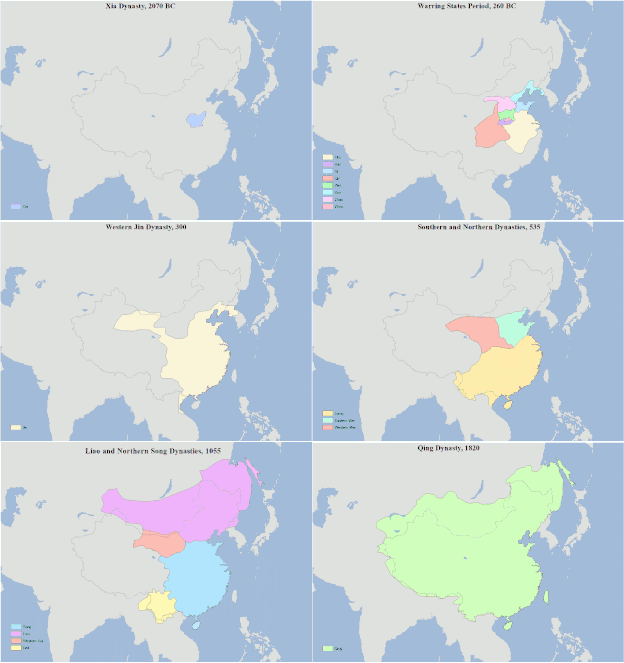 Approximate territories controlled by the various dynasties and states throughout the history of China (from History of China)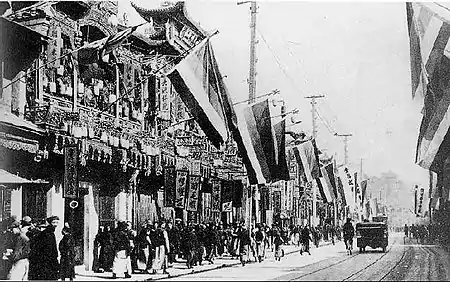
_with_human_faces.jpg.webp) Bronze ding (cauldron) with human faces (from History of China)
Bronze ding (cauldron) with human faces (from History of China)

_-_1958.213.b_-_Cleveland_Museum_of_Art.jpg.webp) Chinese Export—European Market, 18th century - Tea Caddy (from Chinese culture)
Chinese Export—European Market, 18th century - Tea Caddy (from Chinese culture).svg.png.webp) The flag of the Republic of China from 1912 to 1928. (from History of China)
The flag of the Republic of China from 1912 to 1928. (from History of China)
 The Four Treasures of the Study – brush, ink, paper and ink stone in Chinese calligraphy traditions. (from Chinese culture)
 Ming dynasty wood carving books in the Tian Yi Chamber collection (from Chinese culture)
 Box with the character for "Spring" (春), Qianlong period, Qing Dynasty. Nanjing Museum (from Chinese culture)
.jpg.webp) A Moon gate in a Chinese garden (from Chinese culture)
A Moon gate in a Chinese garden (from Chinese culture) Jichang Garden in Wuxi (1506–1521), built during the Ming Dynasty, is an exemplary work of South Chinese style garden. (from Chinese culture)
 Zhu-Ye-Qing-Tea (from Chinese culture)
 Birthplaces of notable Chinese philosophers of the Hundred Schools of Thoughts in the Zhou dynasty. (from Chinese culture)
 Xiqu performance (from Chinese culture)
 Tea caddy, Chinese - Indianapolis Museum of Art (from Chinese culture)
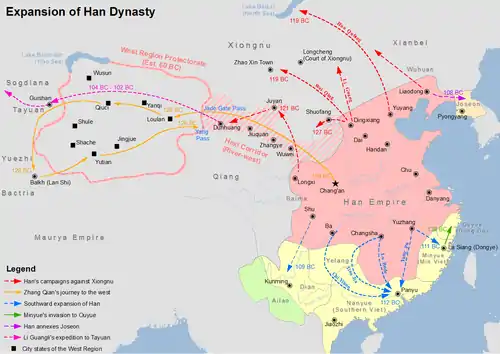 Map showing the expansion of Han dynasty in the 2nd century BC (from History of China)
-111425_(24150640974).jpg.webp) Guzheng, a type of Chinese instrument. (from Chinese culture)
Guzheng, a type of Chinese instrument. (from Chinese culture).jpg.webp) Chinese tea (from Chinese culture)
Chinese tea (from Chinese culture) Tea Pots, Republic of China (from Chinese culture)
 Hair Ornament, China, ca. 19th century (from Chinese culture)
 Taoist architecture in China (from Chinese culture)
 Red lanterns are hung from the trees during the Chinese New Year celebrations in Ditan Park (Temple of Earth) in Beijing. (from Chinese culture)
 Journey to the West (西遊記/西游记) (from Chinese culture)
 Tang dynasty mural from Li Xian's tomb in Qianling showing Han nobility clothing of the era. (from Chinese culture)
 A commercially produced scented wood folding fan, featuring a drawing of the Great Wall of China. (from Chinese culture)
 Hanging Monastery, a temple with the combination of Taoism, Buddhism, and Confucianism. (from Chinese culture)
 The flag of the People's Republic of China since 1949. (from History of China)
 Dragon Tea Pot, Republic of China (from Chinese culture)
 Photo showing serving chopsticks (gongkuai) on the far right, personal chopsticks (putongkuai) in the middle, and a spoon. Serving chopsticks are usually more ornate than the personal ones. (from Chinese culture)

 A Tang dynasty era copy of the preface to the Lantingji Xu poems composed at the Orchid Pavilion Gathering, originally attributed to Wang Xizhi (303–361 AD) of the Jin dynasty (from Chinese culture)
 People's Republic of China 10th Anniversary Parade in Beijing (from History of China)
 Ancient China's Tea Pots (from Chinese culture)
 A traditional red Chinese door with Imperial guardian lion knocker (from Chinese culture)
 Spring rolls are a large variety of filled, rolled appetizers or dim sum found in Chinese cuisine. Spring rolls are the main dishes in Chinese Spring Festival (Chinese New Year). (from Chinese culture)
 Range of Chinese dialect groups according to the Language Atlas of China. (from Chinese culture)
.jpg.webp) Beijing college students rallied during the May Fourth Movement, dissatisfied with Article 156 of the Treaty of Versailles for China (Shandong Problem). (from History of China)
Beijing college students rallied during the May Fourth Movement, dissatisfied with Article 156 of the Treaty of Versailles for China (Shandong Problem). (from History of China) Wooden sculpture of Guanyin (from Chinese culture)
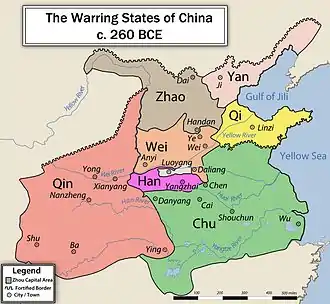 The Warring States, c. 260 BC (from History of China)
 Main hall and tea house in Dunedin Chinese Garden (from Chinese culture)
 "Nine Dragons" handscroll section, by Chen Rong(1244 CE), Song dynasty. Museum of Fine Arts, Boston (from Chinese culture)
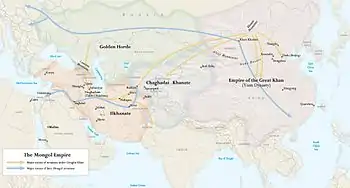 Mongol successor khanates (from History of China)
 Bian Lian("Face-Changing") Performer (from Chinese culture)
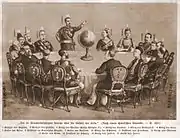 Rulers of the world at the beginning of the 20th century(from History of China)
 Gilin with the head and scaly body of a dragon, tail of a lion and cloven hoofs like a deer. Its body enveloped in sacred flames. Detail from Entrance of General Zu Dashou Tomb (Ming Tomb). (from Chinese culture)
 The flag of the Republic of China from 1928 to now. (from History of China)
 Que pillar gates of Chongqing that once belonged to a temple dedicated to the Warring States period general Ba Manzi (from Chinese culture)
 Traditional clothing from the Ming dynasty (from Chinese culture)
Topics
Categories

In the news
- 5 April 2023 – Taiwan–United States relations
- President of Taiwan Tsai Ing-wen meets with Speaker of the United States House of Representatives Kevin McCarthy at the Ronald Reagan Presidential Library in Simi Valley, California, despite Chinese diplomatic pressure in response to the meeting. (AP)
- 4 April 2023 – China–India relations
- Sino-Indian border dispute
- The Ministry of Civil Affairs of China standardizes the names of 11 places in the Indian state of Arunachal Pradesh in a renewed attempt to assert Chinese territorial claim over the state. (Times of India)
- 29 March 2023 – Brazil–China relations
- Brazil and China sign an agreement to trade in their own currencies, ceasing the usage of the United States dollar as an intermediary. (The Straits Times)
- 27 March 2023 –
- Eleven people are killed after a fire breaks out in a warehouse in Cang County, Hebei, China. (AP)
- 27 March 2023 – Foreign relations of Taiwan
- Former Taiwanese President Ma Ying-jeou becomes the first Taiwanese leader to visit mainland China since the end of the Chinese Civil War in 1949, meeting with China's Taiwan Affairs Office deputy chair Chen Yuanfeng in Shanghai. Taiwan's ruling Democratic Progressive Party criticized this visit as "endorsing" China's position on Taiwan. (Al Jazeera)
Recognized content


Things you can do
 |
Here are some tasks awaiting attention:
|
China's Politics

The General Secretary of the Chinese Communist Party, officially General Secretary of the Central Committee of the Communist Party of China, is head of the Chinese Communist Party and the highest-ranking official within China, a standing member of the Politburo and head of the Secretariat. The officeholder is usually considered the paramount leader of China.
According to the Constitution, the General Secretary serves as an ex officio member of the Politburo Standing Committee, China's de facto top decision-making body. Since the early 1990s, the holder of the post has been, except for transitional periods, the Chairman of the Central Military Commission, making the holder the Commander-in-chief of the People's Liberation Army.
The current General Secretary is Xi Jinping (picture), who took the office at the 18th National Congress on 15 November 2012.


The President of the Republic of China is the head of state of the Republic of China (ROC).
The Constitution names the president as head of state and commander-in-chief of the Republic of China Armed Forces (formerly known as the National Revolutionary Army). The president is responsible for conducting foreign relations, such as concluding treaties, declaring war, and making peace. The president must promulgate all laws and has no right to veto. Other powers of the president include granting amnesty, pardon or clemency, declaring martial law, and conferring honors and decorations.
The current President is Tsai Ing-wen (picture), since May 20, 2016. The first woman to be elected to the office, Tsai is the seventh president of the Republic of China under the 1947 Constitution and the second president from the Democratic Progressive Party (DPP).
Related WikiProjects
 |
You are invited to participate in WikiProject China, a WikiProject dedicated to developing and improving articles about China. ~~~~ |
- Parent projects
- WikiProject Asia
- WikiProject East Asia
- WikiProject Countries

- Main projects
- WikiProject China
- Sub-projects and task forces
- Cartography
- Chinese surnames
- Cinema
- CJKV
- Entertainment
- Go (board game)
- History
- Military history
- Politics
- Three Kingdoms
- Cities
- Pearl River Delta
- Provinces
- Hong Kong
- Macau
- Taiwan
- Tibet
- Transportation
- Related projects
- Buddhism
- Christianity
- Martial arts
- Taoism
Wikipedias in languages found in China
粵語 / 广东话 (Cantonese) •
古文 / 文言文 (Classical Chinese) •
赣语 (Gan) •
Hak-kâ-fa (Hakka) •
قازاق تىلى (Kazakh) •
中文 / 普通话 (Mandarin) (Now unable to access in
China Mainland because of the GFW) •
闽东语 (Min Dong) •
闽南语 (Min-nan) •
བོད་ཡིག (Tibetan) •
ئۇيغۇرچە (Uyghur) •
吴语 (Wu) •
Sawcuengh (Zhuang)
 wiki incubator Xiang (湘语) wiki incubator Xiang (湘语) |
wiki incubator Pu-Xian Min (莆仙话) |
wiki incubator Min Bei (闽北语) |
| wiki incubator lahu (拉祜族,拉祜语) |
wiki incubator Nuosu (彝族,彝语) |
wiki incubator hmong (苗族,苗语) |
| wiki incubator Bouyei (布依族,布依语) |
wiki incubator manchu (满族,满语) |
wiki incubator Xong (苗族,湘西苗语) |
| wiki incubator Daw (苗族,白苗苗语) |
wiki incubator xibo (锡伯族,锡伯语) |
wiki incubator salar (撒拉族,撒拉语) |
| wiki incubator цзинпо (景颇族,景颇语) |
wiki incubator Tai Nüa (傣族,德宏傣语) |
wiki incubator Amis (阿美族,阿美語) |
| wiki incubator Western Yugur (裕固族,西部裕固语) |
wiki incubator northern tujia (土家族,北部土家语) |
Associated Wikimedia
The following Wikimedia Foundation sister projects provide more on this subject:
-
 Commons
Free media repository -
 Wikibooks
Free textbooks and manuals -
 Wikidata
Free knowledge base -
 Wikinews
Free-content news -
 Wikiquote
Collection of quotations -
 Wikisource
Free-content library -
 Wikiversity
Free learning tools -
 Wikivoyage
Free travel guide -
 Wiktionary
Dictionary and thesaurus
-
 List of all portalsList of all portals
 -
 The arts portal
 -
 Biography portal
 -
 Current events portal
 -
 Geography portal
 -
 History portal
 -
 Mathematics portal
 -
 Science portal
 -
 Society portal
 -
 Technology portal
 -
 Random portalRandom portal
 -
 WikiProject PortalsWikiProject Portals