Typhoon Wutip (2019)
Typhoon Wutip, known in the Philippines as Tropical Depression Betty, was the most powerful February typhoon on record, surpassing Typhoon Higos of 2015.[1][2] The third tropical cyclone, second tropical storm, and the first typhoon of the 2019 Pacific typhoon season, Wutip originated from a low-pressure area on February 16, 2019. The disturbance generally tracked westward, passing just south of the Federated States of Micronesia (FSM) before organizing to a tropical depression, receiving the numeral identifier 02W from the Joint Typhoon Warning Center on February 18, and would intensify into a tropical storm and be named Wutip by the Japan Meteorological Agency on the 20th before strengthening further into a typhoon the following day.
| Violent typhoon (JMA scale) | |
|---|---|
| Category 5 super typhoon (SSHWS) | |
 Typhoon Wutip at its secondary peak intensity west of the island of Guam, on February 25. | |
| Formed | February 18, 2019 |
| Dissipated | March 2, 2019 |
| Highest winds | 10-minute sustained: 195 km/h (120 mph) 1-minute sustained: 270 km/h (165 mph) |
| Lowest pressure | 920 hPa (mbar); 27.17 inHg |
| Fatalities | None reported |
| Damage | $3.3 million (2019 USD) |
| Areas affected | Guam, Federated States of Micronesia, Northern Mariana Islands |
| Part of the 2019 Pacific typhoon season | |
Wutip underwent rapid intensification, and on February 23, reached its peak intensity, with 10-minute sustained winds of 195 km/h (120 mph), 1-minute sustained winds of 270 km/h (165 mph), and a minimal pressure of 920 hectopascals (mbar; 27.17 inHg) while passing to the southwest of Guam, becoming the first Category 5-equivalent super typhoon recorded in the month of February. Wutip underwent an eyewall replacement cycle shortly afterward, causing the storm to weaken as it turned northwest. The storm finished its cycle on February 24, resulting in the typhoon rapidly intensifying once again. Wutip reached a secondary peak intensity the following day, with 10-minute sustained winds of 185 km/h (115 mph), 1-minute sustained winds of 255 km/h (160 mph), and a minimum central pressure of 935 hectopascals (mbar; 27.6 inHg). Afterward, Wutip rapidly weakened on February 26 from strong wind shear as it moved northwestward. After reaching the Philippine Area of Responsibility, Wutip attained the name Betty from PAGASA as a tropical depression on February 28, before dissipating on March 2.
Prior to the storm's arrival, advisories were issued across Micronesia and the Northern Mariana Islands by the National Weather Service office in Tiyan, Guam. About 160 houses were damaged and 165 people were homeless in Yap and Chuuk after Wutip's passage. Wutip caused power outages across Guam when it was near its closest approach on February 24. A disaster declaration from Guam governor Lou Leon Guerrero and another from president of the Federated States of Micronesia Peter M. Christian were approved by Donald Trump a few months after the storm. Wutip caused at least $3.3 million (2019 USD) in damages in Guam and Micronesia.[3][4]
Meteorological history

Tropical storm (39–73 mph, 63–118 km/h)
Category 1 (74–95 mph, 119–153 km/h)
Category 2 (96–110 mph, 154–177 km/h)
Category 3 (111–129 mph, 178–208 km/h)
Category 4 (130–156 mph, 209–251 km/h)
Category 5 (≥157 mph, ≥252 km/h)
Unknown


 Extratropical cyclone, remnant low, tropical disturbance, or monsoon depression
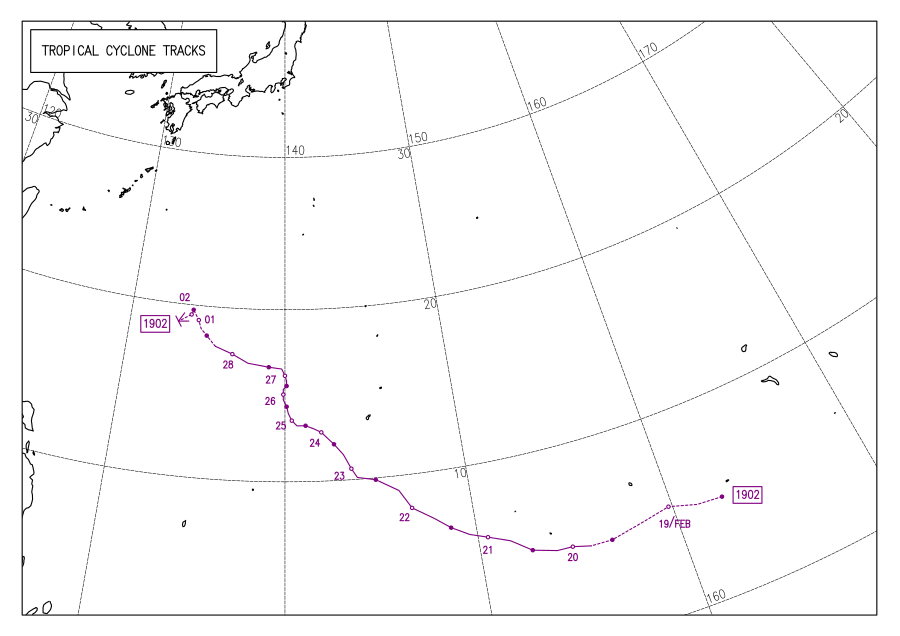
An almost stationary low-pressure area formed near 4°N 170°E on February 16 at 6:00 UTC[5] before the system slowly headed westward[6] southeast of Kosrae as a vigorous trade wind convergence north of the disturbance triggered sporadic deep convection.[7] A Tropical Cyclone Formation Alert was issued on the 18th when the system, designated as Invest 92W by the Joint Typhoon Warning Center (JTWC)[nb 1], was under favorable conditions for development as flaring convection was surrounding several weak low-level circulation centers (LLCC) embedded with the elongated system.[9] The Japan Meteorological Agency (JMA)[nb 2] classified the system as a tropical depression,[10] shortly before the JTWC followed suit, designating the consolidating system as Tropical Depression 02W on February 19.[11] The storm received the name Wutip from the JMA after reaching tropical storm strength the same day.[12]
.gif)
On February 20, the storm tracked westward along the southern periphery of a mid-level subtropical high;[13] and after reaching winds of 100 km/h (60 mph), Wutip attained severe tropical storm status from the JMA.[14] Wutip further upgraded to a typhoon on February 21,[15] as a central dense overcast pattern formed while tracking west-northwestward.[16] Enhanced multi-spectral satellite imagery depicted the well-organized and compact system with an intermittent eye feature.[17] Furthermore, northern spiral rainbands were revealed by radar imagery as gale-force surface winds were produced towards Guam, while also improving its structure.[18]

Wutip rapidly intensified during February 23 as its eye became well-defined after conditions for tropical cyclogenesis had improved, with diminished wind shear and excellent upper-level outflow despite decrease in sea surface temperature.[19] Wutip reached its initial peak intensity at 12:00 UTC as a super typhoon, with 10-minute sustained winds of 195 km/h (120 mph) and the lowest central pressure of 920 hPa (27 inHg),[20] and 1-minute sustained winds of 270 km/h (165 mph), equivalent to Category 5 strength winds on the Saffir–Simpson hurricane wind scale.[21] This made Wutip the most powerful typhoon in the month of February, surpassing Typhoon Higos of 2015.[1] The storm had also become the first and only tropical cyclone in the Northern Hemisphere with Category 5 strength in February.[22] Wutip weakened shortly afterward from dry air as it began an eyewall replacement cycle that day, while also keeping winds of 250 km/h (155 mph).[23] The storm however, would complete its cycle with a well-defined and axisymmetric annular eye and resume a trend of rapid intensification.[24] Wutip again became a Category 5-equivalent typhoon on February 25 at 6:00 UTC, reaching its secondary peak intensity with 10-minute sustained winds of 185 km/h (115 mph),[20] 1-minute sustained winds of 260 km/h (160 mph),[25] and an atmospheric pressure of 935 hPa (27.6 inHg).[20]
An increase of wind shear weakens Wutip as its eye became cloud-filled.[26] The storm's structure had rapidly deteriorated, making its eye no longer detected in satellite imagery, as 1-minute winds decrease to 195 km/h (120 mph).[27] The system became quasi-stationary while eroding rapidly, with its northern periphery being more affected.[28] The storm reached the southern edge of the prevailing westerlies along with escalated wind shear. The poleward outflow channel however, remained robust.[29] Deep convection had also quickly decreased around the LLCC,[30] as Wutip downgraded to a tropical storm on February 27.[31] The storm however, would still retain its strong outflow by being positioned under the westerly midlatitude jet.[32] The well-organized LLCC had become fully exposed the following day.[33] Wutip degraded to a tropical depression after having its 1-minute sustained winds decrease to 45 km/h (30 mph)[34] and on the same day, was given the name Betty by the Philippine Atmospheric, Geophysical and Astronomical Services Administration, as the storm entered the Philippine Area of Responsibility (PAR) in the Philippine Sea.[35] The JTWC issued its final warning on Wutip at 18:00 UTC after winds decreased to 35 km/h (20 mph).[36] Wutip made a clockwise loop on March 1 before dissipating the following day at 12:00 UTC.[20]
Preparations and impact
Federated States of Micronesia
Tropical storm watches and warnings were issued for Chuuk State, Pohnpei, and Yap State of the Federated States of Micronesia by the National Weather Service office in Tiyan, Guam as Tropical Depression 02W was approaching the FSM on February 19, 2019;[37] however, the tropical storm warning for Faraulep in Yap State was later cancelled.[38] The advisories were later upgraded to typhoon watches and warnings after Tropical Depression 02W had intensified into Tropical Storm Wutip on February 20, with forecasts stating that Wutip would later strengthen into a typhoon.[39]
Wutip passed over Chuuk, Pohnpei and Yap States with winds of more than 160 km/h (100 mph) from February 19 to 22, and damaged or destroyed approximately 160 houses and displaced 165 people in Chuuk and Yap.[40] Despite no serious injuries or fatalities occurring, many crops were ruined from the saltwater from Wutip and many breadfruit and banana trees were downed.[41] Food sources were destroyed by the powerful winds along with sea water inundation; the latter had also rendered water sources unsafe for drinking. Local authorities declared states of emergency in response to the destruction.[40] Wutip caused heavy preliminary damage in infrastructure and agriculture and costed a total of $2 million.[4]
Guam
Guam was still reeling from Typhoon Mangkhut as hundreds fled to emergency shelters; over 430 children and adults sought refuge at 5 different emergency shelters.[42] Public schools in Guam were closed in preparation of Wutip on February 22.[43] The same day, Cope North, an annual military exercise that takes place around Guam, was paused "as a precautionary measure due to hazardous and potentially damaging winds caused by Typhoon Wutip," according to the Pacific Air Forces.[44] A team of 18 from the Federal Emergency Management Agency (FEMA) assisted Guam with emergencies.[45] Civil defense officials warned Guam residents that winds between 64–72 km/h (40–45 mph) and rainfall up to 15.24 cm (6.00 in) were expected, and advised them to stay indoors until the storm had passed.[46] Lieutenant Governor Josh Tenorio put Guam and the military bases under Condition of Readiness (COR) 2,[47] before upgrading it to COR 1.[48] Over 20 flights to and from Guam were cancelled,[49] leading to the loss of 4,993 seats.[50]
The Guam Power Authority reported isolated power outages occurring across Guam, leading to danger from sensitive home appliances.[51] Wutip's closest point of approach was on the 24th, when it was about 266 kilometres (165 mi) south of the island. Wutip had dumped 43 cm (17 in) of rain in Inarajan, 30 cm (12 in) in Dandan, and 15 to 20 cm (6 to 8 in) elsewhere in the island.[52] Inarajan experienced more significant damage, with obstructed roads and many downed trees and power lines with major flooding. Despite this, no injury or serious damage were reported.[53] Preliminary damage in infrastructure for Wutip totaled $1.3 million.[3]
Northern Mariana Islands
Tropical storm watches were in effect across the islands of Saipan, Tinian, and Rota. Families were still residing in tents due to the effects from Typhoon Yutu, and were encouraged to seek emergency shelter.[54] A total of 83 individuals took shelter during Wutip's passage.[55] The president of the Asian Football Confederation, Salman bin Ibrahim Al Khalifa, was set to visit Saipan on the 25th, but was postponed in precaution of Wutip.[56] The tropical storm watch in Rota was later upgraded to a typhoon warning, but was canceled on February 25 by Lieutenant Governor Arnold Palacios when Wutip headed in a different direction from the islands, which no longer posed a threat to the islands. As a result, schools were reopened across the Northern Mariana Islands and Guam on the same day.[57] There was only minor flooding upon the islands.[58]
Aftermath

The Federated States of Micronesia President Peter M. Christian issued a national disaster declaration on March 11, due to the effects of the storm, and requested international assistance.[59] U.S. Chargé d'affaires Heather Coble declared a disaster the following day, allowing the USAID, FEMA, and the federal government of the FSM to carry out a damage assessment and relieve activities supporting agriculture and food security,[60] after 11,575 people were left food insecure.[59] The United States Agency for International Development (USAID) supplied $100,000 to aid immediate disaster relief activities for affected populations.[40] A multinational team arrived at Lower Mortlock Islands of Chuuk State to assist local communities as part of Pacific Partnership 2019 on March 31, which included helping the state recover after the storm.[61]
On May 7, U.S. President Donald Trump declared "a disaster under the Compact of Free Association between the Government of the United States of America and the Government of the Federated States of Micronesia, as amended", due to damage resulting from Wutip.[62] Relief and reconstruction funding from the USAID totaled more than $22.3 million.[60] On May 11, 2019, Donald Trump approved the disaster declaration requested by Guam Governor Lou Leon Guerrero on February 23 due to the impact the Mariana Islands had from Wutip. Tracy C. Haynes was appointed by Trump as Federal Coordinating Officer (FCO) for recovery operations across Guam.[63][64]
See also
- Weather of 2019
- Tropical cyclones in 2019
- Other systems named Wutip
- Typhoon Keith – A Category 5-equivalent super typhoon that affected the some of the same areas in 1997
- Typhoon Higos – The previous record holder of the strongest typhoon in February on record
- Typhoon Maysak (2015) – The most powerful pre-April typhoon on record; struck Micronesia and the Philippines
- Typhoon Jelawat – An early-season Category 4-equivalent super typhoon from 2018, which affected some of the same areas
- Typhoon Yutu – A powerful Category 5-equivalent super typhoon that devastated Saipan and Tinian in the Northern Mariana Islands during the previous year
- Typhoon Surigae – The most powerful April typhoon on record
Notes
- The Joint Typhoon Warning Center is a joint United States Navy – United States Air Force task force that issues tropical cyclone warnings for the western Pacific Ocean and other regions.[8]
- The Japan Meteorological Agency is the official Regional Specialized Meteorological Center for the western Pacific Ocean.
References
- Matthew Cappucci (February 25, 2019). "The strongest February typhoon on record packs 180 mph gusts, sideswiping Guam". The Washington Post. Retrieved May 21, 2019.
- Kristina Pydynowski; Robert Richards (February 23, 2019). "Wutip becomes strongest super typhoon in February as it lashes Guam with rain, wind". Accuweather. Archived from the original on February 22, 2019. Retrieved February 23, 2019.
- "Preliminary cost estimate of Wutip: More than $1.3 million". Guam Pacific Daily News. March 1, 2019. Retrieved May 21, 2019.
- Losinio, Louella (April 12, 2019). "Post-Wutip damages to FSM cost at least $2M". PNC News First. Retrieved November 26, 2022.
- Warning and Summary 160600 (TXT) (Report). Tokyo, Japan: Japan Meteorological Agency. February 16, 2019. Retrieved April 1, 2023 – via Iowa Environmental Mesonet.
- Warning and Summary 161200 (TXT) (Report). Tokyo, Japan: Japan Meteorological Agency. February 16, 2019. Retrieved April 1, 2023 – via Iowa Environmental Mesonet.
- ...TROPICAL DISTURBANCE SOUTHEAST OF KOSRAE... (Report). Tiyan, Guam: National Weather Service. February 17, 2019. Retrieved April 1, 2023 – via Iowa Environmental Mesonet.
- "Joint Typhoon Warning Center Mission Statement". Joint Typhoon Warning Center. 2011. Archived from the original on July 26, 2007. Retrieved January 1, 2014.
- Tropical Cyclone Formation Alert (180300 February 2019) (TXT) (Report). Pearl Harbor, Hawaii: Joint Typhoon Warning Center. February 18, 2019. Retrieved February 23, 2023 – via Iowa Environmental Mesonet.
- Warning and Summary 181800 (TXT) (Report). Tokyo, Japan: Japan Meteorological Agency. February 18, 2019. Retrieved March 29, 2023 – via Iowa Environmental Mesonet.
- Prognostic Reasoning for Tropical Depression 02W (Two) Warning No. 1 (TXT) (Report). Pearl Harbor, Hawaii: Joint Typhoon Warning Center. February 19, 2019. Retrieved February 25, 2023 – via Iowa Environmental Mesonet.
- Warning 191800 (TXT) (Report). Tokyo, Japan: Japan Meteorological Agency. February 19, 2019. Retrieved February 25, 2023 – via Iowa Environmental Mesonet.
- Reasoning No. 8 for STS 1902 Wutip (1902) (TXT) (RSMC Tropical Cyclone Prognostic Reasoning). Tokyo, Japan: Japan Meteorological Agency. February 20, 2019. Retrieved March 5, 2023 – via Iowa Environmental Mesonet.
- Warning 201200 (TXT) (Report). Tokyo, Japan: Japan Meteorological Agency. February 20, 2019. Retrieved March 5, 2023 – via Iowa Environmental Mesonet.
- Warning 210000 (TXT) (Report). Tokyo, Japan: Japan Meteorological Agency. February 21, 2019. Retrieved March 15, 2023 – via Iowa Environmental Mesonet.
- Reasoning No. 10 for TY 1902 Wutip (1902) (TXT) (RSMC Tropical Cyclone Prognostic Reasoning). Tokyo, Japan: Japan Meteorological Agency. February 21, 2019. Retrieved March 20, 2023 – via Iowa Environmental Mesonet.
- Prognostic Reasoning for Super Typhoon 02W (Wutip) Warning No. 15 (TXT) (Report). Pearl Harbor, Hawaii: Joint Typhoon Warning Center. February 23, 2019. Retrieved March 27, 2023 – via Iowa Environmental Mesonet.
- Prognostic Reasoning for Super Typhoon 02W (Wutip) Warning No. 17 (TXT) (Report). Pearl Harbor, Hawaii: Joint Typhoon Warning Center. February 23, 2019. Retrieved March 27, 2023 – via Iowa Environmental Mesonet.
- Prognostic Reasoning for Super Typhoon 02W (Wutip) Warning No. 18 (TXT) (Report). Pearl Harbor, Hawaii: Joint Typhoon Warning Center. February 23, 2019. Retrieved March 27, 2023 – via Iowa Environmental Mesonet.
- Annual Report on Activities of the RSMC Tokyo – Typhoon Center 2019 (PDF) (Report). Tokyo, Japan: Japan Meteorological Agency. Retrieved March 28, 2023.
- "Western North Pacific Ocean Best Track Data". Joint Typhoon Warning Center. Retrieved April 5, 2023.
- Teo Blašković (February 24, 2019). "Super Typhoon "Wutip" becomes the strongest February typhoon in West Pacific Ocean". The Watchers. Retrieved May 21, 2019.
- Prognostic Reasoning for Super Typhoon 02W (Wutip) Warning No. 19 (TXT) (Report). Pearl Harbor, Hawaii: Joint Typhoon Warning Center. February 23, 2019. Retrieved March 27, 2023 – via Iowa Environmental Mesonet.
- Prognostic Reasoning for Super Typhoon 02W (Wutip) Warning No. 25 (TXT) (Report). Pearl Harbor, Hawaii: Joint Typhoon Warning Center. February 25, 2019. Retrieved April 2, 2023 – via Iowa Environmental Mesonet.
- Super Typhoon 02W (Wutip) Warning No. 25 (Report). Pearl Harbor, Hawaii: Joint Typhoon Warning Center. February 25, 2019. Archived from the original (TXT) on April 3, 2023. Retrieved April 3, 2023.
- Prognostic Reasoning for Typhoon 02W (Wutip) Warning No. 29 (TXT) (Report). Pearl Harbor, Hawaii: Joint Typhoon Warning Center. February 26, 2019. Retrieved March 28, 2023 – via Iowa Environmental Mesonet.
- Prognostic Reasoning for Typhoon 02W (Wutip) Warning No. 30 (TXT) (Report). Pearl Harbor, Hawaii: Joint Typhoon Warning Center. February 26, 2019. Retrieved March 28, 2023 – via Iowa Environmental Mesonet.
- Prognostic Reasoning for Typhoon 02W (Wutip) Warning No. 31 (TXT) (Report). Pearl Harbor, Hawaii: Joint Typhoon Warning Center. February 26, 2019. Retrieved April 2, 2023 – via Iowa Environmental Mesonet.
- Prognostic Reasoning for Typhoon 02W (Wutip) Warning No. 32 (TXT) (Report). Pearl Harbor, Hawaii: Joint Typhoon Warning Center. February 26, 2019. Retrieved April 2, 2023 – via Iowa Environmental Mesonet.
- Prognostic Reasoning for Tropical Storm 02W (Wutip) Warning No. 34 (TXT) (Report). Pearl Harbor, Hawaii: Joint Typhoon Warning Center. February 27, 2019. Retrieved March 28, 2023 – via Iowa Environmental Mesonet.
- Tropical Storm 02W (Wutip) Warning No. 34 (Report). Pearl Harbor, Hawaii: Joint Typhoon Warning Center. February 27, 2019. Archived from the original (TXT) on April 3, 2023. Retrieved April 3, 2023.
- Prognostic Reasoning for Tropical Storm 02W (Wutip) Warning No. 35 (TXT) (Report). Pearl Harbor, Hawaii: Joint Typhoon Warning Center. February 27, 2019. Retrieved March 28, 2023 – via Iowa Environmental Mesonet.
- Prognostic Reasoning for Tropical Storm 02W (Wutip) No. 36 (TXT) (Report). Pearl Harbor, Hawaii: Joint Typhoon Warning Center. February 28, 2019. Retrieved March 28, 2023 – via Iowa Environmental Mesonet.
- Tropical Depression 02W (Wutip) Warning No. 38 (Report). Pearl Harbor, Hawaii: Joint Typhoon Warning Center. February 28, 2019. Archived from the original (TXT) on April 3, 2023. Retrieved April 3, 2023.
- Rappler.com (February 28, 2019). "Tropical Depression Betty enters PAR, but poses no threat". Rappler. Retrieved September 30, 2019.
- Tropical Depression 02W (Wutip) Warning No. 39 (Report). Pearl Harbor, Hawaii: Joint Typhoon Warning Center. February 28, 2019. Archived from the original (TXT) on April 3, 2023. Retrieved April 3, 2023.
- "02W (Northwestern Pacific Ocean) – Hurricane And Typhoon Updates". blogs.nasa.gov. Retrieved December 1, 2022.
- "Northern Marianas, Guam prepare for Typhoon Wutip". RNZ. February 22, 2019. Retrieved November 1, 2022.
- "Wutip (was 02W – Northwestern Pacific Ocean) – Hurricane And Typhoon Updates". blogs.nasa.gov. Retrieved December 1, 2022.
- "Micronesia, Federated States of". USAID. Archived from the original on January 31, 2022. Retrieved March 30, 2023.
- Weiss, Jasmine Stole (February 23, 2019). "Typhoon Wutip leaves Chuuk islands badly damaged". Pacific Daily News. Retrieved March 30, 2023.
- Gilbert, Haidee Eugenio (February 23, 2019). "Wutip sends hundreds to typhoon shelters, knocks down trees". Pacific Daily News. Retrieved March 30, 2023.
- Kerrigan, Kevin (February 22, 2019). "GovGuam, schools to close early". The Guam Daily Post. Retrieved March 29, 2023.
- Robson, Seth (February 22, 2019). "Typhoon Wutip interrupts three-nation Cope North military drills on Guam". Stars and Stripes. Retrieved March 29, 2023.
- Gilbert, Haidee Eugenio. "FEMA teams arrive to help Guam with emergency response to Typhoon Wutip". USA TODAY. Retrieved September 20, 2019.
- "Wutip Upgraded to Super Typhoon, Lashes Guam With High Winds". Voice of America. February 23, 2019. Retrieved March 29, 2023.
- "Friday Typhoon Wutip updates: Guam now in COR 2". USA TODAY NETWORK. Pacific Daily News. February 22, 2019. Retrieved March 29, 2023.
- Williams, Dana (February 22, 2019). "What Wutip's super typhoon status means for Guam residents". USA TODAY. Retrieved March 29, 2023.
- "Airlines cancel Guam flights because of Typhoon Wutip". Pacific Daily News. February 23, 2019. Retrieved March 29, 2023.
- February 2019 Arrivals (PDF) (Report). Guam Visitors Bureau. Archived from the original (PDF) on October 29, 2019. Retrieved March 30, 2023.
- Gilbert, Haidee Eugenio (February 23, 2019). "Typhoon Wutip: Isolated power outages as storm brings rain and wind". Pacific Daily News. Retrieved March 29, 2023.
- Kaur, Anumita (February 24, 2019). "Super Typhoon Wutip spares Guam". Pacific Daily News. Retrieved March 29, 2023.
- Kerrigan, Kevin (February 25, 2019). "Guam spared brunt of Wutip". The Guam Daily Post. Retrieved March 29, 2023.
- "Northern Marianas, Guam prepare for Typhoon Wutip". RNZ. February 23, 2019. Retrieved March 30, 2023.
- Esmores, Kimberly Bautista (February 25, 2019). "Wutip spares the Marianas". Saipan Tribune. Retrieved April 1, 2023.
- "Sheikh Salman's Saipan visit postponed". Saipan Tribune. February 25, 2019. Retrieved March 31, 2023.
- "Schools to reopen across Micronesia after Typhoon Wutip". RNZ. February 25, 2019. Retrieved November 1, 2022.
- "Typhoon Wutip upgraded to category 5 in Northern Hemisphere first". RNZ. February 26, 2019. Retrieved November 1, 2022.
- "IOM Micronesia Newsletter, July 2018 - April 2019 - Typhoon Wutip Destruction - Micronesia (Federated States of)". ReliefWeb. Retrieved February 21, 2020.
- "FSM and RMI Program Summary" (PDF). www.usaid.gov. October 20, 2020.
- Losinio, Louella (April 5, 2019). "Military team assists Chuuk in post-Wutip recovery". PNC News First. Retrieved November 26, 2022.
- "U.S. President Donald J. Trump Approves a Disaster Declaration for the Federated States of Micronesia". whitehouse.gov. Retrieved September 20, 2019 – via National Archives.
- Governor, Office of the (May 11, 2019). "President Trump Approves Disaster Declaration for Guam for Typhoon Wutip - Governor of Guam". Retrieved November 3, 2022.
- Losinio, Louella (May 10, 2019). "Federal government approves Guam's disaster declaration for Typhoon Wutip". PNC News First. Retrieved November 26, 2022.
External links

- 02W.WUTIP from the U.S. Naval Research Laboratory
- General Information of Typhoon Wutip (1902) from Digital Typhoon
- JMA Best Track Data of Typhoon Wutip (1902) (in Japanese)
- JMA Best Track (Graphics) of Typhoon Wutip (1902)
Tropical cyclones of the 2019 Pacific typhoon season | ||
|---|---|---|
 | ||
| ||