Portal:Tanzania

 Tanzania Portal The Tanzania Portal
Tanzania (/ˌtænzəˈniːə/; Swahili: [tanzaˈni.a]), officially the United Republic of Tanzania (Swahili: Jamhuri ya Muungano wa Tanzania), is a country in East Africa within the African Great Lakes region. It borders Uganda to the north; Kenya to the northeast; the Indian Ocean to the east; Mozambique and Malawi to the south; Zambia to the southwest; and Rwanda, Burundi, and the Democratic Republic of the Congo to the west. Mount Kilimanjaro, Africa's highest mountain, is in northeastern Tanzania. According to 2022 national census, Tanzania has a population of nearly 62 million, making it the fifth largest in Africa. Many important hominid fossils have been found in Tanzania, such as 6-million-year-old Pliocene hominid fossils. The genus Australopithecus ranged across Africa between 4 and 2 million years ago, and the oldest remains of the genus Homo are found near Lake Olduvai. Following the rise of Homo erectus 1.8 million years ago, humanity spread all over the Old World, and later in the New World and Australia under the species Homo sapiens. H. sapiens also overtook Africa and absorbed the older species of humanity. Later in the Stone and Bronze Age, prehistoric migrations into Tanzania included Southern Cushitic speakers who moved south from present-day Ethiopia; Eastern Cushitic people who moved into Tanzania from north of Lake Turkana about 2,000 and 4,000 years ago; and the Southern Nilotes, including the Datoog, who originated from the present-day South Sudan–Ethiopia border region between 2,900 and 2,400 years ago. These movements took place at about the same time as the settlement of the Mashariki Bantu from West Africa in the Lake Victoria and Lake Tanganyika areas. They subsequently migrated across the rest of Tanzania between 2,300 and 1,700 years ago. Tanzania's population is composed of about 120 ethnic, linguistic, and religious groups. Christianity is the largest religion in Tanzania, but there are also substantial Muslim and animist minorities. Over 100 different languages are spoken in Tanzania, making it the most linguistically diverse country in East Africa; the country does not have a de jure official language, although the national language is Swahili which is used in parliamentary debate, in the lower courts, and as a medium of instruction in primary school, spoken by up to 90% as a second language. English is used in foreign trade, in diplomacy, in higher courts, and as a medium of instruction in secondary and higher education, while Arabic is spoken in Zanzibar. Tanzania is mountainous and densely forested in the north-east, where Mount Kilimanjaro is located. Three of Africa's Great Lakes are partly within Tanzania. To the north and west lie Lake Victoria, Africa's largest lake, and Lake Tanganyika, the continent's deepest lake, known for its unique species of fish. To the south lies Lake Malawi. The eastern shore is hot and humid, with the Zanzibar Archipelago just offshore. The Menai Bay Conservation Area is Zanzibar's largest marine protected area. The Kalambo Falls, located on the Kalambo River at the Zambian border, is the second-highest uninterrupted waterfall in Africa. Tanzania is one of the most visited tourist destinations for safaris. Selected article -
Swahili, also known by its local name Kiswahili, is the native language of the Swahili people, who are found primarily in Kenya, Tanzania and Mozambique (along the East African coast and adjacent litoral islands). It is a Bantu language, though Swahili has borrowed a number of words from foreign languages, particularly Arabic and Persian, but also words from Portuguese, English and German. Around forty percent of Swahili vocabulary consists of Arabic loanwords, including the name of the language (سَوَاحِلي sawāḥilī, a plural adjectival form of an Arabic word meaning 'of the coast'). The loanwords date from the era of contact between Arab traders and the Bantu inhabitants of the east coast of Africa, which was also the time period when Swahili emerged as a lingua franca in the region. The number of Swahili speakers, be they native or second-language speakers, is estimated to be around 80 million. Due to concerted efforts by the government of Tanzania, Swahili is one of three official languages (the others being English and French) of the East African Community (EAC) countries, namely Burundi, Democratic Republic of Congo, Kenya, Rwanda, South Sudan, Tanzania, and Uganda. It is a lingua franca of other areas in the African Great Lakes region and East and Southern Africa, including some parts of the Democratic Republic of the Congo (DRC), Malawi, Mozambique, the southern tip of Somalia, and Zambia. Swahili is also one of the working languages of the African Union and of the Southern African Development Community. The East African Community created an institution called the East African Kiswahili Commission (EAKC) which began operations in 2015. The institution currently serves as the leading body for promoting the language in the East African region, as well as for coordinating its development and usage for regional integration and sustainable development. In recent years South Africa, Botswana, Namibia, Ethiopia, and South Sudan have begun offering Swahili as a subject in schools or have developed plans to do so. (Full article...)General images -The following are images from various Tanzania-related articles on Wikipedia.
This month in Tanzanian history
Wildlife of Tanzania - Black Rhinoceros Credit: Joachim Huber
The Ostrich, Struthio camelus, is a large flightless bird native to Africa. It is the only living species of its family and its genus. Ostriches share the order Struthioniformes with the kiwis, Emus, and other ratites. It is distinctive in its appearance, with a long neck and legs and the ability to run at maximum speeds of about 70 km/h (45 mph), the top land speed of any bird. Did you know ...

Categories Category puzzle Select [►] to view subcategories
Tanzania Tanzania-related lists Buildings and structures in Tanzania Tanzanian culture Economy of Tanzania Education in Tanzania Environment of Tanzania Geography of Tanzania Government of Tanzania Health in Tanzania History of Tanzania Images of Tanzania Organisations based in Tanzania Tanzanian people Politics of Tanzania Society of Tanzania Tanzania stubs WikiProjects
Recognised contentFeatured Articles:
Featured Lists:
Good Articles:
Selected panorama -Morogoro is a city with an urban population of 206,868 (2002 census) in the southern highlands of Tanzania, 190 km west of Dar es Salaam. It is the capital of the Morogoro Region. It is also known informally as "Mji kasoro bahari," which translates as 'city short of an ocean/port'.
Uganda–Tanzania War -Articles here focus upon aspects of the Uganda–Tanzania War. These are all Good articles that meet a core set of high editorial standards.
 The Battle of Karuma Falls was one of the last battles in the Uganda–Tanzania War, fought between Tanzania and Uganda Army troops loyal to Idi Amin on 17 May 1979. Soldiers of the Tanzania People's Defence Force attacked Ugandan forces at the bridge over the Nile River at Karuma Falls. Tanzania's 205th Brigade was tasked with advancing from Masindi to Gulu, taking a route which passed over the Karuma Falls Bridge. The brigade assaulted the crossing on the morning of 17 May with tanks and artillery and one of its battalions ran over the bridge to attack the Ugandan positions. The Ugandans destroyed a TPDF tank, delaying the Tanzanians long enough to board buses and retreat to Gulu. The Tanzanians secured Karuma Falls before capturing Gulu several days later. (Full article...) Topics
Selected picture -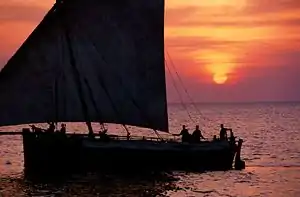 Dhow Credit: Winky
Dhow off the coast of Zanzibar at sunset. Dhows are traditional Arab sailing boats used primarily along the coasts of the Arabian Peninsula, India, and East Africa. Related portalsThings you can do
Associated WikimediaThe following Wikimedia Foundation sister projects provide more on this subject:
Discover Wikipedia using portals
| ||||||||||||||||||||||||||||||||||||||||||||||||||||||||||||||||||||||||||||||||||||||||||||||||||||||


.svg.png.webp)


_in_Southern_Africa_per_million_inhabitants%252C_2013_or_closest_year.svg.png.webp)


_sv.svg.png.webp)
_and_her_husband_Louis_Seymour_Bazett_Leakey_(1903-1972).jpg.webp)

.jpg.webp)
.jpg.webp)


.svg.png.webp)


.svg.png.webp)