Portal:Spain

The Spain Portal (Bienvenido al portal español)

Spain (Spanish: España, [esˈpaɲa] ( listen)), or the Kingdom of Spain (Reino de España), is a country primarily located in southwestern Europe with parts of territory in the Atlantic Ocean and across the Mediterranean Sea. The largest part of Spain is situated on the Iberian Peninsula; its territory also includes the Canary Islands in the Atlantic Ocean, the Balearic Islands in the Mediterranean Sea, and the autonomous cities of Ceuta and Melilla in Africa. The country's mainland is bordered to the south by Gibraltar; to the south and east by the Mediterranean Sea; to the north by France, Andorra and the Bay of Biscay; and to the west by Portugal and the Atlantic Ocean. It is the second-largest country in the European Union (EU) and the fourth-most populous EU member state. Spain's capital and largest city is Madrid; other major urban areas include Barcelona, Valencia, Seville, Zaragoza, Málaga, Murcia, Palma de Mallorca, Las Palmas de Gran Canaria, and Bilbao.
Anatomically modern humans first arrived in the Iberian Peninsula around 42,000 years ago. The ancient Iberian and Celtic tribes, along with other local pre-Roman peoples, dwelled the territory maintaining contacts with foreign Mediterranean cultures. The Roman conquest and colonization of the peninsula (Hispania) ensued, bringing the Romanization of the population. Receding of Western Roman imperial authority ushered in the migration into Iberia of tribes from Central and Northern Europe with the Visigoths as the dominant power in the peninsula by the fifth century. In the early eighth century, most of the peninsula was conquered by the Umayyad Caliphate, and during early Islamic rule, Al-Andalus became a dominant peninsular power centered in Córdoba. Several Christian kingdoms emerged in Northern Iberia, chief among them León, Castile, Aragon, Portugal, and Navarre made an intermittent southward military expansion, known as Reconquista, repelling the Islamic rule in Iberia, which culminated with the Christian seizure of the Emirate of Granada in 1492. Jews and Muslims were forced to choose between conversion to Catholicism or expulsion, and eventually the converts were expelled through different royal decrees. (Full article...)
 Featured article –
![Image 1The Lince (Spanish pronunciation: [ˈlinθe], meaning "Lynx") was a Spanish development programme for a proposed main battle tank that unfolded during the late 1980s and early 1990s. The intention was to replace the M47 and M48 Patton tanks that the Spanish Army had received under the U.S. Mutual Defense Assistance Act between 1954 and 1975, and to complement the AMX-30E tanks manufactured for the army during the 1970s. Companies from several nations, such as German Krauss-Maffei, Spanish Santa Bárbara, and French GIAT, made bids for the development contract. The main priorities were mobility and firepower, with secondary priority placed on protection; the Lince tank was to have been lighter and faster than its competitors. The vehicle's size would also have been restricted by the Spanish rail and highway network. To achieve a sufficient level of firepower and protection, given the size requirements, the Lince was to use Rheinmetall's 120 mm L/44 tank-gun and German composite armour from the Leopard 2A4. (Full article...)](../I/Blank.png.webp) The Lince (Spanish pronunciation: [ˈlinθe], meaning "Lynx") was a Spanish development programme for a proposed main battle tank that unfolded during the late 1980s and early 1990s. The intention was to replace the M47 and M48 Patton tanks that the Spanish Army had received under the U.S. Mutual Defense Assistance Act between 1954 and 1975, and to complement the AMX-30E tanks manufactured for the army during the 1970s. Companies from several nations, such as German Krauss-Maffei, Spanish Santa Bárbara, and French GIAT, made bids for the development contract. The main priorities were mobility and firepower, with secondary priority placed on protection; the Lince tank was to have been lighter and faster than its competitors. The vehicle's size would also have been restricted by the Spanish rail and highway network. To achieve a sufficient level of firepower and protection, given the size requirements, the Lince was to use Rheinmetall's 120 mm L/44 tank-gun and German composite armour from the Leopard 2A4. (Full article...)
The Lince (Spanish pronunciation: [ˈlinθe], meaning "Lynx") was a Spanish development programme for a proposed main battle tank that unfolded during the late 1980s and early 1990s. The intention was to replace the M47 and M48 Patton tanks that the Spanish Army had received under the U.S. Mutual Defense Assistance Act between 1954 and 1975, and to complement the AMX-30E tanks manufactured for the army during the 1970s. Companies from several nations, such as German Krauss-Maffei, Spanish Santa Bárbara, and French GIAT, made bids for the development contract. The main priorities were mobility and firepower, with secondary priority placed on protection; the Lince tank was to have been lighter and faster than its competitors. The vehicle's size would also have been restricted by the Spanish rail and highway network. To achieve a sufficient level of firepower and protection, given the size requirements, the Lince was to use Rheinmetall's 120 mm L/44 tank-gun and German composite armour from the Leopard 2A4. (Full article...) Plate 3: Lo mismo (The same). A man about to cut off the head of a soldier with an axe.
The Disasters of War (Spanish: Los desastres de la guerra) is a series of 82 prints created between 1810 and 1820 by the Spanish painter and printmaker Francisco Goya (1746–1828). Although Goya did not make known his intention when creating the plates, art historians view them as a visual protest against the violence of the 1808 Dos de Mayo Uprising, the subsequent Peninsular War of 1808–1814 and the setbacks to the liberal cause following the restoration of the Bourbon monarchy in 1814. During the conflicts between Napoleon's French Empire and Spain, Goya retained his position as first court painter to the Spanish crown and continued to produce portraits of the Spanish and French rulers. Although deeply affected by the war, he kept private his thoughts on the art he produced in response to the conflict and its aftermath. (Full article...) Hieronymus Bosch, The Garden of Earthly Delights, oil on oak panels, 205.5 cm × 384.9 cm (81 in × 152 in), Museo del Prado, Madrid
The Garden of Earthly Delights is the modern title given to a triptych oil painting on oak panel painted by the Early Netherlandish master Hieronymus Bosch, between 1490 and 1510, when Bosch was between 40 and 60 years old. It has been housed in the Museo del Prado in Madrid, Spain since 1939. (Full article...)- Las Meninas (Spanish for 'The Ladies-in-waiting' pronounced [laz meˈninas]) is a 1656 painting in the Museo del Prado in Madrid, by Diego Velázquez, the leading artist of the Spanish Golden Age. It has become one of the most widely analyzed works in Western painting, due to the way its complex and enigmatic composition raises questions about reality and illusion, and the uncertain relationship it creates between the viewer and the figures depicted. (Full article...)


Hurricane Leslie (known as Storm Leslie or Cyclone Leslie), while extratropical, was the strongest cyclone of tropical origin to strike the Iberian Peninsula since 1842. A large, long-lived, and very erratic tropical cyclone, Leslie was the twelfth named storm and sixth hurricane of the 2018 Atlantic hurricane season.[1] The storm had a non-tropical origin, developing from an extratropical cyclone that was situated over the northern Atlantic on 22 September. The low quickly acquired subtropical characteristics and was classified as Subtropical Storm Leslie on the following day. The cyclone meandered over the northern Atlantic and gradually weakened, before merging with a frontal system on 25 September, which later intensified into a powerful hurricane-force extratropical low over the northern Atlantic. (Full article...) Portrait of a Man (presumed self-portrait of El Greco, c. 1595–1600) in Metropolitan Museum of Art, New York City
Domḗnikos Theotokópoulos (Greek: Δομήνικος Θεοτοκόπουλος, IPA: [ðoˈminikos θeotoˈkopulos]; 1 October 1541 – 7 April 1614), most widely known as El Greco (Spanish pronunciation: [el ˈɣɾeko]; "The Greek"), was a Greek painter, sculptor and architect of the Spanish Renaissance. El Greco was a nickname, and the artist normally signed his paintings with his full birth name in Greek letters, often adding the word Κρής (Krḗs), which means "Cretan". (Full article...)- Muhammad II (Arabic: محمد الثاني) (also known by the epithet al-Faqih, "the canon-lawyer", c. 1235 – 8 April 1302; reigned from 1273 until his death) was the second Nasrid ruler of the Emirate of Granada in Al-Andalus on the Iberian Peninsula, succeeding his father, Muhammad I. Already experienced in matters of state when he ascended the throne, he continued his father's policy of maintaining independence in the face of Granada's larger neighbours, the Christian kingdom of Castile and the Muslim Marinid state of Morocco, as well as an internal rebellion by his family's former allies, the Banu Ashqilula. (Full article...)
 Rokeby Venus, c. 1647–51. 122 × 177 cm (48in × 49.7in). National Gallery, London.
The Rokeby Venus (/ˈroʊkbi/ ROHK-bee; also known as The Toilet of Venus, Venus at her Mirror, Venus and Cupid, or La Venus del espejo) is a painting by Diego Velázquez, the leading artist of the Spanish Golden Age. Completed between 1647 and 1651, and probably painted during the artist's visit to Italy, the work depicts the goddess Venus in a sensual pose, lying on a bed and looking into a mirror held by the Roman god of physical love, her son Cupid. The painting is in the National Gallery, London. (Full article...)
Boletus aereus, the dark cep or bronze bolete, is a highly prized and much sought-after edible mushroom in the family Boletaceae. The bolete is widely consumed in Spain (Basque Country and Navarre), France, Italy, Greece, and generally throughout the Mediterranean. Described in 1789 by French mycologist Pierre Bulliard, it is closely related to several other European boletes, including B. reticulatus, B. pinophilus, and the popular B. edulis. Some populations in North Africa have in the past been classified as a separate species, B. mamorensis, but have been shown to be phylogenetically conspecific to B. aereus and this taxon is now regarded as a synonym. (Full article...).jpg.webp) Witches' Sabbath, 1821–1823. Oil on plaster wall, transferred to canvas; 140.5 × 435.7 cm (56 × 172 in). Museo del Prado, Madrid
Witches' Sabbath, 1821–1823. Oil on plaster wall, transferred to canvas; 140.5 × 435.7 cm (56 × 172 in). Museo del Prado, Madrid
Witches' Sabbath or The Great He-Goat (Spanish: Aquelarre or El gran cabrón) are names given to an oil mural by the Spanish artist Francisco Goya, completed sometime between 1821 and 1823. It explores themes of violence, intimidation, aging and death. Satan hulks, in the form of a goat, in moonlit silhouette over a coven of terrified witches. Goya was then around 75 years old, living alone and suffering from acute mental and physical distress. (Full article...) Dinar minted in Yusuf I's name
Abu al-Hajjaj Yusuf ibn Ismail (Arabic: أبو الحجاج يوسف بن إسماعيل; 29 June 1318 – 19 October 1354), known by the regnal name al-Muayyad billah (المؤيد بالله, "He who is aided by God"), was the seventh Nasrid ruler of the Emirate of Granada on the Iberian Peninsula. The third son of Ismail I (r. 1314–1322), he was Sultan between 1333 and 1354, after his brother Muhammad IV (r. 1325–1333) was assassinated. (Full article...)
The Third of May 1808 (also known as El tres de mayo de 1808 en Madrid or Los fusilamientos de la montaña del Príncipe Pío, or Los fusilamientos del tres de mayo) is a painting completed in 1814 by the Spanish painter Francisco Goya, now in the Museo del Prado, Madrid. In the work, Goya sought to commemorate Spanish resistance to Napoleon's armies during the occupation of 1808 in the Peninsular War. Along with its companion piece of the same size, The Second of May 1808 (or The Charge of the Mamelukes), it was commissioned by the provisional government of Spain at Goya's suggestion. (Full article...) The ruins of Santa María de Óvila in Spain, shown more than 75 years after the most striking architectural features were removed by agents of William Randolph Hearst
Santa María de Óvila is a former Cistercian monastery built in Spain beginning in 1181 on the Tagus River near Trillo, Guadalajara, about 90 miles (140 km) northeast of Madrid. During prosperous times over the next four centuries, construction projects expanded and improved the small monastery. Its fortunes declined significantly in the 18th century, and in 1835 it was confiscated by the Spanish government and sold to private owners who used its buildings to shelter farm animals. (Full article...).jpg.webp) Muhammad I (red tunic and shield) depicted leading his troops during the Mudéjar revolt of 1264–1266 in the Cantigas de Santa Maria
Muhammad I (red tunic and shield) depicted leading his troops during the Mudéjar revolt of 1264–1266 in the Cantigas de Santa Maria
Abu Abdullah Muhammad ibn Yusuf ibn Nasr (Arabic: أبو عبد الله محمد بن يوسف بن نصر; 1195 – 22 January 1273), also known as Ibn al-Aḥmar (Arabic: ابن الأحمر, "the Red") and by his honorific al-Ghalib billah (Arabic: الغالب بالله, "The Victor by the Grace of God"), was the first ruler of the Emirate of Granada, the last independent Muslim state on the Iberian Peninsula, and the founder of its ruling Nasrid dynasty. He lived during a time when Iberia's Christian kingdoms—especially Portugal, Castile and Aragon—were expanding at the expense of the Islamic territory in Iberia, called Al-Andalus. Muhammad ibn Yusuf took power in his native Arjona in 1232 when he rebelled against the de facto leader of Al-Andalus, Ibn Hud. During this rebellion, he was able to take control of Córdoba and Seville briefly, before he lost both cities to Ibn Hud. Forced to acknowledge Ibn Hud's suzerainty, Muhammad was able to retain Arjona and Jaén. In 1236, he betrayed Ibn Hud by helping Ferdinand III of Castile take Córdoba. In the years that followed, Muhammad was able to gain control over southern cities, including Granada (1237), Almería (1238), and Málaga (1239). In 1244, he lost Arjona to Castile. Two years later, in 1246, he agreed to surrender Jaén and accept Ferdinand's overlordship in exchange for a 20-year truce. (Full article...) North View of Gibraltar from Spanish Lines by John Mace (1782)
The history of Gibraltar, a small peninsula on the southern Iberian coast near the entrance of the Mediterranean Sea, spans over 2,900 years. The peninsula has evolved from a place of reverence in ancient times into "one of the most densely fortified and fought-over places in Europe", as one historian has put it. Gibraltar's location has given it an outsized significance in the history of Europe and its fortified town, established in the Middle Ages, has hosted garrisons that sustained numerous sieges and battles over the centuries. (Full article...) A Wehrmacht Panzerkampfwagen I Ausf. A light tank on display at the Deutsches Panzermuseum Munster in Munster, Germany.
The Panzer I was a light tank/tankette produced in Nazi Germany in the 1930s. Its name is short for Panzerkampfwagen I (German for "armored fighting vehicle mark I"), abbreviated as PzKpfw I. The tank's official German ordnance inventory designation was Sd.Kfz. 101 ("special purpose vehicle 101"). (Full article...) Map of the Greek and Latin states in southern Greece c. 1278
The Battle of Halmyros, known by earlier scholars as the Battle of the Cephissus or Battle of Orchomenos, was fought on 15 March 1311, between the forces of the Frankish Duchy of Athens and its vassals under Walter of Brienne against the mercenaries of the Catalan Company, resulting in a decisive victory for the mercenaries. (Full article...).jpg.webp) Alfonso XIII in 1932, after having been renamed España
Alfonso XIII in 1932, after having been renamed España
Alfonso XIII was the second of three España-class dreadnought battleships built in the 1910s for the Spanish Navy. Named after King Alfonso XIII of Spain, the ship was not completed until 1915 owing to a shortage of materials that resulted from the start of World War I the previous year. The España class was ordered as part of a naval construction program to rebuild the fleet after the losses of the Spanish–American War; the program began in the context of closer Spanish relations with Britain and France. The ships were armed with a main battery of eight 305 mm (12 in) guns and were intended to support the French Navy in the event of a major European war. (Full article...)- Nasr (1 November 1287 – 16 November 1322), full name Abu al-Juyush Nasr ibn Muhammad (Arabic: أبو الجيوش نصر بن محمد), was the fourth Nasrid ruler of the Emirate of Granada from 14 March 1309 until his abdication on 8 February 1314. He was the son of Muhammad II al-Faqih and Shams al-Duha. He ascended the throne after his brother Muhammad III was dethroned in a palace revolution. At the time of his accession, Granada faced a three-front war against Castile, Aragon and the Marinid Sultanate, triggered by his predecessor's foreign policy. He made peace with the Marinids in September 1309, ceding to them the African port of Ceuta, which had already been captured, as well as Algeciras and Ronda in Europe. Granada lost Gibraltar to a Castilian siege in September, but successfully defended Algeciras until it was given to the Marinids, who continued its defense until the siege was abandoned in January 1310. James II of Aragon sued for peace after Granadan defenders defeated the Aragonese siege of Almería in December 1309, withdrawing his forces and leaving the Emirate's territories by January. In the ensuing treaty, Nasr agreed to pay tributes and indemnities to Ferdinand IV of Castile and yield some border towns in exchange for seven years of peace. (Full article...)
 View of Badajoz, across the Guadiana river from the foothills of the San Cristóbal heights, by Eugène-Ferdinand Buttura
The Battle of the Gebora was a battle of the Peninsular War between Spanish and French armies. It took place on 19 February 1811, northwest of Badajoz, Spain, where an outnumbered French force routed and nearly destroyed the Spanish Army of Extremadura. (Full article...)- The Nyon Conference was a diplomatic conference held in Nyon, Switzerland, in September 1937 to address attacks on international shipping in the Mediterranean Sea during the Spanish Civil War. The conference was convened in part because Italy had been carrying out unrestricted submarine warfare, although the final conference agreement did not accuse Italy directly; instead, the attacks were referred to as "piracy" by an unidentified body. Italy was not officially at war, nor did any submarine identify itself. The conference was designed to strengthen non-intervention in the Spanish Civil War. The United Kingdom and France led the conference, which was also attended by Bulgaria, Egypt, Greece, Romania, Turkey, the Soviet Union and Yugoslavia. (Full article...)
 Spanish Leopard 2E in Zaragoza, June 2008
The Leopardo 2E or Leopard 2A6E (E stands for España (Spanish for 'Spain')) is a variant of the German Leopard 2 main battle tank (specifically the Leopard 2A6 variant), tailored to the requirements of the Spanish army, which acquired it as part of an armament modernization program named Programa Coraza, or Program Cuirass. The acquisition program for the Leopard 2E began in 1994, five years after the cancellation of the Lince tank program that culminated in an agreement to transfer 108 Leopard 2A4s to the Spanish army in 1998 and started the local production of the Leopard 2E in December 2002. Despite postponement of production owing to the 2003 merger between Santa Bárbara Sistemas and General Dynamics, and continued manufacturing issues between 2006 and 2007, 219 Leopard 2Es have been delivered to the Spanish army. (Full article...).jpg.webp) Conquistador Pedro de Alvarado led the initial efforts to conquer Guatemala.
Conquistador Pedro de Alvarado led the initial efforts to conquer Guatemala.
In a protracted conflict during the Spanish colonization of the Americas, Spanish colonisers gradually incorporated the territory that became the modern country of Guatemala into the colonial Viceroyalty of New Spain. Before the conquest, this territory contained a number of competing Mesoamerican kingdoms, the majority of which were Maya. Many conquistadors viewed the Maya as "infidels" who needed to be forcefully converted and pacified, disregarding the achievements of their civilization. The first contact between the Maya and European explorers came in the early 16th century when a Spanish ship sailing from Panama to Santo Domingo was wrecked on the east coast of the Yucatán Peninsula in 1511. Several Spanish expeditions followed in 1517 and 1519, making landfall on various parts of the Yucatán coast. The Spanish conquest of the Maya was a prolonged affair; the Maya kingdoms resisted integration into the Spanish Empire with such tenacity that their defeat took almost two centuries. (Full article...) The siege of Nice by a Franco-Ottoman fleet in 1543 (drawing by Toselli, after an engraving by Aeneas Vico)
The Italian War of 1542–1546 was a conflict late in the Italian Wars, pitting Francis I of France and Suleiman I of the Ottoman Empire against the Holy Roman Emperor Charles V and Henry VIII of England. The course of the war saw extensive fighting in Italy, France, and the Low Countries, as well as attempted invasions of Spain and England. The conflict was inconclusive and ruinously expensive for the major participants. (Full article...)- Futbol Club Barcelona (Catalan pronunciation: [fubˈbɔl ˈklub bəɾsəˈlonə] (listen)), commonly referred to as Barcelona and colloquially known as Barça ([ˈbaɾsə]), is a professional football club based in Barcelona, Catalonia, Spain, that competes in La Liga, the top flight of Spanish football. (Full article...)
Selected biography

Luis Carrero Blanco, 1st Duke of Carrero-Blanco (March 4, 1903, Santoña, Cantabria – December 20, 1973, Madrid) was a Spanish admiral and statesman. In July 1936, when the Spanish Civil War erupted, Carrero Blanco found himself behind the coalescing Republican line. Taking refuge in the embassy of Mexico and later that of France, he was able to sneak across the front and reach the Nationalist side in June of 1937. Carrero Blanco then served in the Nationalist navy. After the Nationalist victory and subsequent installation of Generalísimo Francisco Franco as military dictator (Caudillo) of Spain, Carrero Blanco became one of his closest collaborators as well a chief of naval operations.
He was said to be in opposition to Spain entering World War II on the side of the Axis powers, a notably different political position compared to some other Falangists. Carrero Blanco himself was a monarchist. Devoted to the Roman Catholic Church, he was close to Opus Dei. After as political career of many positions, he reached its zenith in June 1973 upon being named Prime Minister of Spain and made a top deputy to Franco. It seemed as though it was only a matter of time before he would succeed the ailing dictator. Blanco was assassinated in 1973 in Madrid by four members of the ETA.
Selected picture
 A portrait of Francisco Martínez de la RosaCredit: Petronas
Francisco de Paula Martinez de la Rosa (10 March 1789 — 1862) was a dramatist and statesman. Rosa was born in Granada, and educated at the University of Granada. Rosa became well known after epigrams he performed on celebrities. Artist: UnknownFerdinand I, Holy Roman Emperor, is represented in this anonymous portrait as a young archduke in his native Spain. He left Spain in his early twenties, to start his life as future King of the Romans and successor to his grandfather, Maximilian I. His older brother Charles eventually succeeded as Holy Roman Emperor, but Ferdinand was elected after Charles's abdication. Philip, Charles's son, inherited Spain and became King Philip II of Spain. Ferdinand ruled between 1558 and 1564, for nearly six years.
 Architecture credit: José Grases Riera; photographed by Carlos DelgadoThe Monument to Alfonso XII is located in Buen Retiro Park (El Retiro) in Madrid, Spain. Measuring 30 m (98 ft) high, 86 m (282 ft) long, and 58 m (190 ft) wide, it has at its center an equestrian statue of King Alfonso XII, cast in bronze by the Spanish sculptor Mariano Benlliure in 1904. The monument is situated on the eastern edge of an artificial lake near the center of the park and was inaugurated on 6 June 1922.
 Photograph: J.Ligero & I.BarriosA three-month old Spanish ibex (Capra pyrenaica) in Sierra de Gredos, Spain. These ibexes are strong mountain animals characterized by their large and flexible hooves and short legs.
The two sexes of adults form separate social groups; juveniles stay with the female groups from birth until the following birth season, when they leave. Yearling males then join male groups, while females eventually return to their mothers' groups and stay several years.- Painting: Francisco GoyaThe Third of May 1808 is a painting completed in 1814 by the Spanish master Francisco Goya, now in the Museo del Prado, Madrid. Along with its companion piece of the same size, The Second of May 1808 (or The Charge of the Mamelukes), it was commissioned by the provisional government of Spain at Goya's suggestion. Goya sought to commemorate Spanish resistance to Napoleon's armies during the Peninsular War.
 A distant shot of smoke coming from Madrid Barajas International Airport.Smoke coming from Madrid Barajas International Airport after the 2006 Madrid Barajas International Airport bombing. The terrorist incident occurred on the morning of December 30, 2006, when an explosion took place in the carpark building attached to Terminal 4 of the airport.
 Photo: Mick StephensonThe peaks of the Central Massif overlook the village of Sotres in Cabrales, located in the Picos de Europa, a mountain range in northern Spain forming part of the Cantabrian Mountains. The name (literally: "Peaks of Europe") is believed to derive from being the first European landforms visible to mariners arriving from the Americas.
.jpg.webp) Painting credit: Federico de Madrazo y KuntzAmalia de Llano (April 29, 1822 – July 6, 1874) was a Spanish countess and writer. This 1853 oil-on-canvas portrait by Federico de Madrazo y Kuntz shows her seated in a fine armchair wearing sumptuous clothes, with her youth and beauty accentuated by the dark background, and is quite unlike a traditional Spanish portrait of the period.
Painting credit: Federico de Madrazo y KuntzAmalia de Llano (April 29, 1822 – July 6, 1874) was a Spanish countess and writer. This 1853 oil-on-canvas portrait by Federico de Madrazo y Kuntz shows her seated in a fine armchair wearing sumptuous clothes, with her youth and beauty accentuated by the dark background, and is quite unlike a traditional Spanish portrait of the period. Photograph: Diego DelsoMoros is a municipality in the province of Zaragoza, Spain. Located in the Sistema Ibérico mountain range, the village lies on a hill, with the church and former town hall at the top, the residences in the middle, and the sheep pens at the bottom. The population of Moros has been steadily decreasing in recent decades, and was 478 in 2006.
 Las Médulas mine.Credit: Rayet
Las Médulas, located near the town of Ponferrada in León province, Spain, used to be the most important gold mine in the Roman Empire. Las Médulas Cultural Landscape is listed by the UNESCO as one of the World Heritage Sites. Gaspar de Guzmán, Count-Duke of Olivares (1587–1645) was a Spanish royal favourite of Philip IV and minister. As prime minister from 1621 to 1643, he over-exerted Spain in foreign affairs and unsuccessfully attempted domestic reform. His policies of committing Spain to recapture the Dutch Republic led to his major involvement in the Thirty Years War. This portrait was completed in 1634, with its composition referring to Olivares' military leadership in the service of King Philip.
 Painting credit: Francisco GoyaCharles IV of Spain and His Family is a portrait of the royal family of Spain painted by Francisco Goya in 1800 and 1801. King Charles IV, his wife Maria Luisa of Parma, and his children and relatives are dressed in the height of contemporary fashion, lavishly adorned with jewelry and the sashes of the order of Charles III. The artist does not attempt to flatter the family; instead the group portrait is unflinchingly realist, both in detail and tone. The artist, seated at his easel, is visible in the background. The painting is in the collection of the Museo del Prado in Madrid.
_jeannaea.jpg.webp) Photograph: Benny TrappThe Spanish painted frog (Discoglossus jeanneae) is a species of frog in the family Alytidae. Endemic to Spain, it mostly lives in open areas, pine groves and shrublands. It feeds mostly on insects and worms.
Photograph: Benny TrappThe Spanish painted frog (Discoglossus jeanneae) is a species of frog in the family Alytidae. Endemic to Spain, it mostly lives in open areas, pine groves and shrublands. It feeds mostly on insects and worms. Photo credit: David IliffThe Queen Sofia Palace of the Arts (Valencian: Palau de les Arts Reina Sofía) is an opera house located in Valencia, Spain. The last to be completed of the City of Arts and Sciences complex, it was designed by architect Santiago Calatrava. The 14-story structure opened on 8 October 2005.
 The Battle of RavennaCredit: Ary Scheffer
An artists portrayal of the Battle of Ravenna (1512). This artwork also shows the death of Gaston de Foix, as well as the general scene during the time of battle. Timanfaya National ParkCredit: Yummifruitbat
Timanfaya National Park (Spanish: Parque Nacional de Timanfaya) is a national park, covering the southern area of Tinajo, Las Palmas and the northern area of Yaiza, Las Palmas. The parkland is made up of volcanic soil, with the strongest recorded eruptions occurring between 1730 and 1736. Photo credit: DiliffA stitched panorama taken from St Jerome, the summit of Montserrat, a 1,236 m (4,055 ft) mountain near Barcelona, Spain. The mountain's name means "jagged mountain" and is used because of the peculiar aspect of the formation, which is visible from a great distance.
.jpg.webp) Photograph credit: Biblioteca Nacional de EspañaAna Santos Aramburo (born 1957) has been the director of the National Library of Spain since February 2013. Having received a degree in geography and history from the University of Zaragoza in Spain, she has spent much of her career working at the Complutense University of Madrid, first at the library of the Faculty of Economics and Business Sciences, and later serving as deputy director of the university library. Later she served as Director of the Historical Library Marquis of Valdecilla, General Director of Libraries and Archives of the City of Madrid, and Director of Cultural Action at the National Library. This photograph of Santos shows her at the headquarters of the National Library of Spain in Madrid.
Photograph credit: Biblioteca Nacional de EspañaAna Santos Aramburo (born 1957) has been the director of the National Library of Spain since February 2013. Having received a degree in geography and history from the University of Zaragoza in Spain, she has spent much of her career working at the Complutense University of Madrid, first at the library of the Faculty of Economics and Business Sciences, and later serving as deputy director of the university library. Later she served as Director of the Historical Library Marquis of Valdecilla, General Director of Libraries and Archives of the City of Madrid, and Director of Cultural Action at the National Library. This photograph of Santos shows her at the headquarters of the National Library of Spain in Madrid. Photo credit: David IliffThe Casa Milà, a 1912 work by Catalán architect Antoni Gaudi, in the Eixample district of Barcelona, Spain. Gaudí's fascination with trencadís-influenced decoration and curves (predating biomorphism by almost 20 years) can be seen here.
 A view of Barcelona Free Port.Credit: Lofor
The Barcelona Free Port or Zona franca de Barcelona is a tariff-free industrial park that has developed within the Port of Barcelona, across the flat land of the Llobregat delta between the city of Barcelona and Barcelona International Airport to the south..jpg.webp) Painting: Marià FortunyThe Spanish Wedding is an oil on panel painting by Marià Fortuny completed over a two-year period ending in 1870. It depicts the signing of a wedding contract in 18th century Spain and was influenced heavily by the works of Francisco Goya, whom the artist admired. It is currently exhibited at the National Art Museum of Catalonia.
Painting: Marià FortunyThe Spanish Wedding is an oil on panel painting by Marià Fortuny completed over a two-year period ending in 1870. It depicts the signing of a wedding contract in 18th century Spain and was influenced heavily by the works of Francisco Goya, whom the artist admired. It is currently exhibited at the National Art Museum of Catalonia.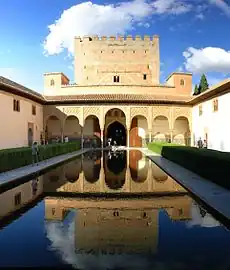 AlhambraCredit: Ra-smit
The Alhambra (Arabic: الحمراء = Al-Ħamrā; literally "the red") is a palace and fortress complex of the Moorish monarchs of Granada in southern Spain (known as Al-Andalus when the fortress was constructed), occupying a hilly terrace on the southeastern border of the city of Granada.
Did you know...
- ... that Ruth M. Anderson recorded a "timeless" Spain in her photographs of the 1920s?
- ... that while other countries built monuments to José Rizal a century after his birth, the Rizal Monument in Madrid was built a century after his death?
- ... that in 2021, Elvis Costello remade his 1978 album This Year's Model in Spanish with several Latin musical artists?
- ... that Japanese voice actress and singer Sora Amamiya's song "Jōnetsu no Te Amo" was heavily influenced by Latin music, including the use of a Spanish guitar?
- ... that in 1988, Elizabeth II became the first British monarch to make an official visit to Spain?
- ... that the Spanish priest Baltasar Calvo was denounced as a "Valencian Robespierre" for leading an 1808 massacre of French residents in Valencia?
 Good article –

The Spanish coup of July 1936 was a nationalist and military uprising that was designed to overthrow the Spanish Second Republic but precipitated the Spanish Civil War; Nationalists fought against Republicans for control of Spain. The coup itself was organized for 18 July 1936, although it started the previous day in Spanish Morocco, and would result in a split of the Spanish military and territorial control, rather than a prompt transfer of power. Although drawn out, the resulting war would ultimately lead to one of its leaders, Francisco Franco, becoming ruler of Spain as a dictator. (Full article...)- Ciutat Morta ([siwˈtat ˈmɔr.tə], "Dead City") is a 2013 Catalan documentary about the 4F case, directed by Xavier Artigas and Xapo Ortega. The film covers the repercussions of the events of February 4, 2006, when a Guàrdia Urbana officer in Barcelona was grievously injured and several people were arrested. This resulted in a long court-case and ultimately four people were convicted and imprisoned, one of whom committed suicide. (Full article...)
- Pikes Hotel, now known as Pikes Ibiza, is a luxury hotel in Ibiza, in the Balearic Islands of Spain. It is located in the countryside, 1.6 miles (2.6 km) to the northeast of the town of Sant Antoni de Portmany, and 10.2 miles (16.4 km) to the northwest of Ibiza Town. A 15th-century stone mansion which was a finca (farm estate), it was converted into a hotel in 1978 by British-born Australian Anthony Pike. (Full article...)
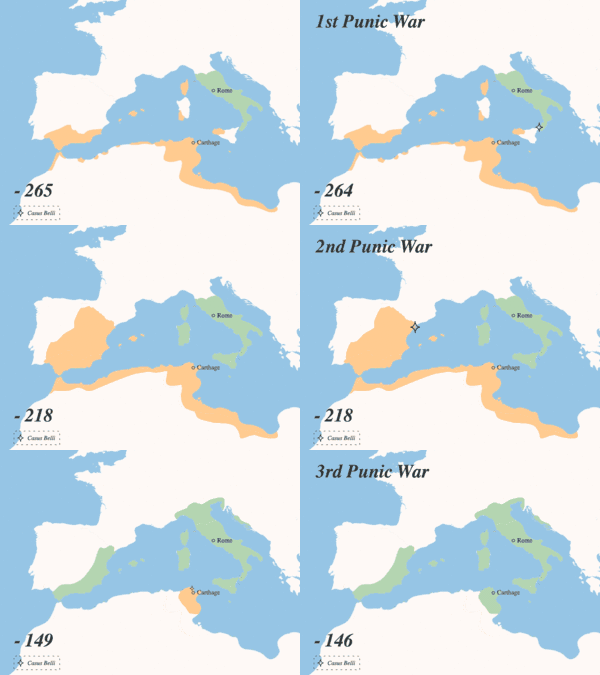 Territory controlled by Rome and Carthage at different times during the Punic WarsCarthaginian possessionsRoman possessions
The Punic Wars were a series of wars between 264 and 146 BC fought between Rome and Carthage. Three conflicts between these states took place on both land and sea across the western Mediterranean region and involved a total of forty-three years of warfare. The Punic Wars are also considered to include the four-year-long revolt against Carthage which started in 241 BC. Each war involved immense materiel and human losses on both sides. (Full article...)
Guanche mummies (Canarian Spanish: xaxos, formerly ['ʃaʃos]; mirlados, "embalmed ones"; enzurronados, "leather-bagged ones") are the intentionally desiccated remains of members of the indigenous Berber Guanche people of the Tenerife. The Guanche mummies were made during the eras prior to Spanish settlement of the area in the 15th century. The methods of embalming are similar to those that were used by the Ancient Egyptians, though fewer mummies remain from the Guanche due to looting and desecration. (Full article...) The moonlight Battle off Cape St Vincent, 16 January 1780, Francis Holman
The Battle of Cape St. Vincent (Spanish: Batalla del Cabo de San Vicente) was a naval battle that took place off the southern coast of Portugal on 16 January 1780 during the American Revolutionary War. A British fleet under Admiral Sir George Rodney defeated a Spanish squadron under Don Juan de Lángara. The battle is sometimes referred to as the Moonlight Battle (batalla a la luz de la luna) because it was unusual for naval battles in the Age of Sail to take place at night. It was also the first major naval victory for the British over their European enemies in the war and proved the value of copper-sheathing the hulls of warships. (Full article...) Capture of the Dorothea, 15 July 1798, Thomas Whitcombe
The action of 15 July 1798 was a minor naval battle of the French Revolutionary Wars, fought off the Spanish Mediterranean coast by the Royal Navy ship of the line HMS Lion under Captain Manley Dixon and a squadron of four Spanish Navy frigates under Commodore Don Felix O'Neil. Lion was one of several ships sent into the Western Mediterranean by Vice-Admiral Earl St Vincent, commander of the British Mediterranean Fleet based at the Tagus in Portugal during the late spring of 1798. The Spanish squadron was a raiding force that had sailed from Cartagena in Murcia seven days earlier, and was intercepted while returning to its base after an unsuccessful cruise. Although together the Spanish vessels outweighed the British ship, individually they were weaker and Commodore O'Neil failed to ensure that his manoeuvres were co-ordinated. As a result, one of the frigates, Santa Dorotea, fell out of the line of battle and was attacked by Lion. (Full article...) Circuit de Barcelona-Catalunya
The 2015 Spanish Grand Prix, formally titled the Formula 1 Gran Premio de España Pirelli 2015, was a Formula One motor race held on 10 May 2015 at the Circuit de Barcelona-Catalunya in Montmeló, Spain. The race was the fifth round of the 2015 season and marked the forty-fifth running of the Spanish Grand Prix as a round of the Formula One World Championship and the twenty-fifth running at Catalunya. Mercedes driver Nico Rosberg took his first win of the season, his first in Spain and the ninth of his career. His team-mate Lewis Hamilton finished second after a bad start, followed by Sebastian Vettel in third. (Full article...)
Manuel de Trujillo y Torres (November 1762 – July 15, 1822) was a Colombian publicist and diplomat. He is best known for being received as the first ambassador of Colombia by U.S. President James Monroe on June 19, 1822. This act represented the first U.S. recognition of a former Spanish colony's independence. (Full article...)- Obras Son Amores is the third studio album by Spanish singer Antonio Carmona. It was released on March 31, 2017, through Universal Music Latin Entertainment. Carmona spent five years working with different artists on songs for the album. Alex Cuba, Claudia Brant, Juanes, Luis Enrique Mejía, and Alejandro Sanz, are some of the artists he collaborated with. (Full article...)

Subtropical Storm Alpha was the first subtropical or tropical cyclone ever observed to make landfall in mainland Portugal. The twenty-second tropical or subtropical cyclone and twenty-first named storm of the extremely active and record-breaking 2020 Atlantic hurricane season, Alpha originated from a large non-tropical low that was first monitored by the National Hurricane Center on 15 September. Initially not anticipated to transition into a tropical cyclone, the low gradually tracked south-southeastward for several days with little development. By early on 17 September, the low had separated from its frontal features and exhibited sufficient organization to be classified as a subtropical cyclone, as it approached the Iberian Peninsula, becoming a subtropical storm around that time. Alpha then made landfall just south of Figueira da Foz, Portugal during the evening of 18 September, then rapidly weakened as it moved over the mountainous terrain of Northeastern Portugal. The system degenerated into a remnant low on 19 September, when it was last noted. (Full article...)- The 2015 Clásica de San Sebastián was a one-day cycling classic that took place in the Basque Country in Spain on 1 August 2015. It was the 35th edition of the Clásica de San Sebastián and was the nineteenth race of the 2015 UCI World Tour. The defending champion was Alejandro Valverde (Movistar Team), who won a solo victory in the 2014 race. (Full article...)
 The battle of Algeciras, Alfred Morel-Fatio
The Algeciras campaign (sometimes known as the Battle or Battles of Algeciras) was an attempt by a French naval squadron from Toulon under Contre-Admiral Charles Linois to join a French and Spanish fleet at Cadiz during June and July 1801 during the French Revolutionary Wars prior to a planned operation against either Egypt or Portugal. To reach Cadiz, the French squadron had to pass the British naval base at Gibraltar, which housed the squadron tasked with blockading Cadiz. The British squadron was commanded by Rear-Admiral Sir James Saumarez. After a successful voyage between Toulon and Gibraltar, in which a number of British vessels were captured, the squadron anchored at Algeciras, a fortified port city within sight of Gibraltar across Gibraltar Bay. On 6 July 1801, Saumarez attacked the anchored squadron, in the First Battle of Algeciras. Although severe damage was inflicted on all three French ships of the line, none could be successfully captured and the British were forced to withdraw without HMS Hannibal, which had grounded and was subsequently seized by the French. (Full article...) Top: Plaza Alta (High Square), Second left: Ayuntamiento de Badajoz (Badajoz City Hall), Second right: Puerta de Palmas (Palms Gate), Third left: Alcazaba de Badajoz, Third right: Torre de Espantaperros (Scaredogs Tower), Bottom: A twilight view of Guadiana River and Badajoz Royal Bridge
Badajoz (Spanish: [baðaˈxoθ]; formerly written Badajos in English) is the capital of the Province of Badajoz in the autonomous community of Extremadura, Spain. It is situated close to the Portuguese border, on the left bank of the river Guadiana. The population in 2011 was 151,565. (Full article...) Shambhala (white) and Dragon Khan (red)
Shambhala: Expedición al Himalaya is a steel hypercoaster roller coaster located at PortAventura Park in Salou and Vilaseca, Spain. Manufactured by Bolliger & Mabillard, it was the tallest (76 metres (249 ft)) and fastest (134 kilometres per hour (83 mph)) coaster in Europe at the time of its opening. The height and speed records were beaten in April 2017 by Red Force (with a height of 112 metres (367 ft)), which was also opened in PortAventura World in its new theme park Ferrari Land. Among coasters with a lift hill, the height and speed records were beaten in July 2018, when Hyperion opened at Energylandia in Poland. Shambhala is named and themed after the inaccessible land in the Himalayas: Shambhala. The coaster was announced on 24 October 2011, and opened to the public on 12 May 2012. (Full article...)- "Amiga Mía" (transl. "My Friend") is a song by Spanish singer Alejandro Sanz from his fifth studio album, Más (1997). WEA Latina released it as the album's fourth single in the same year. The song was written by Sanz and produced by Miguel Angel Arenas and Emanuele Ruffinengo. The rock ballad carries a message of unrequited love and was inspired by a close friend of Sanz. The song received positive reactions from music critics who regarded it as one of his best songs. A music video for "Amiga Mía" features the artist performing on top of a building while the townspeople watch and his love interest leaves with her fiancé. (Full article...)
 Prime Minister Felipe González (left) and Deputy Prime Minister Alfonso Guerra (right) in their seats during the debate on the motion of no confidence on 26 March 1987.
A motion of no confidence in the Spanish government of Felipe González was debated and voted in the Congress of Deputies between 26 and 30 March 1987. It was proposed by People's Alliance (AP) leader Antonio Hernández Mancha, motivated on the "deteriorating situation of the country" as a result of the social conflict sparked throughout the 1986–87 winter between the governing Spanish Socialist Workers' Party (PSOE) and its erstwhile allied Workers' General Union (UGT), which had grown increasingly critical of González's economic policies. However, the motion's true motives were attributed to Mancha's need for public promotion as both AP and opposition leader after his recent election to the post, as well as to his party's perceived urge to vindicate its primacy within the centre-right political spectrum in Spain amid the internal crisis that had been beleaguering it in the previous months. (Full article...) Monbar Hotel in 2007
The Monbar Hotel attack was carried out by the Grupos Antiterroristas de Liberación (GAL), a Spanish state-sponsored death squad, on 25 September 1985 in Bayonne, Pyrénées-Atlantiques, France. The targets were four members of the Basque separatist terrorist group Euskadi Ta Askatasuna (ETA), whom the Spanish government believed to be senior figures in the organization, itself proscribed as a terrorist group in Spain and France. All four people were killed, with a fifth person, apparently unconnected to ETA, injured in the shooting. This represented the deadliest attack carried out by the GAL. Although two of the participants were apprehended shortly after the shooting, controversy surrounded the possible involvement of senior figures in the Spanish police. (Full article...) Veüe du d'Estroit de Gibraltar et des Environs, avec les tranchées du Siège mis en 1704, Louis Boudan
The twelfth siege of Gibraltar was fought between September 1704 and May 1705 during the War of the Spanish Succession. It followed the capture in August 1704 of the fortified town of Gibraltar, at the southern tip of Spain, by an Anglo–Dutch naval force led by Sir George Rooke and Prince George of Hesse-Darmstadt. The members of the Grand Alliance, the Holy Roman Empire, England, the Netherlands, Pro-Habsburg Spain, Portugal and Savoy, had allied to prevent the unification of the French and Spanish thrones by supporting the claim of the Habsburg pretender Archduke Charles VI of Austria as Charles III of Spain. They were opposed by the rival claimant, the Bourbon Philip, Duke of Anjou, ruling as Philip V of Spain, and his patron and ally, Louis XIV of France. The war began in northern Europe and was largely contained there until 1703, when Portugal joined the confederate powers. From then, English naval attentions were focused on mounting a campaign in the Mediterranean to distract the French navy and disrupt French and Bourbon Spanish shipping or capture a port for use as a naval base. The capture of Gibraltar was the outcome of that initial stage of the Mediterranean campaign. (Full article...) The bombing on May 31, 1906
The Morral affair was the attempted regicide of Spanish King Alfonso XIII and his bride, Queen Victoria Eugenie, on their wedding day, May 31, 1906, and its subsequent effects. The attacker, Mateu Morral, acting on a desire to spur revolution, threw a bomb concealed in a floral bouquet from a Madrid hotel window as the King's procession passed, killing 24 bystanders and soldiers and wounding over 100 others, while leaving the royals unscathed. Morral sought refuge from republican journalist José Nakens but fled in the night to Torrejón de Ardoz, whose villagers reported the interloper. Two days after the attack, militiamen accosted Morral, who killed one before killing himself. Morral was likely involved in a similar attack on the king a year earlier. (Full article...) Bust of Hadrian, c. 130
Hadrian (/ˈheɪdriən/; Latin: Caesar Trajanus Hadrianus [ˈkae̯sar trajˈjaːnʊs (h)adriˈjaːnʊs]; 24 January 76 – 10 July 138) was Roman emperor from 117 to 138. He was born in Italica (close to modern Santiponce in Spain), a Roman municipium founded by Italic settlers in Hispania Baetica. He came from a branch of the gens Aelia that originated in the Picenean town of Hadria, the Aeli Hadriani. His father was of senatorial rank and was a first cousin of Emperor Trajan. Hadrian married Trajan's grand-niece Vibia Sabina early in his career before Trajan became emperor and possibly at the behest of Trajan's wife Pompeia Plotina. Plotina and Trajan's close friend and adviser Lucius Licinius Sura were well disposed towards Hadrian. When Trajan died, his widow claimed that he had nominated Hadrian as emperor immediately before his death. (Full article...) Painting by Hidalgo Lara of Lempira fighting a Spanish conquistador.
The Spanish conquest of Honduras was a 16th-century conflict during the Spanish colonization of the Americas in which the territory that now comprises the Republic of Honduras, one of the seven states of Central America, was incorporated into the Spanish Empire. In 1502, the territory was claimed for the king of Spain by Christopher Columbus on his fourth and final trip to the New World. The territory that now comprises Honduras was inhabited by a mix of indigenous peoples straddling a transitional cultural zone between Mesoamerica to the northwest, and the Intermediate Area to the southeast. Indigenous groups included Maya, Lenca, Pech, Miskitu, Mayangna (Sumu), Jicaque, Pipil and Chorotega. Two indigenous leaders are particularly notable for their resistance against the Spanish; the Maya leader Sicumba, and the Lenca ruler referred to as Lempira (a title meaning "Lord of the Mountain"). (Full article...) Pi de les tres branques in 2012
Pi de les tres branques (in Catalan language, meaning "the three-branched pine") is a dead pine tree located in the countryside near the town of Berga in north-central Catalonia, Spain. It has long been regarded by some Catalan nationalists as representing the unity of the three "Catalan Countries" and is the site of regular political-cultural gatherings. (Full article...) A statue of Daoíz in Seville showing him in the act of refusing his orders from the junta and resolving to fight the French
Luis Daoíz y Torres (10 February 1767 – 2 May 1808) was a Spanish artillery officer and one of the leaders of the Dos de Mayo Uprising that signalled the start of the Spanish War of Independence. Daoíz's surname is derived from the town of Aoiz in Navarre and he was descended from a long line of Spanish gentry with soldiering associations dating to the Reconquista. Daoíz's great grandfather married the daughter of the Count of Miraflores de los Angeles and Daoíz spent much of his early life in palaces owned by the family. He was born in Seville and, after receiving a Catholic education, trained at the Royal School of Artillery in Segovia. Daoíz saw action against the Moors in Spanish North Africa, where he was commended for his bravery and promoted to lieutenant. He also served against the French in the short-lived War of the Roussillon where he was captured. After refusing to serve in the French army, he was imprisoned. (Full article...)

_La_Palma_%2526_La_Gomera_Islands%252C_Canary_Islands_(cropped).jpg.webp)
General images
 Advance of Italian tankettes during the Battle of Guadalajara. (from History of Spain)
.jpg.webp) Jamón ibérico (from Culture of Spain)
Jamón ibérico (from Culture of Spain) The Second of May 1808 was the beginning of the popular Spanish resistance against Napoleon. (from History of Spain)
 Wedding portrait of the Catholic Monarchs (from History of Spain)
 Visigothic Hispania and its regional divisions in 700, prior to the Muslim conquest (from History of Spain)

 Proclamation of the Spanish Republic in Madrid (from History of Spain)
 Felipe González signing the treaty of accession to the European Economic Community on 12 June 1985. (from History of Spain)
_-_Fondo_Car-Kutxa_Fototeka.jpg.webp) Franco visiting Tolosa in 1948 (from History of Spain)
Franco visiting Tolosa in 1948 (from History of Spain)_en_Prins_Juan_Carlos%252C_Bestanddeelnr_254-9762.jpg.webp)
 Cathedral of Saint Mary of the See in Sevilla. (from Culture of Spain)
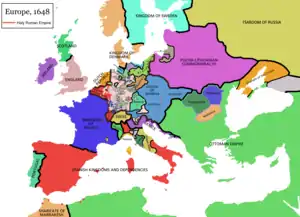 A map of Europe in 1648, after the Peace of Westphalia (from History of Spain)
 1894 satirical cartoon depicting the tacit accord for seamless government change (turnismo) between the leaders of two dynastic parties (Sagasta and Cánovas del Castillo), with the country being lied in an allegorical fashion. (from History of Spain)
 Ethnology of the Iberian Peninsula c. 200 BC (from History of Spain)
 The library of El Escorial (from Spanish Golden Age)
 Visigothic church, San Pedro de la Nave. Zamora. Spain (from History of Spain)
 The Conquest of Tenochtitlán (from History of Spain)
 Louis XIV of France and Philip IV of Spain at the Meeting on the Isle of Pheasants in June 1660, part of the process to put an end to the Franco-Spanish War (1635–59). (from History of Spain)
 Anachronous map of the Spanish Empire (from History of Spain)
 People's militias attacking on a Rebel position in Somosierra in the early stages of the war. (from History of Spain)
.jpg.webp) Members of the provisional government after the 1868 Glorious Revolution, by Jean Laurent. (from History of Spain)
Members of the provisional government after the 1868 Glorious Revolution, by Jean Laurent. (from History of Spain) The realms of Philip II of Spain (from Spanish Golden Age)
 Celebrations of the proclamation of the 2nd Republic in Barcelona. (from History of Spain)
 The Christian kingdoms of Hispania and the Islamic Almohad empire c. 1210
.JPG.webp) Episode of the 1854 Spanish Revolution in the Puerta del Sol, by Eugenio Lucas Velázquez. (from History of Spain)
Episode of the 1854 Spanish Revolution in the Puerta del Sol, by Eugenio Lucas Velázquez. (from History of Spain) The explosion of the USS Maine launched the Spanish–American War in April 1898 (from History of Spain)
 Entombment by Juan de Juni (from Spanish Golden Age)
 The Iberian Peninsula in the 3rd century BC. (from History of Spain)
![Image 32Detail of the votive crown of Recceswinth from the Treasure of Guarrazar, (Toledo-Spain) hanging in Madrid. The hanging letters spell [R]ECCESVINTHVS REX OFFERET [King R. offers this]. (from History of Spain)](../I/Corona_de_(29049230050).jpg.webp) Detail of the votive crown of Recceswinth from the Treasure of Guarrazar, (Toledo-Spain) hanging in Madrid. The hanging letters spell [R]ECCESVINTHVS REX OFFERET [King R. offers this]. (from History of Spain)
Detail of the votive crown of Recceswinth from the Treasure of Guarrazar, (Toledo-Spain) hanging in Madrid. The hanging letters spell [R]ECCESVINTHVS REX OFFERET [King R. offers this]. (from History of Spain)
 Real Madrid vs. Real Betis (from Culture of Spain)
 The Virgin of the Rosary (1675–80) by Bartolomé Esteban Murillo (from Spanish Golden Age)
 Two women and a man during the siege of the Alcázar (from History of Spain)
 Battle of the First Carlist War, by Francisco de Paula Van Halen (from History of Spain)
 Recognition of the Duke of Anjou as King of Spain, under the name of Philip V , November 16, 1700 (from History of Spain)
.jpg.webp) The pro-independence forces delivered a crushing defeat to the royalists and secured the independence of Peru in the 1824 battle of Ayacucho. (from History of Spain)
The pro-independence forces delivered a crushing defeat to the royalists and secured the independence of Peru in the 1824 battle of Ayacucho. (from History of Spain)
 Inner view of the cathedral (from Spanish Golden Age)
 Charles I of Spain (better known in the English-speaking world as the Holy Roman Emperor Charles V) was the most powerful European monarch of his day. (from History of Spain)
 The successful 1925 Alhucemas landing turned the luck in the Rif War towards Spain's favour. (from History of Spain)
 A battle of the Reconquista from the Cantigas de Santa Maria (from History of Spain)
 Ruins of Guernica (from History of Spain)
.jpg.webp) Christopher Columbus leads expedition to the New World, 1492, sponsored by Spanish crown (from History of Spain)
Christopher Columbus leads expedition to the New World, 1492, sponsored by Spanish crown (from History of Spain) Cabeza de Luis Buñuel, sculptor's work by Iñaki, in the center Buñuel Calanda. (from Culture of Spain)
 The greatest extent of the Visigothic Kingdom of Toulouse, c. 500, showing Territory lost after Vouillé in light orange (from History of Spain)
.jpg.webp) Visigothic King Roderic haranguing his troops before the Battle of Guadalete (from History of Spain)
Visigothic King Roderic haranguing his troops before the Battle of Guadalete (from History of Spain)
 In ictu oculi ("In the blink of an eye"), a vanitas by Juan de Valdés Leal (from Spanish Golden Age)
 The Third of May 1808, Napoleon's troops shoot hostages. Goya (from History of Spain)
 An 18th-century map of the Iberian Peninsula (from History of Spain)
.jpg.webp) Execution of Torrijos and his men in 1831. Ferdinand VII took repressive measures against the liberal forces in his country. (from History of Spain)
Execution of Torrijos and his men in 1831. Ferdinand VII took repressive measures against the liberal forces in his country. (from History of Spain) Roman Empire, 3rd century (from History of Spain)
.jpg.webp) El paseo de las Delicias, a 1784–1785 painting by Ramón Bayeu depicting a meeting of members of the aristocracy in the aforementioned location. (from History of Spain)
El paseo de las Delicias, a 1784–1785 painting by Ramón Bayeu depicting a meeting of members of the aristocracy in the aforementioned location. (from History of Spain)
 The Battle of Cape Passaro, 11 August 1718 (from History of Spain)
 The promulgation of the Constitution of 1812, oil painting by Salvador Viniegra. (from History of Spain)
 The Port of Seville in the late 16th century. Seville became one of the most populous and cosmopolitan European cities after the expeditions to the New World. (from History of Spain)
 The title page of the Gramática de la lengua castellana (1492), the first grammar of a modern European language to be published. (from History of Spain)
 Paella mixta (from Culture of Spain)
 Illustration depicting the (now lost) Luzaga's Bronze, an example of the Celtiberian script. (from History of Spain)
 al-Andalus at its greatest extent, 720 (from History of Spain)
 Taking of Oran by Francisco Jiménez de Cisneros in 1509. (from History of Spain)
In the news
- 22 March 2023 – 2023 vote of no confidence in the government of Pedro Sánchez
- Spanish Prime Minister Pedro Sánchez's government survives a second vote of no confidence presented by far-right party Vox, with independent Ramón Tamames as its candidate. (El Periódico)
No recent news
Spain topics
Categories

WikiProjects
- Main project
WikiProject Spain

- Related projects
WikiProject Basque • WikiProject Catalan-speaking Countries • WikiProject Galicia • Spanish Translation of the Week
Things you can do

- Add {{WikiProject Spain}} to article talk pages which have some relation to Spain
- Help write new Spain-related articles and improve and expand existent ones
- Assess: unassessed Spain-related articles
- Suggest: selected articles, biographies, pictures, did you knows? and quotes for this Portal
Related portals
Associated Wikimedia
The following Wikimedia Foundation sister projects provide more on this subject:
-
 Commons
Free media repository -
 Wikibooks
Free textbooks and manuals -
 Wikidata
Free knowledge base -
 Wikinews
Free-content news -
 Wikiquote
Collection of quotations -
 Wikisource
Free-content library -
 Wikiversity
Free learning tools -
 Wikivoyage
Free travel guide -
 Wiktionary
Dictionary and thesaurus
-
 List of all portalsList of all portals
 -
 The arts portal
 -
 Biography portal
 -
 Current events portal
 -
 Geography portal
 -
 History portal
 -
 Mathematics portal
 -
 Science portal
 -
 Society portal
 -
 Technology portal
 -
 Random portalRandom portal
 -
 WikiProject PortalsWikiProject Portals
- "Atlantic hurricane best track (HURDAT version 2)" (Database). United States National Hurricane Center. September 19, 2022. Retrieved April 9, 2023.
 This article incorporates text from this source, which is in the public domain.