The beginning of the Cold War saw the Eastern Bloc of the Soviet Union confront the Western Bloc of the United States, with the latter grouping becoming largely united in 1949 under NATO and the former grouping becoming largely united in 1955 under the Warsaw Pact. As the Soviet Union already had an armed presence and political domination all over its eastern satellite states by 1955, the pact has been long considered "superfluous", and because of the rushed way in which it was conceived, NATO officials labeled it a "cardboard castle". There was no direct military confrontation between the two organizations; instead, the conflict was fought on an ideological basis and through proxy wars. Both NATO and the Warsaw Pact led to the expansion of military forces and their integration into the respective blocs. The Warsaw Pact's largest military engagement was the Warsaw Pact invasion of Czechoslovakia, its own member state, in August 1968 (with the participation of all pact nations except Albania and Romania), which, in part, resulted in Albania withdrawing from the pact less than one month later. Following Stalin's death in 1953, a period known as de-Stalinization occurred under the leadership of Nikita Khrushchev. The Soviets took an early lead in the Space Race with the first artificial satellite, the first human spaceflight, and the first probe to land on another planet (Venus).
Entries here consist of Good and Featured articles, which meet a core set of high editorial standards.
BM-13 Katyusha multiple rocket launcher, based on a ZIS-6 truck.
The Katyusha (Russian:Катю́ша, IPA:[kɐˈtʲuʂə](listen)) is a type of rocket artillery first built and fielded by the Soviet Union in World War II. Multiple rocket launchers such as these deliver explosives to a target area more intensively than conventional artillery, but with lower accuracy and requiring a longer time to reload. They are fragile compared to artillery guns, but are cheap, easy to produce, and usable on almost any chassis. The Katyushas of World War II, the first self-propelled artillery mass-produced by the Soviet Union, were usually mounted on ordinary trucks. This mobility gave the Katyusha, and other self-propelled artillery, another advantage: being able to deliver a large blow all at once, and then move before being located and attacked with counter-battery fire.
Katyusha weapons of World War II included the BM-13 launcher, light BM-8, and heavy BM-31. Today, the nickname Katyusha is also applied to newer truck-mounted post-Soviet – in addition to non-Soviet – multiple-rocket launchers, notably the common BM-21 Grad and its derivatives. (Full article...)
Mikhail Andreyevich Suslov (Russian: Михаи́л Андре́евич Су́слов; 21 November[O.S. 8 November]1902–25 January 1982) was a Soviet statesman during the Cold War. He served as Second Secretary of the Communist Party of the Soviet Union from 1965, and as unofficial chief ideologue of the party until his death in 1982. Suslov was responsible for party democracy and power separation within the Communist Party. His hardline attitude resisting change made him one of the foremost orthodox communist Soviet leaders.
Born in rural Russia in 1902, Suslov became a member of the All-Union Communist Party (Bolsheviks) in 1921 and studied economics for much of the 1920s. He left his job as a teacher in 1931 to pursue politics full-time, becoming one of the many Soviet politicians who took part in the mass repression begun by Joseph Stalin's regime. He was made First Secretary of Stavropol Kraiadministrative area in 1939. During World War II, Suslov headed the local Stavropol guerrilla movement. (Full article...)
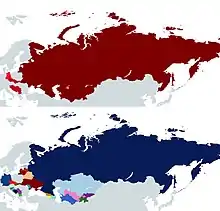
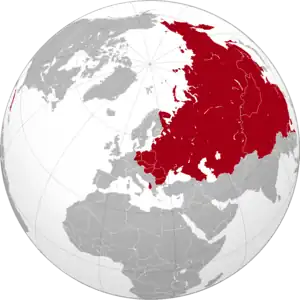
Image 23Map showing greatest territorial extent of the Soviet Union and the states that it dominated politically, economically and militarily in 1960, after the Cuban Revolution of 1959 but before the official Sino-Soviet split of 1961 (total area: c. 35,000,000 km2) (from Soviet Union)
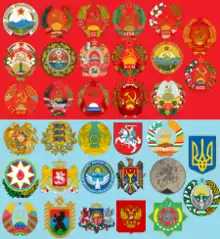
Image 29Country emblems of the Soviet Republics before and after the dissolution of the Soviet Union (note that the Transcaucasian Socialist Federative Soviet Republic (fifth in the second row) no longer exists as a political entity of any kind and the emblem is unofficial.) (from Soviet Union)
Image 30A scene from the July Days. The army has just opened fire on street protesters. (from October Revolution)
... that when Imants Lešinskis defected from the Soviet Union while working for the UN in New York, Kofi Annan, future UN secretary-general, complained that he did not show up to work?
... that a 1955 satirical comedy play by Kasymaly Jantöshev was one of the first signs of the relaxation of Soviet literary restrictions after the death of Joseph Stalin?
... that development of the British UB.109Tcruise missile was given "super-priority" in 1951 to ward off an expected attack by the Soviet Union, only to be cancelled after the attack never came?
... that Mary V.R. Thayer was briefly arrested on suspicion of spying after abandoning a 1929 business trip in the Soviet Union to explore the Caucasus?
Related portals
Recognized content
This is a list of recognized content, updated weekly by JL-Bot(talk · contribs). There is no need to edit the list yourself. If an article is missing from the list, make sure it is tagged(e.g. {{WikiProject Soviet Union}})or categorized correctly. See WP:RECOG for configuration options.
Привет and welcome!Wikipedia is the encyclopedia that anyone can edit. If you are interested in the Soviet Union and have some information that can be added to an existing article, please help. Here are some things you can do:

.svg.png.webp)


.jpg.webp)



















_(B%2526W).jpg.webp)
_-_Restoration.jpg.webp)