Portal:Romania

The Romania Portal
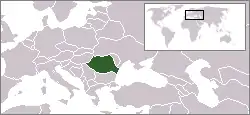
Romania (/roʊˈmeɪniə/ ( Settlement in what is now Romania began in the Lower Paleolithic followed by written records attesting the kingdom of Dacia, its conquest, and subsequent Romanization by the Roman Empire during late antiquity. The modern Romanian state was formed in 1859 through a personal union of the Danubian Principalities of Moldavia and Wallachia. The new state, officially named Romania since 1866, gained independence from the Ottoman Empire in 1877. During World War I, after declaring its neutrality in 1914, Romania fought together with the Allied Powers from 1916. In the aftermath of the war, Bukovina, Bessarabia, Transylvania, and parts of Banat, Crișana, and Maramureș became part of the Kingdom of Romania. In June–August 1940, as a consequence of the Molotov–Ribbentrop Pact and Second Vienna Award, Romania was compelled to cede Bessarabia and Northern Bukovina to the Soviet Union and Northern Transylvania to Hungary. In November 1940, Romania signed the Tripartite Pact and, consequently, in June 1941 entered World War II on the Axis side, fighting against the Soviet Union until August 1944, when it joined the Allies and recovered Northern Transylvania. Following the war and occupation by the Red Army, Romania became a socialist republic and a member of the Warsaw Pact. After the 1989 Revolution, Romania began a transition towards democracy and a market economy. Considered an emerging middle power, Romania is a developing country with a high-income economy having the world's 47th largest economy by nominal GDP. Romania experienced rapid economic growth in the early 2000s; its economy is now based predominantly on services. It is a producer and net exporter of machines and electric energy through companies like Automobile Dacia and OMV Petrom. The majority of Romania's population are ethnic Romanians and religiously identify themselves as Eastern Orthodox Christians, speaking Romanian, a Romance language (more specifically Eastern Romance/Daco-Romance). The Romanian Orthodox Church is the largest religious denomination in the country. Romania is a member of the United Nations, the European Union, NATO, the Council of Europe, BSEC and WTO. (Full article...)
| ||||||||||||||||||||||||||||||||||||||||||||||||||||||||||||||||||||||||||||||||||||||||||||||||||||||||||||||||||||||||||||||||||



.svg.png.webp) Roman province of Dacia (125 AD) |
Roman Dacia (/ˈdeɪʃə/ DAY-shə; also known as Dacia Traiana (Latin for 'Trajan Dacia'); or Dacia Felix, 'Fertile/Happy Dacia') was a province of the Roman Empire from 106 to 271–275 AD. Its territory consisted of what are now the regions of Oltenia, Transylvania and Banat (today all in Romania, except the last one which is split between Romania, Hungary, and Serbia). During Roman rule, it was organized as an imperial province on the borders of the empire. It is estimated that the population of Roman Dacia ranged from 650,000 to 1,200,000. It was conquered by Trajan (98–117) after two campaigns that devastated the Dacian Kingdom of Decebalus. However, the Romans did not occupy its entirety; Crișana, Maramureș, and most of Moldavia remained under the Free Dacians.
After its integration into the empire, Roman Dacia saw constant administrative division. In 119, it was divided into two departments: Dacia Superior ("Upper Dacia") and Dacia Inferior ("Lower Dacia"; later named Dacia Malvensis). Between 124 and around 158, Dacia Superior was divided into two provinces, Dacia Apulensis and Dacia Porolissensis. The three provinces would later be unified in 166 and be known as Tres Daciae ("Three Dacias") due to the ongoing Marcomannic Wars. New mines were opened and ore extraction intensified, while agriculture, stock breeding, and commerce flourished in the province. Roman Dacia was of great importance to the military stationed throughout the Balkans and became an urban province, with about ten cities known and all of them originating from old military camps. Eight of these held the highest rank of colonia. Ulpia Traiana Sarmizegetusa was the financial, religious, and legislative center and where the imperial procurator (finance officer) had his seat, while Apulum was Roman Dacia's military center. (Full article...)

Mungiu and cinematographer Oleg Mutu shot it in Bucharest and other Romanian locations in 2006. After making its world premiere at Cannes, 4 Months, 3 Weeks and 2 Days made its Romanian debut on 1 June 2007, at the Transilvania International Film Festival. It opened to critical acclaim, and was noted for its minimalism and intense themes. (Full article...)
 Location of the battle |
The Battle of Vaslui (also referred to as the Battle of Podul Înalt or the Battle of Racova) was fought on 10 January 1475, between Stephen III of Moldavia and the Ottoman governor of Rumelia, Hadım Suleiman Pasha. The battle took place at Podul Înalt ("the High Bridge"), near the town of Vaslui, in Moldavia (now part of eastern Romania). The Ottoman troops numbered up to 120,000, facing about 40,000 Moldavian troops, plus smaller numbers of allied and mercenary troops.
Stephen inflicted a decisive defeat on the Ottomans, with casualties according to Venetian and Polish records reaching beyond 40,000 on the Ottoman side. Mara Branković (Mara Hatun), the former younger wife of Murad II, told a Venetian envoy that the invasion had been the worst ever defeat for the Ottomans. Stephen was later awarded the title Athleta Christi ("Champion of Christ") by Pope Sixtus IV, who referred to him as "verus christianae fidei athleta" ("the true defender of the Christian faith"). (Full article...)
Pope Gregory XIII appointed Báthory cardinal during his visit to Rome in 1584. A year later, he was installed as coadjutor bishop of Warmia. He was in Rome again when Stephen Báthory died in 1586. Andrew was one of the candidates to succeed him in Poland and Lithuania, but Jan Zamoyski, the Chancellor of Poland, convinced him to support another candidate, Sigismund Vasa, and to demonstrate the Báthorys' claim to the crown only through nominating his minor cousin, Sigismund Báthory, Prince of Transylvania. After Sigismund Vasa was elected king in 1587, Báthory convinced his cousin's advisors to send reinforcements to Poland to fight against Maximilian of Habsburg, who also claimed the throne. Báthory became Prince-Bishop of Warmia after the death of Bishop Marcin Kromer in 1589. (Full article...)
 Inna on the set of Masked Singer România in 2021 |
Elena Alexandra Apostoleanu (born 16 October 1986), known professionally as Inna (stylized in all caps), is a Romanian singer. Born in Mangalia and raised in Neptun, she studied political science at Ovidius University before meeting the Romanian trio Play & Win and pursuing a music career. She adopted the stage name "Alessandra" in 2008 and adopted a pop-rock style; later that year, she changed her stage name to "Inna" and began releasing house music. "Hot" (2008), her debut single, was a commercial success worldwide and topped the Romanian and Billboard's Hot Dance Airplay chart, among others. Her debut studio album of the same name followed in August 2009 and was certified Gold and Platinum. It featured several other successful singles in Europe, including "Amazing" (2009), the singer's second number-one single in Romania.
Inna's second album, I Am the Club Rocker (2011), yielded global success for the single "Sun Is Up" (2010). The track won the Eurodanceweb Award, making Inna the first and only Romanian artist to win the award. In 2011, it was announced Inna was the highest-paid Romanian and Eastern European artist. Her follow-up studio album, Party Never Ends (2013), was nominated for two consecutive years for Best Album at the Romanian Music Awards and reached the top ten in Mexico. It featured "More than Friends", a moderate European hit in collaboration with Daddy Yankee. In 2014, Inna signed with Atlantic Records and released the commercially successful "Cola Song" with J Balvin, which was used to promote that year's FIFA World Cup. (Full article...)
An accompanying music video for "Te Vas" was uploaded onto Inna's YouTube channel on 30 May 2019. Directed by Bogdan Păun, it features the singer and Dragoș Istvan performing a mixture of contemporary dance and acrobatics, representing an on-and-off relationship. For further promotion, Inna performed "Te Vas" for Romanian radio station Kiss FM in June 2019. The track peaked at number 36 on Romania's Airplay 100 chart. It was included in a The Baker and the Beauty episode. (Full article...)
The favourable geographical position and the importance of the Port of Constanța is emphasized by the connection with two Pan-European transport corridors: IV (high speed railway&highway) and the Pan-European Corridor VII (Danube). The two satellite ports, Midia and Mangalia, located not far from Constanța Port, are part of the Romanian maritime port system under the coordination of the Maritime Ports Administration SA. (Full article...)
Heartbreaker was created over the course of three weeks in a mansion where Inna resided with Romanian songwriters and producers Sebastian Barac, Marcel Botezan, David Ciente, Alexandru Cotoi and Minelli. To document the progress made on what was initially planned to be an extended play (EP), Inna uploaded daily YouTube vlogs that constituted the first season of her Dance Queen's House series. However, the EP was ultimately scrapped after the creation of over 50 songs to choose from. Heartbreaker was aided by the release of two singles—"Flashbacks" and "Maza". The former reached number one in Russia's radio ranking, and the top ten in Romania, Bulgaria, Ukraine and the Commonwealth of Independent States. (Full article...)

The Ring of Pietroassa or Buzău torc is a gold torc-like necklace found in a ring barrow in Pietroassa (now Pietroasele), Buzău County, southern Romania (formerly Wallachia), in 1837. It formed part of a large gold hoard (the Pietroasele treasure) dated to between 250 and 400 CE. The ring itself is generally assumed to be of Roman-Mediterranean origin, and features a Gothic language inscription in the Elder Futhark runic alphabet.
The inscribed ring remains the subject of considerable academic interest, and a number of theories regarding its origin, the reason for its burial and its date have been proposed. The inscription, which sustained irreparable damage shortly after its discovery, can no longer be read with certainty, and has been subjected to various attempts at reconstruction and interpretation. Recently, however, it has become possible to reconstruct the damaged portion with the aid of rediscovered depictions of the ring in its original state. Taken as a whole, the inscribed ring may offer insight into the nature of the pre-Christian pagan religion of the Goths. (Full article...)
 Duke Ladislaus (left) at the Battle of Kerlés |
The Battle of Kerlés (Hungarian: kerlési csata) or Battle of Chiraleș, also known as the Battle of Cserhalom, was an engagement between an army of Pechenegs and Ouzes commanded by Osul and the troops of King Solomon of Hungary and his cousins, Dukes Géza and Ladislaus, in Transylvania in 1068. The Pechenegs had been the dominant power of the westernmost regions of the Eurasian steppes since around 895. However, large Pecheneg groups moved to the Balkan Peninsula at the same time as the westward migration of the Ouzes and Cumans in the 1040s. The first recorded Pecheneg invasion of Transylvania occurred during the reign of Stephen I of Hungary (r. 997–1038).
In 1068, the invaders broke into Transylvania through the passes of the Carpathian Mountains. Archaeological finds suggest that they destroyed at least three fortresses made of earth and timber, including the ones at Doboka (now Dăbâca in Romania) and Sajósárvár (present-day Șirioara). They also made a plundering raid in the Nyírség region, to the west of Transylvania. After taking much booty, they planned to leave Hungary, but the Hungarians ambushed and annihilated them at a hill near Doboka. According to a popular legend, a "Cuman" warrior tried to escape from the battlefield, taking a Hungarian girl, but Duke Ladislaus defeated and killed him in single combat. (Full article...)
The track was positively received, with music critics praising its catchiness and commercial appeal. In October 2014, "Club Rocker" was involved in a copyright infringement lawsuit, with Spanish singer Robert Ramirez Carrasco accusing Play & Win of plagiarism. To promote the recording, an accompanying music video was shot by Alex Herron and uploaded onto Inna's YouTube channel on 26 June 2011 to positive response. It was also nominated in the "Best Video" category at the 2012 Romanian Music Awards. The clip portrays Inna at an auto service center and taking part in a rally race. She further promoted the recording through live performances, including at the NRJ Music Tour and Starfloor in 2011, while appearing on several radio stations. Commercially, "Club Rocker" reached number four in Lebanon and peaked within the top 30 in multiple countries. (Full article...)
.jpg.webp) Golubac Fortress |
The Golubac Fortress (Serbian: Голубачки град or Golubački grad) was a medieval fortified town on the south side of the Danube River, 4 km (2.5 mi) downstream from the modern-day town of Golubac, Serbia. According to recent discoveries, the fortress, which was built during the 14th century by Medieval Serbian state, is split into three compounds which were built in stages. It has ten towers, most of which started square, and several of which received many-sided reinforcements with the advent of firearms. Towers were not connected for easier defense. Also inside the fortress were found Serbian Medieval frescos.
Golubac Fortress has had a tumultuous history. Prior to its construction it was the site of a Roman settlement. During the Middle Ages, it became the object of many battles, especially between the Ottoman Empire and the Kingdom of Hungary. It changed hands repeatedly, passing between Turks, Bulgarians, Hungarians, Serbs, and Austrians, until 1867, when it was turned over to the Serbian Knez, Mihailo Obrenović III. Now, it is a popular tourist attraction in the region and a sightseeing point on Danube boat tours. (Full article...)
Selected article -
 3D model of Ciomad's central sector seen from the south |
Ciomad (Hungarian: Csomád) is a dormant volcano in Romania. It is in the Eastern Carpathians, between the spa towns of Băile Tușnad and Balvanyos. Ciomad lies at the southeastern end of the Carpathian volcanic chain and it is the youngest volcano of the Carpatho-Pannonian region. Ciomad consists of several lava domes with two embedded explosion craters known as Mohoș and Sfânta Ana, the latter of which contains a crater lake, Lake Sfânta Ana. The dominant volcanic rock at Ciomad is potassium-rich dacite.
Volcanic activity at Ciomad commenced with effusive activity about one million years ago. Most of the volcano was constructed between 650,000 – 500,000 years ago. (Full article...)Selected biography -
_in_the_ballet_Les_Presages%252C_Sydney%252C_between_6_Dec_1936-Jan_1939_-_studio_photograph_by_Max_Dupain_(6068761108).jpg.webp) Tchinarova in the ballet Les Presages, Sydney, between 6 Dec. 1936 & Jan. 1939 |
Related portals
Selected picture

Did you know (auto generated)

- ... that following the ban of its labour unions in 1934, the Romanian United Socialist Party would rely on its youth and women's wings for political action?
- ... that Romanian poet Dimitrie Stelaru said that he once traveled to Paris by truck, adding "I hardly remember anything, I was drunk the whole time"?
- ... that Rebecca Blake, Anglo-Romanian captain of the Romania women's national cricket team, also led the French team to victory in a six-team tournament?
- ... that Moldavian rebel Teodor Boldur-Lățescu was twice beaten up on circus grounds: once for insulting Wallachian officers of the Romanian Army, and a second time for cruelty to animals?
- ... that, while drunk, Romanian government minister Gheorghe Chițu allegedly had a dentist "pull out the roots of all his molars and his front teeth", resulting in permanent neurological damage?
- ... that Gheorghe Eminescu, nephew of Romania's national poet, spent time in communist prisons, including one which allocated him a 25-centimeters-wide (10-inch) sleeping area?
More did you know
- ...that Romania renominated its currency, the leu, in July 2005, so that 10,000 old lei equal 1 new leu?
General images
 C.A. Rosetti (from Culture of Romania)

 Ethnic map of Greater Romania according to the 1930 census. Sizeable ethnic minorities put Romania at odds with Hungary, Bulgaria, and the Soviet Union throughout the interwar period. (from History of Romania)
 Bran Castle (German: Törzburg, Hungarian: Törcsvár) built in 1212, is commonly known as Dracula's Castle and is situated in the centre of present-day Romania. In addition to its unique architecture, the castle is famous because of persistent myths that it was once the home of Vlad III Dracula. (from History of Romania)
 Baked pumpkin with powdered sugar and cinnamon (from Culture of Romania)
 Sibiu (German: Hermannstadt), the 2007 European Capital of Culture (from Culture of Romania)
 EUROPAfest Jazz festival in Bucharest (2010) (from Culture of Romania)
 Territories inhabited by Romanians before WWI. (from History of Romania)
 Harvest time in Romania, early 20th century (from Culture of Romania)
.jpg.webp)

 Mihai Eminescu, national poet of Romania and Moldova (from Culture of Romania)
 Two of the eight marble statues of Dacian warriors surmounting the Arch of Constantine in Rome. (from History of Romania)
 George Barițiu (from Culture of Romania)
 Romania annexed Transnistria, the area between the Dniester and Southern Bug, in July 1941. (from History of Romania)
 Geto-Dacian Koson, mid 1st century BC (from History of Romania)
.jpg.webp) Mustard soup with croutons (from Culture of Romania)
Mustard soup with croutons (from Culture of Romania)
 Dacian cast in Pushkin Museum, after original in Lateran Museum. Early second century AD. (from History of Romania)
 Votive stele representing Bendis wearing a Dacian cap (British Museum) (from History of Romania)
 Roman monument commemorating the Battle of Adamclisi clearly shows two giant Dacian warriors wielding a two-handed falx (from History of Romania)
 Romanian operations against the Axis (from History of Romania)
 Romanian pavilion at EXPO Paris 1937 (from History of Romania)
 Great Romania (1920–1940) (from History of Romania)
 Peleş Castle, retreat of Romanian monarchs (from History of Romania)
 Titu Maiorescu (from Culture of Romania)
 The medieval and picturesque Transylvanian Saxon town of Sighișoara (German: Schäßburg) (from Culture of Romania)
 Tochitură (from Culture of Romania)
 Winter picture of Chiajna Monastery. The monastery is situated on the outskirts of Bucharest (from Culture of Romania)
 Leutnant Emil Rebreanu was awarded the Medal for Bravery in gold, the highest military award given by the Austrian command to an ethnic Romanian; he would later be hanged for desertion while trying to escape to Romania. Was the inspiration for his brother's famous novel "The Forest of the Hanged" (from History of Romania)
 The foundation of the First Bulgarian Empire (from History of Romania)
 Map of Romania after World War II indicating lost territories. (from History of Romania)
 Tarabostes on the Arch of Constantine (from History of Romania)
 A 19th century depiction of Dacian women (from History of Romania)
 Seal of Michael the Brave during the personal union of the two Romanian principalities with Transylvania (from History of Romania)

 Physical and administrative map of Romania, with the historic regions in grey (Țara Românească means Wallachia). (from Geography of Romania)
 The Principalities of Moldavia and Wallachia in 1786, Italian map by G. Pittori, since the geographer Giovanni Antonio Rizzi Zannoni. (from History of Romania)
.jpg.webp) The sanctuaries of the ancient Dacian Kingdom capital, Sarmizegetusa Regia (from History of Romania)
The sanctuaries of the ancient Dacian Kingdom capital, Sarmizegetusa Regia (from History of Romania) Neacșu's letter is the oldest surviving document written in Romanian. (from Culture of Romania)
 Romania has seen its largest waves of protests against judicial reform ordinances of the PSD-ALDE coalition during the 2017–2019 Romanian protests. (from History of Romania)
 Dacia during Constantine the Great (from History of Romania)
.JPG.webp)

 Southern traditional Romanian costumes from Bucharest, late 19th century (from Culture of Romania)
 Dacian Draco as from Trajan's Column (from History of Romania)
 University Square in Bucharest during Communism (from Culture of Romania)
 The Communist government fostered the personality cult of Nicolae Ceaușescu and his wife Elena, 1986 (from History of Romania)


 Romanian territorial losses in the Treaty of Bucharest on May 1918 (from History of Romania)
 Ioan Slavici (from Culture of Romania)
 Clătite with jam (from Culture of Romania)
 Illustration featuring the Romanian coat of arms and tricolor (from Culture of Romania)
 The sanctuaries in the ruined Sarmizegetusa Regia, the capital of ancient Dacia (from History of Romania)
 Timeline of the borders of Romania between 1859 and 2010 (from History of Romania)
 Victory Avenue in Bucharest, 1940 (from Culture of Romania)

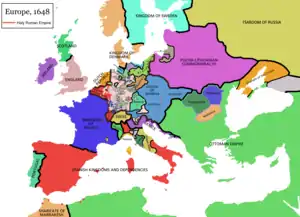 Map of Europe in 1648 showing Transylvania and the two Romanian principalities: Wallachia and Moldavia (from History of Romania)
 Papanași (from Culture of Romania)
.svg.png.webp) 1941 stamp depicting a Romanian and a German soldier in reference to the two countries' common participation in Operation Barbarossa. The text below reads "the holy war against Bolshevism". (from History of Romania)
1941 stamp depicting a Romanian and a German soldier in reference to the two countries' common participation in Operation Barbarossa. The text below reads "the holy war against Bolshevism". (from History of Romania) Baked potatoes with steak and cucumber salad (from Culture of Romania)
 Engraving of a fairy tale scene, featuring Prince Charming (Făt-Frumos) and a dragon (zmeu). (from Culture of Romania)
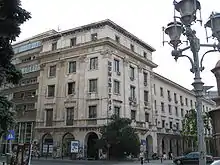 Humanitas headquarters in Bucharest (from Culture of Romania)
 Ștefan Luchian (from Culture of Romania)
 Nicolae Ceaușescu and others welcome the Red Army as it enters Bucharest on 30 August 1944 (from History of Romania)
 Top: territories controlled by the Dacian king, c. 50 BC
Bottom: territories controlled by the Dacian king, circa year zero (from History of Romania).jpg.webp)

 Romania after the territorial losses of 1940. The recovery of Bessarabia and Northern Bukovina was the catalyst for Romania's entry into the war on Germany's side. (from History of Romania)
 George Coșbuc (from Culture of Romania)
 Romania map of Köppen climate classification, according with Clima României from the Administrația Națională de Meteorologie, Bucharest 2008 (from Geography of Romania)
 Proclamation of Union between Transylvania and Romania (from History of Romania)
 Nicolae Ceauşescu condemning the Warsaw Pact invasion of Czechoslovakia in 1968. (from History of Romania)
.svg.png.webp)
 Roman walls in Dacia (from History of Romania)
 Romanian keyboard with special characters (from Culture of Romania)
 Ion Creangă (from Culture of Romania)
Topics


| Europe |
|  | ||||
|---|---|---|---|---|---|---|
| Americas | ||||||
| Asia and Oceania | ||||||
| See also |
| |||||
| Subdialects |
| ||
|---|---|---|---|
| Dialects/related languages |
| ||
| Linguistics | |||
| Periods of historic evolution | |||
| Written form | |||
| Institutions and movements | |||
| Language contact | |||
| Speech communities | |||
| Others | |||
| |||

| ||
| Appetizers & salads | |
|---|---|
| Beverages | |
| Breads | |
| Cheeses | |
| Condiments & sauces | |
| Delicatessen |
|
| Desserts |
|
| Dishes |
|
| Grilled meats | |
| Soups |
|

Recognized content


_in_flight_Danube_delta_2.jpg.webp)

_with_bee_prey_Babadag.jpg.webp)
_R%C3%A1k%C3%B3czi_(1593-1648)_-_Rembrandt_van_Rijn_%2526_Jan_Gillisz._van_Vliet.jpg.webp)


%252C_figurino_di_Adolf_Hohenstein_per_La_Wally_(1892)_-_Archivio_Storico_Ricordi_ICON004639_-_Restoration.jpg.webp)

New articles
- For a listing of new articles, see Portal:Romania/New articles.
Categories

Recent events in Romania
Wikiproject
| WikiProject Romania | |
|---|---|
| Project pages |
|
| Departments |
|
| Announcements |
|
Things you can do

Requested articles: Theater in Romania/Theatre in Romania, Virgil Gheorghiu (poet), Ion Brad
Translation from Romanian: ro:Adrian Sobaru - Adrian Sobaru, ro:Lacul Avrig - Avrig Lake, ro:Letea, Tulcea - Letea, Tulcea
Expand: Bârlad, Romanian lexis, Mihai Leu, Lia Manoliu, Theodor Aman, CFR Cluj, High Court of Cassation and Justice, Health Care in Romania, Development regions of Romania
Cleanup: Cinema of Romania, Culture of Romania, Northern Transylvania
- You can locate significant places in Bucharest using a special map here, which has a unique 3D view.
Administrative divisions
| |||||||||||||||||||||||||||||

Associated Wikimedia
The following Wikimedia Foundation sister projects provide more on this subject:
-
 Commons
Free media repository -
 Wikibooks
Free textbooks and manuals -
 Wikidata
Free knowledge base -
 Wikinews
Free-content news -
 Wikiquote
Collection of quotations -
 Wikisource
Free-content library -
 Wikiversity
Free learning tools -
 Wikivoyage
Free travel guide -
 Wiktionary
Dictionary and thesaurus
-
 List of all portalsList of all portals
 -
 The arts portal
 -
 Biography portal
 -
 Current events portal
 -
 Geography portal
 -
 History portal
 -
 Mathematics portal
 -
 Science portal
 -
 Society portal
 -
 Technology portal
 -
 Random portalRandom portal
 -
 WikiProject PortalsWikiProject Portals