Portal:Renewable energy


Introduction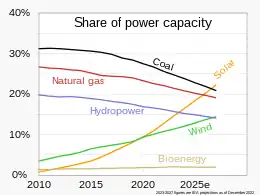 Renewable energy sources, especially solar photovoltaic and wind power, are providing an increasing share of power capacity. Renewable energy is energy from renewable resources that are naturally replenished on a human timescale. Renewable resources include sunlight, wind, the movement of water, and geothermal heat. Although most renewable energy sources are sustainable, some are not. For example, some biomass sources are considered unsustainable at current rates of exploitation. Renewable energy is often used for electricity generation, heating and cooling. Renewable energy projects are typically large-scale, but they are also suited to rural and remote areas and developing countries, where energy is often crucial in human development. Renewable energy is often deployed together with further electrification, which has several benefits: electricity can move heat or objects efficiently, and is clean at the point of consumption. In addition, electrification with renewable energy is more efficient and therefore leads to significant reductions in primary energy requirements. From 2011 to 2021, renewable energy has grown from 20% to 28% of global electricity supply. Use of fossil energy shrank from 68% to 62%, and nuclear from 12% to 10%. The share of hydropower decreased from 16% to 15% while power from sun and wind increased from 2% to 10%. Biomass and geothermal energy grew from 2% to 3%. There are 3,146 gigawatts installed in 135 countries, while 156 countries have laws regulating the renewable energy sector. In 2021, China accounted for almost half of the global increase in renewable electricity. Globally there are over 10 million jobs associated with the renewable energy industries, with solar photovoltaics being the largest renewable employer. Renewable energy systems are rapidly becoming more efficient and cheaper and their share of total energy consumption is increasing, with a large majority of worldwide newly installed electricity capacity being renewable. In most countries, photovoltaic solar or onshore wind are the cheapest new-build electricity. Many nations around the world already have renewable energy contributing more than 20% of their total energy supply, with some generating over half their electricity from renewables. A few countries generate all their electricity using renewable energy. National renewable energy markets are projected to continue to grow strongly in the 2020s and beyond. According to the IEA, to achieve net zero emissions by 2050, 90% of global electricity generation will need to be produced from renewable sources. Some studies have shown that a global transition to 100% renewable energy across all sectors – power, heat, transport and industry – is feasible and economically viable. Renewable energy resources exist over wide geographical areas, in contrast to fossil fuels, which are concentrated in a limited number of countries. Deployment of renewable energy and energy efficiency technologies is resulting in significant energy security, climate change mitigation, and economic benefits. However renewables are being hindered by hundreds of billions of dollars of fossil fuel subsidies. In international public opinion surveys there is strong support for renewables such as solar power and wind power. In 2022 the International Energy Agency asked countries to solve policy, regulatory, permitting and financing obstacles to adding more renewables, to have a better chance of reaching net zero carbon emissions by 2050. (Full article...) Selected article - The Sun produces electromagnetic radiation that can be harnessed as useful energy. Solar energy is radiant light and heat from the Sun that is harnessed using a range of technologies such as solar power to generate electricity, solar thermal energy (including solar water heating), and solar architecture. It is an essential source of renewable energy, and its technologies are broadly characterized as either passive solar or active solar depending on how they capture and distribute solar energy or convert it into solar power. Active solar techniques include the use of photovoltaic systems, concentrated solar power, and solar water heating to harness the energy. Passive solar techniques include orienting a building to the Sun, selecting materials with favorable thermal mass or light-dispersing properties, and designing spaces that naturally circulate air. In 2011, the International Energy Agency said that "the development of affordable, inexhaustible and clean solar energy technologies will have huge longer-term benefits. It will increase countries' energy security through reliance on an indigenous, inexhaustible, and mostly import-independent resource, enhance sustainability, reduce pollution, lower the costs of mitigating global warming .... these advantages are global". (Full article...)Quotations -
– Christopher Flavin in REN21 (2010). Renewables 2010 Global Status Report p. 52. Main topicsRenewable energy sourcesGeneralRenewable energy commercialization · Smart grid · Timeline of sustainable energy research 2020–present Renewable energy by countryList of countries by electricity production from renewable sources
WikiProjectsWikiProjects connected with renewable energy:
Selected image - President Barack Obama addressed an audience of more than 450 people at the Nellis Solar Power Plant on May 27, 2009. Selected biography - Rolf Disch is a German architect, solar energy pioneer and environmental activist. Born in Freiburg im Breisgau, Germany, Disch has dedicated particular focus to regional renewable and sustainable energy. As head of his own architecture firm, Rolf Disch Solar Architecture, Disch is committed to advancing Germany's incorporation of solar energy generation into residential, retail, and commercial building and design. In 1994, Rolf Disch built the Heliotrope in Freiburg which was the world’s first home to create more energy than it uses, as it physically rotates with the sun to maximize its solar intake. Disch then developed the concept PlusEnergy, simply making it a permanent goal for his buildings to produce more energy than they consume in order to sell the surplus solar energy back into the grid for profit. (Full article...)Did you know? -... that the Cragside country house in Northumberland, England was the first house in the world to be lit using hydroelectric power? In 1870, water from one of the estate's lakes was used to drive a Siemens dynamo in what was the world's first hydroelectric power station. The resultant electricity was used to power an arc lamp installed in the Gallery in 1878. General images -The following are images from various renewable energy-related articles on Wikipedia.
Related portalsCategories Category puzzle Select [►] to view subcategories
Renewable energy Renewable energy by continent Renewable energy by country Lists related to renewable energy Algaculture Anaerobic digestion Bioenergy Renewable energy certification Documentary films about alternative energy Geothermal energy Renewable energy organizations People associated with renewable energy Renewable energy policy Renewable electricity Renewable energy economy Solar energy Renewable energy technology Water power Wind power Renewable energy stubs Associated WikimediaThe following Wikimedia Foundation sister projects provide more on this subject:
Discover Wikipedia using portals
|




![Image 14Concentrated solar panels are getting a power boost. Pacific Northwest National Laboratory (PNNL) will be testing a new concentrated solar power system – one that can help natural gas power plants reduce their fuel usage by up to 20 percent.[needs update] (from Solar energy)](../I/Photo_of_the_Week-_Boosting_Solar_Technology_(8722948189).jpg.webp)