Portal:Pacific Northwest

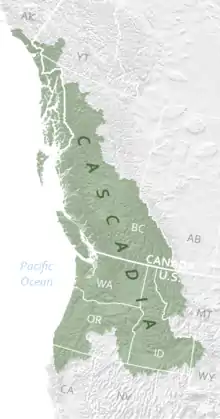
The Pacific Northwest Portal Scattered patches of subalpine fir grow below glaciers and permanent snowfields on the south slope of Mount Rainier in the Cascades ecoregion The Pacific Northwest (PNW), sometimes referred to as Cascadia, is a geographic region in western North America bounded by its coastal waters of the Pacific Ocean to the west and, loosely, by the Rocky Mountains to the east. Though no official boundary exists, the most common conception includes the U.S. states of Oregon, Washington, and Idaho, and the Canadian province of British Columbia. Some broader conceptions reach north into Alaska and Yukon, south into northern California, and east into western Montana. Other conceptions may be limited to the coastal areas west of the Cascade and Coast mountains. The variety of definitions can be attributed to partially overlapping commonalities of the region's history, culture, geography, society, ecosystems, and other factors. The Northwest Coast is the coastal region of the Pacific Northwest, and the Northwest Plateau (also commonly known as "the Interior" in British Columbia and the Inland Northwest in the United States) is the inland region. The term "Pacific Northwest" should not be confused with the Northwest Territory (also known as the Great Northwest, a historical term in the United States) or the Northwest Territories of Canada. The region is sometimes referred to as Cascadia, which, depending on the borders, may or may not be the same thing as the Pacific Northwest. The region's largest metropolitan areas are Greater Seattle, Washington, with 4 million people; Metro Vancouver, British Columbia, with 2.64 million people; and Greater Portland, Oregon, with 2.5 million people. The culture of the Pacific Northwest is influenced by the Canada–United States border, which the United States and the United Kingdom established at a time when the region's inhabitants were composed mostly of indigenous peoples. Two sections of the border—one along the 49th parallel south of British Columbia and one between the Alaska Panhandle and northern British Columbia—have left a great impact on the region. According to Canadian historian Ken Coates, the border has not merely influenced the Pacific Northwest—rather, "the region's history and character have been determined by the boundary". (Full article...) Selected article - A Muzak truck in Indianapolis, Indiana. Muzak is an American brand of background music played in retail stores and other public establishments. The name has been in use since 1934 and has been owned by various companies. In 1981, Westinghouse bought the company and ran it until selling it to the Fields Company of Chicago, publishers of the Chicago Sun-Times, on September 8, 1986. Formerly owned by Muzak Holdings, the brand was purchased in 2011 by Mood Media in a deal worth US$345 million. Muzak was based in various Seattle, Washington locations from 1986 to 1999, after which it moved its headquarters to South Carolina in 2000. The word Muzak has been a registered trademark since December 21, 1954, of Muzak LLC. In the United States, due in part to the company’s market dominance, Muzak has come to be used to refer to most forms of background music, regardless of source. It may also be referred to as "elevator music" or "lift music." Though Muzak Holdings was for many years the best-known supplier of background music, and is commonly associated with elevator music, the company itself did not supply music to elevators. Since 1997, Muzak has used original artists for its music, except on its Environmental channel. (Full article...)Selected biography -
Esperanza Emily Spalding (born October 18, 1984) is an American bassist, singer, songwriter, and composer. Her accolades include five Grammy Awards, a Boston Music Award, a Soul Train Music Award, and two honorary doctorates: in 2018 from her alma mater Berklee College of Music and in 2022 (along with Charles Lloyd and Wayne Shorter) from CalArts. A native of Portland, Oregon, Spalding began playing music professionally in her childhood, performing as a violinist in the Chamber Music Society of Oregon at age five. She was later both self-taught and trained on other instruments, including guitar and bass. Her proficiency earned her academic scholarships to Portland State University and the Berklee College of Music, both of which she attended, studying music. (Full article...)Largest cities of the Pacific Northwest
General images -The following are images from various Pacific Northwest-related articles on Wikipedia.
Did you know -
Indigenous peoples
Related portalsCategories Category puzzle Select [►] to view subcategories
Pacific Northwest British Columbia Culture of the Pacific Northwest Endemic fauna of the Pacific Northwest Flora of the West Coast of the United States Flora of the Northwestern United States Geography of the Pacific Northwest History of the Pacific Northwest Indigenous peoples of the Pacific Northwest Lichens of the Northwestern United States Northwestern United States People from the Pacific Northwest Pacific temperate rainforests Puget Sound region Religion in the Pacific Northwest Society of the Pacific Northwest Pacific Northwest transport templates WikiProjects
Tasks
Associated WikimediaThe following Wikimedia Foundation sister projects provide more on this subject:
Sources
Discover Wikipedia using portals
| |||||||||||||||||||||||||||||||||||||||||||||||||||||||||||||||||||||||||||||||||||||


.jpg.webp)

.jpg.webp)

.jpg.webp)


.jpg.webp)