Portal:Maryland

|
Maryland Portal |
Baltimore Task Force |
Frederick Task Force |
Montgomery Task Force |
WikiProject Maryland |
|
Main page |
Discussion |
Introduction Maryland (US: /ˈmɛrɪlənd/ ( Before its coastline was explored by Europeans in the 16th century, Maryland was inhabited by several groups of Native Americans – mostly by Algonquian peoples and, to a lesser degree, Iroquoian and Siouan. As one of the original Thirteen Colonies of England, Maryland was founded by George Calvert, 1st Baron Baltimore, a Catholic convert who sought to provide a religious haven for Catholics persecuted in England. In 1632, Charles I of England granted Lord Baltimore a colonial charter, naming the colony after his wife, Henrietta Maria. Unlike the Pilgrims and Puritans, who rejected Catholicism in their settlements, Lord Baltimore envisioned a colony where people of different religious sects would coexist under the principle of toleration. Accordingly, in 1649 the Maryland General Assembly passed an Act Concerning Religion, which enshrined this principle by penalizing anyone who "reproached" a fellow Marylander based on religious affiliation. Nevertheless, religious strife was common in the early years, and Catholics remained a minority, albeit in greater numbers than in any other English colony. Maryland's early settlements and population centers clustered around rivers and other waterways that empty into the Chesapeake Bay. Its economy was heavily plantation-based and centered mostly on the cultivation of tobacco. Demand for cheap labor from Maryland colonists led to the importation of numerous indentured servants and enslaved Africans. In 1760, Maryland's current boundaries took form following the settlement of a long-running border dispute with Pennsylvania. Maryland was an active participant in the events leading up to the American Revolution, and by 1776, its delegates signed the Declaration of Independence. Many of its citizens subsequently played key political and military roles in the war. In 1790, the state ceded land for the establishment of the U.S. capital of Washington, D.C. (Full article...)
| ||||||


 The Royal Blue on the Thomas Viaduct in Relay, Maryland in 1937 |
The Royal Blue was the Baltimore and Ohio Railroad (B&O)'s flagship passenger train between New York City and Washington, D.C., in the United States, beginning in 1890. The Baltimore-based B&O also used the name between 1890 and 1917 for its improved passenger service between New York and Washington, collectively dubbed the Royal Blue Line. Using variants such as the Royal Limited and Royal Special for individual Royal Blue trains, the B&O operated the service in partnership with the Reading Railroad and the Central Railroad of New Jersey. Principal intermediate cities served were Philadelphia, Wilmington, and Baltimore. Later, as Europe reeled from the carnage of World War I and connotations of European royalty fell into disfavor, the B&O discreetly omitted the sobriquet Royal Blue Line from its New York passenger service and the Royal Blue disappeared from B&O timetables. Beginning in 1917, former Royal Blue Line trains were renamed: the Royal Limited (inaugurated on May 15, 1898), for example, became the National Limited, continuing west from Washington to St. Louis via Cincinnati. During the Depression, the B&O hearkened back to the halcyon pre-World War I era when it launched a re-christened Royal Blue train between New York and Washington in 1935. The B&O finally discontinued all passenger service north of Baltimore on April 26, 1958, including the Royal Blue.
Railroad historian Herbert Harwood said, in his seminal history of the service, "First conceived in late Victorian times to promote a new railroad line ... it was indeed one of the most memorable images in the transportation business, an inspired blend of majesty and mystique ... Royal Blue Line ... Royal Blue Trains ... the Royal Blue all meant different things at different times. But essentially they all symbolized one thing: the B&O's regal route." Between the 1890s and World War I, the B&O's six daily Royal Blue trains providing service between New York and Washington were noted for their luxury, elegant appearance, and speed. The car interiors were paneled in mahogany, had fully enclosed vestibules (instead of open platforms, still widely in use at the time on U.S. railroads), then-modern heating and lighting, and leaded glass windows. The car exteriors were painted a deep "Royal Saxony blue" color with gold leaf trim, a color personally chosen by the B&O's tenth president, Charles F. Mayer. (Full article...)General images
 The bombardment of Fort McHenry in the Battle of Baltimore inspired "The Star-Spangled Banner". (from Maryland)
 The Battle of Antietam in 1862 was one of the bloodiest battles of the Civil War with nearly 23,000 casualties. (from Maryland)
 Ellicott City Station, on the original B&O Railroad line, is the oldest remaining passenger station in the nation. The rail line is still used by CSX Transportation for freight trains, and the station is now a museum. (from Maryland)
 Ruin left by the Great Baltimore Fire of 1904 (from Maryland)
.svg.png.webp) Map of counties in Maryland by racial plurality, according to 2020 U.S. census findings(from Maryland)
Map of counties in Maryland by racial plurality, according to 2020 U.S. census findings(from Maryland)Non-Hispanic White 40–50%50–60%60–70%70–80%80–90%90%+
Black or African American50–60%60–70%

 Spiro Agnew, 39th Vice President of the United States, is the highest-ranking political leader from Maryland since the nation's founding. (from Maryland)
 Ocean City, a beach resort along the Atlantic Ocean, is a popular tourist destination in Maryland. (from Maryland)
 Patapsco River includes the Thomas Viaduct and is part of the Patapsco Valley State Park. The river forms Baltimore's Inner Harbor as it empties into the Chesapeake Bay. (from Maryland)
 A feral Chincoteague Pony on Assateague Island on Maryland's Atlantic coastal islands (from Maryland)
 UMBC Commons and Quad (from Maryland)
 1732 map of Maryland (from Maryland)
 Maryland's counties (from Maryland)
 Sunset over a marsh at Cardinal Cove on the Patuxent River (from Maryland)
 Maryland population distribution map. Maryland's population is concentrated mostly in the Baltimore and Washington metropolitan areas. (from Maryland)
 Memorial Chapel at the University of Maryland, Maryland's flagship university (from Maryland)

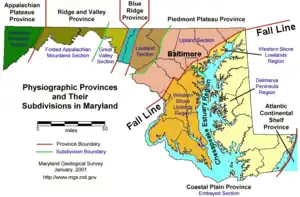 Physical regions of Maryland (from Maryland)
 Western Maryland is known for its heavily forested mountains. A panoramic view of Deep Creek Lake and the surrounding Appalachian Mountains in Garrett County. (from Maryland)
 A map showing Maryland's median income by county. Data is sourced from the 2014 ACS five-year estimate report published by the U.S. Census Bureau (from Maryland)
 The Maryland State House in Annapolis dates to 1772, and houses the Maryland General Assembly and offices of the governor. (from Maryland)
 Agriculture is an important part of Maryland's economy. (from Maryland)
 Tidal wetlands of the Chesapeake Bay, the largest estuary in the nation and the largest water feature in Maryland (from Maryland)
.jpg.webp) The historical coat of arms of Maryland in 1876 (from Maryland)
The historical coat of arms of Maryland in 1876 (from Maryland) American Film Institute Silver Theater (from Arts and culture of Maryland)
 Black-eyed susans, the state flower, grow throughout much of the state. (from Maryland)
In the news
- November 1, 2007 - Westboro Baptist Church ordered to pay US$11 million to family of fallen US soldier
- September 30, 2007 - Interview with gay marriage movement founder Evan Wolfson
- September 1, 2007 - Four jackpot winners confirmed in US 'Mega Millions' lottery drawing
- May 20, 2007 - Horse racing: Curlin wins 2007 Preakness Stakes
On this day...
April 7
Births
- 1915 - Billie Holiday, jazz singer
 Good article -
Eva Marie Cassidy (February 2, 1963 – November 2, 1996) was an American singer and guitarist known for her interpretations of jazz, folk, and blues music, sung with a powerful, emotive soprano voice. In 1992, she released her first album, The Other Side, a set of duets with go-go musician Chuck Brown, followed by the 1996 live solo album titled Live at Blues Alley. Although she had been honored by the Washington Area Music Association, she was virtually unknown outside her native Washington, D.C. at the time of her death from melanoma at the age of 33 in 1996.
Two years later, Cassidy's music was brought to the attention of British audiences, when her versions of "Fields of Gold" and "Over the Rainbow" were played by Mike Harding and Terry Wogan on BBC Radio 2. Following the overwhelming response, a camcorder recording of "Over the Rainbow", taken at Blues Alley in Washington by her friend Bryan McCulley, was shown on BBC Two's Top of the Pops 2. Shortly afterwards, the compilation album Songbird climbed to the top of the UK Albums Chart, almost three years after its initial release. The chart success in the United Kingdom and Ireland led to increased recognition worldwide. Her posthumously released recordings, including three number-one albums and one number-one single in the UK, have sold more than ten million copies. Her music has also charted within the top 10 in Australia, Germany, Norway, Sweden and Switzerland. (Full article...)Selected article -
The bombardment of Fort McHenry by the British. Engraved by John Bower |
The Battle of Baltimore (September 12–15, 1814) was a sea/land battle fought between British invaders and American defenders in the War of 1812. American forces repulsed sea and land invasions off the busy port city of Baltimore, Maryland, and killed the commander of the invading British forces. The British and Americans first met at the Battle of North Point. Though the Americans retreated, the battle was a successful delaying action that inflicted heavy casualties on the British, halted their advance, and consequently allowed the defenders at Baltimore to prepare for an attack properly.
The resistance of Baltimore's Fort McHenry during bombardment by the Royal Navy inspired Francis Scott Key to compose the poem "Defence of Fort McHenry," which later became the lyrics for "The Star-Spangled Banner," the national anthem of the United States. (Full article...)Did you know?
- ...that unlike most other American courts, the judges on the Maryland Court of Appeals wear crimson (not black) robes, and neck bands, reminiscent of British court dress?
- ...that Kent Island was founded in 1631 as part of Virginia, three years before St. Mary's City was founded?

- ...that the Thomas Viaduct (pictured) over the Patapsco River was the first multi-span masonry railroad bridge in the United States when it was constructed between 1833 and 1835?
Subcategories
Topics
.svg.png.webp)
Related portals
Associated Wikimedia
The following Wikimedia Foundation sister projects provide more on this subject:
-
 Commons
Free media repository -
 Wikibooks
Free textbooks and manuals -
 Wikidata
Free knowledge base -
 Wikinews
Free-content news -
 Wikiquote
Collection of quotations -
 Wikisource
Free-content library -
 Wikiversity
Free learning tools -
 Wikivoyage
Free travel guide -
 Wiktionary
Dictionary and thesaurus
-
 List of all portalsList of all portals
 -
 The arts portal
 -
 Biography portal
 -
 Current events portal
 -
 Geography portal
 -
 History portal
 -
 Mathematics portal
 -
 Science portal
 -
 Society portal
 -
 Technology portal
 -
 Random portalRandom portal
 -
 WikiProject PortalsWikiProject Portals