Portal:Mali

The Mali Portal
Mali (/ˈmɑːli/ ( Present-day Mali was once part of three extremely powerful and wealthy West African empires that controlled trans-Saharan trade: the Ghana Empire (for which Ghana is named), the Mali Empire (for which Mali is named), and the Songhai Empire. At its peak in 1300, the Mali Empire was the wealthiest country in Africa, covering an area about twice the size of modern-day France and stretched to the west coast of the continent. Mali was also one of the wealthiest countries on earth, and its emperor at its zenith, Mansa Musa, is believed to be possibly the wealthiest individual in history. Besides being an economic powerhouse, medieval Mali was a centre of Islam, culture and knowledge, with Timbuktu becoming a renowned place of learning with its university, one of the oldest in the world still active. The expanding Songhai Empire absorbed the empire in 1468, followed by a Moroccan army which defeated the Songhai in 1591. The Moroccan colonists established a new ruling class, the Arma, who after 1631 became virtually independent of Morocco. In the late 19th century, during the Scramble for Africa, France seized control of Mali, making it a part of French Sudan. French Sudan (then known as the Sudanese Republic) joined with Senegal in 1959, achieving independence in 1960 as the Mali Federation. Shortly thereafter, following Senegal's withdrawal from the federation, the Sudanese Republic declared itself the independent Republic of Mali. After a long period of one-party rule, a coup in 1991 led to the writing of a new constitution and the establishment of Mali as a democratic, multi-party state. In January 2012, an armed conflict broke out in northern Mali, in which Tuareg rebels took control of a territory in the north, and in April declared the secession of a new state, Azawad. The conflict was complicated by a military coup that took place in March and later fighting between Tuareg and other rebel factions. In response to territorial gains, the French military launched Operation Serval in January 2013. A month later, Malian and French forces recaptured most of the north, although the conflict still continued. Presidential elections were held on 28 July 2013, with a second-round run-off held on 11 August, and legislative elections were held on 24 November and 15 December 2013. In the early 2020s Mali experienced two military takeovers by Assimi Goïta. (Full article...) Selected article - Omar Ould Hamaha (or Oumar Ould Hamaha, Hakka; 5 July 1963 – March 8, 2014) was an Islamist militia commander from Northern Mali. During the 2012 Northern Mali conflict he became known alternatively as the spokesman and chief of staff for both Ansar Dine and Movement for Oneness and Jihad in West Africa (MOJWA), militant groups associated with Al-Qaeda in the Islamic Maghreb (AQIM). Ould Hamaha was born in Kidal, Mali. He was the son of a military camel driver and member of the Arab ethnicity. In 1984, he graduated from the Franco-Arabic lycée in Timbuktu. Instead of going to university, he opted to study the Koran at a Mauritanian madrasa. Returned to Timbuktu in 1990, he was refused preaching licence at the Grand Mosque. After his brother, who was a fighter of the Arab Islamic Front of Azawad, was killed by the Malian army during the Tuareg rebellion of the early 1990s, Ould Hamaha went underground. Influenced by Pakistani preachers, he embraced Salafist teachings. (Full article...)General images -The following are images from various Mali-related articles on Wikipedia.
Categories Category puzzle Select [►] to view subcategories
Mali Mali-related lists Buildings and structures in Mali Malian culture Economy of Mali Education in Mali Environment of Mali Geography of Mali Government of Mali Health in Mali History of Mali Organisations based in Mali Malian people Politics of Mali Society of Mali Mali stubs Cities and townsWikiProjects WikiProject Mali WikiProject Mali WikiProject Africa WikiProject AfricaTopics in Mali
Selected pictureRelated portalsMap Associated WikimediaThe following Wikimedia Foundation sister projects provide more on this subject:
Sources
Discover Wikipedia using portals
| ||||||||||||||||||||


.jpg.webp)


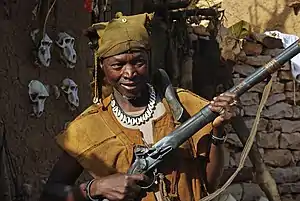
.jpg.webp)
.jpg.webp)
.svg.png.webp)
.jpg.webp)


.png.webp)
.jpg.webp)
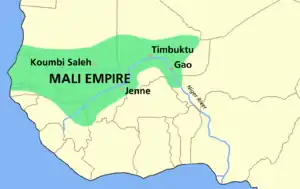


.jpg.webp)


_Mali.jpg.webp)
.jpg.webp)