Portal:Linux

The Linux Portal
 Tux the penguin, the mascot of Linux |
Linux (/ˈliːnʊks/ ( listen) LEE-nuuks or /ˈlɪnʊks/ LIN-uuks) is a family of open-source Unix-like operating systems based on the Linux kernel, an operating system kernel first released on September 17, 1991, by Linus Torvalds. Linux is typically packaged as a Linux distribution, which includes the kernel and supporting system software and libraries, many of which are provided by the GNU Project. Many Linux distributions use the word "Linux" in their name, but the Free Software Foundation uses the name "GNU/Linux" to emphasize the importance of GNU software, causing some controversy.
Linux was originally developed for personal computers based on the Intel x86 architecture, but has since been ported to more platforms than any other operating system. Because of the dominance of the Linux-based Android on smartphones, Linux, including Android, has the largest installed base of all general-purpose operating systems, . Although Linux is, , used by only around 2.6 percent of desktop computers, the Chromebook, which runs the Linux kernel-based ChromeOS, dominates the US K–12 education market and represents nearly 20 percent of sub-$300 notebook sales in the US. Linux is the leading operating system on servers (over 96.4% of the top 1 million web servers' operating systems are Linux), leads other big iron systems such as mainframe computers, and is used on all of the world's 500 fastest supercomputers (since November 2017, having gradually displaced all competitors).
Linux also runs on embedded systems, i.e. devices whose operating system is typically built into the firmware and is highly tailored to the system. This includes routers, automation controls, smart home devices, video game consoles, televisions (Samsung and LG Smart TVs), automobiles (Tesla, Audi, Mercedes-Benz, Hyundai and Toyota), and spacecraft (Falcon 9 rocket, Dragon crew capsule and the Perseverance rover). (Full article...)
Selected articles -
![Image 1SUSE Linux (/ˈsuːsə, ˈsuːzə/ SOO-sə, SOO-zə, German: [ˈzuːzə]) is a computer operating system developed by SUSE. It is built on top of the free and open source Linux kernel and is distributed with system and application software from other open source projects. SUSE Linux is of German origin, its name being an acronym of "Software und System-Entwicklung" (software and systems development), and it was mainly developed in Europe. The first version appeared in early 1994, making SUSE one of the oldest existing commercial distributions. It is known for its YaST configuration tool.Novell bought the SUSE (then "SuSE") brands and trademarks in 2003. Novell, one of the founding members of the Open Invention Network, decided to make the community an important part of their development process by opening widely the distribution development to outside contributors in 2005, creating the openSUSE distribution and the openSUSE Project. Novell employed more than 500 developers working on SUSE in 2004. On 27 April 2011, Novell (and SUSE) were acquired by The Attachmate Group, which made SUSE an independent business unit. Later, in October 2014, the entire Attachmate Group, including SUSE, was acquired by the British firm Micro Focus International. SUSE continues to operate as an independent business unit. On 2 July 2018, it was announced that Micro Focus would sell SUSE to Blitz 18-679 GmbH, a subsidiary of EQT Partners, for $2.535 billion. The acquisition was completed on March 18, 2019. (Full article...)](../I/Blank.png.webp) SUSE Linux (/ˈsuːsə, ˈsuːzə/ SOO-sə, SOO-zə, German: [ˈzuːzə]) is a computer operating system developed by SUSE. It is built on top of the free and open source Linux kernel and is distributed with system and application software from other open source projects. SUSE Linux is of German origin, its name being an acronym of "Software und System-Entwicklung" (software and systems development), and it was mainly developed in Europe. The first version appeared in early 1994, making SUSE one of the oldest existing commercial distributions. It is known for its YaST configuration tool.
SUSE Linux (/ˈsuːsə, ˈsuːzə/ SOO-sə, SOO-zə, German: [ˈzuːzə]) is a computer operating system developed by SUSE. It is built on top of the free and open source Linux kernel and is distributed with system and application software from other open source projects. SUSE Linux is of German origin, its name being an acronym of "Software und System-Entwicklung" (software and systems development), and it was mainly developed in Europe. The first version appeared in early 1994, making SUSE one of the oldest existing commercial distributions. It is known for its YaST configuration tool.
Novell bought the SUSE (then "SuSE") brands and trademarks in 2003. Novell, one of the founding members of the Open Invention Network, decided to make the community an important part of their development process by opening widely the distribution development to outside contributors in 2005, creating the openSUSE distribution and the openSUSE Project. Novell employed more than 500 developers working on SUSE in 2004. On 27 April 2011, Novell (and SUSE) were acquired by The Attachmate Group, which made SUSE an independent business unit. Later, in October 2014, the entire Attachmate Group, including SUSE, was acquired by the British firm Micro Focus International. SUSE continues to operate as an independent business unit. On 2 July 2018, it was announced that Micro Focus would sell SUSE to Blitz 18-679 GmbH, a subsidiary of EQT Partners, for $2.535 billion. The acquisition was completed on March 18, 2019. (Full article...)
KNOPPIX (/ˈknɒpɪks/ KNOP-iks) is an operating system based on Debian designed to be run directly from a CD / DVD (Live CD) or a USB flash drive (Live USB), one of the first live operating system distributions (just after Yggdrasil Linux). Knoppix was developed by, and named after, Linux consultant Klaus Knopper. When starting a program, it is loaded from the removable medium and decompressed into a RAM drive. The decompression is transparent and on-the-fly.
Although KNOPPIX is primarily designed to be used as a Live CD, it can also be installed on a hard disk like a typical operating system. Computers that support booting from USB devices can load KNOPPIX from a live USB flash drive or memory card. (Full article...) Puppy Linux FossaPup 9.5
Puppy Linux is an operating system and family of light-weight Linux distributions that focus on ease of use and minimal memory footprint. The entire system can be run from random-access memory (RAM) with current versions generally taking up about 600 MB (64-bit), 300 MB (32-bit), allowing the boot medium to be removed after the operating system has started. Applications such as AbiWord, Gnumeric and MPlayer are included, along with a choice of lightweight web browsers and a utility for downloading other packages. The distribution was originally developed by Barry Kauler and other members of the community, until Kauler retired in 2013. The tool Woof can build a Puppy Linux distribution from the binary packages of other Linux distributions. (Full article...)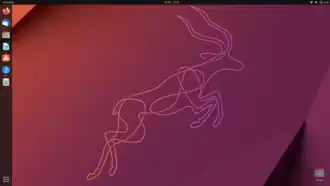 Ubuntu, one of the most popular desktop Linux distributions
A Linux distribution (often abbreviated as distro) is an operating system made from a software collection that includes the Linux kernel, and often a package management system. Linux users usually obtain their operating system by downloading one of the Linux distributions, which are available for a wide variety of systems ranging from embedded devices (for example, OpenWrt) and personal computers (for example, Linux Mint) to powerful supercomputers (for example, Rocks Cluster Distribution).
A typical Linux distribution comprises a Linux kernel, GNU tools and libraries, additional software, documentation, a window system (the most common being the X Window System, or, more recently, Wayland), a window manager, and a desktop environment. (Full article...) An example of LSB output in a terminal (Debian version 11)
The Linux Standard Base (LSB) was a joint project by several Linux distributions under the organizational structure of the Linux Foundation to standardize the software system structure, including the Filesystem Hierarchy Standard used in the Linux kernel. LSB was based on the POSIX specification, the Single UNIX Specification (SUS), and several other open standards, but extended them in certain areas.
According to LSB:
(Full article...)
The goal of the LSB is to develop and promote a set of open standards that will increase compatibility among Linux distributions and enable software applications to run on any compliant system even in binary form. In addition, the LSB will help coordinate efforts to recruit software vendors to port and write products for Linux Operating Systems. Red Hat Enterprise Linux 9.0, showing its desktop environment GNOME 40.
Red Hat Enterprise Linux (RHEL) is a commercial open-source Linux distribution developed by Red Hat for the commercial market. Red Hat Enterprise Linux is released in server versions for x86-64, Power ISA, ARM64, and IBM Z and a desktop version for x86-64. Fedora Linux serves as its upstream source. All of Red Hat's official support and training, together with the Red Hat Certification Program, focuses on the Red Hat Enterprise Linux platform.
The first version of Red Hat Enterprise Linux to bear the name originally came onto the market as "Red Hat Linux Advanced Server". In 2003, Red Hat rebranded Red Hat Linux Advanced Server to "Red Hat Enterprise Linux AS" and added two more variants, Red Hat Enterprise Linux ES and Red Hat Enterprise Linux WS. (Full article...).svg.png.webp)
Android is a mobile operating system based on a modified version of the Linux kernel and other open-source software, designed primarily for touchscreen mobile devices such as smartphones and tablets. Android is developed by a consortium of developers known as the Open Handset Alliance, though its most widely used version is primarily developed by Google. It was unveiled in November 2007, with the first commercial Android device, the HTC Dream, being launched in September 2008.
At its core, the operating system is known as Android Open Source Project (AOSP) and is free and open-source software (FOSS) primarily licensed under the Apache License. However most devices run on the proprietary Android version developed by Google, which ship with additional proprietary closed-source software pre-installed, most notably Google Mobile Services (GMS) which includes core apps such as Google Chrome, the digital distribution platform Google Play, and the associated Google Play Services development platform. While AOSP is free, the "Android" name and logo are trademarks of Google, which imposes standards to restrict the use of Android branding by "uncertified" devices outside their ecosystem. (Full article...) Linux kernel 3.0.0 booting
The Linux kernel is a free and open-source, monolithic, modular, multitasking, Unix-like operating system kernel. It was originally authored in 1991 by Linus Torvalds for his i386-based PC, and it was soon adopted as the kernel for the GNU operating system, which was written to be a free (libre) replacement for Unix.
Linux is provided under the GNU General Public License version 2 only, but it contains files under other compatible licenses. Since the late 1990s, it has been included as part of a large number of operating system distributions, many of which are commonly also called Linux. (Full article...)- Tux, mascot of the Linux Kernel
Within the free software and the open-source software communities there is controversy over whether to refer to computer operating systems that use a combination of GNU software and the Linux kernel as "GNU/Linux" or "Linux" systems.
Proponents of the term Linux argue that it is far more commonly used by the public and media and that it serves as a generic term for systems that combine that kernel with software from multiple other sources, while proponents of the term GNU/Linux note that GNU alone would be just as good a name for GNU variants which combine the GNU operating system software with software from other sources. (Full article...) 
Arch Linux (/ɑːrtʃ/) is an independently developed, x86-64 general-purpose Linux distribution that strives to provide the latest stable versions of most software by following a rolling-release model. The default installation is a minimal base system, configured by the user to only add what is purposely required.
Pacman, a package manager written specifically for Arch Linux, is used to install, remove and update software packages. (Full article...)
Slackware is a Linux distribution created by Patrick Volkerding in 1993. Originally based on Softlanding Linux System, Slackware has been the basis for many other Linux distributions, most notably the first versions of SUSE Linux distributions, and is the oldest distribution that is still maintained.
Slackware aims for design stability and simplicity and to be the most "Unix-like" Linux distribution. It makes as few modifications as possible to software packages from upstream and tries not to anticipate use cases or preclude user decisions. In contrast to most modern Linux distributions, Slackware provides no graphical installation procedure and no automatic dependency resolution of software packages. It uses plain text files and only a small set of shell scripts for configuration and administration. Without further modification it boots into a command-line interface environment. Because of its many conservative and simplistic features, Slackware is often considered to be most suitable for advanced and technically inclined Linux users. (Full article...)
Asahi Linux is a porting project to develop support for Linux on Apple hardware, specifically Apple silicon-powered Macs, allowing them to run alternative operating systems in addition to macOS. The software design project was started and is led by Hector Martin. Work began in early 2021, a few months after Apple formally announced the transition to Apple silicon. An initial alpha release followed in 2022. The project has been made challenging by the lack of publicly available documentation of Apple's proprietary firmware. (Full article...)- Ubuntu 22.10 Kinetic Kudu
Ubuntu releases are made semiannually by Canonical Ltd, the developers of the Ubuntu operating system, using the year and month of the release as a version number. The first Ubuntu release, for example, was Ubuntu 4.10 and was released on 20 October 2004. Consequently, version numbers for future versions are provisional; if the release is delayed until a different month (or even year) to that planned, the version number will change accordingly.
Canonical schedules Ubuntu releases to occur approximately one month after GNOME releases, resulting in each Ubuntu release including a newer version of GNOME. (Full article...) - GoboLinux is a Linux distribution whose most prominent feature is a reorganization of the traditional Linux file system. Rather than following the Filesystem Hierarchy Standard like most Unix-like systems, each program in a GoboLinux system has its own subdirectory tree, where all of its files (including settings specific for that program) may be found. Thus, a program "Foo" has all of its specific files and libraries in
/Programs/Foo, under the corresponding version of this program at hand. For example, the commonly known GCC compiler suite version 8.1.0, would reside under the directory/Programs/GCC/8.1.0.
According to the GoboLinux developers, this results in a cleaner system. (Full article...)  Deepin 20.1 desktop, with the Qt-based Deepin Desktop Environment
Deepin (stylized as deepin; formerly known as Linux Deepin and Hiweed Linux) is a Linux distribution based on the Debian "stable" branch. It features the Deepin Desktop Environment (DDE), built on Qt and available for a variety of distributions. The userbase is predominantly Chinese, though it is in most prominent Linux distributions' repositories as an alternative desktop environment. The company behind the development, Deepin Technology, a wholly owned subsidiary of UnionTech (统信软件), is based in Wuhan, China. (Full article...)
Release news
- 2023-02-19 Linux kernel 6.2 released.
- 2022-12-11 Linux kernel 6.1 released.
- 2022-11-16 Red Hat Enterprise Linux 9.1 and AlmaLinux 9.1 released.
- 2022-11-15 Fedora 37 released.
- 2022-10-20 Ubuntu 22.10 "Kinetic Kudu" released.
- 2022-10-02 Linux kernel 6.0 released.
- 2022-09-21 GNOME 43 released
- 2022-07-31 Linux kernel 5.19 released.
- 2022-05-26 AlmaLinux 9 released.
- 2022-05-22 Linux kernel 5.18 released.
- 2022-05-18 Red Hat Enterprise Linux 9 released.
- 2022-05-10 Fedora 36 released.
- 2022-04-21 Ubuntu 22.04 LTS "Jammy Jellyfish" released.
- 2022-03-23 GNOME 42 released.
- 2022-03-20 Linux kernel 5.17 released.
- 2022-02-02 Slackware 15.0 released.
- 2022-01-09 Linux kernel 5.16 released.
- 2021-11-02 Fedora 35 released.
Selected image
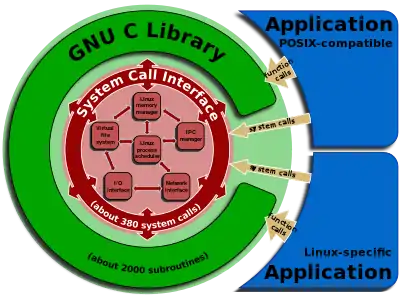
The Linux kernel System Call Interface and the GNU C Library.
Related portals
Selected biographies -
 Photo of Wright (foreground)
Chris Wright is a Linux kernel developer and CTO with Red Hat. He was the Linux kernel co-maintainer for the -stable branch with Greg Kroah-Hartman. He is involved in Linux kernel security related topics and is currently the maintainer for the LSM framework.
Chris also serves as the Chair of the OpenDaylight Project Board of Directors. (Full article...)
Matthew Garrett is an Irish technologist, programmer, and free software activist who is a major contributor to a series of free software projects including Linux, GNOME, Debian, Ubuntu, and Red Hat. He has received the Free Software Award from the Free Software Foundation (FSF) for his work on Secure Boot, UEFI, and the Linux kernel. (Full article...)
Mary Gardiner is an Australian Linux programmer who was director of operations at the Ada Initiative, described as a "non-profit organization dedicated to increasing participation of women in open technology and culture". She was a council member of Linux Australia until September 2011. In 2012, Gardiner and Ada Initiative co-founder Valerie Aurora were named two of the most influential people in computer security by SC Magazine. (Full article...)
Theodore (Ted) Yue Tak Ts'o (曹子德) (born 1968) is an American software engineer mainly known for his contributions to the Linux kernel, in particular his contributions to file systems. He is the Secondary developer and maintainer of e2fsprogs, the userspace utilities for the ext2, ext3, and ext4 filesystems, and is a maintainer for the ext4 file system. (Full article...) Bruce Perens in 2009
Bruce Perens (born around 1958) is an American computer programmer and advocate in the free software movement. He created The Open Source Definition and published the first formal announcement and manifesto of open source. He co-founded the Open Source Initiative (OSI) with Eric S. Raymond. Today, he is a partner at OSS Capital.
In 2005, Perens represented Open Source at the United Nations World Summit on the Information Society, at the invitation of the United Nations Development Programme. He has appeared before national legislatures and is often quoted in the press, advocating for open source and the reform of national and international technology policy. (Full article...) Raymond at Linucon in 2004
Eric Steven Raymond (born December 4, 1957), often referred to as ESR, is an American software developer, open-source software advocate, and author of the 1997 essay and 1999 book The Cathedral and the Bazaar. He wrote a guidebook for the Roguelike game NetHack. In the 1990s, he edited and updated the Jargon File, published as The New Hacker's Dictionary. (Full article...)
Ingo Molnár, employed by Red Hat as of May 2013, is a Hungarian Linux hacker. He is known for his contributions to the operating system in terms of security and performance. (Full article...)- Daniel Robbins is a computer programmer and consultant best known as the founder and former chief architect of the Gentoo Linux project. In 2008, he launched the Funtoo project, a free Linux distribution based on Gentoo, and he became the project's lead developer and organizer. He works in Albuquerque, New Mexico at Zenoss, and as president for Funtoo Technologies. (Full article...)
 Shuttleworth in Dublin, 2011
Mark Richard Shuttleworth (born 18 September 1973) is a South African and British entrepreneur who is the founder and CEO of Canonical, the company behind the development of the Linux-based Ubuntu operating system. In 2002, Shuttleworth became the first South African to travel to space as a space tourist, and the first African from an independent country to travel to space. He lives on the Isle of Man and holds dual citizenship from South Africa and the United Kingdom. According to the Sunday Times Rich List in 2020, Shuttleworth is worth an estimated £500 million. (Full article...)- Alan or Allan Cox may refer to:
- Alan Cox (computer programmer) (born 1968), British computer programmer and Linux developer
- Alan Cox (actor) (born 1970), English actor
- Alan Cox (footballer) (1920–1993), footballer for Tranmere Rovers
- Alan Cox (radio personality) (born 1971), radio host
- Allan Cox (author) (born 1937), American consultant and author
- Allan Cox (cricketer) (1873–1896), Barbadian cricketer
- Allan Leslie Cox (born 1927), Canadian politician in the Legislative Assembly of British Columbia
- Allan V. Cox (1926–1987), American geophysicist
 Jane Silber, 2010
Jane Silber is a board member of Canonical Ltd. and was its Chief Executive Officer from 2010 to 2017.
Silber is also the chair of the board of The Sensible Code Company (whose products include QuickCode.) and Diffblue (whose products include Cover, an AI-driven unit test-writing tool).
Silber joined Canonical in July 2004, where her work has included leading the Ubuntu One project and ensuring that large organizations find Ubuntu "enterprise-ready".
She partially attributes the increasing attention to user research and design in open source since 2009 to Canonical's leadership in this area.
Silber announced her transition out of the CEO role in April 2017, with Canonical founder Mark Shuttleworth resuming the position from July 2017. (Full article...).jpg.webp) Murdock, in interview, April 2008
Murdock, in interview, April 2008
Ian Ashley Murdock (April 28, 1973 – December 28, 2015) was an American software engineer, known for being the founder of the Debian project and Progeny Linux Systems, a commercial Linux company. (Full article...).jpg.webp) Hans Reiser in 2006
Hans Reiser in 2006
Hans Thomas Reiser (born December 19, 1963) is an American computer programmer, entrepreneur, and convicted murderer. In April 2008, Reiser was convicted of the first-degree murder of his wife, Nina Reiser, who disappeared in September 2006. He subsequently pleaded guilty to a reduced charge of second-degree murder, as part of a settlement agreement that included disclosing the location of Nina Reiser's body, which he revealed to be in a shallow grave near the couple's home.
Prior to his incarceration, Reiser created the ReiserFS computer file system, which may be used by the Linux kernel, as well as its attempted successor, Reiser4. In 2004, he founded Namesys, a corporation meant to coordinate the development of both file systems. (Full article...) Hall in 2015
Jon "maddog" Hall (born 7 August 1950) is the board chair for the Linux Professional Institute. (Full article...).jpg.webp)
Hans Peter Anvin (12 January 1972), also known as hpa, is a Swedish-American computer programmer who has contributed to free and open-source software projects. Anvin is the originator of SYSLINUX, Linux Assigned Names and Numbers Authority (LANANA), and various Linux kernel features. (Full article...)
General images -
 An example of Linux kernel panic (from Linux kernel)
 Logo of Debian GNU/kFreeBSD (from Debian)

 Debian 10 installation menu (BIOS Mode) (from Debian)
 Logo of GNU Hurd (from Debian)
 Cloud Ubuntu Orange Box
 Fedora 21, a version that brought experimental Wayland and HiDPI support (2014-12). (from Fedora Linux)
 debian 10 console login and welcome message (from Debian)
 The Linux Storage Stack Diagram (from Linux kernel)
 Deepin logo (from Ubuntu)
_auf_Debian_7_Wheezy_2015-04-02.png.webp)
 Debian 4 (Etch), 2007 (from Debian)
 Debian 6 (Squeeze), 2011 (from Debian)
.jpg.webp)

 Screenshot of GDebi Package installer (from Debian)
 Package installed with Aptitude (from Debian)
 Four interfaces are distinguished: two internal to the kernel, and two between the kernel and userspace. (from Linux kernel)
 Graphical version of the debian Installer (from Debian)
 Text version of the debian Installer (from Debian)
 The core values of the Fedora community (from Fedora Linux)
 The Linux kernel supports various hardware architectures, providing a common platform for software, including proprietary software. (from Linux kernel)
![Image 27Ubuntu family tree[dubious – discuss] (from Ubuntu)](../I/UbuntuFamilyTree1210.svg.png.webp) Ubuntu family tree (from Ubuntu)
Ubuntu family tree (from Ubuntu) Fedora Workstation 35 installation summary (from Fedora Linux)
 Eucalyptus interface (from Ubuntu)
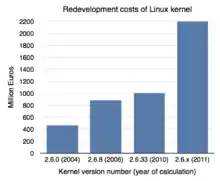 Redevelopment costs of Linux kernel (from Linux kernel)
 At XDC2014, Alex Deucher from AMD announced the unified kernel-mode driver. The proprietary Linux graphic driver, libGL-fglrx-glx, will share the same DRM infrastructure with Mesa 3D. As there is no stable in-kernel ABI, AMD had to constantly adapt the former binary blob used by Catalyst. (from Linux kernel)
 XFCE is default on CD images and non-Linux ports (from Debian)
 The "swirl" logo is said to represent magic smoke. (from Debian)
 Boot messages of a Linux kernel 2.6.25.17 (from Linux kernel)
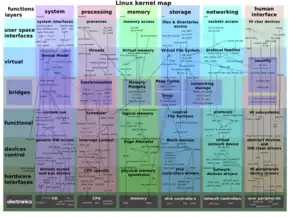 Map of the Linux kernel (from Linux kernel)
 A Debian 10.0 Buster box cover (from Debian)
Did you know?

- ... that it is now possible to run Linux on an Apple-silicon Mac?
- ... that Leafpad is a text editor for Linux that is comparable to Notepad for Windows?
- ... that software company Caldera International tried to combine Unix with Linux for business customers, but did not succeed?
WikiProjects

- WikiProject Programming languages
- WikiProject Computing
- WikiProject Computer science
- WikiProject Java
- WikiProject Software
- WikiProject Portals
Topics
| Linux kernel | |
|---|---|
| Controversies | |
| Distributions | |
| Organizations | |
| Adoption | |
| Media | |
| |


| Android | |||||||||
|---|---|---|---|---|---|---|---|---|---|
| Arch | |||||||||
| Debian |
| ||||||||
| Fedora | |||||||||
| Gentoo | |||||||||
| Slackware | |||||||||
| Mandriva | |||||||||
| Other | |||||||||
| Discontinued |
| ||||||||
| |||||||||


Subcategories

Associated Wikimedia
The following Wikimedia Foundation sister projects provide more on this subject:
-
 Commons
Free media repository -
 Wikibooks
Free textbooks and manuals -
 Wikidata
Free knowledge base -
 Wikinews
Free-content news -
 Wikiquote
Collection of quotations -
 Wikisource
Free-content library -
 Wikiversity
Free learning tools -
 Wiktionary
Dictionary and thesaurus
Sources
More portals
-
 List of all portalsList of all portals
 -
 The arts portal
 -
 Biography portal
 -
 Current events portal
 -
 Geography portal
 -
 History portal
 -
 Mathematics portal
 -
 Science portal
 -
 Society portal
 -
 Technology portal
 -
 Random portalRandom portal
 -
 WikiProject PortalsWikiProject Portals