Portal:Democratic Republic of the Congo

The Democratic Republic of the Congo Portal
The Democratic Republic of the Congo (DRC), also known as Congo-Kinshasa and formerly known as Zaire, is a country in Central Africa bordered to the west by the South Atlantic Ocean. By land area, the DRC is the second-largest country in Africa and the 11th-largest in the world. With a population of around 112 million, the Democratic Republic of the Congo is the most populous officially Francophone country in the world. The national capital and largest city is Kinshasa, which is also the nation's economic center. The country is bordered by the Republic of the Congo, Central African Republic, South Sudan, Uganda, Rwanda, Burundi, Tanzania (across Lake Tanganyika), Zambia, Angola, and the Cabinda exclave of Angola. Centered on the Congo Basin, the territory of the DRC was first inhabited by Central African foragers around 90,000 years ago and was reached by the Bantu expansion about 3,000 years ago. In the west, the Kingdom of Kongo ruled around the mouth of the Congo River from the 14th to 19th centuries. In the northeast, center and east, the kingdoms of Azande, Luba, and Lunda ruled from the 16th and 17th centuries to the 19th century. King Leopold II of Belgium formally acquired rights to the Congo territory in 1885 and declared the land his private property, naming it the Congo Free State. From 1885 to 1908, his colonial military forced the local population to produce rubber and committed widespread atrocities. In 1908, Leopold ceded the territory, which thus became a Belgian colony. Congo achieved independence from Belgium on 30 June 1960 and was immediately confronted by a series of secessionist movements, which culminated in the seizure of power by Mobutu Sese Seko in a 1965 coup d'état. Mobutu renamed the country Zaire in 1971 and imposed a harsh personalist dictatorship until his overthrow in 1997 by the First Congo War. The country then had its name changed back and was confronted by the Second Congo War from 1998 to 2003, which resulted in the deaths of 5.4 million people. The war ended under President Joseph Kabila who governed the country from 2001 to 2019, under whom human rights in the country remained poor and included frequent abuses such as forced disappearances, torture, arbitrary imprisonment and restrictions on civil liberties. Following the 2018 general election, in the country's first peaceful transition of power since independence, Kabila was succeeded as president by Félix Tshisekedi, who has served as president since. Since 2015, the Eastern DR Congo has been the site of an ongoing military conflict in Kivu. The Democratic Republic of the Congo is extremely rich in natural resources but has suffered from political instability, a lack of infrastructure, corruption, and centuries of both commercial and colonial extraction and exploitation, followed by more than 60 years of independence, with little widespread development. Besides the capital Kinshasa, the two next largest cities, Lubumbashi and Mbuji-Mayi, are both mining communities. The DRC's largest export is raw minerals, with China accepting over 50% of its exports in 2019. In 2021, DR Congo's level of human development was ranked 179th out of 191 countries by the Human Development Index. , following two decades of various civil wars and continued internal conflicts, around 600,000 Congolese refugees were still living in neighbouring countries. Two million children risk starvation, and the fighting has displaced 4.5 million people. The country is a member of the United Nations, Non-Aligned Movement, African Union, COMESA, Southern African Development Community, Organisation Internationale de la Francophonie, and the Economic Community of Central African States. (Full article...) Selected article -.svg.png.webp) General images -The following are images from various Democratic Republic of the Congo-related articles on Wikipedia.
| ||||||||||


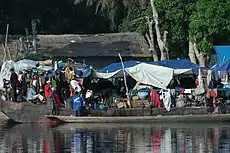
_(8458935824).jpg.webp)
_-_Kasa%C3%AF-Central.svg.png.webp)


_of_clashes_between_M23_and_National_troops._(8782972992).jpg.webp)


.svg.png.webp)
.jpg.webp)

.jpg.webp)

.jpg.webp)
.jpg.webp)


.jpg.webp)



.jpg.webp)


.jpg.webp)


List of Good articles |
|---|
 Featured article -
 Swedish UN peacekeepers led by Major Sture Fagerström plan their attack on the town of Kamina during the operation |
Operation Grandslam was an offensive undertaken by United Nations peacekeeping forces from 28 December 1962 to 15 January 1963 against the forces of the State of Katanga, a secessionist state rebelling against the Republic of the Congo in central Africa. The Katangese forces were decisively defeated and Katanga was forcibly reintegrated into the Congo.
The United Nations had tried several times to reconcile the government of the Congo with the State of Katanga, which had declared independence under Moïse Tshombe with Belgian support in 1960. Though initially limiting its actions, the United Nations Operation in the Congo became increasingly impatient towards Katanga and Tshombe, drawing up plans to resolve the situation through force. Tshombe continuously violated agreements he had made with the United Nations and the Congolese government by building up his forces and bringing foreign mercenaries into the conflict. The situation reached a breaking point in December 1962 when Katangese gendarmes attacked peacekeeping forces in Katanga. United Nations Secretary-General U Thant authorised a retaliatory offensive to eliminate secessionist opposition. (Full article...)List of Featured articles |
|---|
WikiProjects
 WikiProject Democratic Republic of the Congo
 WikiProject Africa
Topics
Categories

Related portals
Associated Wikimedia
The following Wikimedia Foundation sister projects provide more on this subject:
-
 Commons
Free media repository -
 Wikibooks
Free textbooks and manuals -
 Wikidata
Free knowledge base -
 Wikinews
Free-content news -
 Wikiquote
Collection of quotations -
 Wikisource
Free-content library -
 Wikiversity
Free learning tools -
 Wikivoyage
Free travel guide -
 Wiktionary
Dictionary and thesaurus
-
 List of all portalsList of all portals
 -
 The arts portal
 -
 Biography portal
 -
 Current events portal
 -
 Geography portal
 -
 History portal
 -
 Mathematics portal
 -
 Science portal
 -
 Society portal
 -
 Technology portal
 -
 Random portalRandom portal
 -
 WikiProject PortalsWikiProject Portals