Portal:Baseball

| Main page | Content, Categories & Topics | WikiProjects & Things you can do |
The Baseball Portal
.jpg.webp)
 Mookie Betts hits a pitch by swinging his bat |
Baseball is a bat-and-ball sport played between two teams of nine players each, taking turns batting and fielding. The game occurs over the course of several plays, with each play generally beginning when a player on the fielding team, called the pitcher, throws a ball that a player on the batting team, called the batter, tries to hit with a bat. The objective of the offensive team (batting team) is to hit the ball into the field of play, away from the other team's players, allowing its players to run the bases, having them advance counter-clockwise around four bases to score what are called "runs". The objective of the defensive team (referred to as the fielding team) is to prevent batters from becoming runners, and to prevent runners' advance around the bases. A run is scored when a runner legally advances around the bases in order and touches home plate (the place where the player started as a batter).
The opposing teams switch back and forth between batting and fielding; the batting team's turn to bat is over once the fielding team records three outs. One turn batting for each team constitutes an inning. A game is usually composed of nine innings, and the team with the greater number of runs at the end of the game wins. Most games end after the ninth inning, but if scores are tied at that point, extra innings are usually played. Baseball has no game clock, though some competitions feature pace-of-play regulations such as the pitch clock to shorten game time.
Baseball evolved from older bat-and-ball games already being played in England by the mid-18th century. This game was brought by immigrants to North America, where the modern version developed. Baseball's American origins, as well as its reputation as a source of escapism during troubled points in American history such as the American Civil War and the Great Depression, have led the sport to receive the moniker of "America's Pastime"; since the late 19th century, it has been unofficially recognized as the national sport of the United States, though in modern times is considered less popular than other sports, such as American football. In addition to North America, baseball is considered the most popular sport in parts of Central and South America, the Caribbean, and East Asia, particularly in Japan, South Korea, and Taiwan. (Full article...)
 Featured articles -

.jpeg.webp) McGraw in 1910
McGraw in 1910
John Joseph McGraw (April 7, 1873 – February 25, 1934) was an American Major League Baseball (MLB) player and manager who was for almost thirty years manager of the New York Giants. He was also the third baseman of the pennant-winning 1890s Baltimore Orioles teams, noted for their innovative, aggressive play.
McGraw was born into poverty in Truxton, New York. He found an escape from his hometown and a bad family situation through baseball, beginning a quick rise through the minor leagues that led him to the Orioles at the age of 18. Under the tutelage of manager Ned Hanlon, the Orioles of the 1890s won three National League (NL) pennants; McGraw was one of the stalwarts of the team alongside Wee Willie Keeler, Hughie Jennings, and Wilbert Robinson. The Orioles perfected the hit and run play and popularized the Baltimore chop; they also sought to win by intimidating the opposing team and the umpire. (Full article...)
James Francis Thorpe (Sac and Fox (Sauk): Wa-Tho-Huk, translated as "Bright Path"; May 22 or 28, 1887 – March 28, 1953) was an American athlete and Olympic gold medalist. A member of the Sac and Fox Nation, Thorpe was the first Native American to win a gold medal for the United States in the Olympics. Considered one of the most versatile athletes of modern sports, he won two Olympic gold medals in the 1912 Summer Olympics (one in classic pentathlon and the other in decathlon). He also played football (collegiate and professional), professional baseball, and basketball.
He lost his Olympic titles after it was found he had been paid for playing two seasons of semi-professional baseball before competing in the Olympics, thus violating the contemporary amateurism rules. In 1983, 30 years after his death, the International Olympic Committee (IOC) restored his Olympic medals with replicas, after ruling that the decision to strip him of his medals fell outside of the required 30 days. Official IOC records still listed Thorpe as co-champion in decathlon and pentathlon until 2022, when it was decided to restore him as the sole champion in both events. (Full article...)- Wii Sports is a 2006 sports simulation video game developed and published by Nintendo for the Wii video game console. The 1.0 (pre-release) version of the game was released in North America along with the Wii on November 19, 2006, and the 1.1 version was released in Japan, Australia, Europe, and North America over the following months. It was included as a pack-in game with the console in all territories except Japan, making it the first sports game included with the launch of a Nintendo system since Mario's Tennis for the Virtual Boy in 1995. The game is available on its own as part of the Nintendo Selects collection of games.
Wii Sports is a collection of five sports simulations, which have been designed to demonstrate the motion-sensing capabilities of the Wii Remote. The five sports included are tennis, baseball, bowling, golf and boxing. Players use the Wii Remote to mimic actions performed in real-life sports, such as swinging a tennis racket. The rules for each game are simplified to make them more accessible to new players. The game also features training and fitness modes that monitor players' progress in the sports. (Full article...) 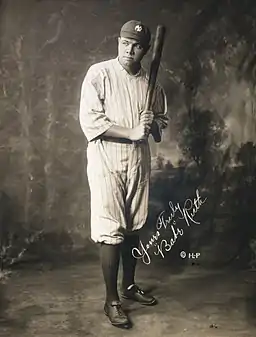 Ruth in 1920
George Herman "Babe" Ruth (February 6, 1895 – August 16, 1948) was an American professional baseball player whose career in Major League Baseball (MLB) spanned 22 seasons, from 1914 through 1935. Nicknamed "the Bambino" and "the Sultan of Swat", he began his MLB career as a star left-handed pitcher for the Boston Red Sox, but achieved his greatest fame as a slugging outfielder for the New York Yankees. Ruth is regarded as one of the greatest sports heroes in American culture and is considered by many to be the greatest baseball player of all time. In 1936, Ruth was elected into the Baseball Hall of Fame as one of its "first five" inaugural members.
At age seven, Ruth was sent to St. Mary's Industrial School for Boys, a reformatory where he was mentored by Brother Matthias Boutlier of the Xaverian Brothers, the school's disciplinarian and a capable baseball player. In 1914, Ruth was signed to play Minor League baseball for the Baltimore Orioles but was soon sold to the Red Sox. By 1916, he had built a reputation as an outstanding pitcher who sometimes hit long home runs, a feat unusual for any player in the pre-1920 dead-ball era. Although Ruth twice won 23 games in a season as a pitcher and was a member of three World Series championship teams with the Red Sox, he wanted to play every day and was allowed to convert to an outfielder. With regular playing time, he broke the MLB single-season home run record in 1919 with 29. (Full article...)
Morris Berg (March 2, 1902 – May 29, 1972) was an American catcher and coach in Major League Baseball, who later served as a spy for the Office of Strategic Services during World War II. Although he played 15 seasons in the major leagues, almost entirely for four American League teams, Berg was never more than an average player and was better known for being "the brainiest guy in baseball." Casey Stengel once described Berg as "the strangest man ever to play baseball".
A graduate of Princeton University and Columbia Law School, Berg spoke several languages and regularly read ten newspapers a day. His reputation as an intellectual was fueled by his successful appearances as a contestant on the radio quiz show Information Please, in which he answered questions about the etymology of words and names from Greek and Latin, historical events in Europe and the Far East, and ongoing international conferences. (Full article...) Rivera pitching for the Yankees in 2007
Mariano Rivera (born November 29, 1969) is a Panamanian-American former professional baseball pitcher who played 19 seasons in Major League Baseball (MLB) for the New York Yankees, from 1995 to 2013. Nicknamed "Mo" and "Sandman", he spent most of his career as a relief pitcher and served as the Yankees' closer for 17 seasons. A thirteen-time All-Star and five-time World Series champion, he is MLB's career leader in saves (652) and games finished (952). Rivera won five American League (AL) Rolaids Relief Man Awards and three Delivery Man of the Year Awards, and he finished in the top three in voting for the AL Cy Young Award four times. He was inducted into the Baseball Hall of Fame as part of its class of 2019 in his first year of eligibility, and was the first and to date only player ever to be elected unanimously by the Baseball Writers' Association of America (BBWAA).
Raised in the modest Panamanian fishing village of Puerto Caimito, Rivera was an amateur player until he was signed by the Yankees organization in 1990. He debuted in the major leagues in 1995 as a starting pitcher, before permanently converting to a relief pitcher late in his rookie year. After a breakthrough season in 1996 as a setup man, he became the Yankees' closer in 1997. In the following seasons, he established himself as one of baseball's top relievers, leading the major leagues in saves in 1999, 2001, and 2004. Rivera primarily threw a sharp-moving, mid-90s mile-per-hour cut fastball that frequently broke hitters' bats and earned a reputation as one of the league's toughest pitches to hit. With his presence at the end of games, signaled by his foreboding entrance song "Enter Sandman", Rivera was a key contributor to the Yankees' success in the late 1990s and early 2000s. An accomplished postseason performer, he was named the 1999 World Series Most Valuable Player (MVP) and the 2003 AL Championship Series MVP, and he holds several postseason records, including lowest earned run average (ERA) (0.70) and most saves (42). (Full article...)
Robert William Meusel (July 19, 1896 – November 28, 1977) was an American baseball left and right fielder who played in Major League Baseball (MLB) for eleven seasons from 1920 through 1930, all but the last for the New York Yankees. He was best known as a member of the Yankees' championship teams of the 1920s, nicknamed the "Murderers' Row", during which time the team won its first six American League (AL) pennants and first three World Series titles.
Meusel, noted for his strong outfield throwing arm, batted fifth behind Baseball Hall of Famers Babe Ruth and Lou Gehrig. In 1925, he became the second Yankee, after Ruth, to lead the AL in home runs (33), runs batted in (138) and extra base hits (79). Nicknamed "Long Bob" because of his 6-foot, 3 inch (1.91 m) stature, Meusel batted .313 or better in seven of his first eight seasons, finishing with a .309 career average; his 1,009 RBI during the 1920s were the fourth most by any major leaguer, and trailed only Harry Heilmann's total of 1,131 among AL right-handed hitters. Meusel ended his career in 1930 with the Cincinnati Reds. He hit for the cycle three times, and was the second of six major leaguers to accomplish this feat as many as three times during a career. (Full article...)_(cropped).jpg.webp) Skaggs with the Angels in 2019
Skaggs with the Angels in 2019
Tyler Wayne Skaggs (July 13, 1991 – July 1, 2019) was an American left-handed professional baseball starting pitcher who played in Major League Baseball (MLB) for the Arizona Diamondbacks and Los Angeles Angels from 2012 until his death in 2019.
A native of Woodland Hills, California, and a graduate of Santa Monica High School, Skaggs was a supplemental first-round selection for the Angels in the 2009 Major League Baseball draft. He was traded to the Diamondbacks the following year as part of an exchange for pitcher Dan Haren and rose through Arizona's farm system. After two consecutive appearances at the All-Star Futures Game in 2011 and 2012, Skaggs made his major league debut on August 22, 2012, against the Miami Marlins. He remained with the Diamondbacks through the end of the season, but was optioned to the minor leagues in 2013. In December 2013 the Diamondbacks traded Skaggs back to the Angels, and he served as the fifth member of the team's starting pitching rotation until an ulnar collateral ligament (UCL) injury and subsequent Tommy John surgery derailed his season on July 31, 2014. Despite his initial plans to begin pitching in the minor leagues by the end of the 2015 season, Skaggs did not start practicing again until the beginning of the 2016 season and returned to the Angels mound that July. Although he figured prominently in the Angels' rotation between 2017 and 2019, Skaggs continued missing large parts of each season because of injury. Through June 2019, he posted a career earned run average (ERA) of 4.41, recorded 476 strikeouts, and had a win–loss record of 28–38. (Full article...) Koufax with the Los Angeles Dodgers, c. 1965
Sanford Koufax (/ˈkoʊfæks/; born Sanford Braun; December 30, 1935) is an American former left-handed pitcher in Major League Baseball (MLB) who played his entire career for the Brooklyn/Los Angeles Dodgers from 1955 to 1966. He has been hailed as one of the greatest pitchers in baseball history. After joining the major leagues at age 19, having never pitched a game in the minor leagues, the first half of his career was marred with inconsistancy and control problems, posting a record of just 36–40 with a 4.10 ERA; he was a member of World Series champions in both Brooklyn and Los Angeles, though he did not appear in any of the team's Series wins despite pitching brilliantly in the 1959 series. After making adjustments prior to the 1961 season to improve his control and getting more regular playing time, Koufax quickly rose to become the most dominant pitcher in Major League Baseball before arthritis in his left elbow ended his career prematurely at age 30.
Koufax was an All-Star in each of his last six seasons, leading the National League (NL) in ERA each of his last five years, in strikeouts four times, in wins and shutouts three times each, and in winning percentage, innings pitched and complete games twice each; he was the first NL pitcher in 20 years to post an ERA below 2.00, doing so three times. After setting a modern NL record in 1961 with 269 strikeouts, in 1963 he became the first pitcher in 17 years and the first left-hander since 1904 to strike out 300 batters. In 1965 he set a major league record with 382 strikeouts; it was broken in 1973 by Nolan Ryan, but remains the top mark for NL pitchers and left-handers. He was the first pitcher to record 300 strikeouts three times, and set a record with 97 games of at least 10 strikeouts, also later broken by Ryan; he twice tied a modern record by striking out 18 batters in a game. Koufax won the Cy Young Award in 1963, 1965 and 1966 by unanimous votes, winning the Triple Crown and leading the Dodgers to a pennant each year; he was the first three-time winner of the award, and the only pitcher to do so when a single award was given instead of one for each league. He was also named the NL Most Valuable Player (MVP) in 1963, and was runner-up for the award the other two years. (Full article...)_(cropped).jpg.webp) Johnson in 2022
Johnson in 2022
Earvin "Magic" Johnson Jr. (born August 14, 1959) is an American former professional basketball player. He is often regarded as the greatest point guard of all-time. Johnson played 13 seasons in the National Basketball Association (NBA). After winning a national championship with Michigan State in 1979, Johnson was selected first overall in the 1979 NBA draft by the Los Angeles Lakers, leading the team to five NBA championships during their Showtime era. Johnson retired abruptly in 1991 after announcing that he had contracted HIV, but returned to play in the 1992 All-Star Game, winning the All-Star MVP Award. After protests from his fellow players, he retired again for four years, but returned in 1996, at age 36, to play 32 games for the Lakers before retiring for the third and final time.
Johnson's career achievements include three NBA MVP Awards, three NBA Finals Most Valuable Player Awards, nine NBA Finals appearances, 12 All-Star games, and nine All-NBA First Team selections. He led the league in regular season assists four times, and is the NBA's all-time leader in average assists per game in both the regular season (11.19 assists per game) and the playoffs (12.35 assists per game). He also holds the record for most career assists in the playoffs. Johnson was a member of the 1992 United States men's Olympic basketball team ("The Dream Team"), which won the Olympic gold medal in Barcelona. After leaving the NBA in 1991, Johnson formed the Magic Johnson All-Stars, a barnstorming team that traveled around the world playing exhibition games. (Full article...)- The 2009 World Series was the championship series of Major League Baseball's (MLB) 2009 season. As the 105th edition of the World Series, it was a best-of-seven playoff contested between the Philadelphia Phillies, champions of the National League (NL) and defending World Series champions, and the New York Yankees, champions of the American League (AL). The Yankees defeated the Phillies, 4 games to 2, winning their 27th World Series championship.
The series was played between October 28 and November 4, broadcast on Fox, and watched by an average of roughly 19 million viewers. Home field advantage for the Series went to the AL for the eighth straight year as a result of its 4–3 win in the All-Star Game. The Phillies earned their berth into the playoffs by winning the National League East. The Yankees won the American League East to earn their berth, posting the best record in the Major Leagues. The Phillies reached the World Series by defeating the Colorado Rockies in the best-of-five National League Division Series and the Los Angeles Dodgers in the best-of-seven NL Championship Series (NLCS). The Yankees defeated the Minnesota Twins in the American League Division Series and the Los Angeles Angels of Anaheim in the AL Championship Series (ALCS) to advance to their first World Series since 2003. As a result of their loss, the Phillies became the first team since the 2001 Yankees to lose the World Series after winning it the previous year. As of 2022, this is the most recent World Series to feature a defending champion. (Full article...)  Feller in 1996
Robert William Andrew Feller (November 3, 1918 – December 15, 2010), nicknamed "the Heater from Van Meter", "Bullet Bob", and "Rapid Robert", was an American baseball pitcher who played 18 seasons in Major League Baseball (MLB) for the Cleveland Indians between 1936 and 1956. In a career spanning 570 games, Feller pitched 3,827 innings and posted a win–loss record of 266–162, with 279 complete games, 44 shutouts, and a 3.25 earned run average (ERA). His career 2,581 strikeouts were third all-time upon his retirement.
A prodigy who bypassed baseball's minor leagues, Feller made his debut with the Indians at the age of 17. His career was interrupted by four years of military service (1942–1945) as a United States Navy Chief Petty Officer aboard USS Alabama during World War II. Feller became the first pitcher to win 24 games in a season before the age of 21. He threw no-hitters in 1940, 1946, and 1951, and 12 one-hitters, both records at his retirement. He helped the Indians win a World Series title in 1948 and an American League-record 111 wins and the pennant in 1954. Feller led the American League in wins six times and in strikeouts seven times. In 1946 he recorded 348 strikeouts, the most since 1904 and then believed to be a record. (Full article...)- William Derrick Bates (born December 7, 1963) is an American former professional baseball second baseman and pinch runner who played in Major League Baseball (MLB) for the Milwaukee Brewers and the Cincinnati Reds. In 29 career games, Bates had a batting average of .125 with six hits, two runs batted in (RBI), 11 runs, and eight stolen bases. Though his defensive position was at second base, the Reds primarily used Bates as a pinch runner. After he scored the winning run in Game 2 of the 1990 World Series, Bates never played in MLB again.
Born in Houston, Bates attended the University of Texas and, in his freshman season, won the 1983 College World Series as a part of the Texas Longhorns baseball team. For the next two seasons, Bates was named to the College Baseball All-America Team, a team composed of the best collegiate baseball athletes in America. Drafted by Milwaukee in the fourth round of the 1985 MLB draft, he rose through the Brewers' farm system helping several of his minor league teams win their respective league titles. He made his MLB debut in 1989, after Milwaukee's starting second baseman Jim Gantner was injured. A trade in 1990 sent Bates to Cincinnati, where the Reds used him primarily as a pinch runner at the end of the regular season and into the postseason. Facing the Oakland Athletics in the World Series, Bates reached base on a pinch hit single against Dennis Eckersley and later scored the winning run in Game 2 as the Reds swept the Athletics four games to none. Following the World Series championship, the Reds re-signed Bates on a one-year contract, and he played for their Triple-A team. He spent the next year with the Chicago Cubs Triple-A affiliate, and last played exhibition baseball in 1995. After retiring, he worked as an equipment supplier in the oil and gas industry in Houston. (Full article...) .jpg.webp) Jeter in 2017
Jeter in 2017
Derek Sanderson Jeter (/ˈdʒiːtər/ JEE-tər; born June 26, 1974) is an American former professional baseball shortstop, businessman, and baseball executive. As a player, Jeter spent his entire 20-year Major League Baseball (MLB) career with the New York Yankees. He was elected to the Baseball Hall of Fame in his first year of eligibility in 2020; he received 396 of 397 possible votes (99.75%), the second-highest percentage in MLB history (behind only teammate Mariano Rivera) and the highest by a position player. He was the chief executive officer (CEO) and part owner of the league's Miami Marlins from September 2017 to February 2022.
A five-time World Series champion with the Yankees, Jeter is regarded as a central contributor to the franchise's dynasty during the late 1990s and early 2000s for his hitting, base-running, fielding, and leadership. He is the Yankees' all-time career leader in hits (3,465), doubles (544), games played (2,747), stolen bases (358), times on base (4,716), plate appearances (12,602) and at bats (11,195). His accolades include 14 All-Star selections, five Gold Glove Awards, five Silver Slugger Awards, two Hank Aaron Awards, and a Roberto Clemente Award. Jeter was the 28th player to reach 3,000 hits and finished his career ranked sixth in MLB history in career hits and first among shortstops. In 2017, the Yankees retired his uniform number 2. (Full article...)- Mookie Betts hits a pitch by swinging his bat
Baseball is a bat-and-ball sport played between two teams of nine players each, taking turns batting and fielding. The game occurs over the course of several plays, with each play generally beginning when a player on the fielding team, called the pitcher, throws a ball that a player on the batting team, called the batter, tries to hit with a bat. The objective of the offensive team (batting team) is to hit the ball into the field of play, away from the other team's players, allowing its players to run the bases, having them advance counter-clockwise around four bases to score what are called "runs". The objective of the defensive team (referred to as the fielding team) is to prevent batters from becoming runners, and to prevent runners' advance around the bases. A run is scored when a runner legally advances around the bases in order and touches home plate (the place where the player started as a batter).
The principal objective of the batting team is to have a player reach first base safely; this generally occurs either when the batter hits the ball and reaches first base before an opponent retrieves the ball and touches the base, or when the pitcher persists in throwing the ball out of the batter's reach. Players on the batting team who reach first base without being called "out" can attempt to advance to subsequent bases as a runner, either immediately or during teammates' turns batting. The fielding team tries to prevent runs by getting batters or runners "out", which forces them out of the field of play. The pitcher can get the batter out by throwing three pitches which result in strikes, while fielders can get the batter out by catching a batted ball before it touches the ground, and can get a runner out by tagging them with the ball while the runner is not touching a base. (Full article...)
General images -
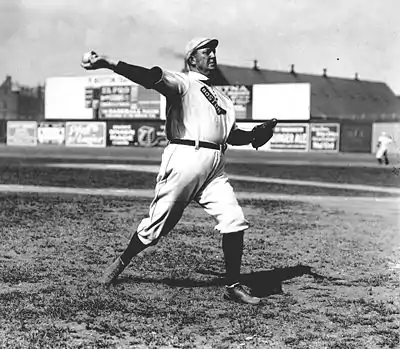 Cy Young—the holder of many major league career marks, including wins and innings pitched, as well as losses—in 1908. MLB's annual awards for the best pitcher in each league are named for Young. (from Baseball)
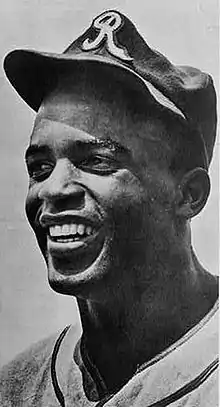 Jackie Robinson in 1945, with the era's Kansas City Royals, a barnstorming squad associated with the Negro American League's Kansas City Monarchs (from Baseball)
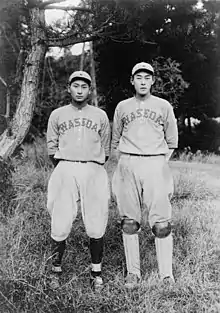 Two players on the baseball team of Tokyo, Japan's Waseda University in 1921 (from Baseball)
_in_the_Cantigas_de_Santa_Maria.jpg.webp) A game from the Cantigas de Santa Maria, c. 1280, involving tossing a ball, hitting it with a stick and competing with others to catch it (from History of baseball)
A game from the Cantigas de Santa Maria, c. 1280, involving tossing a ball, hitting it with a stick and competing with others to catch it (from History of baseball).jpg.webp) Cover of Official Base Ball Rules, 1921 edition, used by the American League and National League (from Baseball rules)
Cover of Official Base Ball Rules, 1921 edition, used by the American League and National League (from Baseball rules)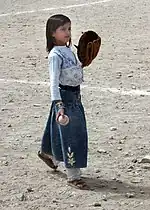 An Afghan girl playing baseball in August 2002 (from Baseball)
- Jackie Robinson in 1945, with the era's Kansas City Royals, a barnstorming squad associated with the Negro American League's Kansas City Monarchs (from History of baseball)
 In May 2010, the Philadelphia Phillies' Roy Halladay pitched the 20th major league perfect game. That October, he pitched only the second no-hitter in MLB postseason history. (from History of baseball)
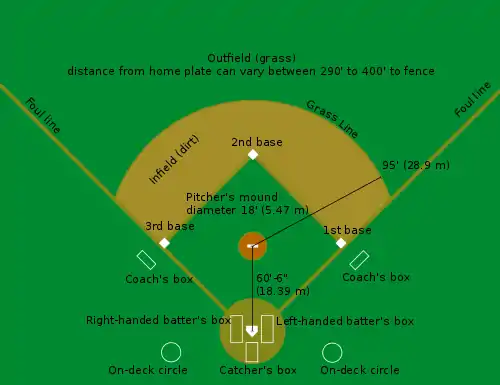 Diagram of a baseball field Diamond may refer to the square area defined by the four bases or to the entire playing field. The dimensions given are for professional and professional-style games. Children often play on smaller fields. (from Baseball)
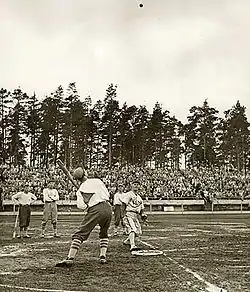 Pesäpallo, a Finnish variation of baseball, was invented by Lauri "Tahko" Pihkala in the 1920s, and after that, it has changed with the times and grown in popularity. Picture of Pesäpallo match in 1958 in Jyväskylä, Finland. (from Baseball)
.jpg.webp) Alexander Cartwright, father of modern baseball (from History of baseball)
Alexander Cartwright, father of modern baseball (from History of baseball)_(LOC).jpg.webp) The NL champion New York Giants baseball team, 1913. Fred Merkle, sixth in line, had committed a baserunning gaffe in a crucial 1908 game that became famous as Merkle's Boner. (from History of baseball)
The NL champion New York Giants baseball team, 1913. Fred Merkle, sixth in line, had committed a baserunning gaffe in a crucial 1908 game that became famous as Merkle's Boner. (from History of baseball)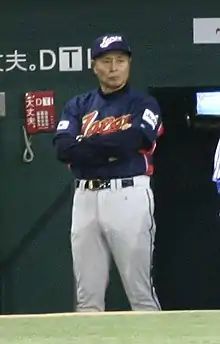 Sadaharu Oh managing the Japan national team in the 2006 World Baseball Classic. Playing for the Central League's Yomiuri Giants (1959–80), Oh set the professional world record for home runs with 868. (from History of baseball)
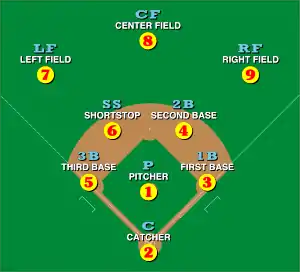 Defensive positions on a baseball field, with abbreviations and scorekeeper's position numbers (not uniform numbers) (from Baseball)
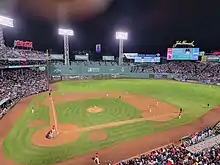 Fenway Park, home of the Boston Red Sox. The Green Monster is visible beyond the playing field on the left. (from Baseball)
- Sadaharu Oh managing the Japan national team in the 2006 World Baseball Classic. Playing for the Central League's Yomiuri Giants (1959–80), Oh set the professional world record for home runs. (from Baseball)
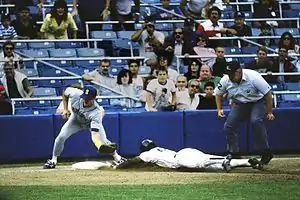 Rickey Henderson—the major leagues' all-time leader in runs and stolen bases—stealing third base in a 1988 game (from Baseball)
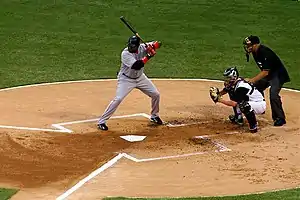 David Ortiz, the batter, awaiting a pitch, with the catcher and umpire (from Baseball)
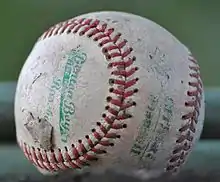 A well-worn baseball (from Baseball)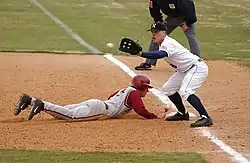
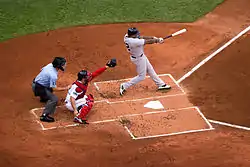 A New York Yankees batter (Andruw Jones) and a Boston Red Sox catcher at Fenway Park (from Baseball)
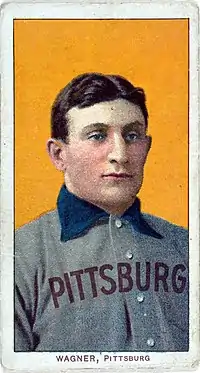 The American Tobacco Company's line of baseball cards featured shortstop Honus Wagner of the Pittsburgh Pirates from 1909 to 1911. In 2007, the card shown here sold for $2.8 million. (from Baseball)
 Good articles -
 Ross with the San Francisco Giants in 2011
Cody Joseph Ross (born December 23, 1980), nicknamed "Toy Cannon" and "Ross the Boss," is an American former professional baseball outfielder. He played in Major League Baseball (MLB) for 12 seasons with the Detroit Tigers (2003), Los Angeles Dodgers (2005–2006), Cincinnati Reds (2006), Florida Marlins (2006–2010), San Francisco Giants (2010–2011), Boston Red Sox (2012), Arizona Diamondbacks (2013–2014) and Oakland Athletics (2015). Ross won a World Series with the San Francisco Giants in 2010. He is one of the few Major League players to bat right-handed and throw left-handed.
Following high school, Ross embarked on his professional career, getting selected by the Detroit Tigers in the fourth round of the 1999 Major League Baseball draft. He reached the Major Leagues in 2003, but suffered a torn ACL which caused him to miss most of September. He was traded to the Los Angeles Dodgers following spring training in 2004, appearing in a handful of games with them in 2005. In 2006, he played for the Los Angeles Dodgers, the Cincinnati Reds, and the Florida Marlins. It was in Florida that he finally established himself, as he played with the Marlins through 2010. He was used mainly as a reserve outfielder in 2006 and 2007, but during the 2008 season he took over a starting role. He would be a starting outfielder for the rest of his Marlins career, playing centerfield or right field. In 2009, he hit a career-high 24 home runs and won the Marlins' Charlie Hough Good Guy award. (Full article...) Cain in 2011
Matthew Thomas Cain (born October 1, 1984), nicknamed "The Horse", "Big Daddy", "Big Sugar" and "Cainer", is an American former professional baseball pitcher who played his entire Major League Baseball (MLB) career for the San Francisco Giants from 2005 to 2017. A two-time World Series champion and a three-time All-Star, he is widely regarded as a central figure of the Giants' success in the 2010s for his pitching and leadership.
The Giants drafted Cain out of high school in 2002, and he made his MLB debut at age 20 in 2005, becoming the youngest player in the National League (NL) that year. In 2009, Cain was named to his first career All-Star Game and won the Willie Mac Award. During the 2010 MLB postseason, he did not allow an earned run in any of the three playoff games he pitched in as the Giants won their first World Series since 1954. In 2012, Cain signed a contract extension that, at the time, gave him the most lucrative contract ever received by a right-handed pitcher in major league history. Cain threw the 22nd perfect game in big league history on June 13, 2012. He had a 16–5 record during the 2012 regular season, finishing sixth in NL Cy Young Award voting. During the Giants' playoff run that led to their victory in the 2012 World Series, the team won every series-clinching playoff game that Cain started. Cain ended his pitching career in 2017. (Full article...).jpg.webp) Moore with the Detroit Tigers in 2019
Moore with the Detroit Tigers in 2019
Matthew Cody Moore (born June 18, 1989) is an American professional baseball pitcher for the Los Angeles Angels of Major League Baseball (MLB). He has previously played in MLB for the Tampa Bay Rays, San Francisco Giants, Texas Rangers, Detroit Tigers and Philadelphia Phillies and in Nippon Professional Baseball (NPB) for the Fukuoka SoftBank Hawks.
Born in Fort Walton Beach, Florida, Moore's family moved to Okinawa when he was seven and Edgewood, New Mexico in 2000. Although he had committed to play college baseball with the University of New Mexico, Moore chose to sign a professional contract with the Rays after they selected him in the 2007 MLB draft. He set multiple strikeout records for the Rays' farm system before making his major league debut in 2011. Moore spent two full seasons with the Rays before Tommy John surgery caused him to miss the 2014 season. He returned in 2015, and was traded to the Giants the following year. (Full article...)- "All the Way" (also known as "(Someday We'll Go) All the Way" and referred to as "Go All the Way") is a song written and performed by Evanston, Illinois native and Pearl Jam vocalist Eddie Vedder about the Chicago Cubs. It was first performed in public on August 2, 2007, recorded on August 21, 2008 and August 22, 2008, and released as a single on September 18, 2008.
At the time of the song's release in 2008, it had been 100 years since the Cubs had last won the World Series. Vedder has been a lifelong Cubs fan. The song, which fondly looks forward to the Cubs' next World Series victory, was written with the encouragement of certain Chicago Cubs, most notably Ernie Banks. The song was first performed in Chicago and was recorded over two nights in 2008 at the end Vedder's first solo tour. The song was accompanied by an official video release by the team following their victory in the 2016 World Series. (Full article...) _(51105526639)_(cropped).jpg.webp) Sandoval with the Atlanta Braves in 2021
Sandoval with the Atlanta Braves in 2021
Pablo Emilio Sandoval Reyes (born August 11, 1986) is a Venezuelan-American professional baseball third baseman for the Olmecas de Tabasco of the Mexican League. He previously played in Major League Baseball (MLB) for the San Francisco Giants, Boston Red Sox, and Atlanta Braves. He stands 5 feet 10 inches (1.78 m) tall, and weighs 268 pounds (122 kg). Nicknamed "Kung Fu Panda", Sandoval is a two-time All-Star and has won three World Series championships with the Giants. He hit three home runs in Game 1 of the 2012 World Series, becoming the fourth player to hit three home runs in a World Series game, leading to his being named that year's World Series Most Valuable Player (MVP). During the offseason, Sandoval plays for the Navegantes del Magallanes of the Venezuelan Professional Baseball League (VPBL).
In 2002, Sandoval was signed by the San Francisco Giants. Sandoval worked his way through the minor leagues and debuted with the Giants in 2008, batting .345 in 41 games. Capable of playing first base, third base, and catcher, he became the Giants' starting third baseman in 2009, ceasing to catch that year and playing first base only occasionally. In 2009, Sandoval finished second in All-Star Final Vote balloting, batting .330 with 25 home runs and 90 runs batted in (RBIs) in his first full season in the majors. However, Sandoval struggled in 2010 and was benched during the playoffs for the 2010 World Series, which the Giants won. He lost weight before 2011 and hit .315 with 23 home runs in 117 games. Injuries limited Sandoval to 109 games in 2012, but he was selected to his second-straight All-Star Game. Then, in Game 1 of the 2012 World Series, Sandoval joined Babe Ruth, Reggie Jackson, and Albert Pujols as the only players to hit three home runs in a World Series Game. For his contributions, Sandoval was named the World Series Most Valuable Player, as the Giants swept the Detroit Tigers. In 2013, he appeared in 141 games, batting .278, with 14 home runs, and 79 RBIs. (Full article...)
August Rodney Mancuso (December 5, 1905 – October 26, 1984), nicknamed "Blackie", was an American professional baseball player, coach, scout and radio sports commentator. He played as a catcher in Major League Baseball with the St. Louis Cardinals (1928, 1930–32, 1941–42), New York Giants (1933–38, 1942–44), Chicago Cubs (1939), Brooklyn Dodgers (1940) and Philadelphia Phillies (1945).
Mancuso was known for his capable handling of pitching staffs and for his on-field leadership abilities. He was a member of five National League pennant-winning teams, and played as the catcher for five pitchers who were eventually inducted into the Baseball Hall of Fame. Mancuso was regarded as one of the top defensive catchers of the 1930s. (Full article...).jpg.webp)
Since 1976, the New York Yankees of Major League Baseball (MLB) have maintained a strict appearance policy, specifying that players' hair must not touch their collars and that they may have mustaches but no other facial hair. The policy came from then-franchise owner George Steinbrenner, who believed that regulating his players' appearance would instill a sense of discipline. Steinbrenner began noting which players he believed needed haircuts when he took over the Yankees in 1973, but the policy was not codified until three years later. Steinbrenner's policy remains in place after his death, and has led to a number of dramatic appearances changes for players who come to the Yankees from other teams, such as Oscar Gamble, as well as pushback from players who prefer long hair and beards. In 1991, Don Mattingly was taken off of the Yankees' lineup for a day when he refused to cut his hair.
Most teams did not formally adopt any grooming or personal appearance policies until the 1970s, as earlier social customs meant that players were generally clean-shaven. This changed in 1972, when members of the Oakland Athletics, led by Reggie Jackson, formed The Mustache Gang. After that point, individual managers began to tighten or relax their teams' grooming standards as they saw fit. Steinbrenner's policy was inspired by that of the Cincinnati Reds, who forbid their players from growing facial hair between 1967 and 1999, when Greg Vaughn petitioned Marge Schott to rescind the rule. Former Yankees Mattingly and Joe Girardi have twice attempted to institute a similar policy on the Florida/Miami Marlins, but restrictions on that team have since loosened. (Full article...)- Raymond Harvey (3 January 1926 – 6 January 2011) was an Australian former first-class cricketer who played for Victoria in the 1940s and 1950s. He was the brother of Australian Test batsmen Merv and Neil and first-class cricketer and umpire Mick Harvey. Ray Harvey was an attacking and talented batsman but failed to reach international standards and only managed to hold down a regular position in the Victorian team in two seasons in the 1950s. This failure to match the standards set by his Test-capped brothers was often attributed to a lack of single-mindedness and hunger.
Harvey was born into a working-class, devoutly Methodist family. His father was a keen amateur cricketer and an instilled a love of the game in his six sons, all of whom played for Fitzroy in Victorian Premier Cricket. Harvey made his first class debut in the middle of the 1947–48 season, and played his first two matches for Victoria alongside his more decorated brothers Merv and Neil. However, he performed poorly and did not play a match in the following summer and for the two subsequent seasons, he played in only three games but contributed little to his team's cause. In 1951–52 he made five appearances, gaining selection only when Victoria's Test players were busy representing Australia. The following season, he gained selection for the last three matches and broke through for his maiden first-class century, having never previously passed 50. (Full article...)  "Brains" Padden in South Side Park, Chicago, 1905.
Richard Joseph Padden (September 17, 1870 – October 31, 1922), nicknamed "Brains", was an American professional baseball player, born in Wheeling, West Virginia, who played mainly as a second baseman in Major League Baseball for nine seasons from 1896 to 1905.
After playing a season and a half in the minor leagues, the right-handed infielder began his major league career for the Pittsburgh Pirates. He played three seasons in Pittsburgh, from 1896 to 1898, before playing one season for the Washington Senators in 1899. He returned to the minor leagues for the 1900 season, where he was the player-manager for the Chicago White Sox, then a minor league team. When the Chicago club entered the American League, a major league, the following season, he moved on to play one season for the St. Louis Cardinals, before becoming Captain of the St. Louis Browns from 1902 and 1905. In total, Padden played in 874 games, and collected 814 hits in 3545 at bats, for a lifetime batting average of .258. He finished in the league's top-ten finishers in being hit by pitches six times, including a league-leading 18 in 1904. (Full article...) Etelman in 1925
Carl Edward Etelman (April 1, 1900 – December 18, 1963) was an American football back and coach. After playing college football at Tufts University in Massachusetts, he played semi-professional football for the independent St Alphonsus Athletic Association from 1924 to 1926. He also played professionally in the American Football League (AFL) and National Football League (NFL) for the Boston Bulldogs and Providence Steam Roller, before returning to the semi-pro ranks with the Fitton Athletic Club, where he spent three seasons. After his playing career, Etelman coached the Whitman High School football team in Massachusetts for 18 years, and also coached the semi-professional Old Town team of Abington for two years. (Full article...).jpg.webp) Asche with the Phillies in 2015
Asche with the Phillies in 2015
Cody James Asche (/ˈæʃiː/ ASH-ee; born June 30, 1990) is an American professional baseball coach and former third baseman and left fielder. He played in Major League Baseball (MLB) for the Philadelphia Phillies and Chicago White Sox.
After growing up in O'Fallon, Missouri, Asche attended the University of Nebraska, where he played college baseball for the Nebraska Cornhuskers, majored in economics, and achieved recognition for both his athletic and academic performance. (Full article...) Balester with the Washington Nationals
Collin Thomas Balester (born June 6, 1986) is an American former professional baseball pitcher. He played in Major League Baseball (MLB) from 2008 to 2015 for the Washington Nationals, Detroit Tigers, and Cincinnati Reds. Balester has also played for the Samsung Lions of the KBO League.
Balester grew up in Huntington Beach, California, the son of a surfboard maker. He was drafted by the Montreal Expos in 2004, making his professional debut that year. By 2007, he was considered a top prospect for the newly relocated Nationals, with him participating in that season's All-Star Futures Game. On July 1, 2008, he made his MLB debut with the Nationals. He won his debut as a starter, becoming the first Expo or National to do so since 1999. That season, he went on to make 14 starts for Washington, recording a 5.51 earned run average (ERA). In 2009, Balester split the year between the Triple-A Syracuse Chiefs and Washington, making a combined 27 starts. Balester was converted into a relief pitcher in 2010, after struggling with Syracuse at the beginning of the year. In both 2010 and 2011, he would continue to split time between Syracuse and Washington. The Nationals traded Balester to Detroit on December 9, 2011, for pitcher Ryan Perry. (Full article...) Harvey in 1950
Robert Neil Harvey OAM MBE (born 8 October 1928) is an Australian former cricketer who was a member of the Australian cricket team between 1948 and 1963, playing in 79 Test matches. He was the vice-captain of the team from 1957 until his retirement. An attacking left-handed batsman, sharp fielder and occasional off-spin bowler, Harvey was the senior batsman in the Australian team for much of the 1950s and was regarded by Wisden as the finest fielder of his era. Upon his retirement, Harvey was the second-most prolific Test run-scorer and century-maker for Australia.
One of six cricketing brothers, four of whom represented Victoria, Harvey followed his elder brother Merv into Test cricket and made his debut in January 1948, aged 19 and three months. In his second match, he became the youngest Australian to score a Test century, a record that still stands. Harvey was the youngest member of the 1948 Invincibles of Don Bradman to tour England, regarded as one of the finest teams in history. After initially struggling in English conditions, he made a century on his Ashes debut. Harvey started his career strongly, with six centuries in his first thirteen Test innings at an average over 100, including four in 1949–50 against South Africa, including a match-winning 151 not out on a sticky wicket. As Bradman's team broke up in the 1950s due to retirements, Harvey became Australia's senior batsman, and was named as one of the Wisden Cricketers of the Year in 1954, in recognition of his feat in scoring more than 2,000 runs during the 1953 tour of England. (Full article...)- The Double was a double hit by the Seattle Mariners' Edgar Martínez in Game 5 of Major League Baseball's 1995 American League Division Series on October 8, 1995. Trailing by one run in the bottom half of the 11th inning, with Joey Cora on third base and Ken Griffey Jr. on first, Martinez's hit drove in Cora and Griffey, giving the Mariners a 6–5 victory over the New York Yankees to clinch the series, 3–2. The play is held to be the "biggest hit in franchise history".
Amid rumors that the team would be sold and/or relocated, the Mariners—who had produced only two winning seasons (1991 and 1993) since beginning play in 1977—mounted a late-season comeback in 1995 to clinch their first postseason appearance in franchise history. They then mounted a series of comebacks in the ALDS, first overcoming a 2-game series deficit to force a deciding Game 5, then tying Game 5 in the 8th inning to force extra innings, and finally a one-run 11th inning deficit that was overcome by the Double. (Full article...) - Harry Hamlet East (April 12, 1862 – June 1, 1905) was an American professional baseball player who played in one game at third base for the Baltimore Orioles of the American Association in 1882. A St. Louis native, he was hitless in four at bats as the Orioles lost 10–5 to the St. Louis Browns at Sportsman's Park. He played two seasons of Minor league baseball as well, then became a doctor. After being admitted to a hospital with melancholia in 1905, East slit his throat with a straight razor, committing suicide at the age of 43. (Full article...)
Did you know (auto-generated) -

- ... that Amanda Asay was the longest-serving member of the Canadian women's baseball team when she died at 33, having played on the team for sixteen years?
- ... that Helen Dettweiler cofounded the LPGA, was a cryptographer and B-17 pilot during World War II, and became the first female broadcaster in baseball?
- ... that Didi Gregorius tweets after every game his baseball team wins, and has dedicated emojis for his teammates?
- ... that Harry Harper refused to play baseball on Sundays?
- ... that Helene Hathaway Britton, the first woman to own a Major League Baseball team, was unsuccessfully pressured by other club owners to sell the team?
- ... that after getting drunk and verbally abusing Cap Anson at a baseball game during his off day, Charlie Bartson was released from the Chicago Pirates?
- ... that Tyler Gilbert threw a no-hitter in his first Major League Baseball start?
- ... that Barack Obama was once gifted a baseball glove belonging to Tampa Bay Rays pitcher Matt Moore?
Quotes
Featured lists -
 Mike Scioscia (1976) won championships with the Dodgers in 1981 and 1988.
The Los Angeles Dodgers are a Major League Baseball (MLB) franchise based in Los Angeles, California. They play in the National League West division. Since the institution of MLB's Rule 4 Draft, the Dodgers have selected 64 players in the first round. Officially known as the "First-Year Player Draft", the Rule 4 Draft is MLB's primary mechanism for assigning players from high schools, colleges, and other amateur clubs to its franchises. The draft order is determined based on the previous season's standings, with the team possessing the worst record receiving the first pick. In addition, teams which lost free agents in the previous off-season may be awarded compensatory or supplementary picks.
Of the 66 players picked in the first round by Los Angeles, 37 have been pitchers, the most of any position; 24 of these were right-handed, while 12 were left-handed. Nine players at shortstop and eight in the outfield were selected, while five catchers, three first basemen, and three third basemen were taken as well. The team also selected two players at second base. Seven of the players came from high schools or universities in the state of Texas, while California follows with six players. (Full article...) Barry Bonds joined the 30–30 club in five seasons, a record he shares with his father Bobby.
In Major League Baseball (MLB), the 30–30 club is the group of batters who have collected thirty home runs and thirty stolen bases in a single season. Ken Williams was the first to achieve this, doing so in 1922. He remained the sole member of the club for 34 years until Willie Mays achieved consecutive 30–30 seasons in 1956 and 1957. Bobby Bonds became the club's fourth member in 1969 and became the first player in MLB history to reach the 30–30 club on three occasions and ultimately on five occasions, subsequently achieving the milestone in 1973, 1975, 1977 and 1978. He remained the only player to accomplish this until 1997, when his son Barry Bonds achieved his fifth 30–30 season. The most recent player to reach the milestone is Cedric Mullins, who achieved the feat during the 2021 season.
In total, 43 players have reached the 30–30 club in MLB history and thirteen have done so more than once. Of these 43 players, 29 were right-handed batters, nine were left-handed and five were switch hitters, meaning they could bat from either side of the plate. Eight of these players (including four active members of the 30–30 club) have played for only one major league team. The Atlanta Braves, Cincinnati Reds, Cleveland Indians, Colorado Rockies, New York Mets, and San Francisco Giants are the only franchises to have three players reach the milestone. Five players – Hank Aaron, Barry Bonds, Willie Mays, Alex Rodriguez and Sammy Sosa – are also members of the 500 home run club, and Aaron, Mays and Rodriguez are also members of the 3,000 hit club. Dale Murphy, Jose Canseco, Barry Bonds, Larry Walker, Jimmy Rollins, Ryan Braun and Mookie Betts won the Most Valuable Player (MVP) Award in the same year as their 30–30 season, with Bonds achieving this on two occasions (1990 and 1992). Both Mays and Rollins also reached the 20–20–20 club in the same season. Four players accomplished 30–30 seasons in 1987, 1996, 1997 and 2011, the most in a single season. (Full article...) Jake Peavy, the Opening Day starting pitcher 2006–09
The San Diego Padres are a Major League Baseball (MLB) team based in San Diego, California. The Padres currently compete in the National League (NL) West division. The Padres first played their home games at San Diego Stadium, now called Qualcomm Stadium, and formerly called Jack Murphy Stadium, until 2003, when they moved into Petco Park. The first game of the new baseball season for a team is played on Opening Day, and being named the Opening Day starter is an honor, which is often given to the player who is expected to lead the pitching staff that season, though there are various strategic reasons why a team's best pitcher might not start on Opening Day. The Padres have used 24 different Opening Day starting pitchers in their 42 seasons. The 24 starters have a combined Opening Day record of 15 wins, 14 losses and 13 no decisions. No decisions are only awarded to the starting pitcher if the game is won or lost after the starting pitcher has left the game.
The Padres' first Opening Day starting pitcher was Dick Selma, who received a win against the Houston Astros. Randy Jones, Eric Show and Jake Peavy tie the Padres' record for most Opening Day starts with four. Peavy has the most consecutive Opening Day starts with four (2006–2009). Jones and Andy Benes each have had three consecutive Opening Day starts. Benes has the most consecutive Opening Day losses with three from 1993 to 1995. (Full article...) Cy Young is the all-time leader in wins.
In Major League Baseball, the 300-win club is the group of pitchers who have won 300 or more games. Twenty-four pitchers have reached this milestone. This list does not include Bobby Mathews who won 297 in the major leagues plus several more in 1869 and 1870 before the major leagues were established in 1871. The San Francisco Giants are the only franchise to see four players reach 300 wins while on their roster: Tim Keefe in the Players' League, Christy Mathewson and Mickey Welch while the team was in New York, and most recently Randy Johnson. Early in the history of professional baseball, many of the rules favored the pitcher over the batter; the distance pitchers threw to home plate was shorter than today, and pitchers were able to use foreign substances to alter the direction of the ball. Moreover, pitchers started games far more frequently than modern pitchers do; in the second half of the 1884 season Old Hoss Radbourne started every other game. The first player to win 300 games was Pud Galvin in 1888. Seven pitchers recorded all or the majority of their career wins in the 19th century: Galvin, Cy Young, Kid Nichols, Keefe, John Clarkson, Charles Radbourn, and Welch. Four more pitchers joined the club in the first quarter of the 20th century: Mathewson, Walter Johnson, Eddie Plank, and Grover Cleveland Alexander. Young is the all-time leader in wins with 511, a mark that is considered unbreakable. If a modern-day pitcher won 20 games per season for 25 seasons, he would still be 11 games short of Young's mark.
Only three pitchers—Lefty Grove, Warren Spahn, and Early Wynn—joined the 300-win club between 1924 and 1982, which may be explained by a number of factors: the abolition of the spitball; World War II military service, such as Bob Feller's; and the growing importance of the home run in the game. As the home run became commonplace, the physical and mental demands on pitchers dramatically increased, which led to the use of a four-man starting rotation. Between 1982 and 1990, the 300-win club gained six members: Gaylord Perry, Phil Niekro, Steve Carlton, Nolan Ryan, Don Sutton, and Tom Seaver. These pitchers benefited from the increased use of specialized relief pitchers, an expanded strike zone, and new stadiums, including Shea Stadium, Dodger Stadium and the Astrodome, that were pitcher's parks, which suppressed offensive production. Also, the increasing sophistication of training methods and sports medicine - such as Tommy John surgery - allowed players to maintain a high competitive level for a longer time. Randy Johnson, for example, won more games in his 40s than he did in his 20s. (Full article...)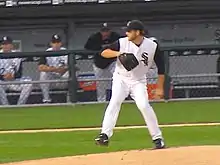 Mark Buehrle has made nine Opening Day starts for the Chicago White Sox, including in 2010.
The Chicago White Sox are a Major League Baseball franchise based in Chicago. They play in the American League Central division. The White Sox have used 62 Opening Day starting pitchers since they were established as a Major League team in 1901. The first game of the new baseball season for a team is played on Opening Day, and being named the Opening Day starter is an honor, which is often given to the player who is expected to lead the pitching staff that season, though there are various strategic reasons why a team's best pitcher might not start on Opening Day. The White Sox have a record of 60 wins and 53 losses in their Opening Day games, through the 2013 season.
The White Sox have played in three different home ball parks. They played at South Side Park from 1901 through the middle of 1910, the first Comiskey Park from 1910 through 1990, and have played at the second Comiskey Park, now known as U.S. Cellular Field, since 1991. They had a record of four wins and two losses in Opening Day games at South Side Park, 18 wins and 19 losses at the first Comiskey Park and four wins and one loss at U.S. Cellular Field, for a total home record in Opening Day games of 27 wins and 22 losses. Their record in Opening Day away games is 33 wins and 31 losses. (Full article...) Brian Jordan (1988) was the Cardinals' first supplemental draft pick.
The St. Louis Cardinals are a Major League Baseball (MLB) franchise based in St. Louis, Missouri. They play in the National League Central division. Since the institution of MLB's Rule 4 Draft, the Cardinals have selected 77 players in the first round. Officially known as the "First-Year Player Draft", the Rule 4 Draft is MLB's primary mechanism for assigning amateur baseball players from high schools, colleges, and other amateur baseball clubs to its teams. The draft order is determined based on the previous season's standings, with the team possessing the worst record receiving the first pick. In addition, teams which lost free agents in the previous off-season may be awarded compensatory or supplementary picks.
Of the 77 players picked in the first round by St. Louis, 39 have been pitchers, the most of any position; 30 of them were right-handed, while nine were left-handed. Eight outfielders, ten third basemen, six shortstops, six first basemen, five catchers, and two second basemen were taken as well. The team also drafted one player, Leron Lee (1966), who played as an infielder. 16 of the players came from high schools or universities in the state of California, and Texas and Arizona follow with seven and six players. The Cardinals have not drafted any players from their home state of Missouri. (Full article...) Mike Schmidt is the Phillies all-time leader in home runs and RBIs
The Philadelphia Phillies have participated in 140 seasons in Major League Baseball since their inception in 1883. They are the oldest continuous same-name, same-city franchise in all of American professional sports. Through October 1, 2022, they have played 21,203 games, winning 10,019 games and losing 11,184.
Since their 1883 inception, the team has made 14 playoff appearances, won eight National League pennants, and won two World Series championships (against the Kansas City Royals in 1980 and the Tampa Bay Rays in 2008). (Full article...)- The Chicago Cubs are a professional baseball team based in Chicago, Illinois. The Cubs are members of the National League (NL) Central Division in Major League Baseball (MLB). In baseball, the head coach of a team is called the manager, or more formally, the field manager. The duties of the team manager include team strategy and leadership on and off the field. Since their inception as the White Stockings in 1876, the Cubs have employed 61 managers. The franchise's first manager was Baseball Hall of Famer Albert Spalding, who helped the White Stockings become the first champions of the newly formed National League.
After co-managing with Silver Flint during the 1879 Chicago White Stockings season, Hall of Famer Cap Anson began an 18-year managerial tenure in 1880, the longest in franchise history. Under Anson, the team won five more NL pennants — in 1880, 1881, 1882, 1885 and 1886—tying the 1885 World Series and losing the 1886 World Series in the process.[a] Anson won 1,283 games as the White Stockings' manager, the most in franchise history. After taking over for Hall of Fame manager Frank Selee in 1905, Frank Chance — another Hall of Famer — managed the team through the 1912 season. During his tenure, the franchise won four more NL pennants in 1906, 1907, 1908, and 1910, winning its only two World Series titles in 1907 and 1908 until 2016 Chance's .664 career winning percentage is the highest of any Cubs manager. After Chance, from 1913 through 1960, the Cubs employed nineteen managers, nine of which were inducted into the Hall of Fame. During this period, the Cubs won six more NL pennants, including three under manager Charlie Grimm. Split between Grimm's two managerial stints in the 1930s and 1940s, plus a brief appearance as manager in 1960, Grimm accumulated 946 career wins, second-most in franchise history behind Anson. (Full article...)  The 1958 Babe Ruth Award, won by Elston Howard
The Babe Ruth Award is given annually to the Major League Baseball (MLB) player with the best performance in the postseason. The award, created in honor of Babe Ruth, was first awarded in 1949 to New York Yankee pitcher, Joe Page, the MVP of the World Series, one year after Ruth's death. The award was created by the New York City chapter of the Baseball Writers' Association of America (BBWAA). It continued to be awarded exclusively for performances in the World Series until 2007, when the New York chapter of the BBWAA changed the award to cover the entire postseason. Though it is older than the World Series Most Valuable Player Award, which was not created until 1955 (as the "SPORT Magazine Award"), the Babe Ruth Award is considered less prestigious, because it is not sanctioned by MLB and is awarded several weeks after the World Series.
MLB expanded its postseason to include the League Championship Series (LCS) in 1969, the League Division Series (LDS) in 1995, and the Wild Card round in 2012. The Wild Card round is a one-game playoff, the LDS follows a best-of-five playoff format, and the LCS and World Series follow a best-of-seven playoff format. In 2020, the Los Angeles Dodgers, won the 2020 World Series, but Randy Arozarena of the Tampa Bay Rays was named winner of the Babe Ruth Award. (Full article...) Cole Hamels, the Phillies' first-round pick in 2002
The Philadelphia Phillies are a Major League Baseball franchise based in Philadelphia, Pennsylvania. They play in the National League East division. Since the institution of Major League Baseball's Rule 4 Draft, the Phillies have selected 51 players in its first round. Officially known as the "First-Year Player Draft", the Rule 4 Draft is Major League Baseball's primary mechanism for assigning amateur baseball players from high schools, colleges, and other amateur baseball clubs to its teams. The draft order is determined based on the previous season's standings, with the team possessing the worst record receiving the first pick. In addition, teams which lost free agents in the previous off-season may be awarded compensatory or supplementary picks.
Of the 51 players picked in the first round by the Phillies, 26 have been pitchers, the most of any position; 20 of these were right-handed, while 6 were left-handed. Nine players picked in the initial round were outfielders, while six catchers, four first basemen, and four shortstops were selected. The team also selected one player each at second base and third base. Thirteen of the 45 players came from high schools or universities in the state of California, while Texas and Florida follow, with six and five players, respectively. (Full article...)
An All-American team is an honorary sports team composed of the best amateur players of a specific season for each position—who in turn are given the honorific "All-America" and typically referred to as "All-American athletes", or simply "All-Americans". Although the honorees generally do not compete as a unit, the term is used in U.S. team sports to refer to players who are selected by members of the national media. Walter Camp selected the first All-America team in the early days of American football in 1889. In 1950, the American Baseball Coaches Association (ABCA) selected its first All-American baseball team. It has since chosen All-American teams and a player of the year for each division (National Collegiate Athletic Association (NCAA) Division I, Division II, Division III, National Association of Intercollegiate Athletics, junior college and high school). Collegiate Baseball selects All-American, Freshman All-American and High School All-American teams. Baseball America magazine selects pre-season and post-season All-American teams and College Player of the Year honorees.
Various organizations selected All-American lists of the best players for the 1993 NCAA Division I college baseball season. The ABCA, the magazine Baseball America, and Collegiate Baseball were the NCAA-sanctioned selectors. This list only includes players selected to the post-season All-American first team for each selector. However, many All-American selections choose second, third, etc. teams from the remaining eligible candidates. (Full article...)
The Boston Red Sox are a Major League Baseball (MLB) franchise based in Boston, Massachusetts. They have played in the American League since it was founded in 1901, and the American League East since divisions were introduced in 1969. The first game of each baseball season for a team is played on Opening Day, for which being named the starting pitcher is an honor. That honor is often given to the player who is expected to lead the pitching staff that season, although there are various strategic reasons why a team's best pitcher might not start on Opening Day. (Full article...) Keith Hernandez won eleven consecutive Gold Gloves at first base, the most by any MLB player.
The Rawlings Gold Glove Award, usually referred to as the Gold Glove, is the award given annually to the Major League Baseball players judged to have exhibited superior individual fielding performances at each fielding position in both the National League (NL) and the American League (AL), as voted by the managers and coaches in each league. Managers are not permitted to vote for their own players. Eighteen Gold Gloves are awarded each year (with the exception of 1957, 1985, 2007 and 2018), one at each of the nine positions in each league. In 1957, the baseball glove manufacturer Rawlings created the Gold Glove Award to commemorate the best fielding performance at each position. The award was created from a glove made from gold lamé-tanned leather and affixed to a walnut base. Initially, only one Gold Glove per position was awarded to the top fielder at each position in the entire league; however, separate awards were given for the National and American Leagues beginning in 1958.
Keith Hernandez has won the most Gold Gloves at first base, capturing 11 consecutive awards in the National League from 1978 to 1988. In the American League, Don Mattingly won nine times with the New York Yankees for the second-highest total among first basemen, and George Scott won eight awards playing for the Boston Red Sox (three) and the Milwaukee Brewers[a] (five). Vic Power[b], and Bill White each won seven awards; six-time winners include Wes Parker and J. T. Snow. Mark Teixeira has won five Gold Gloves at the position. Eddie Murray and Jeff Bagwell are the only members of the Baseball Hall of Fame to have won a Gold Glove at first base. (Full article...) First-round selections Ken Griffey Jr. (top left), Mike Harkey (top right), Jack McDowell (bottom left), and Mike Remlinger (bottom right).
The Major League Baseball Draft is the process by which Major League Baseball (MLB) teams select athletes to play for their organization. High school seniors, college juniors and seniors, and anyone who had never played under a professional contract were considered eligible for the draft. The 1987 MLB Draft took place as a conference call to the Commissioner of Baseball's office in New York from June 2–4. As opposed to the National Football League Draft which appeared on ESPN, no network aired the MLB Draft.
The American League (AL) and the National League (NL) alternated picks throughout the first round; because an NL team drafted first in the 1986 MLB Draft, an AL team had the first selection in 1987. Having finished 67–95 in 1986, the Seattle Mariners had the worst record in the AL and thus obtained the first overall selection. The second selection went to the Pittsburgh Pirates, who had the worst record in the NL. (Full article...)
More did you know
- ... that Negro league baseball executive Cum Posey organized the East-West League in 1932, but the league folded before the end of the season?
- ... that Freeman Fitzgerald played football with Knute Rockne and once struck out 19 batters in a baseball game?
- ... that despite being named one of the "top prospects of the decade" by Baseball America, American baseball pitcher Nick Neugebauer compiled a career record of just two wins and eight losses?
- ... that Milwaukee Brewers baseball player Dan Thomas was called the "Sundown Kid" because he refused to play on Sabbath?
- ... that when Roger Bresnahan adopted the use of shin guards in Major League Baseball on Opening Day in 1907, angry fans threw snow onto the field?
Sports portals
Selected picture

Andrew Eugene "Andy" Pettitte; born June 15, 1972) is an American former baseball starting pitcher who played 18 seasons in Major League Baseball (MLB), primarily for the New York Yankees. He also pitched for the Houston Astros. Pettitte won five World Series championships with the Yankees and was a three-time All-Star. He ranks as MLB's all-time postseason wins leader with 19.
Associated Wikimedia
The following Wikimedia Foundation sister projects provide more on this subject:
-
 Commons
Free media repository -
 Wikibooks
Free textbooks and manuals -
 Wikidata
Free knowledge base -
 Wikinews
Free-content news -
 Wikiquote
Collection of quotations -
 Wikisource
Free-content library -
 Wikiversity
Free learning tools -
 Wiktionary
Dictionary and thesaurus
More portals
-
 List of all portalsList of all portals
 -
 The arts portal
 -
 Biography portal
 -
 Current events portal
 -
 Geography portal
 -
 History portal
 -
 Mathematics portal
 -
 Science portal
 -
 Society portal
 -
 Technology portal
 -
 Random portalRandom portal
 -
 WikiProject PortalsWikiProject Portals