Portal:Ancient Greece

The Ancient Greece Portal
Ancient Greece (Greek: Ἑλλάς, romanized: Hellás) was a northeastern Mediterranean civilization, existing from the Greek Dark Ages of the 12th–9th centuries BC to the end of classical antiquity (c. 600 AD), that comprised a loose collection of culturally and linguistically related city-states and other territories. Most of these regions were officially unified only once, for 13 years, under Alexander the Great's empire from 336 to 323 BC (though this excludes a number of Greek city-states free from Alexander's jurisdiction in the western Mediterranean, around the Black Sea, Cyprus, and Cyrenaica). In Western history, the era of classical antiquity was immediately followed by the Early Middle Ages and the Byzantine period.
Roughly three centuries after the Late Bronze Age collapse of Mycenaean Greece, Greek urban poleis began to form in the 8th century BC, ushering in the Archaic period and the colonization of the Mediterranean Basin. This was followed by the age of Classical Greece, from the Greco-Persian Wars to the 5th to 4th centuries BC, and which included the Golden Age of Athens. The conquests of Alexander the Great of Macedon spread Hellenistic civilization from the western Mediterranean to Central Asia. The Hellenistic period ended with the conquest of the eastern Mediterranean world by the Roman Republic, and the annexation of the Roman province of Macedonia in Roman Greece, and later the province of Achaea during the Roman Empire.
Classical Greek culture, especially philosophy, had a powerful influence on ancient Rome, which carried a version of it throughout the Mediterranean and much of Europe. For this reason, Classical Greece is generally considered the cradle of Western civilization, the seminal culture from which the modern West derives many of its founding archetypes and ideas in politics, philosophy, science, and art. (Full article...)
Selected article -
 Location and main events of the Ionian Revolt. |
The Ionian Revolt, and associated revolts in Aeolis, Doris, Cyprus and Caria, were military rebellions by several Greek regions of Asia Minor against Persian rule, lasting from 499 BC to 493 BC. At the heart of the rebellion was the dissatisfaction of the Greek cities of Asia Minor with the tyrants appointed by Persia to rule them, along with the individual actions of two Milesian tyrants, Histiaeus and Aristagoras. The cities of Ionia had been conquered by Persia around 540 BC, and thereafter were ruled by native tyrants, nominated by the Persian satrap in Sardis. In 499 BC, the tyrant of Miletus, Aristagoras, launched a joint expedition with the Persian satrap Artaphernes to conquer Naxos, in an attempt to bolster his position. The mission was a debacle, and sensing his imminent removal as tyrant, Aristagoras chose to incite the whole of Ionia into rebellion against the Persian king Darius the Great.
In 498 BC, supported by troops from Athens and Eretria, the Ionians marched on, captured, and burnt Sardis. However, on their return journey to Ionia, they were followed by Persian troops, and decisively beaten at the Battle of Ephesus. This campaign was the only offensive action by the Ionians, who subsequently went on the defensive. The Persians responded in 497 BC with a three pronged attack aimed at recapturing the outlying areas of the rebellion, but the spread of the revolt to Caria meant that the largest army, under Daurises, relocated there. While initially campaigning successfully in Caria, this army was annihilated in an ambush at the Battle of Pedasus. This battle had started a stalemate for the rest of 496 BC and 495 BC. (Full article...)Selected location -
.jpg.webp) The Acropolis of Athens, seen from the Hill of the Muses |
The Acropolis of Athens (Ancient Greek: ἡ Ἀκρόπολις τῶν Ἀθηνῶν, romanized: hē Akrópolis tôn Athēnôn; Modern Greek: Ακρόπολη Αθηνών, romanized: Akrópoli Athinón) is an ancient citadel located on a rocky outcrop above the city of Athens and contains the remains of several ancient buildings of great architectural and historical significance, the most famous being the Parthenon. The word acropolis is from the Greek words ἄκρον (akron, "highest point, extremity") and πόλις (polis, "city"). The term acropolis is generic and there are many other acropoleis in Greece. During ancient times the Acropolis of Athens was known also more properly as Cecropia, after the legendary serpent-man, Cecrops, the supposed first Athenian king.
While there is evidence that the hill was inhabited as early as the fourth millennium BC, it was Pericles (c. 495–429 BC) in the fifth century BC who coordinated the construction of the buildings whose present remains are the site's most important ones, including the Parthenon, the Propylaea, the Erechtheion and the Temple of Athena Nike. The Parthenon and the other buildings were seriously damaged during the 1687 siege by the Venetians during the Morean War when gunpowder being stored by the then Turkish rulers in the Parthenon was hit by a Venetian bombardment and exploded. (Full article...)Did you know...
- ... that the Greeks did not have a term for "religion" ?

- ... that Ancient Greek cuisine was characterized by its frugality, reflecting agricultural hardship?

- ... that the economy of ancient Greece was characterized by the extreme importance of agriculture, all the more so because of the relative poverty of Greece's soil?

Related portals
Selected biography -
 Archimedes Thoughtful by Domenico Fetti (1620) |
Archimedes of Syracuse (/ˌɑːrkɪˈmiːdiːz/; c. 287 – c. 212 BC) was a Greek mathematician, physicist, engineer, astronomer, and inventor from the ancient city of Syracuse in Sicily. Although few details of his life are known, he is regarded as one of the leading scientists in classical antiquity. Considered the greatest mathematician of ancient history, and one of the greatest of all time, Archimedes anticipated modern calculus and analysis by applying the concept of the infinitely small and the method of exhaustion to derive and rigorously prove a range of geometrical theorems. These include the area of a circle, the surface area and volume of a sphere, the area of an ellipse, the area under a parabola, the volume of a segment of a paraboloid of revolution, the volume of a segment of a hyperboloid of revolution, and the area of a spiral.
Archimedes' other mathematical achievements include deriving an approximation of pi, defining and investigating the Archimedean spiral, and devising a system using exponentiation for expressing very large numbers. He was also one of the first to apply mathematics to physical phenomena, working on statics and hydrostatics. Archimedes' achievements in this area include a proof of the law of the lever, the widespread use of the concept of center of gravity, and the enunciation of the law of buoyancy or Archimedes' principle. He is also credited with designing innovative machines, such as his screw pump, compound pulleys, and defensive war machines to protect his native Syracuse from invasion. (Full article...)General images -
 Ruins of the Temple of Heracles, Agrigento, Sicily, built in the late 6th century BC. Sicily was the site of the earliest Greek colonies. (from Archaic Greece)
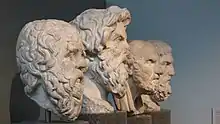 The carved busts of four ancient Greek philosophers, on display in the British Museum. From left to right: Socrates, Antisthenes, Chrysippus, and Epicurus. (from Ancient Greece)
 Homer, author of the earliest surviving Greek literature (from Archaic Greece)
 The remains of the Temple of Apollo at Corinth, the first Greek temple to be built in stone. (from Archaic Greece)
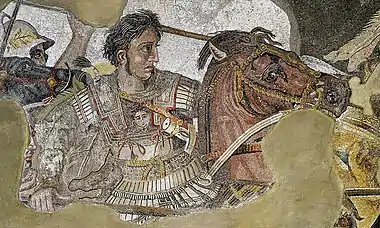 Alexander Mosaic, National Archaeological Museum, Naples (from Ancient Greece)
 Ruins of the Temple of Apollo within the polis of Ancient Corinth, built c. 540 BC, with the Acrocorinth (the city's acropolis) seen in the background (from Archaic Greece)
.JPG.webp)
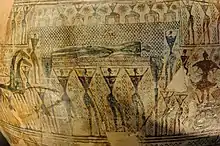 Dipylon Vase of the late Geometric period, or the beginning of the Archaic period, c. 750 BC (from Ancient Greece)
 Ancient Greek pair of terracotta boots. Early geometric period cremation burial of a woman, 900 BC. Ancient Agora Museum in Athens. (from Greek Dark Ages)
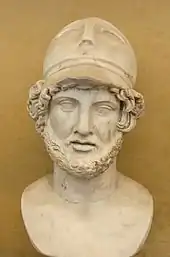 Marble bust of Pericles with a Corinthian helmet, Roman copy of a Greek original, Museo Chiaramonti, Vatican Museums; Pericles was a key populist political figure in the development of the radical Athenian democracy. (from Ancient Greece)
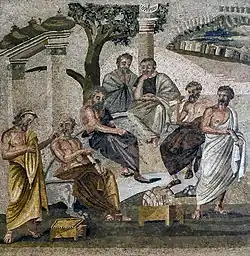
 The gymnasium and palaestra at Olympia, the site of the ancient Olympic games. The archaic period conventionally dates from the first Olympiad. (from Archaic Greece)
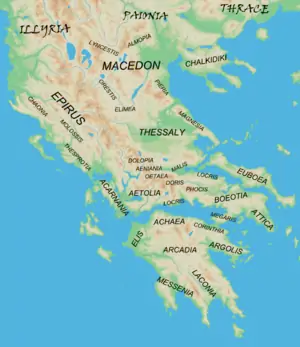 Map showing the major regions of mainland ancient Greece and adjacent "barbarian" lands (from Ancient Greece)
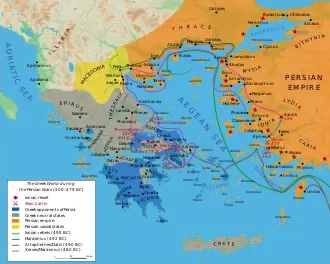 Map showing events of the first phases of the Greco-Persian Wars (from Ancient Greece)
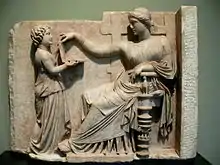 Gravestone of a woman with her slave child-attendant, c. 100 BC (from Ancient Greece)
 Geometric-style box in the shape of a barn. On display in the Ancient Agora Museum in Athens, housed in the Stoa of Attalus. From early geometric cremation burial of a wealthy pregnant woman, 850 BC. (from Greek Dark Ages)
 Finds from an early geometric Cremation Burial of a pregnant wealthy woman, from the N.W. of the Areopagus, about 850 BC, Ancient Agora Museum (Athens); exhibit 14–16: broad gold finger rings; exhibit 17–19: gold finger rings; 20: pair of gold earrings with trapezoid endings (from Greek Dark Ages)
 The lawgiver Solon reformed the Athenian constitution at the beginning of the sixth century BC (from Archaic Greece)
.jpg.webp) The Parthenon, a temple dedicated to Athena, located on the Acropolis in Athens, is one of the most representative symbols of the culture and sophistication of the ancient Greeks. (from Ancient Greece)
The Parthenon, a temple dedicated to Athena, located on the Acropolis in Athens, is one of the most representative symbols of the culture and sophistication of the ancient Greeks. (from Ancient Greece) A map of the Bronze Age collapse (from Greek Dark Ages)
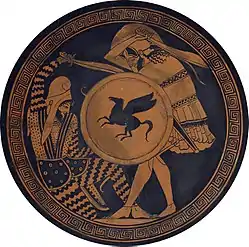 Greek hoplite and Persian warrior depicted fighting, on an ancient kylix, 5th century BC (from Ancient Greece)
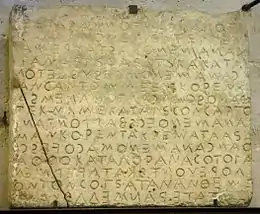 Inheritance law, part of the Law Code of Gortyn, Crete, fragment of the 11th column. Limestone, 5th century BC (from Ancient Greece)
 Early Athenian coin, depicting the head of Athena on the obverse and her owl on the reverse – 5th century BC (from Ancient Greece)
 Areas settled by Greeks by the close of the archaic period (from Archaic Greece)
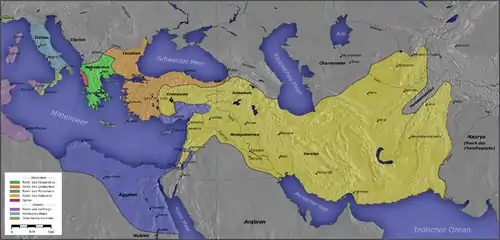 The major Hellenistic realms included the Diadochi kingdoms:Also shown on the map:
The orange areas were often in dispute after 281 BC. The Attalid dynasty occupied some of this area. Not shown: Indo-Greek Kingdom. (from Ancient Greece)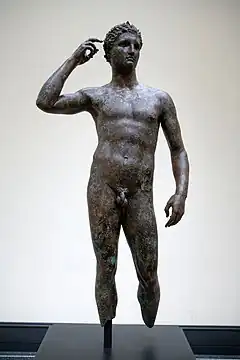 The Victorious Youth (c. 310 BC) is a rare, water-preserved bronze sculpture from ancient Greece. (from Ancient Greece)
 A scene from the Iliad: Hypnos and Thanatos carrying the body of Sarpedon from the battlefield of Troy; detail from an Attic white-ground lekythos, c. 440 BC (from Ancient Greece)
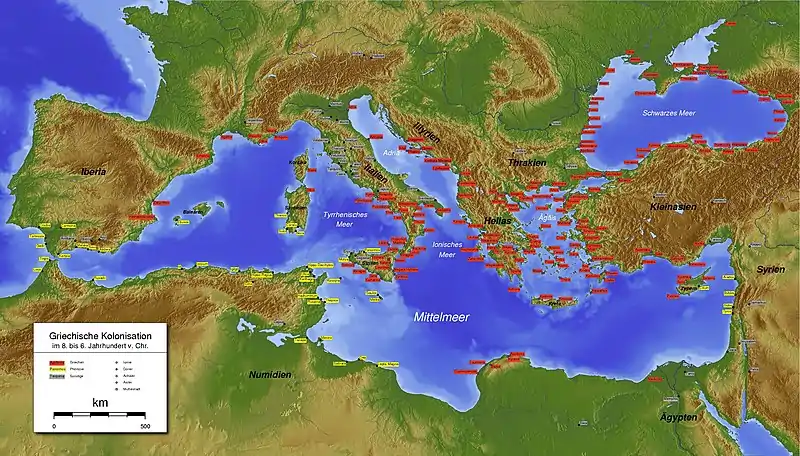 Greek cities & colonies c. 550 BC (in red color) (from Ancient Greece)
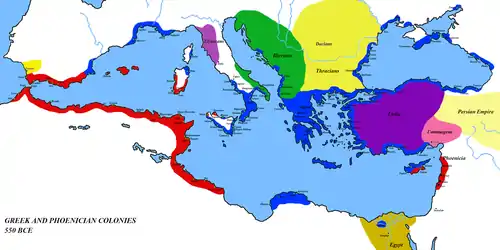 Colonisation of the Mediterranean by the 6th century BC: Phoenician settlements in red, Greek areas in blue, and other territories as marked (from Ancient Greece)
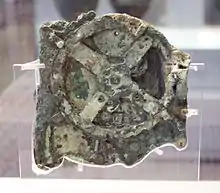 The Antikythera mechanism was an analog computer from 150 to 100 BC designed to calculate the positions of astronomical objects. (from Ancient Greece)
.jpg.webp) The Vix Krater, an imported Greek wine-mixing bronze vessel found in the Hallstatt/La Tène grave of the "Lady of Vix", Burgundy, France, c. 500 BC (from Archaic Greece)
The Vix Krater, an imported Greek wine-mixing bronze vessel found in the Hallstatt/La Tène grave of the "Lady of Vix", Burgundy, France, c. 500 BC (from Archaic Greece) Delian League ("Athenian Empire"), immediately before the Peloponnesian War in 431 BC (from Ancient Greece)
.jpg.webp) The ancient Theatre of Epidaurus, 4th century BC (from Ancient Greece)
The ancient Theatre of Epidaurus, 4th century BC (from Ancient Greece)
Selected picture

Topics
Life: Agriculture · Art · Cuisine · Democracy · Economy · Language · Law · Medicine · Paideia · Pederasty · Pottery · Prostitution · Slavery · Technology · Olympic Games
Philosophers: Pythagoras · Heraclitus · Parmenides · Protagoras · Empedocles · Democritus · Socrates · Plato · Aristotle · Zeno · Epicurus
Authors: Homer · Hesiod · Pindar · Sappho · Aeschylus · Sophocles · Euripides · Aristophanes · Menander · Herodotus · Thucydides · Xenophon · Plutarch · Lucian · Polybius · Aesop
Buildings: Parthenon · Temple of Artemis · Acropolis · Ancient Agora · Arch of Hadrian · Temple of Zeus at Olympia · Colossus of Rhodes · Temple of Hephaestus · Samothrace temple complex
Chronology: Aegean civilization · Minoan Civilization · Mycenaean civilization · Greek dark ages · Classical Greece · Hellenistic Greece · Roman Greece
People of Note: Alexander The Great · Lycurgus · Pericles · Alcibiades · Demosthenes · Themistocles · Archimedes · Hippocrates
Art and Sculpture: Kouroi · Korai · Kritios Boy · Doryphoros · Statue of Zeus · Discobolos · Aphrodite of Knidos · Laocoön · Phidias · Euphronios · Polykleitos · Myron · Parthenon Frieze · Praxiteles


Subcategories

WikiProjects
- Wikipedia:WikiProject Greece
- Wikipedia:WikiProject Classical Greece and Rome
Things to do
 |
Here are some tasks awaiting attention:
|
Associated Wikimedia
The following Wikimedia Foundation sister projects provide more on this subject:
-
 Commons
Free media repository -
 Wikibooks
Free textbooks and manuals -
 Wikidata
Free knowledge base -
 Wikinews
Free-content news -
 Wikiquote
Collection of quotations -
 Wikisource
Free-content library -
 Wikiversity
Free learning tools -
 Wiktionary
Dictionary and thesaurus
-
 List of all portalsList of all portals
 -
 The arts portal
 -
 Biography portal
 -
 Current events portal
 -
 Geography portal
 -
 History portal
 -
 Mathematics portal
 -
 Science portal
 -
 Society portal
 -
 Technology portal
 -
 Random portalRandom portal
 -
 WikiProject PortalsWikiProject Portals