leporine
See also: léporine
English
WOTD – 23 January 2023
Etymology

The adjective is a learned borrowing from Latin leporīnus + English -ine (suffix meaning ‘of or pertaining to’). Leporīnus is derived from leporis (the genitive singular form of lepus (“hare”)) + -īnus (suffix meaning ‘of or pertaining to’).[1][2]
The noun is derived from the adjective.[1]
Pronunciation
- (Received Pronunciation) IPA(key): /ˈlɛpəɹaɪn/
Audio (Southern England) (file) - (General American) IPA(key): /ˈlɛpəˌɹaɪn/, /ˈlɛpəɹən/
- Hyphenation: lep‧or‧ine
Adjective
leporine (not comparable)
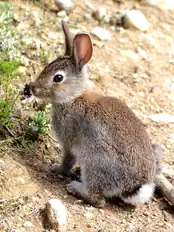
- (chiefly mammalogy, also figuratively) Of, relating to, or resembling a hare or rabbit.
- Synonym: (shaped like a hare or rabbit) leporiform
- (hare): Synonyms: harelike, (shaped like a hare) lagomorphic
- (rabbit): Synonyms: cunicular, rabbitlike, rabbitish, rabbity
- His leporine ears perked up at the mention of dessert.
- 1784, Thomas Pennant, “Harp Seal”, in Arctic Zoology, volume I (Introduction. Class I. Quadrupeds.), London: […] Henry Hughs, OCLC 1326111301, paragraph 77, page 164:
- This [the harp seal] inhabits the ſame countries vvith the Rough and Leporine Seal; but loves the coldeſt parts of the coaſt.
- 1824, Captain Rock [pseudonym; Thomas Moore], chapter X, in Memoirs of Captain Rock, the Celebrated Irish Chieftain, with Some Account of His Ancestors. […], 3rd edition, London: […] Longman, Hurst, Rees, Orms, Brown, and Green, OCLC 221580927, pages 322–323:
- Thus it is that one injustice generates another, and that the breed is propagated, with more than leporine fecundity, through every successive measure which these third-rate Legislators, these Statesmen in waiting, are sent to inflict upon Ireland.
- 1846 March, E[dward] Blyth, “XXIV.—Description of Caprolagus, a New Genus of Leporine Mammalia.”, in The Annals and Magazine of Natural History, volume XVII, number 111, London: R[ichard] and J[ohn] E[dward] Taylor, OCLC 926150169, page 164:
- [T]he fur [of the hispid hare] is very remarkable for an animal of the Leporine group, on account of its harshness, which is well expressed by the specific appellation hispidus.
- 1897, Ch[arles] Wardell Stiles, “A Revision of the Adult Tapeworms of Hares and Rabbits”, in Proceedings of the United States National Museum, volume XIX, number 1105, Washington, D.C.: Smithsonian Institution, United States National Museum, Government Printing Office, OCLC 12155796, page 146:
- I further give an anatomical systematic revision of the adult leporine tapeworms, together with their generic relationship to the cestodes of cattle, sheep, and horses.
- 1919, Israel Zangwill, “Winter’s Tale”, in Jinny the Carrier, London: William Heinemann, OCLC 459221166, section I, page 448:
- Glad as she was to eat of the leporine family, she detested sport for sport's sake, even the fox-hunting, though her poultry-run had just been raided and a dog-fox had snarled fearlessly at Nip from the ditch.
- 1975 February, Dennis J. Chase, “A Commentary: Clouding the Nuclear Reactor Debate”, in Eugene Rabinowitch, editor, The Bulletin of the Atomic Scientists: A Magazine of Science and Public Affairs, volume XXXI, number 2, Chicago, Ill.: Educational Foundation for Nuclear Science, ISSN 0096-3402, OCLC 875845084, page 41, column 1:
- This is basic Peter Rabbit economics that everyone can understand [quoting Thomas G. Ayers]. / Having little faith in economists, even leporine ones, I propose to examine Ayers' thesis carefully.
- 1990, Craig Werner, “The Framing of Charles W. Chesnutt: Practical Deconstruction in the Afro-American Tradition”, in Jefferson Humphries, editor, Southern Literature and Literary Theory, Athens, Ga.; London: University of Georgia Press, →ISBN, page 348:
- This curious passage begins with an intimation of a level of awareness in Uncle Remus, associated with his leporine "quick ear," which allows him to shift from the "senseless affair" into "a recitation of nonsense."
- 2005 June 3, John Banville, “Part I”, in The Sea, London: Picador, →ISBN, page 17:
- Mr Todd launched into a forceful disquisition, […] At last he stopped and sat gazing at her with the same desperate, leporine look as before, audibly breathing, his lips drawn back in a sort of leer and those teeth on show again.
- 2021, Stefanie P. Lazow; Dario O. Fauza, “Transamniotic Stem Cell Therapy”, in Kürşad Türkşen, editor, Cell Biology and Translational Medicine (Advances in Experimental Medicine and Biology; 1237), volume 7 (Stem Cells and Therapy: Emerging Approaches), Cham, Switzerland: Springer Nature, DOI:, →ISBN, ISSN 0065-2598, page 68, column 1:
- The aforementioned rodent and leporine studies represented some of the first in vivo reports of intra-amniotic injection of fetal cells in mammals.
Related terms
Translations
of, relating to, or resembling a hare or rabbit
|
Noun
leporine (plural leporines) (mammalogy)
- Synonym of leporid (“any mammal of the family Leporidae: the hares and rabbits”)
- 1879, T[homas] Spencer Cobbold, “Parasites of Animals”, in Parasites; a Treatise on the Entozoa of Man and Animals, including Some Account of the Ectozoa, London: J[ohn] & A[ugustus] Churchill, […], OCLC 3277851, book II, page 319:
- The most frequent intestinal parasite of rodents is probably Oxyuris ambigua, but Strong. retortæformis is tolerably abundant in the hare, and Trichocephalus unguiculatus is liable to occur in all leporines. […] Acari infest rats and mice, and especially leporines.
- 1888, Elliott Coues, “Order II.—Rodentia.”, in John Sterling Kingsley, editor, The Riverside Natural History, volume V (Mammals), London: Kegan Paul, Trench & Co., […], OCLC 5048215, page 70:
- It will be seen that the variability in any one formula (excepting the anomaly of m. 4⁄4) is confined to the premolars; that these only vary in one instance in the Hystricines; and that the incisors only vary from 2⁄2 to 4⁄2 in the Leporines.
- 2008, Nieves Lopez-Martinez, “The Lagomorph Fossil Record and the Origin of the European Rabbit”, in Paulo C[élio] Alves, Nuno Ferrand, and Klaus Hackländer, editors, Lagomorph Biology: Evolution, Ecology, and Conservation, Berlin; Heidelberg: Springer-Verlag, →ISBN, page 41:
- +Trischizolagus has been proposed as a probable Oryctolagus ancestor, as well as for Lepus and other leporines, although no transitional populations have yet been found.
- 2009, Trevor H[enry] Worthy, “Fossil Birds”, in Rosemary G. Gillespie and David A. Clague, editors, Encyclopedia of Islands (Encyclopedias of the Natural World; 2), Berkeley; Los Angeles, Calif.; London: University of California Press, →ISBN, page 321, column 1:
- The western Balearic Islands (Mallorca, Menorca, Ibiza, Formentera) have an insular history since the Miocene, and are famed for the unique caprine Myotragus (a goat relative) and endemic leporines (rabbits). […] [R]aptors coevolved with the insular radiations of rodents, leporines, and larger mammals.
- 2021, Alexandra van der Geer; George Lyras; John de Vos, “Japan: the Southern and Central Ryukyu Islands”, in Evolution of Island Mammals: Adaptation and Extinction of Placental Mammals on Islands, 2nd edition, Hoboken, N.J.; Chichester, West Sussex: Wiley Blackwell, →ISBN, page 370:
- They [the Mexican volcano rabbit and the South African red rock hare] may be leftovers of a primitive stock because their distribution is peripheral to that of the advanced leporines.
-
- (historical) A supposed hybrid between a hare and a rabbit, now known not to exist; a leporide.
- 1861 February 26, Edwards Crisp, “On Some Points Relating to the Habits and Anatomy of the Oceanic and of the Freshwater Ducks, and also of the Hare (Lepus timidus) and of the Rabbit (L. cuniculus), in Relation to the Question of Hybridism”, in Prideaux John Selby, Charles C[ardale] Babington, John Edward Gray, and William Francis, editors, The Annals and Magazine of Natural History, including Zoology, Botany, and Geology, volume VIII (Third Series), number 43, London: Taylor and Francis […], published July 1861, OCLC 725905569, page 75:
- I come now to the more interesting part of my subject, viz. that of the Leporines—hybrids, so called, between the hare and the rabbit. It has been stated that M. Rouy, of Angoulême, has bred for the market a thousand of these Leporines yearly—that they are fertile both with the hare and the rabbit, and with each other.
- 1887, W[illia]m H[enry] Brewer, “Syllabus of Lectures on the Principles of Stock Breeding [Fourth Lecture. Crossing—Breeding to Points.]”, in Report of the Department of Agriculture of the University of Minnesota: Supplement I to the Fourth Biennial Report of the Board of Regents. 1886, St. Paul, Minn.: The Pioneer Press Company, OCLC 907219965, page 213:
- In France there is a hybrid bred between the rabbit and the hare, known as the leporine, that is said to be fertile; I do not know much about it. I tried to get some definite information on the matter and failed. I simply know that I have seen numers of statements going the rounds of the press that the leporine is a valuable poultry animal raised for food, and is a cross between the hare and the rabbit, and that it is fertile. If so, it is the only case I know of where the continued fertility is kept up.
- 1897 February, “Editorial Gleanings”, in W[illiam] L[ucas] Distant, editor, The Zoologist: A Monthly Journal of Natural History, volume I (4th series), number 668, London: West, Newman, & Co., […]; Simpkin, Marshall, & Co., OCLC 1302481002, page 96:
- Mr. Thomas Christy enquired what position the so-called Belgian Hare or Leporine occupied in relation to the question of hybridity; and was answered that the popular notion of that animal being a hybrid between Hare and Rabbit was fallacious, since it was nothing more than an overgrown tame Rabbit coloured like a Hare.
- 2010, Simon Carnell, “Lagographia Curiosa: The Natural and Unnatural History of the Hare”, in Hare (Animal Series), London: Reaktion Books, →ISBN, page 16:
- […] [Charles] Darwin was intrigued by contemporary experiments claiming to have produced hare–rabbit crosses or ‘leporines’ (‘most curious, if true’), […] [T]hose supporting the existence of leporines were giving credence to a creature as actually imposible and fabulous as the horned hare.
-
Translations
synonym of leporid — see leporid
supposed hybrid between a hare and a rabbit, now known not to exist
See also
- Appendix:Animals
References
- Compare “leporine, adj. and n.”, in OED Online
 , Oxford, Oxfordshire: Oxford University Press, March 2022.
 - “leporine, adj.”, in Dictionary.com Unabridged, Dictionary.com, LLC, 1995–present, reproduced from Stuart Berg Flexner, editor in chief, Random House Unabridged Dictionary, 2nd edition, New York, N.Y.: Random House, 1993, →ISBN.

Italian
This article is issued from Wiktionary. The text is licensed under Creative Commons - Attribution - Sharealike. Additional terms may apply for the media files.