Saurornitholestes
Saurornitholestes ("lizard-bird thief") is a genus of dromaeosaurid theropod dinosaur that lived from 77 to 68 million years ago, during the Campanian and Maastrichtian ages of the Late Cretaceous, in what is now Alberta and the United States of America (Montana, New Mexico, Alabama, North Carolina, and South Carolina).
| Saurornitholestes Temporal range: Late Cretaceous, Possible Cretaceous-Paleogene boundary record | |
|---|---|
 | |
| A skeletal reconstruction of S. langstoni | |
Scientific classification  | |
| Kingdom: | Animalia |
| Phylum: | Chordata |
| Clade: | Dinosauria |
| Clade: | Saurischia |
| Clade: | Theropoda |
| Family: | †Dromaeosauridae |
| Clade: | †Eudromaeosauria |
| Subfamily: | †Saurornitholestinae |
| Genus: | †Saurornitholestes Sues, 1978 |
| Type species | |
| †Saurornitholestes langstoni Sues, 1978 | |
| Other species | |
| |
| Synonyms | |
| |
Two species have been named: Saurornitholestes langstoni in 1978 and Saurornitholestes sullivani in 2015. Saurornitholestes was a small bipedal carnivorous dinosaur, equipped with a sickle claw on the second toe of each foot.
Discovery and naming
In 1974, Canadian amateur paleontologist Irene Vanderloh discovered the skeleton of a small theropod near Steveville, Alberta. She showed it to John Storer, who worked at the Provincial Museum of Alberta. Storer then brought it to the attention of Hans-Dieter Sues. In 1978, Sues named and described the specimen as the type species Saurornitholestes langstoni. The generic name is in reference to Saurornithoididae (now known as Troodontidae), due to the resemblance with this group that is today seen as part of Troodontidae. It combines their name with the Greek word lestes, meaning "thief", and the specific name honours Wann Langston, Jr.[1]
The holotype specimen, TMP 1974.10.5, was uncovered in a layer of the Dinosaur Park Formation dating to the late Campanian age. It consists of a very fragmentary skeleton made up of teeth, skull fragments, two vertebrae, a few ribs, tail fragments, and a part of the hand. Three paratypes were also assigned: CMN 12343, CMN 12354, and UA 5283, all of them being frontals.[1]
Additional specimens

Two more complete, larger partial skeletons, RTMP 88.121.39 and MOR 660, dozens of isolated bones, and swathes of teeth are known from the badlands of Dinosaur Provincial Park. Most of these are housed at the Royal Tyrrell Museum of Palaeontology, located in Drumheller, Alberta, but they remain undescribed. The Alberta and Montana remains are usually attributed to the single species Saurornitholestes langstoni, but they come from a variety of rock formations indicating a wide span of time. For example, the Oldman Formation dated to about 77 million years ago[2], and the upper Two Medicine Formation dated to about 72 million years ago. Similar teeth are found in younger deposits, dated to about 70 to 69 million years ago,[3] but whether they represent S. langstoni or a different, related species is unknown. Neonate sized Saurornitholestes fossils have been reported in scientific literature.[4]
Fragmentary fossils of Saurornitholestes have also been found in the eastern half of the United States of America. A tooth found in the Mooreville Chalk Formation of Alabama was assigned to the genus. In 2015, Schwimmer et al. identified the existence of Saurornitholestes langstoni from the Tar Heel, Coachman, and Donoho Creek formations of North and South Carolina based on diagnostic teeth and a pedal ungual. This also makes S. langstoni the only dromaeosaurid taxon that is currently reported to have actually lived on the East Coast.[5]
Saurornitholestes sullivani is known from the Hunter Wash fauna of New Mexico’s Kirtland Formation, based on the frontal specimen SMP VP-1270. It differs from S. langstoni in the characters of the frontal.[6]
A well preserved skeleton of Saurornitholestes, named UALVP 55700, was discovered in 2014 and is currently under preparation by University of Alberta paleontologists working in Japan.[7] After examining the skull of the specimen, Currie and Evans announced in 2019 that the Zapsalis teeth from the Dinosaur Park Formation represented the second premaxillary tooth of S. langstoni.[8]
Formerly assigned species
In 2006, Robert Sullivan named and described a second nominal species, Saurornitholestes robustus, based on holotype specimen named SMP VP-1955. The specimen is a left frontal, and the specific name refers to the great thickness of this bone, the only trait in which the species is known to differ from S. langstoni. The holotype was found in the Willow Wash fauna of the Kirtland Formation, dated to about 73 million years ago.[9] However, a subsequent overview of dromaeosaurid phylogeny asserted that S. robustus lacked any dromaeosaurid characters and should be considered an indeterminate theropod.[10] A study published in 2014 took the conclusion a step further by demonstrating that S. robustus was assignable to Troodontidae based on similarities with troodontids.[11]
Possible indeterminate fossils are known from the Hell Creek Formation of Montana, North Dakota, and South Dakota, dated to about 66 million years ago.[12]
Description
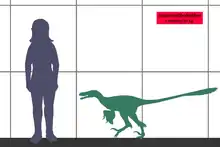
Saurornitholestes was a somewhat small dromaeosaur, with the type species S. langstoni measuring about 4 to 6 feet long and weighing approximately 15 to 50 pounds.[13][14][15][16] At the hip, it stood around 2 feet tall. Like other dromaeosaurids, Saurornitholestes had a long, curving, sickle shaped claw on the second toe of each foot. Saurornitholestes was more long legged and lightly built than other dromaeosaurids, such as Velociraptor and Dromaeosaurus. It resembles Velociraptor in having large, fanglike teeth in the front of its jaws. Saurornitholestes most closely resembles Velociraptor, but the precise relationships of these dromaeosaurids are still poorly understood.
Classification


In 1978, Sues assigned Saurornitholestes to Dromaeosauridae. Later studies most often found it to be a member of Velociraptorinae, but a cladistic analysis by Phil Currie in 2009 recovered a position in a more basal dromaeosaurid clade that was named Saurornitholestinae.
The cladogram below is the result of a 2019 analysis by Currie and Evans. Currie and Evans recovered Saurornitholestes as the sister taxon of Atrociraptor.[8]
| Eudromaeosauria |
| |||||||||||||||||||||||||||||||||||||||||||||||||||||||||||||||||||||||||||||||||
Paleobiology
Senses
Saurornitholestes sullivani is thought to have had a very keen sense of smell, due to its brain case showing that it had an unusually large olfactory bulb for its size.[6]
Teeth function
The second premaxillary teeth of Saurornitholestes, as well as those of Velociraptor and Bambiraptor, may have been structurally specialized for preening feathers. This may also have been the function of the unusual premaxillary teeth of the oviraptorosaurs Protarchaeopteryx and Incisivosaurus.[8]
Feeding habits

Saurornitholestes' feeding habits were discovered to be typical of coelurosaurian theropods, with a characteristic "puncture and pull" feeding method. Studies of wearing patterns on its teeth by Angelica Torices et al. in a study regarding theropod feeding habits indicate that dromaeosaurid teeth share similar wearing patterns to those seen in tyrannosaurids and troodontids, respectively. However, micro wearing on the teeth indicated that Saurornitholestes likely preferred larger prey items than troodontids it shared its environment with. Such differentiations in its diet likely allowed it to inhabit the same environment as its more distant maniraptoran relatives. The same study also indicated that both Saurornitholestes and the related Dromaeosaurus likely included bones in their diet and were better adapted to handling the stress associated with attacking struggling prey, while troodontids, equipped with weaker jaws, preyed on softer animals and prey items, such as invertebrates and carrion. This feeding strategy and ability to handle struggling prey was also a feature dromaeosaurids shared with tyrannosaurids, such as Gorgosaurus, which was also analyzed in said study alongside these smaller theropods.[17][18]
A tooth of Saurornitholestes has been found embedded in the wing bone of a large pterosaur, probably a juvenile Quetzalcoatlus.[19] Because the pterosaur was so much larger than Saurornitholestes, Currie and Jacobsen suggest that the theropod was probably scavenging the remains of an already dead animal.[19]
Paleopathology
In 2001, Bruce Rothschild and others published a study examining evidence for stress fractures and tendon avulsions in theropod dinosaurs and the implications for their behavior. They found that only two of the 82 Saurornitholestes foot bones checked for stress fractures actually had them. Two of the nine hand bones examined for stress fractures were found to have them as well.[20]
Aase Roland Jacobsen published a description of a Saurornitholestes dentary in 2001.[21] The dentary is about 12 cm long and preserves fifteen tooth positions, of which only ten preserve teeth.[22] Three toothmarks were visible on the inner "lingual" surface of the dentary.[22] Two of the three marks are series of grooves made by the serrations on the maker's teeth.[22] The striations are between 0.37 mm and 0.40 mm thick with cuboidal cross-sections.[23]
The shape of the preserved serrations are too different from those of Saurornitholestes for the marks to be the result of injuries incurred during intraspecific face biting behaviors.[24] Although the right shape for Dromaeosaurus tooth serrations, the preserved marks are too coarse to have been left by that genus.[24] Although a specific identification cannot be made, the most likely perpetrator would be a juvenile individual of one of the Dinosaur Park Formation's tyrannosaurids, like Gorgosaurus, or Daspletosaurus.[25]
Paleoenvironment

Saurornitholestes was found on both sides of the Western Interior Seaway. Alberta, the location of Saurornitholestes langstoni, had a habitat similar to the United States Midwest, being vast plains[26] and floodplain swamps.[27] In its eastern range, Saurornitholestes lived alongside hadrosaurids like Hypsibema, large theropods like Appalachiosaurus and Dryptosaurus, an unidentified ornithomimosaur, and another unidentified small theropod that was likely either a dromaeosaurid or a troodontid. Saurornitholestes appears to have been the most common small theropod in Dinosaur Provincial Park, with teeth and bones being much more common than those of its more robust contemporary, Dromaeosaurus.[5]
See also
Footnotes
- H.-D. Sues, 1978, "A new small theropod dinosaur from the Judith River Formation (Campanian) of Alberta Canada", Zoological Journal of the Linnean Society 62: 381-400
- Arbour, et al. (2009).
- "3.33 Alaska, United States; 3. Prince Creek Formation," in Weishampel et al. (2004). Page 587.
- "Abstract," Tanke and Brett-Surman (2001). Page 207.
- Brownstein, Chase D. (2018-02-08). "The biogeography and ecology of the Cretaceous non-avian dinosaurs of Appalachia". Palaeontologia Electronica. 21 (1): 1–56. doi:10.26879/801. ISSN 1094-8074.
- Steven E. Jasinski (2015) A new dromaeosaurid (Theropoda: Dromaeosauridae) from the Late Cretaceous of New Mexico. in Sullivan, R.M. and Lucas, S.G., eds. Fossil Record 4. New Mexico Museum of Natural History and Science Bulletin 67: 79-88
- "Small but vicious Alberta dinosaur to be discussed in Red Deer - Red Deer Advocate". Red Deer Advocate. 2018-03-09. Retrieved 2018-03-11.
- Currie, Philip J.; Evans, David C. (2020). "Cranial Anatomy of New Specimens of Saurornitholestes langstoni (Dinosauria, Theropoda, Dromaeosauridae) from the Dinosaur Park Formation (Campanian) of Alberta". The Anatomical Record. 303 (4): 691–715. doi:10.1002/ar.24241. PMID 31497925. S2CID 202002676.
- Sullivan and Lucas (2006).
- Turner, A.H., Makovicky, P.J. and Norell, M.A., 2012, A review of dromaeosaurid systematics and paravian phylogeny: Bulletin of the American Museum of Natural History, v. 371, p. 1–206.
- Evans, D.C., Larson, D.W., Cullen, T.M. and Sullivan, R.M., 2014. "Saurornitholestes" robustus is a troodontid (Dinosauria: Theropoda): Canadian Journal of Earth Sciences, v. 51, p. 730–734.
- Dinosaur distribution (Late Cretaceous; North America; North Dakota). Weishampel, et al. (2004). Page 585
- Currie and Koppelhus (2005). Pages 372–373.
- Longrich and Currie (2009).
- Paul, Gregory S. (2016). The Princeton Field Guide to Dinosaurs. Princeton University Press. p. 154. ISBN 978-1-78684-190-2. OCLC 985402380.
- Christiansen, P.; Fariña, R.A. (2004). "Mass Prediction in Theropod Dinosaurs". Historical Biology. 16 (2–4): 85–92. doi:10.1080/08912960412331284313.
- "Dinosaurs' tooth wear sheds light on their predatory lives". ScienceDaily. April 2018. Retrieved 14 February 2019.
- "Scratches on dinosaur teeth reveal their fierce, efficient eating habits - The Washington Post". The Washington Post.
- Currie and Jacobsen (1995).
- "Table 23.1," in Rothschild, et al. (2001); page 333.
- "Abstract," Jacobsen (2001). Page 58.
- "Description," Jacobsen (2001). Page 59.
- "Description," Jacobsen (2001). Page 60.
- "Discussion," Jacobsen (2001). Page 60.
- "Discussion," Jacobsen (2001). Page 61.
- Strauss, Bob. "Meet the Raptor Dinosaurs of the Mesozoic Era". ThoughtCo. Retrieved 14 February 2019.
- Norell and Makovicky.
References
- Arbour, V.M.; Burns, M. E.; Sissons, R. L. (2009). "A redescription of the ankylosaurid dinosaur Dyoplosaurus acutosquameus Parks, 1924 (Ornithischia: Ankylosauria) and a revision of the genus". Journal of Vertebrate Paleontology. 29 (4): 1117–1135. doi:10.1671/039.029.0405. S2CID 85665879.
- Currie, Philip J.; Jacobsen, Aase Roland (1995). "An azhdarchid pterosaur eaten by a velociraptorine theropod" (PDF). Canadian Journal of Earth Sciences. 32 (7): 922–925. Bibcode:1995CaJES..32..922C. doi:10.1139/e95-077. Archived from the original (PDF) on 2006-05-28.
- Currie P.J. & Koppelhus E.B., Dinosaur Provincial Park: a spectacular ancient ecosystem revealed, Vol. 1 (Indiana University Press, 2005), p. 372–373.
- Jacobsen, A.R. 2001. Tooth-marked small theropod bone: An extremely rare trace. p. 58-63. In: Mesozoic Vertebrate Life. Ed.s Tanke, D. H., Carpenter, K., Skrepnick, M. W. Indiana University Press.
- Longrich N.R. & Currie P.J. (2009), "A microraptorine (Dinosauria–Dromaeosauridae) from the Late Cretaceous of North America", PNAS 106(13): p. 5002-5007.
- Norell, Mark A. and Makovicky, Peter J. "Dromaeosauridae." In: Weishampel, David B.; Dodson, Peter; and Osmólska, Halszka (eds.): The Dinosauria, 2nd, Berkeley: University of California Press. Pp. 208. ISBN 0-520-24209-2
- Saurornitholestes - Dinosaur Saurornitholestes Characteristics, Behavior and Habitat; Subheadings: Habitat, Historical Period, Size and Weight
- Sullivan, R.M. (2006). "Saurornitholestes robustus, n. sp. (Theropoda:Dromaeosauridae) from the Upper Cretaceous Kirtland Formation (De-Na-Zin member_), San Juan Basin, New Mexico." NMMNH Bulletin 35: 253–256.
- Sullivan, R.M. and Lucas, S.G. (2006). "The Kirtlandian land-vertebrate "age" – faunal composition, temporal position and biostratigraphic correlation in the nonmarine Upper Cretaceous of western North America." New Mexico Museum of Natural History and Science, 35: 7-29.
- Tanke, D.H. and Brett-Surman, M.K. 2001. Evidence of Hatchling and Nestling-Size Hadrosaurs (Reptilia:Ornithischia) from Dinosaur Provincial Park (Dinosaur Park Formation: Campanian), Alberta, Canada. pp. 206–218. In: Mesozoic Vertebrate Life—New Research Inspired by the Paleontology of Philip J. Currie. Edited by D.H. Tanke and K. Carpenter. Indiana University Press: Bloomington. xviii + 577 pp.


.png.webp)


.jpg.webp)