Quebec City Tramway
The Quebec City Tramway (French: Tramway de Québec) is a planned light rail system. The line will be 19.3 kilometres (12.0 mi) long and have 29 stations, two of which will be underground.
| Quebec City Tramway (light rail system) | |||
|---|---|---|---|
| Overview | |||
| Native name | Tramway de Québec | ||
| Locale | Quebec City, Canada | ||
| Transit type | Light rail | ||
| Number of lines | 1 | ||
| Number of stations | 29[1] | ||
| Operation | |||
| Began operation | 2028[2] | ||
| Operator(s) | Réseau de transport de la Capitale | ||
| Technical | |||
| System length | 19.3 km (12.0 mi)[3] | ||
| |||

A former streetcar system existed in the city between 1865 and 1948. It was electrified in 1897.
First tramway (1865 to 1948)
Horsecars

In fall 1863, a group of local businessmen and public figures from Quebec City presented a petition at the Parliament of the Province of Canada for the incorporation of a streetcar company. Among them were Pierre Garneau and John Lemesurier, future mayors of Quebec City, entrepreneurs Guillaume-Eugène Chinic and Cérice Têtu and many others. The group was incorporated under the name Quebec Street Railway Company.[4] (QSRC) on October 15, 1863. It obtained the right to build a system for the city five neighbourhoods. Nevertheless, it was mainly the commercial and port sector of the Lower Town that interested the company. First, they established a horse-drawn omnibus between Champlain Market and St. Ours Street barrier. Wooden rails were embedded in the roadway in this corridor to create the first horsecar line. The service started on August 18, 1865. The arrival of streetcars disrupted centuries-old practices: a ticket cost 5 cents while a horse-drawn carriage varied between 25 and 50 cents. Coach drivers denounced unfair competition and some vehicles were vandalized, rails removed and drivers brutalized. Also, the city and the company were sometimes inconsistent, regarding for instance who was responsible for road maintenance. Moreover, for financial reasons, the company refused to expand its network to the Upper Town, which would also have benefited from public transport. In 1874, the QSRC proceeded to an extension toward Saint-Sauveur, which was not part of the city at the time, to build its depot and avoid paying taxes to the municipality.
Streecars appeared in the Upper Town from 1878 onwards with the creation of a second company, the St. John Street Railway Company Ltd. It built a line linking the Château Frontenac to De Salaberry Avenue through St. John Street. Stables were situated at the intersection with Philippe-Dorval Street.
Electrification and networking

The desire to create a real electrified city system was felt throughout 1890s, especially with the arrival of the electric streetcars in Montreal in 1892. The Quebec, Montmorency and Charlevoix Railway Company and its president, businessman and engineer Horace Jansen Beemer, got an exclusive franchise from the Quebec City Council to this end. They created the Quebec District Railway Company, a subsidiary responsible for managing the city streetcar system. This branch purchased two existing tram companies. Major works were needed: the Montmorency Electric Power Company had to modernize its facilities to provide the new energy demand from the electric network, a metal structure was essential for tram traffic between the Upper and Lower town with a very smooth slope, St. Jean's Gate was demolished to improve traffic flow with Old Quebec, etc. In the summer of 1897, the four lines of this united and electrified public transport system were opened. Côte Dinan trestle, connecting St. Paul Street to the Hôtel-Dieu de Québec, received its first trams in December. From then on, trams would be pulled by horses only when they broke down.
| Line | Route | Opening |
|---|---|---|
_-_Losange_rouge.svg.png.webp) |
The "red diamond line" served the Lower Town. It linked Champlain Market to Saint-Sauveur (Aqueduc Street) | July 19, 1897 |
_-_Croix_de_Malte.svg.png.webp) |
The "Maltese Cross line" served the Upper Town. It linked the Château Frontenac to Mapple Street through St. John Street and the Grande Allée | August 25, 1897 — September 16, 1897 |
_-_Cercle_blanc_sur_carr%C3%A9_vert.svg.png.webp) |
The "white circle on green square line" connected the lower and the upper town through Côte d'Abraham. It linked the Château Frontenac to Victoria Park | August 1897 |
_-_Cercle_blanc.svg.png.webp) |
The "white circle line" connected the lower and the upper town through Côte Dinan trestle. It linked the Château Frontenac to Champlain Market | December 29, 1897 |
New streetcars built in New York could accommodate 25 to 27 passengers up to 50 people and are equipped with heaters. This new public transport participated in the rapid expansion of the city toward Ville-Montcalm, which was growing in population and confirming its residential character.
Expansion, apogee and decline


In 1899, railway and power companies merged to form the powerful Quebec Railway Light & Power Company, a trust in the power and transport sectors for the whole Quebec City area. This company, later known under the name Quebec Power, would run the tramway until its closure in 1948.
In 1910, the network was expanded to Sillery and in 1912, to Beauport. The tramway was at its peak and covered almost the entire city. In 1932, the network stretched from Sillery to Montmorency. At the time, 11 lines in total were in service.
| # | Line | Terminus | ||
|---|---|---|---|---|
| 1 | Saint-Sauveur | Champlain Market | Saint-Malo Industrial Park | |
| 2 | Saint-Vallier | Carré Parent | Saint-Charles Cemetery | |
| 3 | Limoilou | Château Frontenac | Externat Saint-Jean-Eudes | |
| 4 | Exposition | Montcalm Market | Exhibition Park | |
| 5 | Charlesbourg | 1st Ave / Lilas Street | 3th ave / 10th Street | |
| 6 | St. John Street | Maple Street | City Hall of Quebec City | |
| 7 | Grande Allée | Maple Street | Château Frontenac | |
| 8 | Saint-Sacrement | Champlain Market | École de Chimie et des Mines | |
| 9 | Sillery | Maple Street | Maguire Avenue | |
| - | Québec - Montmorency | C.P.Ry Station | Clermont | |
| 11 | Kent House | Crown Street | Kent House | |
From 1937 onwards, buses' popularity was increasing and caused the disappearance of the trams. On May 26, 1948, the last line serving Saint-Sauveur was permanently closed.
 Streetcars at Place D'Youville in 1938.
 Streetcars at Place D'Youville in 1944.
 Rails, Grande Allée, 1945.
 Tram 901 in 1947.
Light rail system
Project history
- 2000: The Ministère des Transports du Québec gives the RTC the mandate to carry out an opportunity and feasibility study for the insertion of a tramway along the Metrobus routes.
- 2003: The study recommends the construction of a tramway network in the city.
- 2005: The City adds the tramway to its 2005-2025 Master Development Plan.
- 2010: The City committee for sustainable transport submit a report. It recommends to build a tramway line by 2030.
- 2015: Second feasibility study. The City chooses bus rapid transit instead of tramway.[6]
- 2017: Six weeks after municipal elections, the reelected mayor (Régis Labeaume) goes back to a tramway concept.
- 2021: The City launches the procurement process for the construction of the tramway.[2]
2003: First attempt
In 2003, the Réseau de transport de la Capitale publishes an opportunity and feasibility study on a light rail system following a government request in 2000. The study shows that a tramway system could be positive for the city. The initially presented project proposes to insert the tram along the existing 800 and 801 Metrobus axes. Those routes pass through high-population-density sectors. With a length of 21.5 km (13.4 mi), the infrastructures would take four years to build. The service frequency would be 5 to 10 minutes.
2010: Project presented by the City Committee for sustainable transport
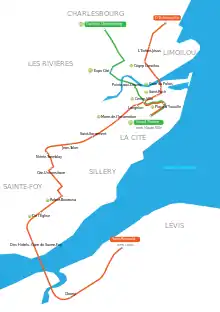
On June 10, 2010, the City Committee for sustainable transport recommended to build two tramway lines for $1.5 billion. The first line would be 22.6 km (14.0 mi) long. Starting on the Saint Lawrence south shore, trams would cross the Quebec Bridge, then run along Laurier Boulevard, going through the Laval University campus, down Côte Nérée-Tremblay, along Charest Boulevard to the Quebec Courthouse. From there, they would go north, taking Capucins Boulevard and Chemin de la Canardière to finally end in the future D'Estimauville Ecodistrict. The second line would separate from the first line in Saint-Roch neighbourhood to service Quebec Parliament Hill with a final stop near the Grand Théâtre de Québec. That line, 6.6 km (4.1 mi) long, would link the Grand Théâtre to Charlesbourg. It would pass through Pointe-aux-Lièvres, ExpoCité to Galeries Charlesbourg. A possible extension would be in the Upper town in the direction of Sainte-Foy.
This project was finally abandoned in 2015 in favour of bus rapid transit (SRB). The bus project was in turn cancelled in April 2017 following the withdrawal of the Lévis municipal authorities.
2018: Structure-enhancing public transit network
In December 2017, a few weeks after the November municipal elections, reelected Mayor Régis Labeaume said his election promise for a new transport system would after all take the form of a light rail system. The current political context enables a great investment from provincial and federal governments in public transit, unlike the 2010 project.
In March 2018, the City, along with the Government of Quebec, announced the construction of a 23 km (14 mi)-long tramway line for $3 billion.[7] The line will link Charlesbourg to Cap-Rouge, passing through Quebec Parliament Hill. There will be a 3.5 km (2.2 mi) tunnel in this part. The service frequency will be 3 to 5 minutes in peak periods, 10 to 15 minutes during the day and weekend. Passenger capacity will be 260 per tram. The Quebec City tramway should be in service in 2026.[8]
2020: Reassessment of tramway project
In November 2020, Quebec's environmental review board (BAPE, part of the Ministry of Sustainable Development, Environment, and Fight Against Climate Change) has turned down Quebec City's $3.3-billion tramway project proposal. In the report, BAPE stated that planners should have also considered a subway or light rail system, rather than a tramway. The BAPE also states that the existing tramway proposal does not do enough to serve the city's suburbs, which are rapidly growing. Furthermore, BAPE questioned whether a tramway system could cope with the city's winter weather or how it would be integrated into the landscape.[9] Quebec's Transport Minister, François Bonnardel, announced that the government was withdrawing the support for Quebec City's proposed tramway network, which he said will not go ahead unless it is reconfigured to better serve the suburbs.[10]
As of March 18, 2021, an agreement was reached to move the tramway project forward.[11] However, the opposition party in Quebec, Quebec 21, proposed a light metro in place of a tramway revival in June 2021.[12]
Construction
Despite a late project approval in 2021, studies and preliminary work began from 2019. Land acquisitions, drilling and archaeological excavations were also carried out from 2019.[13][14] The first major works took place in Saint-Roch, from March 2021, with the transformation of Rue de la Couronne and Dorchester Street.[15] In 2022, other works began on Chemin des Quatre-Bourgeois and Boulevard Laurier[16]. All these so-called "preparatory" or "pre-work" sites aim to move the underground pipes to prevent them from being under the tram tracks.[17]
In April 2022, Quebec City started the selection process for a supplier of light-rail vehicles. In February 2023, Alstom Transport Canada Inc. was the successful bidder. Besides supplying the vehicles, it will also maintain them for 30 years.[3]
Stations
The Quebec City Tramway is a 19.3-kilometre (12.0 mi) light-rail line running between the city districts of Cap-Rouge in the west and Maizerets in the east.[3] The line will have 29 stations of which two will be underground. Five of the stations will be designated as transit hubs (French: pôles d’échanges). The average distance between stations will be 690 metres (2,260 ft).[1]
The following table lists stations from west to east. Stations use one of the following platform configurations:[18]
- Centre: centre or island platform serving both tracks
- Parallel: two parallel side platforms facing one another directly opposite each other
- Offset: two side platforms each located separately at different sides of an intersection
| Station | Type | Platforms | Map | Location | Connections |
|---|---|---|---|---|---|
| Pôle Le Gendre | surface | parallel | 46°46′23″N 71°21′11″W | Av. Blaise Pascal & Av. Le Gendre,[19] Cap-Rouge | hub: 7 bus bays[20] |
| Chaudière | surface | parallel | 46°46′25″N 71°20′41″W | Rue Mendel & Boul. de la Chaudière,[19] Cap-Rouge | |
| McCartney | surface | centre | 46°45′58″N 71°19′48″W | Av. McCartney & Boul. Pie-XII, Sainte-Foy | Buses |
| Pie-XII | surface | parallel | 46°45′39″N 71°19′13″W | Ch. des Quatre-Bourgeois & Boul. Pie-XII, Sainte-Foy | |
| Bégon | surface | parallel | 46°45′49″N 71°18′57″W | Ch. des Quatre-Bourgeois & Av. Bégon, Sainte-Foy | |
| Duchesneau | surface | parallel | 46°46′03″N 71°18′36″W | Ch. des Quatre-Bourgeois & Av. Duchesneau, Sainte-Foy | |
| Roland-Beaudin | surface | parallel | 46°46′20″N 71°17′57″W | Parc Roland-Beaudin, Sainte-Foy | |
| Pôle de Sainte-Foy | surface | parallel | 46°46′01″N 71°17′29″W | Boul. Laurier, Sainte-Foy | hub: 12 bus bays[21] |
| CHUL | surface | parallel | 46°46′11″N 71°17′01″W | Boul. Laurier at CHUL (hospital) | |
| Place Sainte-Foy | surface | parallel | 46°46′24″N 71°16′35″W | Boul. Laurier at Place Ste-Foy (shopping centre) | |
| Pôle de l'Université Laval | surface | parallel | 46°46′38″N 71°16′29″W | Av. de la Medicine at Université Laval | hub: 16 bus bays[22] |
| Desjardins | surface | parallel | 46°46′47″N 71°16′12″W | Rue de l'Université at Université Laval | |
| Myrand | surface | parallel | 46°47′01″N 71°15′46″W | Boul. René-Lévesque & Av. Myrand | |
| Maguire | surface | parallel | 46°47′11″N 71°15′28″W | Boul. René-Lévesque & Av. Maguire | |
| Holland | surface | parallel | 46°47′30″N 71°14′56″W | Boul. René-Lévesque & Av. Holland | |
| Collège Saint-Charles-Garnier | surface | parallel | 46°47′39″N 71°14′39″W | Boul. René-Lévesque at St. Charles Garnier College | |
| Belvédère | surface | parallel | 46°47′50″N 71°14′21″W | Boul. René-Lévesque & Av. Belvédère | |
| Brown | surface | parallel | 46°48′00″N 71°14′03″W | Boul. René-Lévesque & Av. Brown | |
| Cartier | surface | offset | 46°48′15″N 71°13′36″W | Boul. René-Lévesque & Av. Cartier | |
| Colline parlementaire | underground | parallel | 46°48′32″N 71°13′03″W | Boul. René-Lévesque at Colline Parlementaire | Buses |
| D'Youville | underground | parallel | 46°48′42″N 71°12′55″W | near Place d'Youville, Vieux-Québec | Buses |
| Jean-Paul-L'Allier | surface | parallel | 46°48′49″N 71°13′27″W | Boulevard Charest E & Rue Couronne, Saint-Roch | Buses |
| Pôle de Saint-Roch | surface | centre | 46°49′08″N 71°13′46″W | Rue de la Croix-Rouge & Autoroute Laurentienne, Saint-Roch | hub: 18 bus bays[23] |
| 3e Avenue | surface | parallel | 46°49′21″N 71°13′35″W | 4e Rue & 3e Av, Vieux-Limoilou | Buses |
| Cégep Limoilou | surface | offset | 46°49′45″N 71°13′32″W | Ch. de la Canardière at Cégep Limoilou (college), Vieux-Limoilou | Buses |
| Hôpital de l'Enfant-Jésus | surface | parallel | 46°50′10″N 71°13′22″W | Ch. de la Canardière at Hôpital de l'Enfant-Jésus, Maizerets | Buses |
| Bardy | surface | parallel | 46°50′21″N 71°13′17″W | Ch. de la Canardière & Av. Bardy, Maizerets | Buses |
| De Courtemanche | surface | parallel | 46°50′36″N 71°13′00″W | Boul. Sainte-Anne & Rue de la Courtemanche, Maizerets | |
| Pôle D'Estimauville | surface | parallel | 46°50′47″N 71°12′42″W | Boul. Sainte-Anne, Maizerets | hub: 15 bus bays[24] |
Operations
The line will have a maximum capacity of 3,900 passengers per hour. The peak-period frequency will be every 4 to 8 minutes. Tramway service will operate from 5AM to 1AM. Trams will operate in reserved lanes and have priority at traffic lights.[25]
Vehicles will be 43 metres (141 ft) long and have a capacity of 260 passengers each, 4 times the capacity of a regular bus. The trams will be designed to accommodate 3.3 passengers per square metre.[25]
The Operation and Maintenance Centre (French: Centre d'exploitation et d'entretien – CEE) will be located along Rue Mendel between the stations Pôle Le Gendre and Chaudière.[19] The site occupies an area of 3.62 hectares (8.9 acres).[26] A U-shaped building will provide indoor vehicle storage as well as maintenance functions such as motor repairs, paint shop, vehicle wash and the repair of doors, windows, air conditioning or light fixtures. The facility will also contain a control centre to monitor operation of the line.[19]
References
- "Stations". Tramway de Québec (in French). Retrieved April 3, 2023.
- "Les grandes étapes". Tramway de Québec (in French). Retrieved April 4, 2023.
- "Tramway de Québec : un jalon supplémentaire de franchi vers la sélection du partenaire pour le matériel roulant". Ville de Québec (in French). February 23, 2023. Archived from the original on February 23, 2023.
- "Transit History of Quebec, Quebec". home.cc.umanitoba.ca. Retrieved 2019-06-07.
- Pharand, Jacques (1998). Les tramways de Québec. Beauport: Publications MNH. p. 190. ISBN 978-2-921912-33-4.
- "Le service d'autobus rapide plutôt qu'un tramway, à moyen terme". Radio-Canada.ca (in Canadian French). Retrieved 2019-06-07.
- Page, Julia (March 16, 2018). "Quebec City unveils plans for $3-billion tramway network, wants feds and province to pay". CBC/Radio-Canada. Retrieved 2019-06-07.
- "Mayor, premier unveil plans for $3-billion tramway for Quebec City". Montreal Gazette. 2018-03-16. Retrieved 2019-06-07.
- Van Dyk, Spencer (November 9, 2020). "Province's environmental review board rejects Quebec City's proposed tramway". Canadian Broadcasting Corporation. CBC News. Retrieved 28 December 2020.
- "Province won't fund Quebec City's $3.3B tramway unless changes are made". Canadian Broadcasting Corporation. CBC News. November 10, 2020. Retrieved 28 December 2020.
- "Quebec City tramway is one step closer to becoming a reality". Canadian Broadcasting Corporation. CBC News. March 18, 2021. Retrieved 8 April 2021.
- "Un métro léger, la vision de l'avenir de Québec 21 | Élections municipales au Québec 2021".
- "Plus de 350 acquisitions de terrains pour faire place au tramway" (in French). Radio-Canada. July 16, 2020.
- "Tramway: des fouilles le long du tracé pour éviter les surprises" (in French). Le Journal de Québec. October 13, 2020.
- "Travaux d'importance lancés dans Saint-Roch". Tramway de Québec (in French). March 25, 2021.
- "315 chantiers et des entraves majeures à Québec cet été" (in French). Radio-Canada. March 1, 2022.
- "Secteur du boulevard Laurier: des prétravaux majeurs d'un an pour le tramway" (in French). Le Journal de Québec. April 11, 2022.
- "La carte du projet". Tramway de Québec (in French). Retrieved April 6, 2023.
- "Centre d'exploitation et d'entretien". Tramway de Québec (in French). Retrieved April 5, 2023.
- "Pôle Le Gendre". Tramway de Québec (in French). Retrieved April 6, 2023.
- "Pôle d'échanges de Sainte-Foy". Tramway de Québec (in French). Retrieved April 6, 2023.
- "Pôle d'échanges de l'Université Laval". Tramway de Québec (in French). Retrieved April 6, 2023.
- "Pôle d'échanges de Saint-Roch". Tramway de Québec (in French). Retrieved April 6, 2023.
- "Pôle d'échanges D'Estimauville". Tramway de Québec (in French). Retrieved April 6, 2023.
- "Un tramway pour transformer l'offre en transport en commun à Québec". Tramway de Québec (in French). Retrieved April 5, 2023.
- "36 000 m2 de boisé bientôt rasés pour le « garage » du tramway". Radio-Canada. February 3, 2023.
External links
- Official Website (in French)