Pulga, California
Pulga is an unincorporated community in Butte County, California. It is located along the west slope of the Feather River canyon. A variant name for the community is Big Bar.
Pulga, California | |
|---|---|
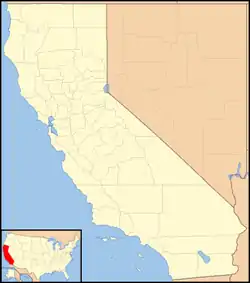  Pulga, California Location in California  Pulga, California Pulga, California (the United States) | |
| Coordinates: 39°48′11″N 121°26′55″W | |
| Country | United States |
| State | California |
| County | Butte County |
| Elevation | 1,398 ft (426 m) |
History
The land was once occupied by Konkow Maidu tribes.[2] In 1885, the town of Pulga was founded by William King, a sawmill owner and railroad geologist.[2][3] A post office was opened in 1906.[4] The area had attracted gold miners and miners of vesuvianite, also known as "Pulga Jade".[2] The town was always small, and peaked in size in the 1930s and 1940s with a few hundred people.[2] The Western Pacific Railroad's Feather River Route line ran through the town and offered Vista Dome cars, designed and built with the scenery on this route in mind.[2] In the late-1960s, the this was no longer a train route and the mining business had dried up.[2][3]
In 1994, the William King estate sold the town property, on which the Mystic Valley Retreat and School of Hypnotism was erected; most of the buildings have fallen into disrepair.[2]
In 2015, the 64-acre (26 ha) town was purchased by Betsy Ann Cowley.[2][5] Crowley opened it as a feminist artist retreat and event venue, also named Pulga.[2][3]
In 2018, high tension lines near the Poe Dam, north of Pulga, were the cause of the Camp Fire. Two buildings in Pulga were destroyed and others were damaged.[6][7]
Geography
Pulgsa is at the mouth of Flea Valley Creek, which gives rise to the toponym.[4]
A Union Pacific Railroad passes through the settlement.
See also
References
- U.S. Geological Survey Geographic Names Information System: Pulga, California
- Leibrock, Rachel (Winter 2020). "Welcome to Pulga: How One Woman Bought A Ghost Town And Turned It Into A Feminist Haven". Bust magazine. Retrieved 2022-12-15.
- Lefebvre, Sam (November 19, 2018). "Inside Pulga, Artist Refuge at the Center of the Camp Fire". KQED. Retrieved 2022-12-15.
- Durham, David L. (1998). California's Geographic Names: A Gazetteer of Historic and Modern Names of the State. Clovis, Calif.: Word Dancer Press. p. 296. ISBN 1-884995-14-4.
- Morris, J. D.; Alexander, Kurtis (2018-11-13). "Homeowner's claim on PG&E work raises questions on Camp Fire's origin". San Francisco Chronicle. Retrieved 2022-12-15.
- "ArcGIS Web Application".
- "Update: PG&E says email to Camp Fire victim focused on different transmission line". The Mercury News. 2018-11-12. Retrieved 2022-12-15.
External links
Municipalities and communities of Butte County, California, United States | ||
|---|---|---|
| Cities and towns |  Butte County map | |
| CDPs | ||
| Unincorporated communities |
| |
| Ghost towns |
| |
| Footnotes | ‡This populated place also has portions in an adjacent county or counties | |