Portal:World War II

The World War II Portal
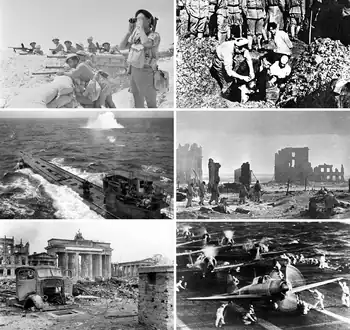
Clockwise from top left: Commonwealth troops in the desert; Chinese civilians being buried alive by Japanese soldiers; Soviet forces during a winter offensive; Carrier-borne Japanese planes readying for take off; Soviet troops fighting in Berlin; A German submarine under attack.

World War II, or the Second World War, was a global military conflict. It began as the joining of what had initially been two separate conflicts, with the first beginning in Asia in 1937 (the Second Sino-Japanese War) and the other beginning in Europe in 1939 (the German and Soviet invasion of Poland).

The war split the majority of the world's nations into two opposing military alliances: the Allies and the Axis. It involved the mobilization of over 100 million military personnel, making it the most widespread war in history, and placed the participants in a state of "total war", which erased the distinction between civil and military resources and resulted in the complete activation of a nation's economic, industrial, and scientific capabilities for the purposes of the war effort. Over 70 million people, the majority of them civilians, were killed, making it the deadliest conflict in human history.

The Allies won the war, and as a result, the Soviet Union and the United States emerged as the world's leading superpowers. This set the stage for the Cold War, which lasted for the next 45 years. The United Nations was formed in the hope of preventing another such conflict. The self-determination spawned by the war accelerated decolonization movements in Asia and Africa, while Europe itself began moving toward integration.

Featured article -

The U.S. Marine Corps War Memorial, located in Arlington, Virginia is based on the photo.
Raising the Flag on Iwo Jima is a historic photograph taken on February 23, 1945, by Joe Rosenthal. It depicts five United States Marines and a U.S. Navy corpsman raising the flag of the United States atop Mount Suribachi during the Battle of Iwo Jima in World War II. The photograph was extremely popular, being reprinted in thousands of publications. Later, it became the only photograph to win the Pulitzer Prize for Photography in the same year as its publication, and ultimately came to be regarded as one of the most significant and recognizable images of the war, and possibly the most reproduced photograph of all time.Of the six men depicted in the picture, three (Franklin Sousley, Harlon Block, and Michael Strank) did not survive the battle; the three survivors (John Bradley, Rene Gagnon, and Ira Hayes) became celebrities upon their identification in the photo. The picture was later used by Felix de Weldon to sculpt the USMC War Memorial, located adjacent to Arlington National Cemetery just outside Washington, D.C.


Selected equipment -

Nevada underway off of the Atlantic coast of the United States in 1944
USS Nevada (BB-36), the second United States Navy ship to be named after the 36th state, was the lead ship of the two Nevada-class battleships; her sister ship was Oklahoma. Nevada was a giant leap forward in dreadnought technology, as she showcased four new features that would be included on almost every subsequent U.S. battleship: gun turrets with three guns, anti-aircraft guns, oil in place of coal for fuel, and the "all or nothing" armor principle. All of these new features resulted in Nevada becoming the first U.S. Navy "super-dreadnought". Nevada served in both of the World Wars: during World War I, Nevada was based in Bantry Bay, Ireland, for the last few months of the war to support the supply convoys that were sailing to and from Great Britain. In World War II, she was one of the battleships that were trapped when the Japanese attacked Pearl Harbor on 7 December 1941. Subsequently salvaged and modernized at Puget Sound Navy Yard, Nevada served in four amphibious assaults: the Normandy Landings and the invasions of Southern France, Iwo Jima, and Okinawa. At the end of World War II, the Navy decided that Nevada was too old to be retained in the post-war fleet, so they assigned her to be a target ship in the Bikini atomic experiments of July 1946. After being hit by two atomic bombs, she was still afloat but heavily damaged and radioactive. She was sunk during naval gunfire exercise in 1948.


Selected battle -

Dead Japanese soldiers, killed assaulting United States Marine positions, lie on the sandbar at the mouth of Alligator Creek, Guadalcanal after the battle on August 21, 1942.
The Battle of the Tenaru (or Battle of the Ilu River) took place August 21, 1942, on the island of Guadalcanal, and was a land battle of the Pacific campaign of World War II, between Imperial Japanese Army and Allied (mainly United States (U.S.) Marine) ground forces. The battle was the first major Japanese land offensive during the Guadalcanal campaign.In the battle, U.S. Marines, under the overall command of U.S. Major General Alexander Vandegrift, successfully repulsed an assault by the "First Element" of the "Ichiki" Regiment, under the command of Japanese Colonel Kiyonao Ichiki. The Marines were defending the Lunga perimeter, which guarded Henderson Field, which was captured by the Allies in landings on Guadalcanal on August 7. Ichiki's unit was sent to Guadalcanal in response to the Allied landings with the mission of recapturing the airfield and driving the Allied forces off of the island. Underestimating the strength of Allied forces on Guadalcanal, which at that time numbered about 11,000 personnel, Ichiki's unit conducted a nighttime frontal assault on Marine positions at Alligator Creek on the east side of the Lunga perimeter. Ichiki's assault was defeated with heavy losses for the Japanese attackers.


General images

The following are images from various World War II-related articles on Wikipedia.

Selected picture -

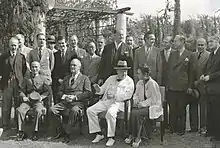
Key American military officials, 1945
Senior American military officials of World War II. Seated are (from left to right) Gens. William H. Simpson, George S. Patton, Carl A. Spaatz, Dwight D. Eisenhower, Omar Bradley, Courtney H. Hodges, and Leonard T. Gerow; standing are (from left to right) Gens. Ralph F. Stearley, Hoyt Vandenberg, Walter Bedell Smith, Otto P. Weyland, and Richard E. Nugent.

Selected biography -

GOC Malaya in December 1941
Lieutenant-General Arthur Ernest Percival, CB, DSO and Bar, OBE, MC, OStJ, DL, (26 December 1887 – 31 January 1966) was a British Army officer and World War I veteran. He built a successful military career during the interwar period but is most noted for his involvement in World War II, when he commanded the forces of the British Commonwealth during the Battle of Malaya and the subsequent Battle of Singapore. Percival's surrender to the invading Imperial Japanese Army force was and remains the largest capitulation in British military history, and it permanently undermined Britain's prestige as an imperial power in the Far East. However, current knowledge about the years of under-funding of Malaya's defences and the inexperienced, under-equipped nature of the Commonwealth army makes it possible to hold a more sympathetic view of his command. Arthur Ernest Percival was born on 26 December 1887 in Aspenden Lodge, Aspenden near Buntingford in Hertfordshire, England, the second son of Alfred Reginald and Edith Percival (née Miller).


Did you know...? -

Categories

Category puzzle
Category puzzle
World War II
World War II by continent
World War II by country
Lists of World War II topics
World War II-related lists
Chronology of World War II
Aftermath of World War II
Military awards and decorations of World War II
Battles and operations of World War II
World War II casualties
Collaboration during World War II
Cultural history of World War II
Military deception during World War II
Economic history of World War II
Escapes and rescues during World War II
Friendly fire incidents of World War II
Historiography of World War II
Intelligence of World War II
World War II legislation
World War II and the media
Military animals of World War II
Military discipline and World War II
Military equipment of World War II
Military medicine in World War II
Military units and formations of World War II
World War II non-governmental organizations
People of World War II
Politics of World War II
World War II propaganda
World War II resistance movements
Science and technology during World War II
World War II sites
Sociology of World War II
Transport in World War II
Unfree labor during World War II
World War II crimes
Works about World War II
World War II Heritage Cities
World War II stubs

Selected quote -

"I said, to the people of the Philippines whence I came, I shall return. Tonight, I repeat those words: I shall return!"
Douglas MacArthur, 30 March 1942

Topics

World War II
Theatres Main events Specific articles Participants

Prelude
Causes
in Europe
in Asia

Main theatres
Europe
Eastern Europe
China
Mediterranean, Middle East and Africa
Asia and the Pacific
Atlantic

General timeline
Timeline

1939
Invasion of Poland
Winter War

1940
Invasion of Denmark/Norway
Battle of France
Battle of Britain

1941
Invasion of the Soviet Union
Battle of Moscow
Attack on Pearl Harbor

1942
Battle of Midway
Battle of Stalingrad
Second Battle of El Alamein

1943
Battle of Kursk
Guadalcanal campaign
Invasion of Italy

1944
Battle of Normandy
Operation Bagration
Battle of Leyte Gulf
Operation Market Garden
Battle of the Bulge

1945
Battle of Iwo Jima
Battle of Okinawa
Battle of Berlin
End in Europe
Hiroshima and Nagasaki
Surrender of Japan

more...

Blitzkrieg
Cryptography
Equipment
Home Front
Military engagements
Production
Resistance
Technology

Civilian impact and atrocities
Nanking Massacre
The Holocaust
Siege of Leningrad
Bataan Death March
Dutch famine of 1944
Bengal famine of 1943
Hiroshima and Nagasaki
Unit 731
Strategic bombings
Comfort women
Allied war crimes
German war crimes
Japanese war crimes

Aftermath
Effects
Casualties
Expulsion of Germans
Denazification
Cold War
Universal Declaration of Human Rights
Decline of the British Empire

The Allies
Australia Australia
Belgium Belgium
Brazil Brazil
British Raj British India
Canada Canada
Czechoslovakia Czechoslovakia
Kingdom of Egypt Egypt
El Salvador El Salvador
French Third Republic France (after June 16, 1940: Free France Free France)
Kingdom of Greece Greece
Netherlands Netherlands
Dominion of New Zealand New Zealand
Norway Norway
Commonwealth of the Philippines Philippines
Poland Poland
Republic of China (1912–1949) Republic of China
Union of South Africa South Africa
Soviet Union Soviet Union
United Kingdom United Kingdom
United States United States
Kingdom of Yugoslavia Yugoslavia

more...

The Axis
Nazi Germany Germany
Kingdom of Italy Italy
Empire of Japan Japan
 Slovakia
Kingdom of Bulgaria Bulgaria
 Independent State of Croatia
Finland Finland
 Vichy France
Kingdom of Hungary (1920–1946) Hungary
Kingdom of Romania Romania
Thailand Thailand

more...


Things you can do

From the World War II task force of the Military history WikiProject:

Attention needed
...to referencing and citation   ...to coverage and accuracy   ...to structure   ...to grammar   ...to supporting materials 
Popular pages
Full list
Cleanup needed
Battle of Kiev (1943) Battle of Ko Chang Colditz Castle Spiritual national defence Tuskegee Airmen
Requested articles
Battle of Uhtua-Kiestinki Battles of Repola-Rukajärvi Battle of Siiranmäki Battle of Łuck Battle of Równe Battle of Włodzimierz Wołyński Battle of Lubartów Battle of Miedniki Battle of Jodła Francis Blanchain Shinshou Draenger Christer Lyst Hansen Ove Kampman League for Combat Policy Julien Meline Operation Mittelmeer Operation Richard Otto Program Martin Poppel Roehm's Avengers Poul Bruun Raoul Boulanger Battle of West Ukraine (1941) Battle of Zunyi Liberation of Denmark (currently redirect) Operation Vado (currently redirect) Finnish 19th Division (Continuation War) Finnish 11th Division (Continuation War) Finnish Cavalry Brigade 1st Jaeger Brigade 2nd Jaeger Brigade 168th Rifle Division (Soviet Union) 71st Rifle Division (Soviet Union) Group Oinonen Operation Vesuvius (currently redirect) Capture of Kassala (currently redirect) Battle of Pankow Brandenburg–Rathenow Offensive Japanese internment of European civilians during World War II Miranda de Ebro concentration camp German occupation of the Netherlands (current redirect) Soviet home front during World War II Labour Charter (Vichy France) Berles-Monchel and Aubigny-en-Artois massacres (1940) Febvin-Palfart massacre (1940) German massacres of French colonial prisoners of war 1941 Nord-Pas de Calais miners' strike Spitfire funds Good War (historiography) Nederlandsche Oost Compagnie West African Pioneers 2nd Marching Battalion of Ubangui-Shari Bataillon du Pacifique Persecution of freemasons in Nazi Germany and German-occupied Europe Mohammed El Maadi Luxembourgers in the Wehrmacht Chantiers de la Jeunesse (Vichy France)
Expansion needed
Princess Irene Brigade Battle of Bay of Viipuri Demilitarisation Free Dutch Forces Martha Desrumeaux Mochitsura Hashimoto Operation Cascade Operation Tan No. 2 Burma Area Army Battle of Courland Battle of Munda Point Battle of Voronezh (1943) Drive on Munda Point First Battle of Kharkov Race to Berlin Marie Fourcade Donald Blakeslee Operation Nordwind Battle of Skerki Bank Michael Sinclair (soldier) Battle of Maastricht Battle of Zeeland Landings on Rendova New Georgia counterattack Operation Waterfall Petsamo–Kirkenes Offensive American-British-Dutch-Australian Command Battle of Viru Harbor Battle of Wickham Anchorage Western New Guinea campaign (and the individual battles of the campaign) Operation Blockbuster Operation Cooney The Holocaust in France Knowledge of the Holocaust in Nazi Germany and German-occupied Europe Francoist Spain and the Holocaust Japan campaign Volcano and Ryukyu Islands campaign Légion Français des Combattants more
Images needed
Twelfth Army (United Kingdom) 4th Airborne Division (United Kingdom) 5th Airborne Division (United Kingdom) XVI Corps (United Kingdom) Battle of Dakar Battle of the Lys (1940) Battle of Zeeland Battle of the Grebbeberg Franco-Thai War Battle of Ko Chang Switzerland during the World Wars Berthe Fraser Western Allied invasion of Germany LXXXIII Army Corps (Wehrmacht)
Merging needed
Add an article here!
Citations needed
Battle of Borneo (1941–42) Battle of Imphal Garderegiment Fuseliers Prinses Irene Japanese invasion of French Indochina Japanese invasion of Thailand Luxembourg in World War II New Georgia Campaign Operation Cartwheel Operation Chastise Royal Netherlands Motorized Infantry Brigade Solomon Islands campaign Battle of Radom Seishin Operation Moravia–Ostrava Offensive Panzerjäger
Translation needed
5th Guards Fighter Aviation Regiment Novorossiysk-Taman Operation 1943 Novorossiysk Operation 1943 Air Battles over Kuban Battle of Rostov (1943) Battle of Olshansky Nalchik-Ordzhonikidzevskaya Operation Bukrinsky Landing Cape Tarhan Landing 1942 Sudak Landing Mozdok-Malgobek Operation Alexander Sergeyevich Ksenofontov Henri de Vernejoul André Bergeret Battle of Nice Liberation de Saint-Malo Battle of Seuil Valley René-Jean-Paul Cassagne Cameroun's rallying to the Free French Battle of Bouno-Misaki

Associated Wikimedia

More portals

Discover Wikipedia using portals
This article is issued from Wikipedia. The text is licensed under Creative Commons - Attribution - Sharealike. Additional terms may apply for the media files.