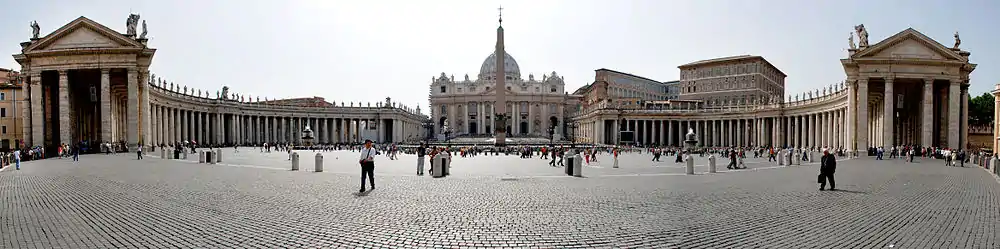
Vatican City (/ˈvætɪkən/(listen)), officially Vatican City State (Italian: Stato della Città del Vaticano; Latin: Status Civitatis Vaticanae), is a landlocked independent city-state, microstate and enclave within Rome, Italy. It became independent from Italy in 1929 with the Lateran Treaty, and it is a distinct territory under "full ownership, exclusive dominion, and sovereign authority and jurisdiction" of the Holy See, itself a sovereign entity of international law, which maintains the city state's temporal, diplomatic, and spiritual independence. With an area of 49 hectares (121 acres) and a 2019 population of about 453, it is the smallest state in the world both by area and population. As governed by the Holy See, Vatican City State is an ecclesiastical or sacerdotal-monarchical state ruled by the Pope who is the bishop of Rome and head of the Catholic Church. The highest state functionaries are all Catholic clergy of various origins. After the Avignon Papacy (1309–1377) the popes have mainly resided at the Apostolic Palace within what is now Vatican City, although at times residing instead in the Quirinal Palace in Rome or elsewhere. The Vatican is also a metonym for the Holy See.
The Holy See dates back to early Christianity and is the principal episcopal see of the Catholic Church, which has approximately 1.329billion baptised Catholics in the world in the Latin Church and 23 Eastern Catholic Churches. The independent state of Vatican City, on the other hand, came into existence on 11 February 1929 by the Lateran Treaty between the Holy See and Italy, which spoke of it as a new creation, not as a vestige of the much larger Papal States (756–1870), which had previously encompassed much of Central Italy. (Full article...)
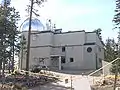
The heart of the telescope is an f/1.0 honeycombed construction, borosilicate primary mirror. The mirror was manufactured at The University of Arizona's Steward Observatory Mirror Laboratory, which pioneered both the spin-casting and the stressed-lap polishing techniques which are being used for telescope mirrors that include the 6.5 meter aperture MMT and Magellan telescopes and the two 8.4 meter mirrors of the Large Binocular Telescope. The VATT's mirror is unusually 'fast', f/1, which means that its focal distance is equal to its diameter. Because it has such a short focal length, a Gregorian design could be employed which uses a concave secondary mirror at a point beyond the primary focus; this allows unusually sharp focusing across the field of view.
The unusual optical design and novel mirror fabrication techniques mean that both the primary and secondary mirrors are among the most exact surfaces ever made for a ground-based telescope. In addition, the skies above Mount Graham are among the most clear, steady, and dark in the continental North America. Seeing of better than one arc-second even without adaptive optics can be achieved on a regular basis.
Image 13A monument to Fr. Maximilian Kolbe, among the estimated 3,000 members (18%) of the Polish clergy who were killed by the Nazis; of these, 1,992 died in concentration camps. (from Vatican City during World War II)
... that the Vatican selected Mary Milligan in 1987 to be one of only three U.S. experts to assist the International Synod of Bishops on the Laity in Rome?




.jpg.webp)


_-_stained_glass%252C_Saint_Th%C3%A9r%C3%A8se_of_Lisieux%252C_detail.jpg.webp)